Multicritical Scaling Limit of Shifted Schur Measure
Pith reviewed 2026-05-20 17:25 UTC · model grok-4.3
The pith
Under multicritical scaling, the edge correlations of shifted Schur measures converge to the determinant of the higher-order Airy kernel.
A machine-rendered reading of the paper's core claim, the machinery that carries it, and where it could break.
Core claim
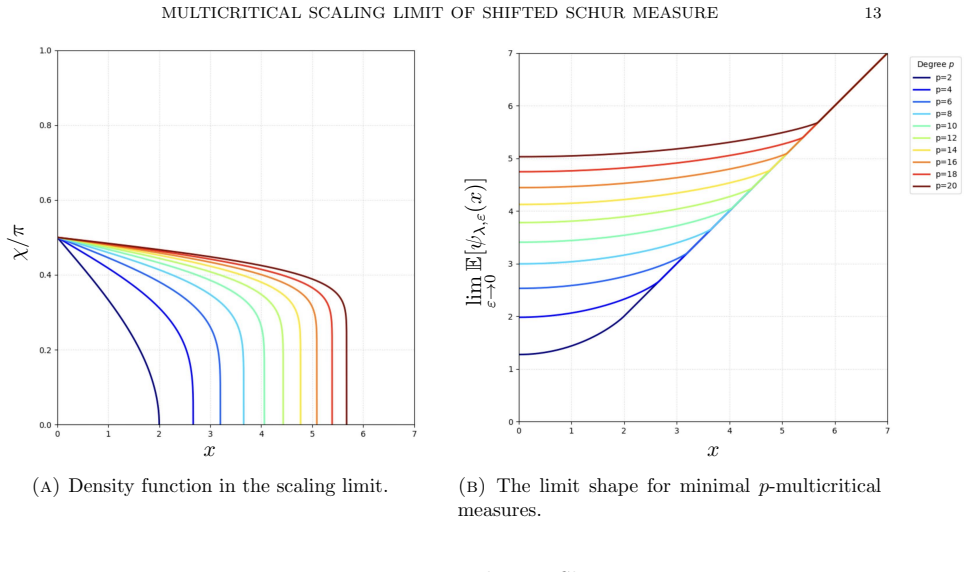
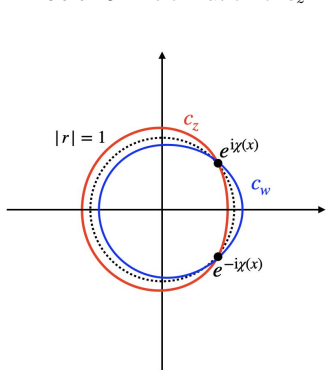
We investigate the multicritical scaling limit of the shifted Schur measures. Under an appropriate scaling limit and specific conditions on the continuous parameters, we explicitly determine the limit shape of strict partitions distributed according to the shifted Schur measure. We then show that, under a multicritical condition, the edge scaling limit of the correlation function converges to a determinant of the higher-order Airy kernel. This rigorously demonstrates a transition from a Pfaffian point process to a determinantal distribution in the scaling limit.
What carries the argument
The higher-order Airy kernel, which encodes the multicritical edge behavior of the point process arising from the shifted Schur measure.
If this is right
- The limit shape of strict partitions is determined explicitly under the scaling.
- The correlation functions at the edge converge to a determinantal form with the higher-order Airy kernel.
- This establishes a rigorous transition from Pfaffian to determinantal point processes.
- The multicritical regime is realized through specific tuning of continuous parameters.
Where Pith is reading between the lines
- Similar multicritical scalings could be applied to other partition measures to find analogous transitions.
- The result may help classify different universality classes in random strict partitions.
- Numerical simulations of finite shifted Schur measures could confirm the rate of convergence to the Airy limit.
Load-bearing premise
An appropriate scaling limit exists along with parameter conditions that realize the multicritical regime and allow explicit determination of the limit shape.
What would settle it
Computing the correlation function for a large but finite shifted Schur measure at the multicritical parameters and observing that it does not approach the higher-order Airy determinant would falsify the claim.
Figures

read the original abstract
We investigate the multicritical scaling limit of the shifted Schur measures. Under an appropriate scaling limit and specific conditions on the continuous parameters, we explicitly determine the limit shape of strict partitions distributed according to the shifted Schur measure. We then show that, under a multicritical condition, the edge scaling limit of the correlation function converges to a determinant of the higher-order Airy kernel. This rigorously demonstrates a transition from a Pfaffian point process to a determinantal distribution in the scaling limit.
Editorial analysis
A structured set of objections, weighed in public.
Referee Report
Summary. The manuscript investigates the multicritical scaling limit of the shifted Schur measure on strict partitions. Under an appropriate scaling limit and specific conditions on the continuous parameters, the authors explicitly determine the limit shape. They then show that, under a multicritical condition, the edge scaling limit of the correlation function converges to the determinant of the higher-order Airy kernel, thereby establishing a transition from a Pfaffian point process to a determinantal point process.
Significance. If the central claims are fully substantiated, the work would provide a rigorous multicritical example in the theory of random strict partitions, extending Airy-type asymptotics to higher order while documenting an explicit change in point-process type (Pfaffian to determinantal). This would strengthen the catalog of integrable scaling limits and offer a concrete setting in which variational problems for limit shapes admit higher-order critical points with controllable kernel asymptotics.
major comments (2)
- [§3 (definition of multicritical condition)] The existence and non-emptiness of the parameter set realizing the multicritical condition (vanishing of the first three derivatives of the variational functional) is asserted but not verified with explicit bounds or a concrete example; without this, the claim of an explicit limit shape and the subsequent higher-order Airy convergence rest on an unproven hypothesis.
- [§5 (edge scaling limit)] The steepest-descent or Riemann-Hilbert analysis for the correlation kernel at the multicritical point does not supply error estimates that remain uniform when the first three derivatives vanish; it is therefore unclear whether the remainder terms stay controllable precisely at the point where the higher-order Airy kernel is expected to appear.
minor comments (2)
- Notation for the shifted Schur measure and the associated orthogonal polynomials could be introduced with a short explicit example early in the introduction to aid readability.
- [References] A few references to prior work on Pfaffian-to-determinantal transitions in other partition models would help situate the result.
Simulated Author's Rebuttal
We thank the referee for the careful reading and constructive comments on our manuscript. The two major points raised concern the verification of the multicritical parameter set and the uniformity of error estimates in the edge scaling analysis. We address each below and indicate the planned revisions.
read point-by-point responses
-
Referee: [§3 (definition of multicritical condition)] The existence and non-emptiness of the parameter set realizing the multicritical condition (vanishing of the first three derivatives of the variational functional) is asserted but not verified with explicit bounds or a concrete example; without this, the claim of an explicit limit shape and the subsequent higher-order Airy convergence rest on an unproven hypothesis.
Authors: We agree that the current assertion lacks an explicit verification. In the revised version we will add a concrete numerical example of parameters satisfying the simultaneous vanishing of the first three derivatives of the variational functional, together with a short argument showing that the solution set is open and non-empty in a neighborhood of this point. This will remove the hypothesis and make the existence claim fully rigorous. revision: yes
-
Referee: [§5 (edge scaling limit)] The steepest-descent or Riemann-Hilbert analysis for the correlation kernel at the multicritical point does not supply error estimates that remain uniform when the first three derivatives vanish; it is therefore unclear whether the remainder terms stay controllable precisely at the point where the higher-order Airy kernel is expected to appear.
Authors: The referee correctly notes that uniformity of the error estimates requires additional care once the first three derivatives vanish. We will revise §5 by deriving a uniform bound on the remainder after the higher-order saddle-point contribution, using the multicritical conditions to control the phase function and by deforming contours in a manner that remains valid at the critical point. An auxiliary estimate on the oscillatory integral will be added to ensure the error is o(1) uniformly in a small neighborhood of the multicritical parameters. revision: yes
Circularity Check
Derivation self-contained from measure definition and explicit scaling analysis
full rationale
The paper starts from the definition of the shifted Schur measure on strict partitions, imposes an appropriate scaling limit together with continuous-parameter conditions that realize the multicritical regime, explicitly solves for the limit shape via the associated variational problem, and then performs steepest-descent or Riemann-Hilbert analysis on the correlation kernel to obtain convergence to the higher-order Airy determinant. No quoted step reduces a claimed prediction or uniqueness statement to a fitted input, self-citation, or ansatz imported from the authors' prior work; the central transition from Pfaffian to determinantal structure is obtained as a consequence of the kernel asymptotics at the multicritical point rather than by construction. The derivation therefore remains independent of its own outputs.
Axiom & Free-Parameter Ledger
Lean theorems connected to this paper
-
IndisputableMonolith/Cost/FunctionalEquation.leanwashburn_uniqueness_aczel unclear?
unclearRelation between the paper passage and the cited Recognition theorem.
under a multicritical condition, the edge scaling limit of the correlation function converges to a determinant of the higher-order Airy kernel
-
IndisputableMonolith/Foundation/RealityFromDistinction.leanreality_from_one_distinction unclear?
unclearRelation between the paper passage and the cited Recognition theorem.
limit shape ... x + 2/π ∫ max{D(θ)−x,0} dθ
What do these tags mean?
- matches
- The paper's claim is directly supported by a theorem in the formal canon.
- supports
- The theorem supports part of the paper's argument, but the paper may add assumptions or extra steps.
- extends
- The paper goes beyond the formal theorem; the theorem is a base layer rather than the whole result.
- uses
- The paper appears to rely on the theorem as machinery.
- contradicts
- The paper's claim conflicts with a theorem or certificate in the canon.
- unclear
- Pith found a possible connection, but the passage is too broad, indirect, or ambiguous to say the theorem truly supports the claim.
Reference graph
Works this paper leans on
- [1]
-
[2]
, Multicritical S chur measures and higher-order analogues of the T racy- W idom distribution , http://dx.doi.org/10.1007/s11040-023-09472-7 Math. Phys. Anal. Geom. 27 (2024) 2 , http://arxiv.org/abs/2307.05303 arXiv:2307.05303 [math.CO]
-
[3]
J. Baik, P. Deift, and K. Johansson, On the distribution of the length of the longest increasing subsequence of random permutations, http://dx.doi.org/10.1090/S0894-0347-99-00307-0 J. Amer. Math. Soc. 12 (1999) 1119--1178 , http://arxiv.org/abs/math/9810105 arXiv:math/9810105 [math.CO]
work page internal anchor Pith review Pith/arXiv arXiv doi:10.1090/s0894-0347-99-00307-0 1999
-
[4]
P. Biane, Representations of symmetric groups and free probability, http://dx.doi.org/10.1006/aima.1998.1745 Adv. Math. 138 (1998) 126--181
-
[5]
Asymptotics of Plancherel measures for symmetric groups
A. Borodin, A. Okounkov, and G. Olshanski, Asymptotics of P lancherel measures for symmetric groups , http://dx.doi.org/10.1090/S0894-0347-00-00337-4 J. Amer. Math. Soc. 13 (2000) 481--515 , http://arxiv.org/abs/math/9905032 arXiv:math/9905032 [math.CO]
work page internal anchor Pith review Pith/arXiv arXiv doi:10.1090/s0894-0347-00-00337-4 2000
-
[6]
M. Jimbo and T. Miwa, Solitons and infinite-dimensional L ie algebras , http://dx.doi.org/10.2977/prims/1195182017 Publ. Res. Inst. Math. Sci. 19 (1983) 943--1001
-
[7]
Discrete orthogonal polynomial ensembles and the Plancherel measure
K. Johansson, Discrete orthogonal polynomial ensembles and the P lancherel measure , http://dx.doi.org/10.2307/2661375 Ann. of Math. (2) 153 (2001) 259--296 , http://arxiv.org/abs/math/9906120 arXiv:math/9906120 [math.CO]
work page internal anchor Pith review Pith/arXiv arXiv doi:10.2307/2661375 2001
-
[8]
S. V. Kerov, Transition probabilities of continual Y oung diagrams and the M arkov moment problem , http://dx.doi.org/10.1007/BF01085981 Funktsional. Anal. i Prilozhen. 27 (1993) 32--49, 96
-
[9]
M. Kontsevich, Intersection theory on the moduli space of curves and the matrix A iry function , Comm. Math. Phys. 147 (1992) 1--23 http://projecteuclid.org.ezoris.lib.hokudai.ac.jp/euclid.cmp/1104250524
-
[10]
T. Kimura and A. Zahabi, Universal edge scaling in random partitions , http://dx.doi.org/10.1007/s11005-021-01389-y Lett. Math. Phys. 111 (2021) 48 , http://arxiv.org/abs/2012.06424 arXiv:2012.06424 [cond-mat.stat-mech]
-
[11]
, Unitary matrix models and random partitions: Universality and multi-criticality , http://dx.doi.org/10.1007/JHEP07(2021)100 JHEP 07 (2021) 100 , http://arxiv.org/abs/2105.00509 arXiv:2105.00509 [hep-th]
-
[12]
, Universal cusp scaling in random partitions, http://dx.doi.org/10.1007/s11005-024-01771-6 Lett. Math. Phys. 114 (2024) Paper No. 27, 56 , http://arxiv.org/abs/2208.07288 arXiv:2208.07288 [math-ph]
-
[13]
Multicritical edge statistics for the momenta of fermions in non-harmonic traps
P. Le Doussal, S. N. Majumdar, and G. Schehr, Multicritical edge statistics for the momenta of fermions in nonharmonic traps, http://dx.doi.org/10.1103/PhysRevLett.121.030603 Phys. Rev. Lett. 121 (2018) 030603 , http://arxiv.org/abs/1802.06436v1 arXiv:1802.06436v1 [cond-mat.stat-mech]
work page internal anchor Pith review Pith/arXiv arXiv doi:10.1103/physrevlett.121.030603 2018
-
[14]
B. F. Logan and L. A. Shepp, A variational problem for random Y oung tableaux , http://dx.doi.org/10.1016/0001-8708(77)90030-5 Adv. Math. 26 (1977) 206--222
-
[15]
S. Matsumoto, Correlation functions of the shifted S chur measure , http://dx.doi.org/10.2969/jmsj/1158241925 J. Math. Soc. Japan 57 (2005) 619--637 , http://arxiv.org/abs/math/0312373v2 arXiv:math/0312373v2 [math.CO]
-
[16]
Infinite wedge and random partitions
A. Okounkov, Infinite wedge and random partitions, http://dx.doi.org/10.1007/PL00001398 Selecta Math. 7 (2001) 57--81 , http://arxiv.org/abs/math/9907127 arXiv:math/9907127 [math.RT]
work page internal anchor Pith review Pith/arXiv arXiv doi:10.1007/pl00001398 2001
-
[17]
C. A. Tracy and H. Widom, Level-spacing distributions and the A iry kernel , http://dx.doi.org/10.1007/BF02100489 Comm. Math. Phys. 159 (1994) 151--174 , http://arxiv.org/abs/hep-th/9211141 arXiv:hep-th/9211141
work page internal anchor Pith review Pith/arXiv arXiv doi:10.1007/bf02100489 1994
-
[18]
, A limit theorem for shifted S chur measures , http://dx.doi.org/10.1215/S0012-7094-04-12316-4 Duke Math. J. 123 (2004) 171--208 , http://arxiv.org/abs/math/0210255 arXiv:math/0210255 [math.PR]
work page internal anchor Pith review Pith/arXiv arXiv doi:10.1215/s0012-7094-04-12316-4 2004
-
[19]
A. M. Vershik and S. V. Kerov, Asymptotic behavior of the P lancherel measure of the symmetric group and the limit form of Y oung tableaux , Dokl. Akad. Nauk SSSR 233 (1977) 1024--1027 https://www.mathnet.ru/eng/dan40430
work page 1977
-
[20]
Wasow, Asymptotic expansions for ordinary differential equations, Pure and Applied Mathematics, vol
W. Wasow, Asymptotic expansions for ordinary differential equations, Pure and Applied Mathematics, vol. Vol. XIV, Interscience Publishers John Wiley & Sons, Inc., New York-London-Sydney, 1965
work page 1965
-
[21]
BKP hierarchy and Pfaffian point process
Z.-L. Wang and S.-H. Li, BKP hierarchy and Pfaffian point process , http://dx.doi.org/https://doi.org/10.1016/j.nuclphysb.2018.12.028 Nucl. Phys. B 939 (2019) 447--464 , http://arxiv.org/abs/1807.02259 arXiv:1807.02259 [math-ph]
work page internal anchor Pith review Pith/arXiv arXiv doi:10.1016/j.nuclphysb.2018.12.028 2018
discussion (0)
Sign in with ORCID, Apple, or X to comment. Anyone can read and Pith papers without signing in.