Spatiotemporal decoupled physics-informed Stone-Weierstrass neural operator for long-time prediction of time-dependent parametric PDEs
Pith reviewed 2026-05-19 18:51 UTC · model grok-4.3
The pith
Encoding spatial and temporal information via separate subnetworks allows a physics-informed neural operator to avoid error accumulation in long-time predictions of parametric PDEs.
A machine-rendered reading of the paper's core claim, the machinery that carries it, and where it could break.
Core claim
The PI-SWNO architecture encodes spatial information in one subnetwork to produce time-invariant basis functions and temporal information in a second subnetwork to produce time-varying coefficients; their combination approximates the solution operator for time-dependent parametric PDEs. This decoupling, justified by the Stone-Weierstrass theorem, is claimed to structurally limit error accumulation over long intervals. The time-marching batch sampling strategy then enables full-domain training without exceeding memory constraints, yielding continuous and convergent solutions across the entire time span.
What carries the argument
Spatiotemporal decoupling realized by two separate subnetworks that learn time-invariant spatial basis functions and time-varying evolution coefficients.
If this is right
- Long-time predictions remain accurate without progressive degradation from accumulated approximation errors.
- Memory usage during training drops enough to allow full-domain modeling of extended time sequences.
- The framework applies directly to families of parametric time-dependent PDEs encountered in physics and engineering.
- Training stability improves because the separation removes one source of compounding numerical drift.
Where Pith is reading between the lines
- The same spatial-temporal split could be tested inside other neural operator families to check whether the error-mitigation benefit is architecture-specific or more general.
- Application to stiff or multi-scale temporal problems would reveal whether the fixed spatial bases still capture the required dynamics without frequent retraining.
- Hybrid models that combine this decoupling with classical numerical time-steppers could be examined for further gains in long-horizon accuracy.
Load-bearing premise
The assumption that time-invariant spatial basis functions combined with time-varying coefficients will inherently prevent error accumulation over long time intervals for time-dependent parametric PDEs.
What would settle it
A side-by-side run on a standard benchmark PDE such as the time-dependent Burgers equation or Navier-Stokes, comparing whether prediction error stays bounded or grows much more slowly with the decoupled architecture than with a conventional integrated neural operator when the time horizon is extended by factors of ten or more.
Figures


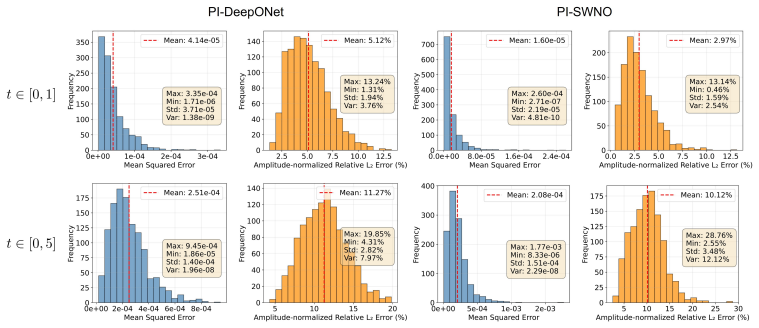


read the original abstract
Driven by rapid advances in artificial intelligence and modern GPU computing capabilities, deep learning methods based on the optimization paradigm have provided new pathways to solve spatiotemporal physical problems, whose mathematical core lies in solving partial differential equations (PDEs). As an emerging class of function-space learning methods, neural operators (NOs) have exhibited great potential in efficient PDE solving. However, existing mainstream neural operator frameworks suffer from critical bottlenecks when modeling time-dependent PDEs over long time horizons, including accuracy degradation, insufficient stability, high training costs, and excessive memory consumption, which severely limit their practical deployment. To address these challenges in long-time prediction with neural operators, we propose a novel spatiotemporally decoupled physics-informed neural operator architecture, termed the physics-informed Stone-Weierstrass neural operator (PI-SWNO). The design is theoretically grounded in the decoupling paradigm combining time-invariant spatial basis functions with time-varying evolution coefficients, as well as the Stone-Weierstrass approximation theorem. By encoding spatial and temporal information via two separate subnetworks, the framework structurally mitigates the accumulation of errors over extended time intervals. Furthermore, we introduce a time-marching batch-wise sampling strategy to resolve the memory bottleneck of full-range modeling over extended time spans, ensuring continuity and convergence of full-time-domain solutions.
Editorial analysis
A structured set of objections, weighed in public.
Referee Report
Summary. The manuscript introduces the physics-informed Stone-Weierstrass neural operator (PI-SWNO) for long-time prediction of time-dependent parametric PDEs. It proposes a spatiotemporally decoupled architecture that encodes spatial information via time-invariant basis functions in one subnetwork and temporal evolution via time-varying coefficients in a second subnetwork, grounded in the Stone-Weierstrass approximation theorem. A time-marching batch-wise sampling strategy is added to address memory bottlenecks while maintaining continuity of the full-time-domain solution.
Significance. If the decoupling can be shown to control error growth without additional stability assumptions, the approach would offer a practical route to stable long-horizon neural-operator predictions at reduced memory cost, addressing a recognized limitation of existing operator-learning frameworks for evolutionary PDEs.
major comments (2)
- [Abstract] Abstract: the assertion that separate subnetworks for spatial bases and temporal coefficients 'structurally mitigates the accumulation of errors' is not accompanied by a Lipschitz bound, contraction mapping, or stability estimate on the learned coefficient evolution; Stone-Weierstrass supplies only density on compact sets and does not control amplification of coefficient errors under the underlying PDE dynamics.
- [Theoretical grounding] Theoretical grounding section: the decoupling replaces one source of temporal accumulation with another whose growth rate is not shown to be bounded by the separation alone; for PDEs that develop fine-scale structures or exhibit sensitivity to initial data, a small error in the coefficient subnetwork at step n can still be amplified even if the spatial basis remains fixed.
minor comments (1)
- [Abstract] Abstract: inclusion of at least one schematic equation or diagram illustrating the two-subnetwork split would clarify the claimed decoupling for readers.
Simulated Author's Rebuttal
We thank the referee for the constructive comments, which help clarify the theoretical scope of our claims regarding error mitigation in the PI-SWNO framework. We address each major comment below and describe the revisions planned for the manuscript.
read point-by-point responses
-
Referee: [Abstract] Abstract: the assertion that separate subnetworks for spatial bases and temporal coefficients 'structurally mitigates the accumulation of errors' is not accompanied by a Lipschitz bound, contraction mapping, or stability estimate on the learned coefficient evolution; Stone-Weierstrass supplies only density on compact sets and does not control amplification of coefficient errors under the underlying PDE dynamics.
Authors: We agree that the manuscript does not supply a Lipschitz bound, contraction mapping, or other stability estimate to rigorously prove control of error growth. The abstract phrasing is motivated by the architectural separation, in which time-invariant spatial basis functions are learned independently of the time-varying coefficients, thereby avoiding repeated spatial approximation errors at each time step. Stone-Weierstrass is invoked only for the density of the basis representation on compact sets. In the revised manuscript we will replace 'structurally mitigates' with 'is designed to mitigate' in the abstract and add a short paragraph in the theoretical section noting that a complete stability analysis under the PDE dynamics remains an open question for future work. revision: yes
-
Referee: [Theoretical grounding] Theoretical grounding section: the decoupling replaces one source of temporal accumulation with another whose growth rate is not shown to be bounded by the separation alone; for PDEs that develop fine-scale structures or exhibit sensitivity to initial data, a small error in the coefficient subnetwork at step n can still be amplified even if the spatial basis remains fixed.
Authors: The referee is correct that fixing the spatial basis does not by itself bound the growth rate of errors in the coefficient subnetwork, and that amplification remains possible for sensitive or fine-scale PDEs. The design choice reduces one pathway of error compounding (repeated spatial re-approximation) while leaving the temporal coefficient evolution to be learned; empirical results in the paper indicate improved long-time stability, yet no general bound is derived. We will revise the theoretical grounding section to state this limitation explicitly and to clarify that the separation provides a structural advantage rather than a proven contraction property. revision: yes
Circularity Check
No significant circularity; derivation grounded in external theorem and design choice
full rationale
The paper's central architecture is presented as a novel combination of time-invariant spatial subnetworks and time-varying coefficient subnetworks, justified by appeal to the standard Stone-Weierstrass density theorem and a decoupling paradigm. No load-bearing step reduces by construction to a fitted parameter, self-citation chain, or renamed input; the error-mitigation claim is an asserted structural property rather than a tautological re-expression of training data. The time-marching batch strategy is a practical implementation detail without circular dependence on the predicted outputs. The derivation chain is therefore self-contained against external mathematical benchmarks.
Axiom & Free-Parameter Ledger
axioms (2)
- standard math Stone-Weierstrass approximation theorem can be used to justify the encoding of spatial and temporal information via separate subnetworks in the neural operator.
- domain assumption Time-invariant spatial basis functions combined with time-varying coefficients will maintain stability over long time horizons for the PDEs considered.
Lean theorems connected to this paper
-
IndisputableMonolith/Foundation/AlexanderDuality.leanalexander_duality_circle_linking unclear?
unclearRelation between the paper passage and the cited Recognition theorem.
The design is theoretically grounded in the decoupling paradigm combining time-invariant spatial basis functions with time-varying evolution coefficients, as well as the Stone-Weierstrass approximation theorem.
-
IndisputableMonolith/Cost/FunctionalEquation.leanwashburn_uniqueness_aczel unclear?
unclearRelation between the paper passage and the cited Recognition theorem.
non-decreasing theorem of fitting error for fixed-parameter neural operators
What do these tags mean?
- matches
- The paper's claim is directly supported by a theorem in the formal canon.
- supports
- The theorem supports part of the paper's argument, but the paper may add assumptions or extra steps.
- extends
- The paper goes beyond the formal theorem; the theorem is a base layer rather than the whole result.
- uses
- The paper appears to rely on the theorem as machinery.
- contradicts
- The paper's claim conflicts with a theorem or certificate in the canon.
- unclear
- Pith found a possible connection, but the passage is too broad, indirect, or ambiguous to say the theorem truly supports the claim.
Reference graph
Works this paper leans on
-
[1]
A. M. Vargas, Finite difference method for solving fractional differential equations at irregular meshes, Mathematics and Computers in Simulation 193 (2022) 204–216.doi:https: //doi.org/10.1016/j.matcom.2021.10.010. URLhttps://www.sciencedirect.com/science/article/pii/ S037847542100361X
-
[2]
K. Kergrene, I. Babuška, U. Banerjee, Stable generalized finite element method and associated iterative schemes; application to interface prob- lems, Computer Methods in Applied Mechanics and Engineering 305 (2016) 1–36.doi:https://doi.org/10.1016/j.cma.2016.02.030. URLhttps://www.sciencedirect.com/science/article/pii/ S0045782516300603
-
[3]
P. Buchmüller, J. Dreher, C. Helzel, Finite volume weno methods for hyperbolic conservation laws on cartesian grids with adaptive mesh refinement, Applied Mathematics and Computation 272 (2016) 460–478.doi:https://doi.org/10.1016/j.amc.2015.03.078. URLhttps://www.sciencedirect.com/science/article/pii/ S0096300315003926
-
[4]
M. Raissi, P. Perdikaris, G. Karniadakis, Physics-informed neu- ral networks: A deep learning framework for solving forward 60 and inverse problems involving nonlinear partial differential equa- tions, Journal of Computational Physics 378 (2019) 686–707. doi:https://doi.org/10.1016/j.jcp.2018.10.045. URLhttps://www.sciencedirect.com/science/article/pii/ S...
-
[5]
Z. Li, K. Meidani, A. B. Farimani, Transformer for partial differen- tial equations’ operator learning, Transactions on Machine Learning Re- search (2023). URLhttps://openreview.net/forum?id=EPPqt3uERT
work page 2023
-
[6]
N. T. Mücke, S. M. Bohté, C. W. Oosterlee, Reduced order modeling for parameterized time-dependent pdes using spatially and memory aware deep learning, Journal of Computational Science 53 (2021) 101408. doi:https://doi.org/10.1016/j.jocs.2021.101408. URLhttps://www.sciencedirect.com/science/article/pii/ S1877750321000934
-
[7]
L. Lu, P. Jin, G. Pang, Z. Zhang, G. E. Karniadakis, Learning nonlinear operators via deeponet based on the universal approximation theorem of operators, Nature Machine Intelligence 3 (3) (2021) 218–229.doi: 10.1038/s42256-021-00302-5. URLhttps://doi.org/10.1038/s42256-021-00302-5
-
[8]
Z. Li, N. Kovachki, K. Azizzadenesheli, B. Liu, K. Bhattacharya, A. Stu- art, A. Anandkumar, Fourier neural operator for parametric partial dif- ferential equations (2021).arXiv:2010.08895. URLhttps://arxiv.org/abs/2010.08895
work page internal anchor Pith review Pith/arXiv arXiv 2021
- [9]
-
[10]
S. Wang, H. Wang, P. Perdikaris, Learning the solution operator of parametric partial differential equations with physics-informed deep- onets, Science Advances 7 (40) (2021) eabi8605.arXiv:https:// www.science.org/doi/pdf/10.1126/sciadv.abi8605,doi:10.1126/ sciadv.abi8605. URLhttps://www.science.org/doi/abs/10.1126/sciadv.abi8605 61
-
[11]
L. Mandl, D. Nayak, T. Ricken, S. Goswami, Physics-informed time- integrated deeponet: Temporal tangent space operator learning for high-accuracy inference (August 01, 2025 2025).doi:10.48550/arXiv. 2508.05190. URLhttps://ui.adsabs.harvard.edu/abs/2025arXiv250805190M
work page internal anchor Pith review doi:10.48550/arxiv 2025
-
[12]
D. N. Arnold, F. Brezzi, B. Cockburn, L. D. Marini, Unified analysis of discontinuous galerkin methods for elliptic problems, SIAM J. Numer. Anal. 39 (5) (2001) 1749–1779.doi:10.1137/S0036142901384162. URLhttps://doi.org/10.1137/S0036142901384162
-
[13]
J. Villadsen, W. Stewart, Solution of boundary-value problems by orthogonal collocation, Chemical Engineering Science 50 (24) (1995) 3981–3996.doi:https://doi.org/10.1016/0009-2509(96)81831-8. URLhttps://www.sciencedirect.com/science/article/pii/ 0009250996818318
-
[14]
J. He, S. Kushwaha, J. Park, S. Koric, D. Abueidda, I. Jasiuk, Sequen- tial deep operator networks (s-deeponet) for predicting full-field solu- tions under time-dependent loads, Engineering Applications of Artifi- cial Intelligence 127 (2024) 107258.doi:https://doi.org/10.1016/ j.engappai.2023.107258
-
[15]
P. Jin, S. Meng, L. Lu, Mionet: Learning multiple-input operators via tensor product, SIAM Journal on Scientific Computing 44 (2022) A3490–A3514.doi:10.1137/22M1477751
-
[16]
W. Diab, M. Al Kobaisi, Temporal neural operator for modeling time- dependent physical phenomena, Scientific Reports 15 (1) (2025) 32791. doi:10.1038/s41598-025-16922-5. URLhttps://doi.org/10.1038/s41598-025-16922-5
-
[17]
Z. Li, N. Kovachki, K. Azizzadenesheli, B. Liu, K. Bhattacharya, A. Stu- art, A. Anandkumar, Neural operator: Graph kernel network for partial differential equations (2020).arXiv:2003.03485. URLhttps://arxiv.org/abs/2003.03485
work page internal anchor Pith review Pith/arXiv arXiv 2020
- [18]
-
[19]
S. Karumuri, L. Graham-Brady, S. Goswami, Physics-informed latent neural operator for real-time predictions of time-dependent parametric pdes, Computer Methods in Applied Mechanics and Engineering 450 (2026) 118599.doi:https://doi.org/10.1016/j.cma.2025.118599. URLhttps://www.sciencedirect.com/science/article/pii/ S0045782525008710
-
[20]
T. Wang, C. Wang, Latent neural operator pretraining for solving time- dependent pdes, in: M. Mahmud, M. Doborjeh, K. Wong, A. C. S. Leung, Z. Doborjeh, M. Tanveer (Eds.), Neural Information Processing, Springer Nature Singapore, Singapore, 2025, pp. 163–178
work page 2025
-
[21]
S. Koric, D. W. Abueidda, Data-driven and physics-informed deep learning operators for solution of heat conduction equa- tion with parametric heat source, International Journal of Heat and Mass Transfer 203 (2023) 123809.doi:https: //doi.org/10.1016/j.ijheatmasstransfer.2022.123809. URLhttps://www.sciencedirect.com/science/article/pii/ S0017931022012777
- [22]
-
[23]
S. Ding, Y. Tian, L. Qin, H. Ma, R. Yang, Physics-informed hierar- chical neural operator for solving inverse problem of unsteady heat conduction, International Journal of Heat and Mass Transfer 258 (2026) 128335.doi:https://doi.org/10.1016/j.ijheatmasstransfer. 2026.128335. URLhttps://www.sciencedirect.com/science/article/pii/ S0017931026000116
- [24]
-
[25]
S. W. Cho, J. Y. Lee, H. J. Hwang, Learning time-dependent pde via graph neural networks and deep operator network for robust accuracy on irregular grids, Journal of Computational Physics 544 (2026) 114430. doi:https://doi.org/10.1016/j.jcp.2025.114430. URLhttps://www.sciencedirect.com/science/article/pii/ S0021999125007120
- [26]
-
[27]
T. Dao, A. Gu, Transformers are ssms: Generalized models and efficient algorithms through structured state space duality (2024).arXiv:2405. 21060. URLhttps://arxiv.org/abs/2405.21060
work page internal anchor Pith review Pith/arXiv arXiv 2024
-
[28]
Z. Hu, N. A. Daryakenari, Q. Shen, K. Kawaguchi, G. E. Kar- niadakis, State-space models are accurate and efficient neu- ral operators for dynamical systems, Neural Networks (2025) 108496doi:https://doi.org/10.1016/j.neunet.2025.108496. URLhttps://www.sciencedirect.com/science/article/pii/ S0893608025013772
-
[29]
A. Gu, T. Dao, Mamba: Linear-time sequence modeling with selective state spaces (2024). URLhttps://openreview.net/forum?id=AL1fq05o7H
work page 2024
-
[30]
Empirical Evaluation of Gated Recurrent Neural Networks on Sequence Modeling
J. Chung, C. Gulcehre, K. Cho, Y. Bengio, Empirical evaluation of gated recurrent neural networks on sequence modeling (2014).arXiv: 1412.3555. URLhttps://arxiv.org/abs/1412.3555
work page internal anchor Pith review Pith/arXiv arXiv 2014
- [31]
-
[32]
R. Buitrago, T. Marwah, A. Gu, A. Risteski, On the benefits of memory for modeling time-dependent PDEs, in: The Thirteenth International 64 Conference on Learning Representations, 2025. URLhttps://openreview.net/forum?id=o9kqa5K3tB
work page 2025
-
[33]
K. Michałowska, S. Goswami, G. E. Karniadakis, S. Riemer-Sørensen, Neural operator learning for long-time integration in dynamical systems with recurrent neural networks (2024).arXiv:2303.02243. URLhttps://arxiv.org/abs/2303.02243
-
[34]
Z. Hu, Q. Cao, K. Kawaguchi, G. E. Karniadakis, Deepomamba: State- space model for spatio-temporal pde neural operator learning, Journal of Computational Physics 540 (2025) 114272.doi:https://doi.org/ 10.1016/j.jcp.2025.114272
-
[35]
W. Wang, M. Hakimzadeh, H. Ruan, S. Goswami, Time-marching neu- ral operator–fe coupling: Ai-accelerated physics modeling, Computer Methods in Applied Mechanics and Engineering 446 (2025) 118319. doi:https://doi.org/10.1016/j.cma.2025.118319. URLhttps://www.sciencedirect.com/science/article/pii/ S0045782525005912
-
[36]
Y. Chen, Y. Lin, X. Sun, C. Yuan, Z. Gao, Tensor decomposition-based neural operator with dynamic mode decomposition for parameterized time-dependent problems, Journal of Computational Physics 533 (2025) 113996.doi:https://doi.org/10.1016/j.jcp.2025.113996. URLhttps://www.sciencedirect.com/science/article/pii/ S0021999125002797
-
[37]
J. Chen, W. Xu, Z. Xu, N. Grande Gutiérrez, S. P. Narra, C. McComb, Enforcing the principle of locality for physical simulations with neural operators, Journal of Computational Physics 538 (2025) 114131. doi:https://doi.org/10.1016/j.jcp.2025.114131. URLhttps://www.sciencedirect.com/science/article/pii/ S0021999125004140
-
[38]
T. Chen, H. Chen, Universal approximation to nonlinear operators by neural networks with arbitrary activation functions and its application to dynamical systems, IEEE Trans Neural Netw 6 (4) (1995) 911–917
work page 1995
-
[39]
Rudin, Real and Complex Analysis, 3rd Edition, McGraw-Hill, New York, 1987
W. Rudin, Real and Complex Analysis, 3rd Edition, McGraw-Hill, New York, 1987. 65
work page 1987
-
[40]
G. Cybenko, Approximation by superpositions of a sigmoidal function, Mathematics of Control, Signals and Systems 2 (4) (1989) 303–314.doi: 10.1007/BF02551274. URLhttps://doi.org/10.1007/BF02551274
-
[41]
URLhttps://www.sciencedirect.com/science/article/pii/ S0045782524009538 66
D.W.Abueidda, P.Pantidis, M.E.Mobasher, Deepokan: Deepoperator network based on kolmogorov arnold networks for mechanics problems, Computer Methods in Applied Mechanics and Engineering 436 (2025) 117699.doi:https://doi.org/10.1016/j.cma.2024.117699. URLhttps://www.sciencedirect.com/science/article/pii/ S0045782524009538 66
discussion (0)
Sign in with ORCID, Apple, or X to comment. Anyone can read and Pith papers without signing in.