Goodness-of-Fit Testing for Point Processes in Large Populations
Pith reviewed 2026-05-19 19:42 UTC · model grok-4.3
The pith
A unitary transformation maps the natural testing process for parametric point processes to a limiting target whose distribution is free of unknown intensity parameters.
A machine-rendered reading of the paper's core claim, the machinery that carries it, and where it could break.
Core claim
Constructing a unitary transformation of the natural parametric testing process produces a limiting process that converges weakly to a standard target independent of the particular parametric form assumed under the null hypothesis, thereby enabling asymptotically distribution-free goodness-of-fit testing for parametric point processes.
What carries the argument
Unitary transformation of the natural parametric testing process that removes dependence on the unknown parameters in the intensity family.
If this is right
- Goodness-of-fit tests for point-process intensities can be performed without deriving parameter-specific limiting distributions.
- The same transformed process applies directly to Aalen-type survival processes with or without censoring.
- The approach covers mixture cure models and software reliability models with comparable asymptotic behavior.
- Monte Carlo evidence indicates that the tests maintain reasonable size and power in moderate sample sizes.
- The procedure can be applied immediately to observed lifetime records and failure-count data.
Where Pith is reading between the lines
- The same transformation idea could be examined for other classes of counting processes whose intensity estimators produce non-pivotal limits.
- Explicit construction of the unitary operator for common intensity families would allow ready implementation in statistical packages.
- Power comparisons against local alternatives that perturb the intensity function could be derived from the same transformed process.
- Links to the theory of empirical processes for marked point processes might yield sharper rates of convergence.
Load-bearing premise
A unitary transformation exists that maps the natural parametric testing process onto a limiting target whose distribution does not depend on the unknown parameters of the intensity family.
What would settle it
For any parametric family, compute the transformed process on simulated data under the null and check whether its finite-dimensional distributions or empirical measure converge to the claimed parameter-free target; persistent dependence on parameters or failure to match the standard limit would refute the claim.
Figures


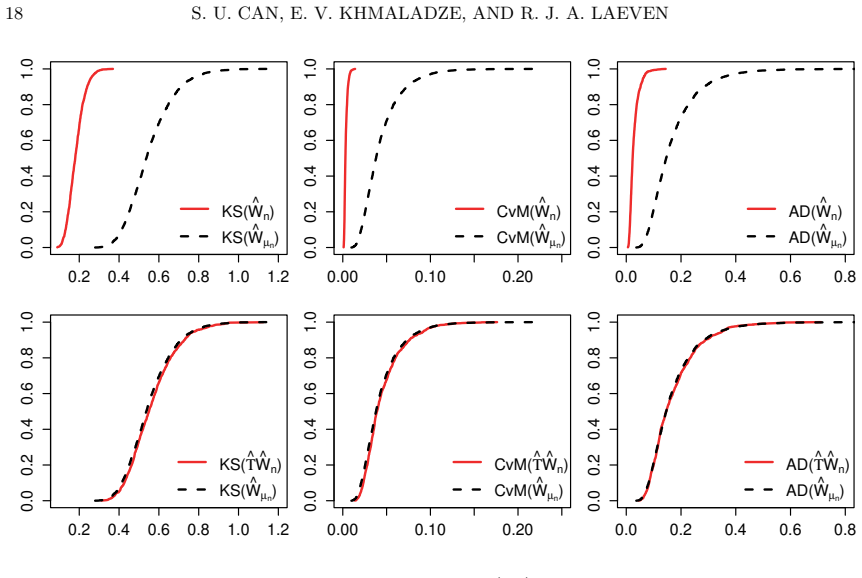


read the original abstract
Suppose we have an observed path from a point process counting event occurrences in a large population. Based on the observed path, we would like to test the null hypothesis that the conditional intensity of the point process belongs to a particular parametric family. We propose a novel approach to conducting such goodness-of-fit tests. The idea is to construct a unitary transformation of a natural parametric testing process such that it converges weakly to a ``standard'' target process, independent of the particular parametric form assumed under the null hypothesis. This transformation therefore paves the way for asymptotically distribution-free goodness-of-fit testing of parametric point processes. We demonstrate the good finite-sample performance of our approach through Monte Carlo simulations of Aalen-type survival processes, without and with censoring, mixture cure models, and software reliability models, and we illustrate its applicability with observed human lifetimes as well as real software failures.
Editorial analysis
A structured set of objections, weighed in public.
Referee Report
Summary. The paper proposes a unitary transformation of a natural parametric testing process for observed paths of point processes in large populations. Under the null that the conditional intensity belongs to a given parametric family, the transformed process is claimed to converge weakly to a standard target process whose distribution is independent of the particular parametric form. This is positioned as enabling asymptotically distribution-free goodness-of-fit tests. The approach is supported by Monte Carlo simulations for Aalen-type survival processes (with and without censoring), mixture cure models, and software reliability models, plus illustrations on real human lifetime and software failure data.
Significance. If the central transformation result holds under suitable regularity conditions, the method would supply a useful, distribution-free tool for goodness-of-fit assessment in parametric point-process models arising in survival analysis and reliability. The breadth of simulation settings and the real-data examples provide concrete evidence of practical applicability and finite-sample behavior.
major comments (1)
- [theoretical development and main theorem] The abstract asserts that the unitary transformation yields weak convergence to a parameter-free limiting target process. However, the manuscript supplies neither the explicit construction of this transformation (presumably via score or compensator operators) nor a derivation of the weak-convergence result, nor the precise regularity conditions under which the limiting covariance kernel becomes independent of θ. This omission is load-bearing for the central claim, especially for the Aalen-type models with censoring and the mixture cure models included in the simulations, where the compensator satisfies an integral equation whose orthogonal complement may retain θ-dependence absent an additional orthogonality condition.
minor comments (2)
- [Section 2] The description of the natural parametric testing process (prior to transformation) should include its explicit definition and the precise form of the intensity estimator used under the null.
- [simulation studies] Finite-sample diagnostics (e.g., empirical coverage of critical values or QQ plots of the transformed statistic) would strengthen the simulation section; currently only qualitative statements of “good performance” are given.
Simulated Author's Rebuttal
We thank the referee for the careful reading and constructive comments on our manuscript. We address the major comment point by point below and will incorporate revisions to strengthen the theoretical presentation.
read point-by-point responses
-
Referee: [theoretical development and main theorem] The abstract asserts that the unitary transformation yields weak convergence to a parameter-free limiting target process. However, the manuscript supplies neither the explicit construction of this transformation (presumably via score or compensator operators) nor a derivation of the weak-convergence result, nor the precise regularity conditions under which the limiting covariance kernel becomes independent of θ. This omission is load-bearing for the central claim, especially for the Aalen-type models with censoring and the mixture cure models included in the simulations, where the compensator satisfies an integral equation whose orthogonal complement may retain θ-dependence absent an additional orthogonality condition.
Authors: We agree that the explicit construction of the unitary transformation and the full derivation of the weak-convergence result require more detailed exposition to support the central claim. In the revised manuscript we will insert a dedicated subsection that gives the explicit form of the transformation in terms of the score operator and the compensator, followed by a complete proof of weak convergence to the parameter-free target process. We will also state the precise regularity conditions (including the required orthogonality with respect to the parametric family) that guarantee the limiting covariance kernel is independent of θ. For the Aalen-type models with censoring and the mixture cure models, we will verify that the integral equation satisfied by the compensator admits the necessary orthogonality condition and will add this verification explicitly. These changes will be placed in the main theoretical section with supporting technical details moved to an appendix if needed. revision: yes
Circularity Check
No circularity: unitary transformation is a constructive proposal, not a reduction to inputs
full rationale
The paper's central claim is the existence and application of a unitary transformation that maps a natural parametric testing process to a weakly convergent limit independent of the intensity parameter. This is presented as a novel construction enabling distribution-free tests, with demonstrations via Monte Carlo simulations on Aalen models, censoring, mixture cure models, and software reliability. No quoted equations or steps reduce the claimed limit or transformation to a fitted quantity, self-definition, or self-citation chain; the derivation remains self-contained as an explicit operator construction whose independence property is asserted and verified externally through simulation rather than by tautological re-expression of the null family.
Axiom & Free-Parameter Ledger
axioms (1)
- domain assumption The observed path comes from a point process whose conditional intensity belongs to a specified parametric family under the null hypothesis.
Lean theorems connected to this paper
-
IndisputableMonolith/Foundation/RealityFromDistinction.leanreality_from_one_distinction unclear?
unclearRelation between the paper passage and the cited Recognition theorem.
construct a unitary transformation of a natural parametric testing process such that it converges weakly to a 'standard' target process, independent of the particular parametric form
-
IndisputableMonolith/Cost/FunctionalEquation.leanwashburn_uniqueness_aczel unclear?
unclearRelation between the paper passage and the cited Recognition theorem.
Ra,b ϕ = ϕ − 2⟨a−b,ϕ⟩Bλ / ∥a−b∥²Bλ (a−b)
What do these tags mean?
- matches
- The paper's claim is directly supported by a theorem in the formal canon.
- supports
- The theorem supports part of the paper's argument, but the paper may add assumptions or extra steps.
- extends
- The paper goes beyond the formal theorem; the theorem is a base layer rather than the whole result.
- uses
- The paper appears to rely on the theorem as machinery.
- contradicts
- The paper's claim conflicts with a theorem or certificate in the canon.
- unclear
- Pith found a possible connection, but the passage is too broad, indirect, or ambiguous to say the theorem truly supports the claim.
Reference graph
Works this paper leans on
-
[1]
The Statistical Analysis of Failure Time Data , AUTHOR =. 2002 , PUBLISHER =
work page 2002
-
[2]
Weak Convergence and Empirical Processes: With Applications to Statistics , AUTHOR =. 1996 , PUBLISHER =
work page 1996
- [3]
- [4]
-
[5]
and Dobler, Dennis and de Gunst, Mathisca C
Dietrich, Marina T. and Dobler, Dennis and de Gunst, Mathisca C. M. , JOURNAL =. Wild bootstrap for counting process‑based statistics:
-
[6]
Dynamic Regression Models for Survival Data , AUTHOR =
-
[7]
Statistical Inference for a Family of Counting Processes , AUTHOR =
- [8]
-
[9]
Limit theorems for Markovian Hawkes processes with a large initial intensity , AUTHOR =. Stochastic Process. Appl. , VOLUME =
-
[10]
Integrability of expected increments of point processes and a related random change of scale , AUTHOR =. Trans. Amer. Math. Soc. , VOLUME =
-
[11]
A simple proof of the multivariate random time change theorem for point processes , AUTHOR =. J. Appl. Probab. , VOLUME =
-
[12]
Random time changes for multivariate counting processes , AUTHOR =. Scand. Actuar. J. , VOLUME =
-
[13]
A Martingale Approach to Point Processes , AUTHOR =
-
[14]
Meyer, Paul-Andr. D. S
-
[15]
Statistical Models Based on Counting Processes , AUTHOR =
-
[16]
Statistical Methods with Applications to Demography and Life Insurance , AUTHOR =
-
[17]
Nonparametric inference for a family of counting processes , AUTHOR =. Ann. Statist. , VOLUME =
-
[18]
Point Processes and Their Statistical Inference , AUTHOR =
-
[19]
An Introduction to the Theory of Point Processes: Volumes I and II , AUTHOR =
-
[20]
Unitary transformations, empirical processes and distribution free testing , AUTHOR =. Bernoulli , VOLUME =
-
[21]
Aalen, Odd O. and. Survival and Event History Analysis:
- [22]
-
[23]
Contemporary Multivariate Analysis and Design of Experiments , PAGES =
Multidimensional variation for quasi-Monte Carlo , AUTHOR =. Contemporary Multivariate Analysis and Design of Experiments , PAGES =
-
[24]
Alexander, Kenneth S , JOURNAL =. Sample moduli for set-indexed
-
[25]
Statistics of Extremes: Theory and Applications , AUTHOR =. 2004 , PUBLISHER =
work page 2004
- [26]
-
[27]
An Introduction to Statistical Modeling of Extreme Values , AUTHOR =. 2001 , PUBLISHER =
work page 2001
-
[28]
Extreme Value Distributions: Theory and Applications , AUTHOR =. 2000 , PUBLISHER =
work page 2000
-
[29]
Coles, Stuart G. and Tawn, Jonathan A. , TITLE =. J. Roy. Statist. Soc. Ser. B , VOLUME =. 1991 , NUMBER =
work page 1991
-
[30]
Limit theory for multivariate sample extremes , AUTHOR =. Z. Wahrsch. verw. Gebiete , VOLUME =
-
[31]
Delgado, M. A. and Hidalgo, J. and Velasco, C. , TITLE =. Ann. Statist. , VOLUME =. 2005 , PAGES =
work page 2005
-
[32]
Dette, H. and Hetzler, B. , TITLE =. Math. Methods Statist. , VOLUME =. 2009 , PAGES =
work page 2009
-
[33]
Approximations to the tail empirical distribution function with application to testing extreme value conditions , AUTHOR =. J. Statist. Plann. Inference , VOLUME =
-
[34]
Einmahl, J.H.J. and de Haan, L. and Sinha, A.K. , TITLE =. Stochastic Process. Appl. , VOLUME =. 1997 , PAGES =
work page 1997
-
[35]
A method of moments estimator of tail dependence , AUTHOR =. Bernoulli , VOLUME =
-
[36]
An M-estimator for tail dependence in arbitrary dimensions , AUTHOR =. Ann. Statist. , VOLUME =
-
[37]
Weighted approximations of tail copula processes with application to testing the bivariate extreme value condition , AUTHOR =. Ann. Statist. , VOLUME =
-
[38]
Parametric tail copula estimation and model testing , AUTHOR =. J. Multivariate Anal. , VOLUME =
-
[39]
Joe, Harry and Smith, Richard L. and Weissman, Ishay , TITLE =. J. Roy. Statist. Soc. Ser. B , VOLUME =. 1992 , NUMBER =
work page 1992
- [40]
- [41]
- [42]
-
[43]
Inference on the quantile regression process , AUTHOR =. Econometrica , VOLUME =
-
[44]
Quantile autoregression , AUTHOR =. J. Amer. Statist. Assoc. , VOLUME =
- [45]
-
[46]
Model checks under random censorship , AUTHOR =. Statist. Probab. Lett. , VOLUME =
-
[47]
Stute, W. and Thies, S. and Zhu, L. , TITLE =. Ann. Statist. , VOLUME =. 1998 , PAGES =
work page 1998
- [48]
-
[49]
Martingale transforms goodness-of-fit tests in regression models , AUTHOR =. Ann. Statist. , VOLUME =
-
[50]
Goodness-of-fit problem for errors in nonparametric regression: Distribution free approach , AUTHOR =. Ann. Statist. , VOLUME =
-
[51]
McKeague, Ian W. and Nikabadze, A. M. and Sun, Yan Qing , TITLE =. Ann. Statist. , VOLUME =. 1995 , NUMBER =
work page 1995
-
[52]
Estimating the limit distribution of multivariate extremes , AUTHOR =. Comm. Statist. Stochastic Models , VOLUME =
-
[53]
Hardy, G. H. , JOURNAL =. On double
-
[54]
Topological algebras of functions of bounded variation
Bl\". Topological algebras of functions of bounded variation. Manuscripta Math. , VOLUME =
- [55]
- [56]
- [57]
-
[58]
Multivariate Analysis V , YEAR =
Bivariate extremes: Foundations and statistics , AUTHOR =. Multivariate Analysis V , YEAR =
-
[59]
International Encyclopedia of Statistical Science , YEAR =
Khmaladze transformation , AUTHOR =. International Encyclopedia of Statistical Science , YEAR =
-
[60]
Some notes on goodness-of-fit tests and innovation martingales , AUTHOR =. Proc. A. Razmadze Math. Inst. , VOLUME =
-
[61]
Supplement to ``Asymptotically Distribution-Free Goodness-of-Fit Testing for Tail Copulas'' , AUTHOR =
-
[62]
Statistical Computer Performance Evaluation , publisher =
SOFTWARE RELIABILITY RESEARCH , editor =. Statistical Computer Performance Evaluation , publisher =. 1972 , author =
work page 1972
- [63]
-
[64]
Littlewood, B. , journal=. Theories of software reliability:. 1980 , volume=
work page 1980
-
[65]
Ross Maller and Sidney Resnick and Soudabeh Shemehsavar and Muzhi Zhao , title =. Stat. Surv. , pages =
- [66]
- [67]
- [68]
-
[69]
Yanqing Sun and Ram C. Tiwari and Jyoti N. Zalkikar , journal =. Goodness of Fit Tests for Multivariate Counting Process Models with Applications , volume =
- [70]
discussion (0)
Sign in with ORCID, Apple, or X to comment. Anyone can read and Pith papers without signing in.