Which Moments Matter? Heuristics of Remembered Travel Experience in Public Transport
Pith reviewed 2026-05-20 16:45 UTC · model grok-4.3
The pith
Retrospective satisfaction with public transport trips is best predicted by a minimum-end heuristic combining the worst moment and the final experience.
A machine-rendered reading of the paper's core claim, the machinery that carries it, and where it could break.
Core claim
Drawing on theories of experienced and remembered utility, the study collected high-frequency ratings every five minutes during 2576 trips and compared them to post-trip evaluations. The results establish that a Minimum-End heuristic, which takes the most negative moment and the final experience, provides the strongest prediction of retrospective travel satisfaction. Other heuristics like the overall mean or peak-end performed worse, indicating that negative extremes and trip endings shape memory independently.
What carries the argument
The Minimum-End heuristic for aggregating travel experiences, which combines the minimum experience rating and the ending rating to forecast post-trip satisfaction.
If this is right
- Targeted fixes at the most negative moments during a journey can raise remembered satisfaction without changing the rest of the trip.
- Improving the final phase of trips, such as smoother arrivals or clear information at the end, can boost overall evaluations on its own.
- Public transport planning should prioritize eliminating deep negative experiences rather than raising average ratings across the board.
- Encouraging shifts to sustainable mobility may succeed more by addressing these specific memory-forming moments than by general service upgrades.
Where Pith is reading between the lines
- The same minimum-end pattern could appear in remembered experiences of other services such as healthcare visits or retail interactions.
- Transport networks might reduce lasting negative impressions by redesigning schedules to avoid long waits or disruptions in the middle of trips.
- Testing this heuristic on different trip durations or in other cities could show whether the pattern is universal or context-specific.
Load-bearing premise
High-frequency experience sampling every five minutes during trips accurately captures the relevant moment-to-moment experiences without missing critical events or introducing response biases.
What would settle it
A follow-up study using continuous monitoring or different sampling rates that finds average experience or peak-end rules predict post-trip satisfaction better than the minimum-end combination.
Figures
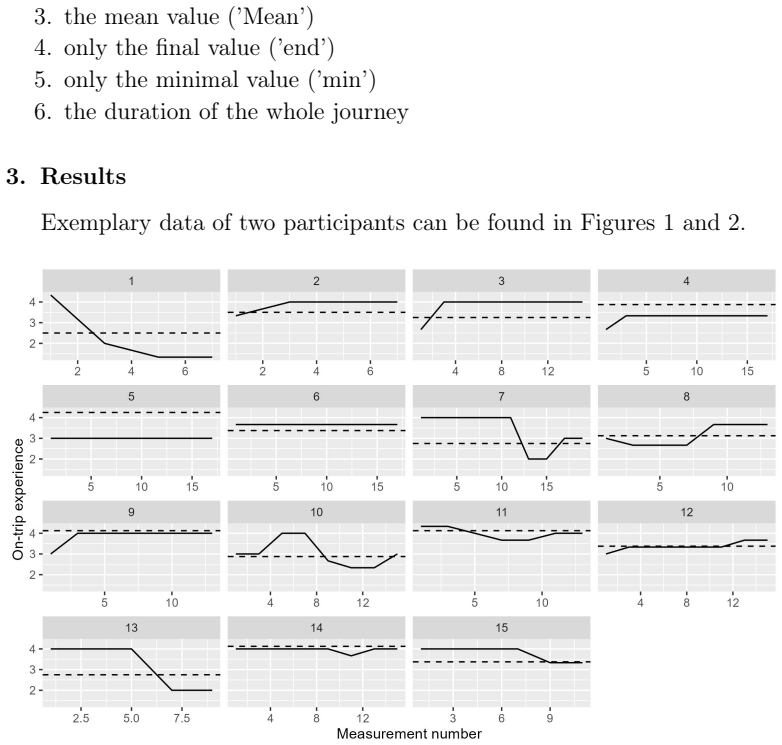
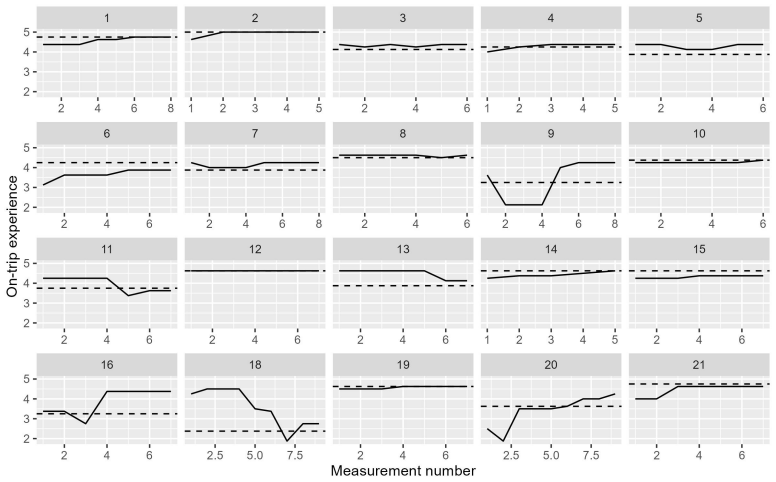
read the original abstract
Understanding how travelers form overall evaluations of public transport journeys is critical for improving travel satisfaction and encouraging sustainable mode choice. While travel satisfaction is discussed to influence attitudes and future behavior, the cognitive rules by which moment-to-moment experiences are aggregated into retrospective evaluations remain poorly understood in transport research. Drawing on psychological theories of experienced and remembered utility, this study investigates which temporal aggregation heuristics best predict post-trip travel satisfaction. Using a smartphone-based experience sampling approach, we collected high-frequency on-trip experience ratings and post-trip evaluations for 2576 real-world public transport trips across three German cities. Travel experience was assessed every five minutes during trips using a multi-item scale, allowing direct comparison of competing aggregation rules, including mean experience, peak-end, minimum-end, final moment, and trip duration. Multilevel regression models were estimated to evaluate the explanatory power of each heuristic. Results show that retrospective travel satisfaction is best predicted by a Minimum-End heuristic, combining the most negative moment of the journey and the final experience. Models based on mean experience, peak-end rules, final moment alone, or trip duration performed substantially worse. This pattern indicates that both negative extremes and the final phase of a journey independently contribute to remembered evaluations, rather than overall satisfaction reflecting an average of momentary experiences. The results have important implications for theory and practice, suggesting that targeted interventions at critical negative moments and at trip endings may yield substantial improvements in remembered satisfaction and, ultimately, support shifts toward sustainable mobility.
Editorial analysis
A structured set of objections, weighed in public.
Referee Report
Summary. The manuscript investigates which temporal aggregation heuristics best predict post-trip travel satisfaction in public transport. Drawing on experienced and remembered utility theories, it uses smartphone-based experience sampling every five minutes across 2576 real-world trips in three German cities to compare rules including mean experience, peak-end, minimum-end, final moment, and trip duration via multilevel regression models. The central claim is that a Minimum-End heuristic (most negative moment plus final experience) outperforms the alternatives and that both negative extremes and trip endings independently shape remembered evaluations.
Significance. If the result holds after addressing sampling and modeling details, the work provides a direct empirical test of psychological aggregation rules in a high-stakes real-world domain, with clear implications for designing interventions that target negative moments and trip endings to boost satisfaction and sustainable mode choice. The large sample, high-frequency real-world data collection, and predefined (non-circular) heuristics are strengths that distinguish it from purely theoretical or lab-based studies.
major comments (2)
- [Methods (experience sampling description)] The experience sampling procedure (every five minutes) is load-bearing for constructing the minimum rating variable that drives the Minimum-End result. Brief negative events shorter than the sampling window (e.g., sudden delays or crowding) can be missed entirely, producing an upward-biased minimum that may artifactually favor Minimum-End over mean or peak-end rules. A sensitivity analysis or validation that the 5-minute interval adequately captures worst moments is required to support the central claim.
- [Results and model estimation sections] The multilevel regression results claim that Minimum-End models perform substantially better than mean, peak-end, final-moment, or duration models, yet full specification details (exact controls, random effects structure, operationalization of each heuristic as predictors, and quantitative fit metrics such as R² or AIC differences) are not provided. Without these, it is difficult to verify that the superiority is not driven by omitted variables or differing model complexity.
minor comments (2)
- [Abstract] The abstract states that models based on mean experience, peak-end, final moment, or trip duration performed substantially worse, but does not report the magnitude of the differences or any cross-validation metrics; adding these numbers would improve interpretability.
- [Methods] The cities in which data were collected are mentioned but not named; listing them would aid replicability and contextual interpretation.
Simulated Author's Rebuttal
We thank the referee for their constructive comments, which help clarify key aspects of our methods and results. We address each major comment below, indicating revisions where appropriate to strengthen the manuscript.
read point-by-point responses
-
Referee: The experience sampling procedure (every five minutes) is load-bearing for constructing the minimum rating variable that drives the Minimum-End result. Brief negative events shorter than the sampling window (e.g., sudden delays or crowding) can be missed entirely, producing an upward-biased minimum that may artifactually favor Minimum-End over mean or peak-end rules. A sensitivity analysis or validation that the 5-minute interval adequately captures worst moments is required to support the central claim.
Authors: We acknowledge that the 5-minute sampling interval represents a practical trade-off between temporal resolution and participant burden in a field study, but agree it could miss very brief negative events. In the revised manuscript we will add an explicit discussion of this limitation, supported by literature on typical durations of public transport disruptions (which often exceed five minutes). We will also include a sensitivity analysis that subsamples longer trips and examines whether the Minimum-End advantage persists when restricting to trips with more stable rating patterns. These additions will be placed in the Methods and Limitations sections. revision: yes
-
Referee: The multilevel regression results claim that Minimum-End models perform substantially better than mean, peak-end, final-moment, or duration models, yet full specification details (exact controls, random effects structure, operationalization of each heuristic as predictors, and quantitative fit metrics such as R² or AIC differences) are not provided. Without these, it is difficult to verify that the superiority is not driven by omitted variables or differing model complexity.
Authors: We agree that complete model specifications are necessary for transparency. In the revised Results and model estimation sections we will report: the full set of control variables (trip duration, time of day, city, and participant demographics), the random-effects structure (random intercepts for participants and trips), the exact operationalization of each heuristic (e.g., minimum-end as the lowest rating plus the final rating), and comparative fit statistics including marginal and conditional R² as well as AIC and BIC differences across all models. These details will be presented in both text and an expanded table. revision: yes
Circularity Check
Empirical heuristic comparison is self-contained with no circularity
full rationale
The paper collects high-frequency experience-sampling ratings every five minutes during real-world trips and applies multilevel regressions to compare the predictive power of a priori defined aggregation heuristics (mean, peak-end, minimum-end, final moment, duration) against post-trip satisfaction. These heuristics are computed directly from the sampled data points using fixed rules drawn from psychological theory; no parameters are fitted to the target outcome in a way that would render the reported superiority tautological or forced by construction. The central claim rests on statistical model comparison against external post-trip measures rather than any self-referential derivation, self-citation chain, or ansatz that reduces to the inputs. This is a standard empirical test and therefore self-contained.
Axiom & Free-Parameter Ledger
free parameters (1)
- regression coefficients in multilevel models
axioms (1)
- domain assumption The experience ratings collected every five minutes represent the true underlying momentary experiences.
Lean theorems connected to this paper
-
IndisputableMonolith/Cost/FunctionalEquation.leanwashburn_uniqueness_aczel unclear?
unclearRelation between the paper passage and the cited Recognition theorem.
Results show that retrospective travel satisfaction is best predicted by a Minimum–End heuristic, combining the most negative moment of the journey and the final experience.
-
IndisputableMonolith/Foundation/RealityFromDistinction.leanreality_from_one_distinction unclear?
unclearRelation between the paper passage and the cited Recognition theorem.
Models based on mean experience, peak–end rules, final moment alone, or trip duration performed substantially worse.
What do these tags mean?
- matches
- The paper's claim is directly supported by a theorem in the formal canon.
- supports
- The theorem supports part of the paper's argument, but the paper may add assumptions or extra steps.
- extends
- The paper goes beyond the formal theorem; the theorem is a base layer rather than the whole result.
- uses
- The paper appears to rely on the theorem as machinery.
- contradicts
- The paper's claim conflicts with a theorem or certificate in the canon.
- unclear
- Pith found a possible connection, but the passage is too broad, indirect, or ambiguous to say the theorem truly supports the claim.
Reference graph
Works this paper leans on
-
[1]
Abenoza, R.F., Cats, O., Susilo, Y.O., 2019. How does travel satisfactionsum up? an exploratory analysis in decomposing the door-to-door experience for multimodal trips. Transportation 46, 1615–1642
work page 2019
-
[2]
Ariely, D., 1998. Combining experiences over time: The effects of duration, intensity changes and on-line measurements on retrospective pain evalua- tions. Journal of Behavioral Decision Making 11, 19–45
work page 1998
-
[3]
Ariely, D., Loewenstein, G., 2000. When does duration matter in judgment and decision making? Journal of experimental psychology: general 129, 508
work page 2000
-
[4]
Critical service encounters: The employee’s viewpoint
Bitner, M.J., Booms, B.H., Mohr, L.A., 1994. Critical service encounters: The employee’s viewpoint. Journal of marketing 58, 95–106
work page 1994
-
[5]
Bosch, E., Luther, A.R., Ihme, K., 2025. Travel experience in public trans- port: Experience sampling and cardiac activity data for spatial analysis. Scientific Data 12, 633
work page 2025
-
[6]
Davelaar, E.J., Goshen-Gottstein, Y., Ashkenazi, A., Haarmann, H.J., Usher, M., 2005. The demise of short-term memory revisited: empirical and computational investigations of recency effects. Psychological review 112, 3. De Vos, J., Singleton, P.A., Gärling, T., 2022. From attitude to satisfaction: introducing the travel mode choice cycle. Transport Revie...
work page 2005
-
[7]
The structure of affective reactions to critical incidents
Friman, M., 2004. The structure of affective reactions to critical incidents. Journal of Economic Psychology 25, 331–353
work page 2004
-
[8]
Frequency of negative critical incidents and satisfaction with public transport services
Friman, M., Edvardsson, B., Gärling, T., 2001. Frequency of negative critical incidents and satisfaction with public transport services. i. Journal of retailing and consumer services 8, 95–104. Gärling, T., Ettema, D., Connolly, F.F., Friman, M., Olsson, L.E., 2020. Reviewandassessmentofself-reportsoftravel-relatedemotionalwellbeing. Journal of Transport ...
work page 2001
-
[9]
The critical incident technique in service research
Gremler, D.D., 2004. The critical incident technique in service research. Journal of service research 7, 65–89. 21
work page 2004
-
[10]
Heron, K.E., Smyth, J.M., 2013. Is intensive measurement of body image reactive? a two-study evaluation using ecological momentary assessment suggests not. Body Image 10, 35–44
work page 2013
-
[11]
When more pain is preferred to less: Adding a better end
Kahneman, D., Fredrickson, B.L., Schreiber, C.A., Redelmeier, D.A., 1993. When more pain is preferred to less: Adding a better end. Psychological science 4, 401–405
work page 1993
-
[12]
Back to bentham? explo- rations of experienced utility
Kahneman, D., Wakker, P.P., Sarin, R., 1997. Back to bentham? explo- rations of experienced utility. The quarterly journal of economics 112, 375–406
work page 1997
-
[13]
Financial rewards for long- term environmental protection
Kaiser, F.G., Henn, L., Marschke, B., 2020. Financial rewards for long- term environmental protection. Journal of Environmental Psychology 68, 101411. Lättman, K., Friman, M., Olsson, L.E., 2016. Perceivedaccessibilityofpublic transport as a potential indicator of social inclusion. Social inclusion 4, 36–45
work page 2020
-
[14]
Lim, T., Thompson, J., Pearson, L., Odgers, J.C., Beck, B., 2024. Effects of within-trip subjective experiences on travel satisfaction and travel mode choice: A conceptual framework. Transportation Research Part F: Traffic Psychology and Behaviour 104, 201–216
work page 2024
-
[15]
Hedonic adaptation and the role of deci- sion and experience utility in public policy
Loewenstein, G., Ubel, P.A., 2008. Hedonic adaptation and the role of deci- sion and experience utility in public policy. Journal of Public Economics 92, 1795–1810
work page 2008
-
[16]
Smartphone-based survey for real-time and retrospective happi- ness related to travel and activities
Raveau, S., Ghorpade, A., Zhao, F., Abou-Zeid, M., Zegras, C., Ben-Akiva, M., 2016. Smartphone-based survey for real-time and retrospective happi- ness related to travel and activities. Transportation Research Record 2566, 102–110
work page 2016
-
[17]
Redelmeier, D.A., Kahneman, D., 1996. Patients’ memories of painful med- ical treatments: Real-time and retrospective evaluations of two minimally invasive procedures. pain 66, 3–8
work page 1996
-
[18]
Memories of colonoscopy: a randomized trial
Redelmeier, D.A., Katz, J., Kahneman, D., 2003. Memories of colonoscopy: a randomized trial. Pain 104, 187–194. 22
work page 2003
-
[19]
Negativity bias, negativity dominance, and contagion
Rozin, P., Royzman, E.B., 2001. Negativity bias, negativity dominance, and contagion. Personality and social psychology review 5, 296–320
work page 2001
-
[20]
An experimental test of loss aversion
Schmidt, U., Traub, S., 2002. An experimental test of loss aversion. Journal of risk and Uncertainty 25, 233–249
work page 2002
-
[21]
Determinants of the remembered utility of aversive sounds
Schreiber, C.A., Kahneman, D., 2000. Determinants of the remembered utility of aversive sounds. Journal of Experimental Psychology: General 129, 27
work page 2000
-
[22]
Steinhorst, J., Klöckner, C.A., 2018. Effects of monetary versus environmen- tal information framing: Implications for long-term pro-environmental be- havior and intrinsic motivation. Environment and Behavior 50, 997–1031
work page 2018
-
[23]
Exploringkeydeterminantsoftravelsatisfaction for multi-modal trips by different traveler groups
Susilo, Y.O., Cats, O., 2014. Exploringkeydeterminantsoftravelsatisfaction for multi-modal trips by different traveler groups. Transportation Research Part A: Policy and Practice 67, 366–380. Van Lierop, D., Badami, M.G., El-Geneidy, A.M., 2018. What influences satisfaction and loyalty in public transport? a review of the literature. Transport Reviews 38,...
work page 2014
discussion (0)
Sign in with ORCID, Apple, or X to comment. Anyone can read and Pith papers without signing in.