Generating collective spin cat states via photon-number measurements near the Dicke critical point
Pith reviewed 2026-05-20 18:33 UTC · model grok-4.3
The pith
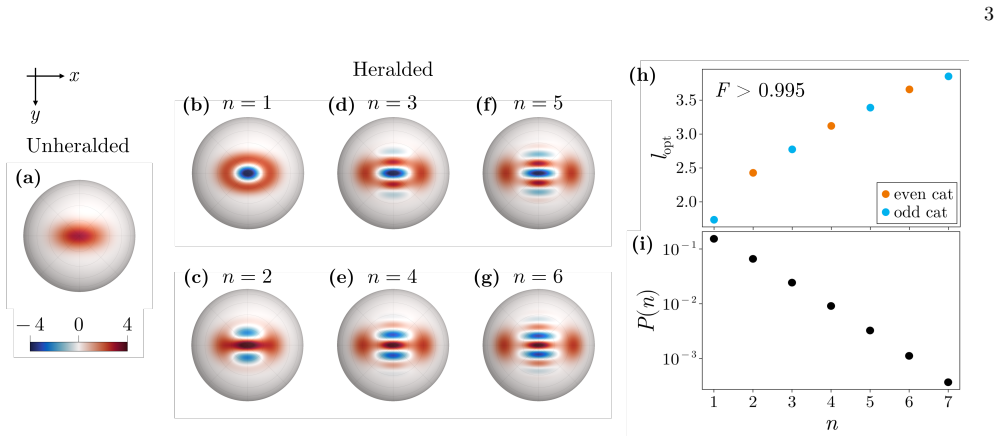
Photon-number measurements on the near-critical Dicke ground state herald collective spin cat states.
A machine-rendered reading of the paper's core claim, the machinery that carries it, and where it could break.
Core claim
Photon-number measurements performed on the ground state of the Dicke model near the superradiant critical point herald collective spin cat states in the atomic ensemble. The near-critical regime increases both the size of the cat states and the likelihood of obtaining larger photon-number results, and larger photon numbers correspond to even bigger cats. In the thermodynamic limit, the mechanism is equivalent to a natural light-matter analogue of generalized photon subtraction used in optical cat-state generation.
What carries the argument
Photon-number projective measurement applied to the entangled ground state of the Dicke Hamiltonian near the superradiant phase transition, which projects the collective atomic spins into a cat state via the built-up anti-squeezing.
If this is right
- Higher measured photon numbers directly yield larger spin cat states.
- Operating closer to the critical point both enlarges the cats and raises the probability of large-photon outcomes.
- The protocol supplies a concrete route to many-body cat states useful for quantum metrology and sensing.
- The generation mechanism is the light-matter counterpart of generalized photon subtraction.
Where Pith is reading between the lines
- The same critical-enhancement principle could be tested in other light-matter or spin-boson models with tunable phase transitions.
- The heralded cats may improve sensitivity in collective spin interferometers beyond the standard quantum limit.
- Realistic implementations will require cavities with coupling strengths that outpace both cavity loss and atomic decoherence rates.
Load-bearing premise
The cavity-atom system must remain in the Dicke-model ground state long enough for the photon-number measurement to occur before decoherence or photon loss destroys the generated entanglement.
What would settle it
An experiment in which photon-number-resolved detection on a near-critical Dicke system produces an atomic state whose Wigner function or parity oscillations fail to show the interference signature of a spin cat state.
Figures



read the original abstract
We propose a method for generating collective spin cat states in a cavity-coupled atomic ensemble by exploiting strong light-matter entanglement and anti-squeezing associated with the superradiant phase transition. We numerically and analytically demonstrate that the cat states can be heralded by photon-number measurement on the ground state of the Dicke model. The near-critical regime enhances both the cat-state size and the probability of obtaining larger photon-number outcomes, and outcomes with larger photon numbers yield even larger cat states. We also show that a thermodynamic-limit analysis clarifies the generation mechanism and connects it to a natural light-matter analogue of generalized photon subtraction for optical cat-state generation. These results suggest that exploiting criticality in strongly coupled light-matter systems could open new directions for matter-based many-body quantum technologies.
Editorial analysis
A structured set of objections, weighed in public.
Referee Report
Summary. The paper proposes generating collective spin cat states in a cavity-coupled atomic ensemble by photon-number measurements on the ground state of the Dicke model near the superradiant critical point. Numerical and analytical results are presented showing that proximity to criticality and higher photon-number outcomes produce larger cat states, with a thermodynamic-limit analysis linking the mechanism to a light-matter analogue of generalized photon subtraction.
Significance. If the central mechanism holds, the work offers a route to macroscopic spin cat states by leveraging light-matter entanglement near criticality, with potential implications for many-body quantum technologies. The thermodynamic-limit connection to photon subtraction provides conceptual clarity, and the numerical demonstrations for finite systems illustrate the effect, though practical realization hinges on addressing state preparation.
major comments (2)
- [Thermodynamic-limit analysis and numerical demonstrations] The manuscript assumes the atomic ensemble occupies the ground state of the Dicke Hamiltonian sufficiently close to the critical point for photon-number measurement to project onto a macroscopic cat state (see abstract and thermodynamic-limit analysis). However, the excitation gap closes as the superradiant critical point is approached, causing adiabatic preparation times to diverge with system size; this preparation protocol and associated timescales are not discussed or incorporated into the analysis.
- [Numerical and analytical demonstrations] The numerical demonstrations rely on exact diagonalization or similar methods feasible only for small N, where finite-size rounding of the gap makes preparation trivial. The thermodynamic-limit argument for cat generation does not address how the heralding mechanism survives when preparation constraints are included, which is load-bearing for claims about larger cats at larger N and closer to criticality.
minor comments (2)
- [Results sections] Clarify the precise definition of 'collective spin cat states' and the quantitative measure of cat size (e.g., separation in phase space or overlap with ideal cat) used in the numerics and analytics.
- [Abstract] The abstract states that 'outcomes with larger photon numbers yield even larger cat states' without specifying the probability distribution or success probability scaling near criticality.
Simulated Author's Rebuttal
We thank the referee for their thoughtful comments, which highlight important practical considerations for realizing the proposed protocol. We address each major comment below, clarifying the scope of our analysis while agreeing to incorporate additional discussion in the revised manuscript.
read point-by-point responses
-
Referee: The manuscript assumes the atomic ensemble occupies the ground state of the Dicke Hamiltonian sufficiently close to the critical point for photon-number measurement to project onto a macroscopic cat state (see abstract and thermodynamic-limit analysis). However, the excitation gap closes as the superradiant critical point is approached, causing adiabatic preparation times to diverge with system size; this preparation protocol and associated timescales are not discussed or incorporated into the analysis.
Authors: We agree that the closing excitation gap near criticality leads to diverging adiabatic preparation times in the thermodynamic limit, and this practical aspect was not addressed in the original manuscript. Our analysis centers on the conditional state obtained after photon-number measurement, assuming the system begins in the ground state of the Dicke model. For the finite-N cases treated numerically, the gap remains finite and preparation is feasible within the demonstrated regimes. The thermodynamic-limit analysis focuses on the scaling properties of the heralded cat states and their connection to a light-matter analogue of generalized photon subtraction. We will revise the manuscript to include a dedicated paragraph discussing these preparation challenges, noting that alternative approaches such as finite-time ramps or auxiliary driving fields could be explored in future work. revision: yes
-
Referee: The numerical demonstrations rely on exact diagonalization or similar methods feasible only for small N, where finite-size rounding of the gap makes preparation trivial. The thermodynamic-limit argument for cat generation does not address how the heralding mechanism survives when preparation constraints are included, which is load-bearing for claims about larger cats at larger N and closer to criticality.
Authors: The small-N numerics illustrate the heralding effect in computationally tractable regimes where finite-size rounding permits straightforward ground-state preparation. The thermodynamic-limit analysis derives the cat-state properties directly from the structure of the critical ground-state wave function and the photon-number projection, showing that larger photon outcomes and closer proximity to criticality produce larger cats. While we acknowledge that a full dynamical treatment of preparation constraints in the thermodynamic limit is not provided and would strengthen the scalability discussion, the analytical framework indicates the mechanism is intrinsic to the entangled ground state. We will partially revise by adding a qualitative discussion of this point and emphasizing that the claims concern the projection mechanism rather than a complete end-to-end protocol. revision: partial
Circularity Check
No significant circularity; derivation chain is self-contained via numerics and thermodynamic-limit analysis.
full rationale
The paper's central claim—that photon-number measurement on the near-critical Dicke ground state heralds collective spin cat states—is supported by direct numerical diagonalization for finite N and an analytical thermodynamic-limit argument that maps the process to a light-matter analogue of generalized photon subtraction. This mapping is presented explicitly as an explanatory analogy rather than a fitted parameter or self-referential definition. No equations reduce the output cat size or heralding probability to the input by construction, no load-bearing self-citations close the derivation loop, and the preparation assumption (ground-state occupancy) is stated as a modeling choice without being smuggled in via prior author work. The skeptic concern about gap closing and adiabatic preparation time is a physical feasibility issue, not a circularity in the mathematical chain.
Axiom & Free-Parameter Ledger
axioms (2)
- domain assumption The Dicke model Hamiltonian accurately describes the cavity-coupled atomic ensemble.
- domain assumption Photon-number measurement can be performed without destroying the light-matter entanglement generated near criticality.
Lean theorems connected to this paper
-
IndisputableMonolith.Cost.FunctionalEquationwashburn_uniqueness_aczel unclear?
unclearRelation between the paper passage and the cited Recognition theorem.
The effective Hamiltonian ... two coupled harmonic oscillators ... unitary ... squeezing and mixing operations ... generalized photon subtraction protocol
What do these tags mean?
- matches
- The paper's claim is directly supported by a theorem in the formal canon.
- supports
- The theorem supports part of the paper's argument, but the paper may add assumptions or extra steps.
- extends
- The paper goes beyond the formal theorem; the theorem is a base layer rather than the whole result.
- uses
- The paper appears to rely on the theorem as machinery.
- contradicts
- The paper's claim conflicts with a theorem or certificate in the canon.
- unclear
- Pith found a possible connection, but the passage is too broad, indirect, or ambiguous to say the theorem truly supports the claim.
Reference graph
Works this paper leans on
-
[1]
E. Schr¨ odinger, Die gegenw¨ artige Situation in der Quan- tenmechanik, Naturwissenschaften23, 823 (1935)
work page 1935
-
[2]
S. Del´ eglise, I. Dotsenko, C. Sayrin, J. Bernu, M. Brune, J.-M. Raimond, and S. Haroche, Reconstruction of non- classical cavity field states with snapshots of their deco- herence, Nature455, 510 (2008)
work page 2008
-
[3]
W. J. Munro, K. Nemoto, G. J. Milburn, and S. L. Braunstein, Weak-force detection with superposed coher- ent states, Phys. Rev. A66, 023819 (2002)
work page 2002
-
[4]
J. Joo, W. J. Munro, and T. P. Spiller, Quantum Metrol- ogy with Entangled Coherent States, Phys. Rev. Lett. 107, 083601 (2011)
work page 2011
- [5]
-
[6]
L. Pezz` e, A. Smerzi, M. K. Oberthaler, R. Schmied, and P. Treutlein, Quantum metrology with nonclassical states of atomic ensembles, Rev. Mod. Phys.90, 035005 (2018)
work page 2018
-
[7]
T. C. Ralph, A. Gilchrist, G. J. Milburn, W. J. Munro, and S. Glancy, Quantum computation with optical co- herent states, Phys. Rev. A68, 042319 (2003)
work page 2003
-
[8]
N. Ofek, A. Petrenko, R. Heeres, P. Reinhold, Z. Leghtas, B. Vlastakis, Y. Liu, L. Frunzio, S. M. Girvin, L. Jiang, M. Mirrahimi, M. H. Devoret, and R. J. Schoelkopf, Ex- tending the lifetime of a quantum bit with error correc- tion in superconducting circuits, Nature536, 441 (2016)
work page 2016
-
[9]
P. T. Cochrane, G. J. Milburn, and W. J. Munro, Macro- scopically distinct quantum-superposition states as a bosonic code for amplitude damping, Phys. Rev. A59, 2631 (1999)
work page 1999
-
[10]
F. Fr¨ owis, P. Sekatski, W. D¨ ur, N. Gisin, and N. San- gouard, Macroscopic quantum states: Measures, fragility, and implementations, Rev. Mod. Phys.90, 025004 (2018)
work page 2018
-
[11]
R. Lescanne, M. Villiers, T. Peronnin, A. Sarlette, M. Delbecq, B. Huard, T. Kontos, M. Mirrahimi, and Z. Leghtas, Exponential suppression of bit-flips in a qubit encoded in an oscillator, Nat. Phys.16, 509 (2020)
work page 2020
- [12]
-
[13]
A. Ourjoumtsev, R. Tualle-Brouri, J. Laurat, and P. Grangier, Generating Optical Schr¨ odinger Kittens for Quantum Information Processing, Science312, 83 (2006)
work page 2006
-
[14]
J. S. Neergaard-Nielsen, B. M. Nielsen, C. Hettich, K. Mølmer, and E. S. Polzik, Generation of a Superposi- tion of Odd Photon Number States for Quantum Infor- mation Networks, Phys. Rev. Lett.97, 083604 (2006)
work page 2006
-
[15]
H. Takahashi, K. Wakui, S. Suzuki, M. Takeoka, K. Hayasaka, A. Furusawa, and M. Sasaki, Generation of Large-Amplitude Coherent-State Superposition via Ancilla-Assisted Photon Subtraction, Phys. Rev. Lett. 101, 233605 (2008)
work page 2008
-
[16]
T. Gerrits, S. Glancy, T. S. Clement, B. Calkins, A. E. 10 Lita, A. J. Miller, A. L. Migdall, S. W. Nam, R. P. Mirin, and E. Knill, Generation of optical coherent-state super- positions by number-resolved photon subtraction from the squeezed vacuum, Phys. Rev. A82, 031802 (2010)
work page 2010
-
[17]
K. Huang, H. Le Jeannic, J. Ruaudel, V. B. Verma, M. D. Shaw, F. Marsili, S. W. Nam, E. Wu, H. Zeng, Y.-C. Jeong, R. Filip, O. Morin, and J. Laurat, Optical Syn- thesis of Large-Amplitude Squeezed Coherent-State Su- perpositions with Minimal Resources, Phys. Rev. Lett. 115, 023602 (2015)
work page 2015
-
[18]
D. V. Sychev, A. E. Ulanov, A. A. Pushkina, M. W. Richards, I. A. Fedorov, and A. I. Lvovsky, Enlargement of optical Schr¨ odinger’s cat states, Nature Photon11, 379 (2017)
work page 2017
-
[19]
H. Saito and M. Ueda, Measurement-induced spin squeezing in a cavity, Phys. Rev. A68, 043820 (2003)
work page 2003
-
[20]
A. S. Sørensen and K. Mølmer, Measurement Induced Entanglement and Quantum Computation with Atoms in Optical Cavities, Phys. Rev. Lett.91, 097905 (2003)
work page 2003
-
[21]
R. McConnell, H. Zhang, J. Hu, S. ´Cuk, and V. Vuleti´ c, Entanglement with negative Wigner function of almost 3,000 atoms heralded by one photon, Nature519, 439 (2015)
work page 2015
-
[22]
S. Massar and E. S. Polzik, Generating a Superposition of Spin States in an Atomic Ensemble, Phys. Rev. Lett. 91, 060401 (2003)
work page 2003
-
[23]
C. Genes and P. R. Berman, Generating conditional atomic entanglement by measuring photon number in a single output channel, Phys. Rev. A73, 013801 (2006)
work page 2006
-
[24]
R. McConnell, H. Zhang, S. ´Cuk, J. Hu, M. H. Schleier- Smith, and V. Vuleti´ c, Generating entangled spin states for quantum metrology by single-photon detection, Phys. Rev. A88, 063802 (2013)
work page 2013
-
[25]
O. Pettersson and T. Byrnes, Light-mediated non- Gaussian entanglement of atomic ensembles, Phys. Rev. A95, 043817 (2017)
work page 2017
-
[26]
E. J. Davis, Z. Wang, A. H. Safavi-Naeini, and M. H. Schleier-Smith, Painting Nonclassical States of Spin or Motion with Shaped Single Photons, Phys. Rev. Lett. 121, 123602 (2018)
work page 2018
-
[27]
S. Imai, Macroscopic Schr¨ odinger-cat states of nonequi- librium electrons induced by cat-state optical driving and projective measurements on the light field, Phys. Rev. A 113, 023702 (2026)
work page 2026
-
[28]
K. Hepp and E. H. Lieb, Equilibrium Statistical Mechan- ics of Matter Interacting with the Quantized Radiation Field, Phys. Rev. A8, 2517 (1973)
work page 1973
-
[29]
Y. K. Wang and F. T. Hioe, Phase Transition in the Dicke Model of Superradiance, Phys. Rev. A7, 831 (1973)
work page 1973
-
[30]
N. Lambert, C. Emary, and T. Brandes, Entanglement and the Phase Transition in Single-Mode Superradiance, Phys. Rev. Lett.92, 073602 (2004)
work page 2004
-
[31]
K. Takase, J.-i. Yoshikawa, W. Asavanant, M. Endo, and A. Furusawa, Generation of optical Schr¨ odinger cat states by generalized photon subtraction, Phys. Rev. A103, 013710 (2021)
work page 2021
-
[32]
C. Emary and T. Brandes, Chaos and the quantum phase transition in the Dicke model, Phys. Rev. E67, 066203 (2003)
work page 2003
-
[33]
D. S. Shapiro, W. V. Pogosov, and Yu. E. Lozovik, Uni- versal fluctuations and squeezing in a generalized Dicke model near the superradiant phase transition, Phys. Rev. A102, 023703 (2020)
work page 2020
-
[34]
K. Hayashida, T. Makihara, N. Marquez Peraca, D. Fal- las Padilla, H. Pu, J. Kono, and M. Bamba, Perfect intrinsic squeezing at the superradiant phase transition critical point, Sci Rep13, 2526 (2023)
work page 2023
-
[35]
C. Brif and A. Mann, Phase-space formulation of quan- tum mechanics and quantum-state reconstruction for physical systems with Lie-group symmetries, Phys. Rev. A59, 971 (1999)
work page 1999
- [36]
-
[37]
F. Hong-Yi, Density Matrix and Squeezed State of the Two Coupled Harmonic Oscillators, EPL19, 443 (1992)
work page 1992
-
[38]
J.-Y. Zhou, Y.-H. Zhou, X.-L. Yin, J.-F. Huang, and J.- Q. Liao, Quantum entanglement maintained by virtual excitations in an ultrastrongly-coupled-oscillator system, Sci Rep10, 12557 (2020)
work page 2020
-
[39]
S. Mirkhalaf, H. Ritsch, and K. Gietka, Frequency shifts heralding ground state squeezing and entanglement of two coupled harmonic oscillators, arXiv:2511.03687v2 (2025)
-
[40]
M. Kitagawa and M. Ueda, Squeezed spin states, Phys. Rev. A47, 5138 (1993)
work page 1993
-
[41]
C. Groiseau, S. J. Masson, and S. Parkins, Generation of spin cat states in an engineered Dicke model, Phys. Rev. A104, 053721 (2021)
work page 2021
- [42]
-
[43]
K. Baumann, C. Guerlin, F. Brennecke, and T. Esslinger, Dicke quantum phase transition with a superfluid gas in an optical cavity, Nature464, 1301 (2010)
work page 2010
-
[44]
F. Mivehvar, F. Piazza, T. Donner, and H. Ritsch, Cavity QED with quantum gases: New paradigms in many-body physics, Advances in Physics70, 1 (2021)
work page 2021
-
[45]
C. Guerlin, J. Bernu, S. Del´ eglise, C. Sayrin, S. Gleyzes, S. Kuhr, M. Brune, J.-M. Raimond, and S. Haroche, Pro- gressive field-state collapse and quantum non-demolition photon counting, Nature448, 889 (2007)
work page 2007
-
[46]
S. Gleyzes, S. Kuhr, C. Guerlin, J. Bernu, S. Del´ eglise, U. Busk Hoff, M. Brune, J.-M. Raimond, and S. Haroche, Quantum jumps of light recording the birth and death of a photon in a cavity, Nature446, 297 (2007)
work page 2007
- [47]
discussion (0)
Sign in with ORCID, Apple, or X to comment. Anyone can read and Pith papers without signing in.