Driven two-level systems as a minimal resource for remote entanglement stabilization
Pith reviewed 2026-05-20 19:25 UTC · model grok-4.3
The pith
A driven two-level system produces photons that stabilize remote entanglement between qubits, but filter cavities are required to reach near-maximal entanglement.
A machine-rendered reading of the paper's core claim, the machinery that carries it, and where it could break.
Core claim
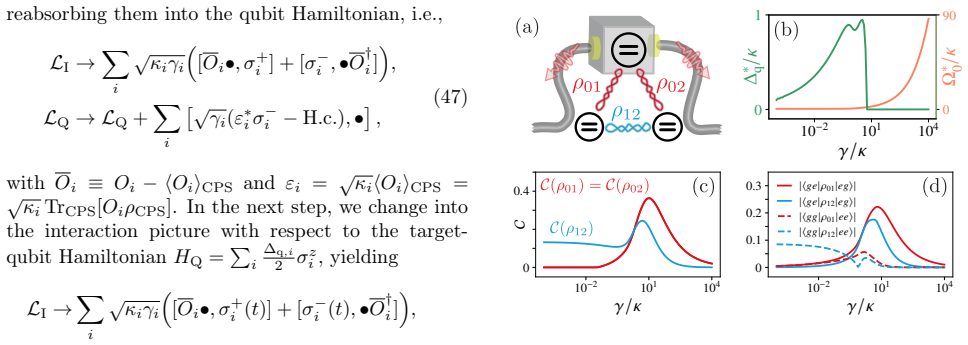
By treating the qubits as idealized entanglement detectors, the maximum stabilizable entanglement is determined solely from the properties of the photon source. For a bare driven two-level system the Mollow sidebands contain distributable entanglement, yet stabilizing close to maximally entangled states requires additional filter cavities that enhance the relevant correlated emission events compared to other processes. Optimized driving and cavity parameters are identified and the achievable entanglement is accounted for in terms of an effective two-mode squeezing model.
What carries the argument
Framework that quantifies maximum stabilizable entanglement solely from photon-source properties by modeling remote qubits as ideal detectors.
If this is right
- Optimized driving strength and cavity parameters yield specific amounts of entanglement in different regimes.
- The same source can be used for networks based on either photons or phonons in solid-state systems.
- Isolated spins, impurity centers, or other two-level defects serve as minimal resources for remote entanglement distribution.
- An effective two-mode squeezing description accounts for the entanglement in the filtered and unfiltered cases.
Where Pith is reading between the lines
- Practical devices would require accounting for finite qubit coherence times to determine the entanglement actually achievable.
- The approach may extend to other readily available two-level defects in materials where engineered photon sources are unavailable.
- Phonon-mediated versions could offer an alternative route in systems where optical filtering is technically challenging.
Load-bearing premise
The qubits function as idealized entanglement detectors with perfect efficiency and no decoherence or measurement back-action.
What would settle it
An experiment that drives two remote qubits with the filtered output of a driven two-level system and measures the resulting steady-state concurrence to check whether it approaches the value predicted by the two-mode squeezing model.
Figures


read the original abstract
We analyze the autonomous stabilization of remote entanglement by driving two distant qubits with the output of a correlated photon source. By treating the qubits as idealized entanglement detectors, we develop a general framework to quantify the maximum amount of entanglement that can be remotely stabilized in this way with a given photon source. We then apply this approach to evaluate the suitability of a single driven two-level system as a minimal resource for autonomous entanglement distribution schemes. While our analysis confirms the presence of distributable entanglement in the Mollow sidebands of a bare two-level system, we show that stabilizing close to maximally entangled states requires additional filter cavities that enhance the relevant correlated emission events compared to other processes. We identify optimized driving and cavity parameters and explain the achievable amount of entanglement in different regimes in terms of an effective two-mode squeezing model. These insights are particularly relevant for quantum networks based on photons or phonons in solid-state systems, where isolated spins, impurity centers, or other two-level defects are readily available, while alternative sources of correlated photons are difficult to realize.
Editorial analysis
A structured set of objections, weighed in public.
Referee Report
Summary. The manuscript develops a general framework for quantifying the maximum amount of remote entanglement that can be autonomously stabilized by driving two distant qubits with output from a correlated photon source, treating the qubits as idealized detectors. It applies this framework to a driven two-level system, confirming distributable entanglement in the Mollow sidebands but showing that near-maximal entanglement requires additional filter cavities to enhance correlated emission events over other processes. Optimized driving and cavity parameters are identified, and the results are interpreted through an effective two-mode squeezing model.
Significance. If the central results hold, the work provides a minimal-resource approach for remote entanglement distribution relevant to solid-state quantum networks, where two-level systems like spins or defects are readily available. The framework for evaluating photon sources and the distinction between bare TLS and filtered cases, together with the squeezing-model explanation, offers practical guidance for experimental designs in photon- or phonon-based networks.
major comments (1)
- [Framework and main analysis] Framework for quantifying entanglement (general approach outlined in abstract and main analysis): The treatment of qubits as idealized entanglement detectors with perfect efficiency, no decoherence, and no measurement back-action is load-bearing for the claim that filter cavities enable stabilization close to maximally entangled states while bare TLS yield only modest entanglement. Realistic finite efficiency or back-action could degrade the stabilized state enough to alter the reported regimes or invalidate the effective two-mode squeezing reduction; the manuscript should include bounds or a sensitivity analysis on these effects.
minor comments (2)
- The abstract states that optimized parameters are identified but does not indicate the optimization procedure or the specific numerical ranges achieved for entanglement with versus without filters; adding this detail would improve clarity and reproducibility.
- Notation for the effective two-mode squeezing parameters could be introduced more explicitly when first used to avoid ambiguity in how they relate to the TLS emission spectrum.
Simulated Author's Rebuttal
We thank the referee for their careful reading of the manuscript and for the constructive comment on the idealized detector model. We address the point below and will incorporate revisions to strengthen the presentation of the framework's robustness.
read point-by-point responses
-
Referee: The treatment of qubits as idealized entanglement detectors with perfect efficiency, no decoherence, and no measurement back-action is load-bearing for the claim that filter cavities enable stabilization close to maximally entangled states while bare TLS yield only modest entanglement. Realistic finite efficiency or back-action could degrade the stabilized state enough to alter the reported regimes or invalidate the effective two-mode squeezing reduction; the manuscript should include bounds or a sensitivity analysis on these effects.
Authors: We agree that the idealized-detector assumption is central to the framework and that real devices will introduce imperfections capable of reducing the stabilized entanglement. Our analysis was designed to compute the maximum achievable entanglement for a given photon source, providing an upper-bound benchmark rather than a direct experimental prediction. To address the concern, we will add a dedicated subsection with analytical bounds and a brief numerical sensitivity study. Specifically, we show that the concurrence scales linearly with detection efficiency in the filtered regime for moderate loss, remaining above 0.75 for efficiencies above 65 percent while the bare-TLS case stays below 0.4; the two-mode squeezing interpretation continues to hold qualitatively because the dominant correlated emission processes are preserved. We also include a short discussion of back-action in the weak-coupling limit relevant to our parameter optimization. These additions will not change the main conclusions or the reported optimal parameters but will clarify the regime of validity. revision: yes
Circularity Check
Derivation self-contained; effective squeezing model is interpretive not fitted by construction
full rationale
The paper develops a general framework from photon source properties and idealized qubit detectors to quantify maximum stabilizable entanglement, then applies it to the Mollow sidebands of a driven TLS and to filtered configurations. The effective two-mode squeezing model is invoked only to explain regimes after the framework has already produced the entanglement values; no evidence that squeezing parameters are fitted to the target entanglement or that the central claims reduce to re-expression of inputs. No load-bearing self-citations, uniqueness theorems, or ansatzes imported from prior work are present in the derivation chain. The analysis remains independent of the final entanglement numbers and rests on the source spectrum and cavity filtering.
Axiom & Free-Parameter Ledger
free parameters (2)
- driving strength and detuning
- filter cavity parameters
axioms (2)
- domain assumption Qubits act as ideal entanglement detectors with unit efficiency and no back-action
- standard math Markovian approximation for the driven TLS dynamics
Lean theorems connected to this paper
-
IndisputableMonolith/Cost/FunctionalEquation.leanwashburn_uniqueness_aczel unclear?
unclearRelation between the paper passage and the cited Recognition theorem.
We identify optimized driving and cavity parameters and explain the achievable amount of entanglement in different regimes in terms of an effective two-mode squeezing model.
-
IndisputableMonolith/Foundation/RealityFromDistinction.leanreality_from_one_distinction unclear?
unclearRelation between the paper passage and the cited Recognition theorem.
the effective qubit ME is equivalent to a ME for two qubits coupled to a thermal TMS reservoir... reff≡½ tanh^{-1}(2|M|/(N1+N2+1))
What do these tags mean?
- matches
- The paper's claim is directly supported by a theorem in the formal canon.
- supports
- The theorem supports part of the paper's argument, but the paper may add assumptions or extra steps.
- extends
- The paper goes beyond the formal theorem; the theorem is a base layer rather than the whole result.
- uses
- The paper appears to rely on the theorem as machinery.
- contradicts
- The paper's claim conflicts with a theorem or certificate in the canon.
- unclear
- Pith found a possible connection, but the passage is too broad, indirect, or ambiguous to say the theorem truly supports the claim.
Reference graph
Works this paper leans on
- [1]
-
[2]
H. J. Kimble, Nature453, 1023 (2008)
work page 2008
- [3]
- [4]
- [5]
-
[6]
A. S. Cacciapuoti, M. Caleffi, F. Tafuri, F. S. Cataliotti, S. Gherardini, and G. Bianchi, IEEE Netw.34, 137 (2020)
work page 2020
-
[7]
H. K. Beukers, M. Pasini, H. Choi, D. Englund, R. Hanson, and J. Borregaard, PRX Quantum 5, 010202 (2024)
work page 2024
-
[8]
D. Awschalom, K. K. Berggren, H. Bernien, S. Bhave, L. D. Carr, P. Davids, S. E. Economou, D. Englund, A. Faraon, M. Fejer, S. Guha, M. V. Gustafsson, E. Hu, L. Jiang, J. Kim, B. Korzh, P. Kumar, P. G. Kwiat, M. Lončar, M. D. Lukin, D. A. Miller, C. Mon- roe, S. W. Nam, P. Narang, J. S. Orcutt, M. G. Raymer, A. H. Safavi-Naeini, M. Spiropulu, K. Srinivasa...
work page 2021
-
[9]
J. I. Cirac, P. Zoller, H. J. Kimble, and H. Mabuchi, Phys. Rev. Lett.78, 3221 (1997)
work page 1997
- [10]
- [11]
-
[12]
T. E. Northup and R. Blatt, Nature Photon8, 356 (2014)
work page 2014
-
[13]
H. Pichler, T. Ramos, A. J. Daley, and P. Zoller, Phys. Rev. A91, 042116 (2015)
work page 2015
- [14]
-
[15]
C. J. Axline, L. D. Burkhart, W. Pfaff, M. Zhang, K. Chou, P. Campagne-Ibarcq, P. Reinhold, L. Frunzio, S. M. Girvin, L. Jiang, M. H. Devoret, and R. J. Schoelkopf, Nature Phys14, 705 (2018)
work page 2018
-
[16]
P. Kurpiers, P. Magnard, T. Walter, B. Royer, M. Pechal, J. Heinsoo, Y. Salathé, A. Akin, S. Storz, J.-C. Besse, S. Gasparinetti, A. Blais, and A. Wallraff, Nature558, 264 (2018)
work page 2018
-
[17]
A. Bienfait, K. J. Satzinger, Y. P. Zhong, H.-S. Chang, M.-H. Chou, C. R. Conner, É. Dumur, J. Grebel, G. A. Peairs, R. G. Povey, and A. N. Cleland, Science364, 368 (2019)
work page 2019
-
[18]
P. Kurpiers, M. Pechal, B. Royer, P. Magnard, T. Walter, J. Heinsoo, Y. Salathé, A. Akin, S. Storz, J.-C. Besse, S. Gasparinetti, A. Blais, 17 and A. Wallraff, Phys. Rev. Applied12, 044067 (2019)
work page 2019
- [19]
-
[20]
Y. Zhong, H.-S. Chang, A. Bienfait, É. Dumur, M.-H. Chou, C. R. Conner, J. Grebel, R. G. Povey, H. Yan, D. I. Schuster, and A. N. Cle- land, Nature590, 571 (2021)
work page 2021
-
[21]
A. Lingenfelter, M. Yao, A. Pocklington, Y.-X. Wang, A.Irfan, W.Pfaff,andA.A.Clerk,Phys. Rev. X14, 021028 (2024)
work page 2024
-
[22]
P. S. Shah, F. Yang, C. Joshi, and M. Mirhos- seini, PRX Quantum5, 030346 (2024)
work page 2024
-
[23]
A. Almanakly, B. Yankelevich, M. Hays, B. Kannan, R. Assouly, A. Greene, M. Gingras, B. M. Niedzielski, H. Stickler, M. E. Schwartz, K. Serniak, J. Î.-j. Wang, T. P. Orlando, S. Gus- tavsson, J. A. Grover, and W. D. Oliver, Nat. Phys.21, 825 (2025)
work page 2025
- [24]
-
[25]
W. Son, M. S. Kim, J. Lee, and D. Ahn, Journal of Modern Optics49, 1739 (2002)
work page 2002
-
[26]
F. Benatti, R. Floreanini, and M. Piani, Phys. Rev. Lett.91, 070402 (2003)
work page 2003
- [27]
-
[28]
M. Paternostro, W. Son, and M. S. Kim, Phys. Rev. Lett.92, 197901 (2004)
work page 2004
-
[29]
S. Felicetti, M. Sanz, L. Lamata, G. Romero, G. Johansson, P. Delsing, and E. Solano, Phys. Rev. Lett.113, 093602 (2014)
work page 2014
- [30]
-
[31]
J. You, Z. Liao, S.-W. Li, and M. S. Zubairy, Phys. Rev. A97, 023810 (2018)
work page 2018
- [32]
-
[33]
S. Zippilli, M. Paternostro, G. Adesso, and F. Il- luminati, Phys. Rev. Lett.110, 040503 (2013)
work page 2013
- [34]
-
[35]
L. C. G. Govia, A. Lingenfelter, and A. A. Clerk, Phys. Rev. Research4, 023010 (2022)
work page 2022
- [36]
- [37]
-
[38]
A. Andrés-Juanes, J. Agustí, R. Sett, E. S. Red- chenko, L. Kapoor, S. Hawaldar, P. Rabl, and J. M. Fink, arXiv:2510.07139 [quant-ph] (2025)
-
[39]
B. R. Mollow, Phys. Rev.188, 1969 (1969)
work page 1969
-
[40]
H. J. Carmichael and D. F. Walls, J. Phys. B: Atom. Mol. Phys.9, 1199 (1976)
work page 1976
-
[41]
C. Cohen-Tannoudji and S. Reynaud, J. Phys. B: Atom. Mol. Phys.10, 345 (1977)
work page 1977
-
[42]
H. J. Kimble, M. Dagenais, and L. Mandel, Phys. Rev. Lett.39, 691 (1977)
work page 1977
- [43]
- [44]
- [45]
-
[46]
H. F. Arnoldus and G. Nienhuis, J. Phys. B: Atom. Mol. Phys.17, 963 (1984)
work page 1984
-
[47]
E. del Valle, A. Gonzalez-Tudela, F. P. Laussy, C. Tejedor, and M. J. Hartmann, Phys. Rev. Lett.109, 183601 (2012)
work page 2012
- [48]
-
[49]
A. Gonzalez-Tudela, F. P. Laussy, C. Tejedor, M. J. Hartmann, and E. del Valle, New J. Phys. 15, 033036 (2013)
work page 2013
-
[50]
C. Sánchez Muñoz, E. del Valle, C. Tejedor, and F. P. Laussy, Phys. Rev. A90, 052111 (2014)
work page 2014
-
[51]
C. S. Muñoz, E. del Valle, A. G. Tudela, K. Müller, S. Lichtmannecker, M. Kaniber, C. Tejedor, J. J. Finley, and F. P. Laussy, Nat. Photonics8, 550 (2014)
work page 2014
- [52]
-
[53]
J. C. López Carreño, E. del Valle, and F. P. Laussy, Laser Photonics Rev.11, 1700090 (2017)
work page 2017
-
[54]
C. Sánchez Muñoz, F. P. Laussy, E. del Valle, C. Tejedor, and A. González-Tudela, Optica5, 14 (2018)
work page 2018
-
[55]
E. Zubizarreta Casalengua, E. del Valle, and F. P. Laussy, Phys. Scr.98, 055104 (2023)
work page 2023
-
[56]
J. C. López Carreño, S. Bermúdez Feijoo, and M. Stobińska, npj Nanophotonics1, 3 (2024)
work page 2024
-
[57]
S.Bermúdez-Feijóo, E. ZubizarretaCasalengua, K. Müller, and K. D. Jöns, Phys. Rev. Res.7, 033296 (2025)
work page 2025
-
[58]
A. Elliott, J. Ngaha, S. Parkins, and T. Aoki, arXiv:2510.25331 [quant-ph] (2025)
-
[59]
Vivas-Viaña,Nonclassical Driven- Dissipative Dynamics in Collective Quantum Optics, Ph.D
A. Vivas-Viaña,Nonclassical Driven- Dissipative Dynamics in Collective Quantum Optics, Ph.D. thesis, Autonomous University of Madrid (2025)
work page 2025
- [60]
- [61]
-
[62]
L. Hanschke, L. Schweickert, J. C. L. Car- reño, E. Schöll, K. D. Zeuner, T. Lettner, E. Z. Casalengua, M. Reindl, S. F. C. da Silva, R. Trotta, J. J. Finley, A. Rastelli, E. del Valle, 18 F. P. Laussy, V. Zwiller, K. Müller, and K. D. Jöns, Phys. Rev. Lett.125, 170402 (2020)
work page 2020
-
[63]
L. Masters, X.-X. Hu, M. Cordier, G. Maron, L. Pache, A. Rauschenbeutel, M. Schemmer, and J. Volz, Nat. Photonics17, 972 (2023)
work page 2023
-
[64]
S. Liu, O. A. D. Sandberg, M. L. Chan, B. Schrinski, Y. Anyfantaki, R. B. Nielsen, R. G. Larsen, A. Skalkin, Y. Wang, L. Mi- dolo, S. Scholz, A. D. Wieck, A. Ludwig, A. S. Sørensen, A.Tiranov,andP.Lodahl,Nat.Phys. 20, 1429 (2024)
work page 2024
-
[65]
J. Wang, X.-L. Zhou, Z.-M. Shen, D.-Y. Huang, S.-J. He, Q.-Y. Huang, Y.-J. Liu, C.-F. Li, and G.-C. Guo, Phys. Rev. Lett.134, 053401 (2025)
work page 2025
-
[66]
J. Yang, I. Strandberg, A. Vivas-Viaña, A.Gaikwad, C.Castillo-Moreno, A.F.Kockum, M. A. Ullah, C. S. Muñoz, A. M. Eriksson, and S. Gasparinetti, npj Quantum Inf11, 1 (2025)
work page 2025
-
[67]
H. J. Carmichael, Phys. Rev. Lett.70, 2273 (1993)
work page 1993
-
[68]
C. W. Gardiner, Phys. Rev. Lett.70, 2269 (1993)
work page 1993
- [69]
- [70]
-
[71]
D. Suárez-Forero, M. Jalali Mehrabad, C. Vega, A.González-Tudela,andM.Hafezi,PRXQuan- tum6, 020101 (2025)
work page 2025
-
[72]
S. Barzanjeh, A. Xuereb, A. Alù, S. A. Mann, N. Nefedkin, V. Peano, and P. Rabl, arXiv:2508.03945 [quant-ph] (2025)
-
[73]
C. W. Gardiner and A. S. Parkins, Phys. Rev. A50, 1792 (1994)
work page 1994
-
[74]
R. Horodecki, P. Horodecki, M. Horodecki, and K. Horodecki, Rev. Mod. Phys.81, 865 (2009)
work page 2009
-
[75]
H. P. Breuer and F. Petruccione,The Theory of Open Quantum Systems(Oxford University Press, Great Clarendon Street, 2002)
work page 2002
-
[76]
Á. Rivas and S. F. Huelga,Open Quantum Sys- tems: An Introduction(Springer Berlin Heidel- berg, 2012)
work page 2012
-
[77]
S. L. Braunstein and P. Van Loock, Rev. Mod. Phys.77, 513 (2005)
work page 2005
-
[78]
A. Serafini, F. Illuminati, M. G. A. Paris, and S. De Siena, Phys. Rev. A69, 022318 (2004)
work page 2004
-
[79]
E. M. Purcell, H. C. Torrey, and R. V. Pound, Phys. Rev.69, 37 (1946)
work page 1946
-
[80]
Gonzalez-Ballestero, Quantum8, 1454 (2024)
C. Gonzalez-Ballestero, Quantum8, 1454 (2024)
work page 2024
discussion (0)
Sign in with ORCID, Apple, or X to comment. Anyone can read and Pith papers without signing in.