A model-independent test of the cosmic distance-duality relation using galaxy clusters and Type Ia supernovae matched pairs
Pith reviewed 2026-05-20 16:17 UTC · model grok-4.3
The pith
Matched pairs of galaxy clusters and supernovae show the cosmic distance-duality relation holds with no significant violation.
A machine-rendered reading of the paper's core claim, the machinery that carries it, and where it could break.
Core claim
Using 38 matched pairs, the analysis constrains the cosmic distance-duality violation parameter to η = 0.050^{+0.348}_{-0.307} and the supernova evolution parameter to ε = -0.184^{+0.724}_{-0.574} at 68 percent , both consistent with zero, while deriving an absolute magnitude calibration M_0 = -19.460^{+0.126}_{-0.124} mag; the conclusions are unchanged under stricter matching or added baryon acoustic oscillation data.
What carries the argument
The matched-pair technique that pairs galaxy clusters and Type Ia supernovae at nearly identical redshifts to compare luminosity and angular diameter distances directly.
If this is right
- The standard cosmological framework remains consistent under this direct, model-independent distance comparison.
- No adjustment for cosmic opacity or photon non-conservation is required by the current matched-pair data.
- A cosmology-independent anchor for the absolute magnitude of Type Ia supernovae is now available at the level of 0.12 mag.
- Tighter matching criteria or additional baryon acoustic oscillation points leave the same null result for violation.
Where Pith is reading between the lines
- Larger future catalogs could shrink the uncertainty on the violation parameter enough to detect or rule out percent-level departures.
- The same pairing method could be applied to other distance indicators to test related duality relations in modified-gravity scenarios.
- If the calibration of supernova magnitude is adopted more widely, it would reduce model dependence in local Hubble-constant estimates.
Load-bearing premise
The selected galaxy clusters and supernovae in each pair sit at essentially the same redshift and the cluster distances carry no large systematic errors from X-ray or Sunyaev-Zel'dovich measurements.
What would settle it
A future sample of matched pairs that returns a violation parameter η lying many standard deviations away from zero would overturn the no-violation result.
Figures


read the original abstract
The cosmic distance-duality relation (CDDR), expressed as $ D_L/D_A(1+z)^{-2}=1 $, is a fundamental relation in cosmology connecting luminosity distance ($ D_L $) and angular diameter distance ($ D_A $). Any departure from this relation would indicate new physics such as photon non-conservation, cosmic opacity, or non-metric gravity. We perform a stringent, model-independent test of the CDDR using a matched sample of 38 galaxy clusters from the Bonamente et al. compilation and Type Ia supernovae from the Pantheon+ sample. Employing the matched-pair technique, we simultaneously constrain the CDDR-violation parameter $ \eta $ and a possible redshift evolution of the SNe Ia absolute magnitude, parameterized as $ M_B(z)=M_0 + \varepsilon z $. We assess the robustness against matching tolerance and further supplement the analysis with DESI 2024 BAO measurements. Our results yield $ \eta = 0.050^{+0.348}_{-0.307} $ and $ \varepsilon = -0.184^{+0.724}_{-0.574} $ (68% CL), showing no statistically significant evidence for CDDR violation or SNe Ia evolution. The conclusions remain unchanged with stricter matching criteria and the inclusion of DESI BAO data. We also derive a cosmology-independent calibration of $ M_0 = -19.460^{+0.126}_{-0.124} $ mag. The standard cosmological model remains robust under this model-independent scrutiny.
Editorial analysis
A structured set of objections, weighed in public.
Referee Report
Summary. The manuscript performs a model-independent test of the cosmic distance-duality relation (CDDR) using 38 matched pairs of galaxy clusters from the Bonamente et al. X-ray+SZ compilation and Type Ia supernovae from the Pantheon+ sample. It simultaneously constrains a CDDR-violation parameter η and a possible linear redshift evolution ε in the SNe Ia absolute magnitude M_B(z) = M_0 + ε z, while also deriving a cosmology-independent calibration of M_0. The analysis reports η = 0.050^{+0.348}_{-0.307} and ε = -0.184^{+0.724}_{-0.574} (68% CL), consistent with no violation, and states that results are robust to matching tolerance and the addition of DESI 2024 BAO data.
Significance. If the central result holds, the work supplies a useful model-independent constraint on possible CDDR violations and SNe Ia evolution, supporting the standard cosmological framework. Strengths include the matched-pair technique that avoids assuming a specific cosmology for distance comparisons, the joint fit for η and ε, the explicit robustness checks against matching criteria, and the supplementary use of DESI BAO measurements. The derived M_0 calibration is a practical byproduct that could be adopted in other analyses.
major comments (2)
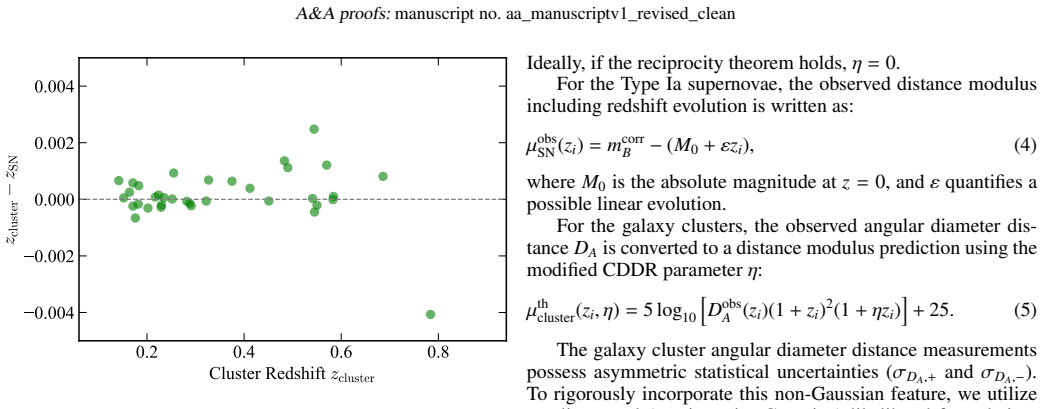
- [§3] §3 (matched-pair construction): the analysis assumes that the selected clusters and SNe Ia lie at essentially identical redshifts and that the Bonamente et al. angular-diameter distances are free of significant redshift-dependent systematics, yet no quantitative marginalization over hydrostatic-equilibrium violations, gas clumping, or merger-induced biases (known to reach 10–20 % in individual clusters) is performed; such biases could be partially absorbed into the fitted η or ε and shift the reported posteriors.
- [§4.2] §4.2 (error budget and robustness): while robustness to matching tolerance and DESI BAO inclusion is shown, the covariance treatment and propagation of cluster-specific systematic floors are not detailed; adding a redshift-dependent systematic uncertainty floor to the DA measurements would be required to confirm that the η ≈ 0 conclusion is not sensitive to unmodeled biases.
minor comments (2)
- [Figure 2] Figure 2 (posterior contours): axis labels and contour levels should explicitly state whether the plotted uncertainties are 68 % or 95 % CL to avoid ambiguity.
- [Table 1] Table 1 (matched-pair list): include the individual redshift differences Δz for each pair so readers can assess the tightness of the matching criterion directly.
Simulated Author's Rebuttal
We thank the referee for their constructive and positive review of our manuscript. Their comments have prompted us to strengthen the discussion of systematics and error propagation. We address each major comment below and indicate the revisions made to the manuscript.
read point-by-point responses
-
Referee: [§3] §3 (matched-pair construction): the analysis assumes that the selected clusters and SNe Ia lie at essentially identical redshifts and that the Bonamente et al. angular-diameter distances are free of significant redshift-dependent systematics, yet no quantitative marginalization over hydrostatic-equilibrium violations, gas clumping, or merger-induced biases (known to reach 10–20 % in individual clusters) is performed; such biases could be partially absorbed into the fitted η or ε and shift the reported posteriors.
Authors: We agree that hydrostatic-equilibrium violations, gas clumping, and merger effects represent important potential systematics in the Bonamente et al. angular-diameter distances. These could in principle introduce redshift-dependent biases that are partially absorbed by the fitted parameters. The quoted cluster uncertainties already include statistical and some systematic contributions from the X-ray and SZ data, and our matching criterion enforces Δz < 0.005 to ensure essentially identical redshifts. In the revised manuscript we have added an explicit discussion of these biases in §3 and performed a new robustness test in which we marginalize over an additional 15% redshift-dependent systematic floor on DA. The posteriors for η and ε remain consistent with zero (with modestly enlarged uncertainties), supporting the robustness of the central result. A full per-cluster marginalization over all possible bias mechanisms would require detailed hydrodynamic modeling beyond the scope of the present work. revision: partial
-
Referee: [§4.2] §4.2 (error budget and robustness): while robustness to matching tolerance and DESI BAO inclusion is shown, the covariance treatment and propagation of cluster-specific systematic floors are not detailed; adding a redshift-dependent systematic uncertainty floor to the DA measurements would be required to confirm that the η ≈ 0 conclusion is not sensitive to unmodeled biases.
Authors: We thank the referee for this suggestion. In the revised §4.2 we now provide the explicit form of the covariance matrix used in the likelihood, detailing the combination of cluster DA uncertainties, Pantheon+ magnitude errors, and their propagation. Following the recommendation, we have introduced a redshift-dependent systematic floor on the DA measurements (10% at z=0, rising linearly to 20% at z=0.5) and re-derived the posteriors. The constraints η = 0.050^{+0.348}_{-0.307} and ε = -0.184^{+0.724}_{-0.574} remain unchanged within the enlarged errors, confirming that the conclusion of no significant CDDR violation is insensitive to these unmodeled biases. revision: yes
Circularity Check
No significant circularity in matched-pair CDDR test
full rationale
The derivation fits the CDDR-violation parameter η and SNe evolution parameter ε directly to distance ratios constructed from external, independent compilations (Bonamente et al. cluster DA values and Pantheon+ SNe DL values) via the matched-pair technique. No step reduces a reported result to a prior fit, self-definition, or self-citation chain; the constraints and the auxiliary M0 calibration emerge from the likelihood applied to the observed pairs. The analysis remains self-contained against external benchmarks with no load-bearing internal assumptions that loop back to the target quantities.
Axiom & Free-Parameter Ledger
free parameters (2)
- η =
0.050
- ε =
-0.184
axioms (1)
- domain assumption Galaxy-cluster angular diameter distances can be extracted from X-ray and SZ observations without assuming a specific background cosmology.
Lean theorems connected to this paper
-
IndisputableMonolith/Foundation/RealityFromDistinction.leanreality_from_one_distinction unclear?
unclearRelation between the paper passage and the cited Recognition theorem.
We utilize a matched sample of 38 galaxy clusters from the Bonamente et al. compilation and SNe Ia from the Pantheon+ compilation. To avoid cosmological model dependence, we employ the matched pair technique, pairing DA and DL at identical redshifts.
-
IndisputableMonolith/Foundation/AlexanderDuality.leanalexander_duality_circle_linking echoes?
echoesECHOES: this paper passage has the same mathematical shape or conceptual pattern as the Recognition theorem, but is not a direct formal dependency.
The validity of this relation rests on three crucial theoretical pillars: (i) the spacetime is described by a Riemannian metric theory of gravity
What do these tags mean?
- matches
- The paper's claim is directly supported by a theorem in the formal canon.
- supports
- The theorem supports part of the paper's argument, but the paper may add assumptions or extra steps.
- extends
- The paper goes beyond the formal theorem; the theorem is a base layer rather than the whole result.
- uses
- The paper appears to rely on the theorem as machinery.
- contradicts
- The paper's claim conflicts with a theorem or certificate in the canon.
- unclear
- Pith found a possible connection, but the passage is too broad, indirect, or ambiguous to say the theorem truly supports the claim.
Reference graph
Works this paper leans on
-
[1]
Abdalla, E. et al. 2022, JHEAp, 34, 49
work page 2022
-
[2]
Adame, A. G. et al. 2025a, Journal of Cosmology and Astroparticle Physics, 2025, 012
work page 2025
-
[3]
Adame, A. G. et al. 2025b, Journal of Cosmology and Astroparticle Physics, 2025, 021
work page 2025
-
[4]
Aghanim, N. et al. 2020, Astron. Astrophys., 641, A6
work page 2020
-
[5]
Alfano, A. C. & Luongo, O. 2026, Phys. Dark Univ., 51, 102205
work page 2026
-
[6]
Barua, S., Dalui, S. K., Okazaki, R., & Desai, S. 2026, Eur. Phys. J. C, 86, 25, s10052-025-15267-7
work page 2026
-
[7]
Bassett, B. A. & Kunz, M. 2004, Astrophys. J., 607, 661
work page 2004
-
[8]
Bonamente, M. et al. 2006, Astrophys. J., 647, 25
work page 2006
-
[9]
Brout, D. et al. 2022, Astrophys. J., 938, 110
work page 2022
-
[10]
Cavaliere, A. & Fusco-Femiano, R. 1976, Astron. Astrophys., 49, 137
work page 1976
-
[11]
Corasaniti, P. S. 2006, Mon. Not. R. Astron. Soc., 372, 191 De Filippis, E., Sereno, M., Bautz, M. W., & Longo, G. 2005, Astrophys. J., 625, 108 Di Valentino, E. et al. 2021, Class. Quant. Grav., 38, 153001
work page 2006
-
[12]
Ellis, G. F. R. 1971, General Relativity and Cosmology (Academic Press)
work page 1971
-
[13]
Ellis, G. F. R. 2007, Gen. Relativ. Gravit., 39, 1047
work page 2007
-
[14]
Etherington, I. M. H. 1933, Phil. Mag., 15, 761
work page 1933
- [15]
-
[16]
Holanda, R. F. L., Carvalho, J. C., & Alcaniz, J. S. 2013, JCAP, 04, 027
work page 2013
-
[17]
Holanda, R. F. L., Gonçalves, R. S., & Alcaniz, J. S. 2012, JCAP, 06, 022
work page 2012
-
[18]
Holanda, R. F. L., Lima, J. A. S., & Ribeiro, M. B. 2010, Astrophys. J. Lett., 722, L233
work page 2010
- [19]
-
[20]
Hu, J., Hu, J.-P., Li, Z., Zhao, W., & Chen, J. 2023, Phys. Rev. D, 108, 083024
work page 2023
- [21]
-
[22]
Hu, J., Yu, H., & Wang, F. Y . 2017, Astrophys. J., 836, 107
work page 2017
-
[23]
Kang, Y . et al. 2020, Astrophys. J., 889, 8
work page 2020
- [24]
-
[25]
Keil, F., Nesseris, S., Tutusaus, I., & Blanchard, A. 2026, JCAP, 01, 022
work page 2026
- [26]
-
[27]
Liang, N. et al. 2013, Astrophys. J., 778, 72
work page 2013
-
[28]
Merloni, A. et al. 2012, arXiv:1209.3114
work page internal anchor Pith review Pith/arXiv arXiv 2012
-
[29]
Montiel, A. et al. 2021, Phys. Rev. D, 104
work page 2021
-
[30]
Nicolas, N. et al. 2021, Astron. Astrophys., 649, A74
work page 2021
-
[31]
Peebles, P. J. E. 1993, Principles of Physical Cosmology (Princeton, NJ: Prince- ton University Press)
work page 1993
- [32]
-
[33]
Riess, A. G. et al. 2022, Astrophys. J. Lett., 934, L7
work page 2022
-
[34]
Scolnic, D. et al. 2022, Astrophys. J., 938, 113
work page 2022
- [35]
-
[36]
Sunyaev, R. A. & Zeldovich, Y . B. 1972, Comments Astrophys. Space Phys., 4, 173
work page 1972
- [37]
-
[38]
Tutusaus, I., Lamine, B., Dupays, A., & Blanchard, A. 2017, Astron. Astrophys., 602, A73
work page 2017
-
[39]
Tutusaus, I. et al. 2019, Phys. Rev. D, 99, 023510
work page 2019
- [40]
-
[41]
Vagnozzi, S. et al. 2023, Class. Quant. Grav., 40, 165007
work page 2023
-
[42]
Reconstruct the Distance Duality Relation by Gaussian Process
Zhang, Y . 2014, arXiv:1408.3897
work page internal anchor Pith review Pith/arXiv arXiv 2014
-
[43]
Zhou, C., Hu, J., Li, M., Yin, X., & Fang, G. 2021, Astrophys. J., 909, 118 A. Matched Galaxy Cluster and SNe Ia Sample In this appendix, we present the catalog of the 38 matched pairs used in our baseline analysis. For each galaxy cluster, we list its redshift (zcl), angular diameter distance (D A) with asymmet- ric uncertainties, and the derived distanc...
work page 2021
discussion (0)
Sign in with ORCID, Apple, or X to comment. Anyone can read and Pith papers without signing in.