The Wolf and the Cello: Modelling and design of multiple resonance suppressors in large string instruments
Pith reviewed 2026-05-19 18:17 UTC · model grok-4.3
The pith
A coupled dynamical model shows that one or two tuned suppressors can eliminate wolf notes in large string instruments while limiting damage to tonal balance.
A machine-rendered reading of the paper's core claim, the machinery that carries it, and where it could break.
Core claim
The authors construct a coupled system of a string and a two-dimensional body, each containing second-order elastic and fourth-order stiffness terms, and equip the body with one or two suppressors. They introduce performance indicators for wolf-tone perception, note attenuation, and spectral fidelity, then use numerical integration to demonstrate that appropriate tuning and positioning of the suppressors can suppress the wolf note while largely preserving the global frequency response of the instrument.
What carries the argument
The two-dimensional body model that combines second-order elastic and fourth-order stiffness contributions and is coupled to the string and to the suppressors.
If this is right
- One or two suppressors placed at carefully chosen body locations can reduce wolf-note amplitude while keeping most other partials intact.
- Tuning the suppressor natural frequency close to the problematic body resonance is required for effective damping.
- Two suppressors generally allow finer control over the trade-off between wolf suppression and tonal fidelity than a single suppressor.
- The performance indicators can be used as objective functions to automate the search for suppressor parameters.
Where Pith is reading between the lines
- The same modeling framework could be adapted to study wolf-like instabilities in other large instruments such as double basses or harps.
- Real instruments vary in wood properties and geometry, so the numerical optima would need calibration for each individual cello.
- Extending the excitation model to continuous bowing gestures might reveal how suppressors affect playability during sustained notes.
Load-bearing premise
The two-dimensional body model with combined second-order elastic and fourth-order stiffness contributions accurately captures the relevant resonances that interact with the string.
What would settle it
Direct experimental measurement of resonance frequencies and decay rates on a real cello with and without added suppressors, compared against the model's predicted suppression thresholds.
Figures




read the original abstract
The wolf note is an acoustic instability that occurs in large bowed string instruments when a strong body resonance interacts with the vibrating string, producing amplitude modulation and loss of tonal control. Various wolf suppressors - tuned mass dampers attached to the string or to the instrument body - are used in practice to mitigate this effect. In this paper, we propose a mathematical model describing the coupled dynamics of a string and a two-dimensional body equipped with one or two wolf suppressors. Both string and body include elastic (second-order) and stiffness (fourth-order) contributions and can be excited either by plucking or bowing. Three performance indicators are introduced: The first one perceives the wolf-tone appearance, the second one quantifies the attenuation of the notes possibly caused by the wolf suppressor, and the third one measures the acoustic fidelity (in terms of spectrum) with respect to the original instrument. The proposed numerical tests give insights about optimal tuning and placement of one or two suppressors, achieving effective wolf-note suppression while preserving as much as possible the global tonal balance.
Editorial analysis
A structured set of objections, weighed in public.
Referee Report
Summary. The manuscript develops a mathematical model for the coupled dynamics of a vibrating string and a two-dimensional instrument body that incorporates both second-order elastic and fourth-order stiffness contributions. One or two tuned-mass-damper wolf suppressors can be attached to the string or body. Three scalar performance indicators are defined to quantify wolf-tone perception, note attenuation, and spectral fidelity relative to the unmodified instrument. Numerical simulations of the coupled system are used to explore optimal tuning frequencies and attachment positions for one or two suppressors.
Significance. If the two-dimensional body model is shown to reproduce the low-frequency resonances that drive wolf-note instability, the quantitative performance indicators and the resulting design recommendations would constitute a useful, reproducible framework for suppressor optimization in bowed-string instruments. The explicit separation of suppression efficacy from tonal degradation is a constructive modeling choice.
major comments (2)
- [Abstract / model formulation] Abstract and model section: the two-dimensional body model that combines second-order elastic and fourth-order stiffness terms is asserted to capture the relevant string-body resonances, yet the manuscript contains no comparison of the computed body modes against measured cello admittance data or against three-dimensional reference solutions. Because the central claim—that the numerical tests yield actionable optimal tuning and placement—rests on this modeling choice, the absence of such validation is load-bearing.
- [Numerical experiments / performance indicators] Numerical tests and performance indicators: the three indicators (wolf-tone perception, attenuation, spectral fidelity) are used to rank suppressor configurations, but the manuscript does not specify the precise formulas, frequency windows, or thresholds by which these scalars are extracted from the simulated time series or spectra, nor are error bars or sensitivity ranges reported. This omission prevents assessment of the robustness of the reported optima.
minor comments (2)
- [String and body equations] The excitation models for plucking and bowing should be stated explicitly, including any assumptions on bow force or contact duration.
- [Numerical methods] A brief description of the spatial discretization and time-stepping scheme used for the coupled system would improve reproducibility.
Simulated Author's Rebuttal
We thank the referee for the constructive and detailed report. We address each major comment below, indicating the revisions we will make to strengthen the manuscript.
read point-by-point responses
-
Referee: [Abstract / model formulation] Abstract and model section: the two-dimensional body model that combines second-order elastic and fourth-order stiffness terms is asserted to capture the relevant string-body resonances, yet the manuscript contains no comparison of the computed body modes against measured cello admittance data or against three-dimensional reference solutions. Because the central claim—that the numerical tests yield actionable optimal tuning and placement—rests on this modeling choice, the absence of such validation is load-bearing.
Authors: We agree that explicit validation would strengthen the modeling foundation. The 2D body formulation is a reduced-order model intended to reproduce the dominant low-frequency string-body coupling responsible for wolf-note instability, with parameters selected to match typical cello resonance ranges reported in the acoustics literature. In the revised manuscript we will insert a dedicated paragraph (with supporting table) that compares the computed body-mode frequencies against published experimental admittance measurements for cellos; we will also note the inherent limitations of the 2D approximation relative to full 3D solutions. This addition directly addresses the load-bearing concern while remaining within the scope of a modeling study. revision: partial
-
Referee: [Numerical experiments / performance indicators] Numerical tests and performance indicators: the three indicators (wolf-tone perception, attenuation, spectral fidelity) are used to rank suppressor configurations, but the manuscript does not specify the precise formulas, frequency windows, or thresholds by which these scalars are extracted from the simulated time series or spectra, nor are error bars or sensitivity ranges reported. This omission prevents assessment of the robustness of the reported optima.
Authors: We accept that the lack of explicit definitions and robustness measures limits reproducibility. The revised manuscript will contain the precise mathematical expressions for all three indicators, the exact frequency windows employed (e.g., a narrow band centered on the wolf frequency for the perception metric and a broader 0–2000 Hz range for spectral fidelity), and any threshold values used. We will also add a sensitivity study that reports mean values together with standard deviations obtained from repeated simulations under small parameter perturbations, thereby providing error bars and demonstrating the stability of the reported optima. revision: yes
Circularity Check
No significant circularity detected
full rationale
The paper proposes a coupled dynamical model for string and 2D body (with explicit second-order elastic and fourth-order stiffness terms), introduces three independent performance indicators (wolf-tone perception, note attenuation, spectral fidelity), and reports numerical optimization results for suppressor placement and tuning. No load-bearing step reduces a claimed prediction or result to a fitted parameter, self-citation chain, or definitional equivalence; the performance metrics are defined separately from the governing equations and the outputs are obtained by forward simulation rather than by construction from the inputs.
Axiom & Free-Parameter Ledger
free parameters (2)
- suppressor mass and tuning frequency
- suppressor attachment positions
axioms (1)
- domain assumption The instrument body can be represented as a two-dimensional elastic-stiffness system whose resonances interact with the string.
Lean theorems connected to this paper
-
IndisputableMonolith/Foundation/AlexanderDuality.leanalexander_duality_circle_linking unclear?
unclearRelation between the paper passage and the cited Recognition theorem.
Both string and body include elastic (second-order) and stiffness (fourth-order) contributions... two-dimensional thin plate... finite-difference discretization of the governing partial differential equations
-
IndisputableMonolith/Cost/FunctionalEquation.leanwashburn_uniqueness_aczel unclear?
unclearRelation between the paper passage and the cited Recognition theorem.
Three performance indicators... J_wolf... J_sustain... J_fidelity
What do these tags mean?
- matches
- The paper's claim is directly supported by a theorem in the formal canon.
- supports
- The theorem supports part of the paper's argument, but the paper may add assumptions or extra steps.
- extends
- The paper goes beyond the formal theorem; the theorem is a base layer rather than the whole result.
- uses
- The paper appears to rely on the theorem as machinery.
- contradicts
- The paper's claim conflicts with a theorem or certificate in the canon.
- unclear
- Pith found a possible connection, but the passage is too broad, indirect, or ambiguous to say the theorem truly supports the claim.
Reference graph
Works this paper leans on
-
[1]
P. Neubauer, J. Tschesche, J. B¨os, et al. An active-system approach for eliminating the wolf note on a cello. The Journal of the Acoustical Society of America, 143:2965–2974, 2018
work page 2018
- [2]
-
[3]
I. M. Firth and J. M. Buchanan. The wolf in the cello.The Journal of the Acoustical Society of America, 53:457–463, 1973
work page 1973
-
[4]
M. E. McIntyre and J. Woodhouse. The acoustics of stringed musical instruments.Interdisciplinary Science Reviews, 3:157–173, 1978
work page 1978
-
[5]
M. E. McIntyre and J. Woodhouse. On the fundamentals of bowed-string dynamics.Acustica, 43(2):93–108, 1979
work page 1979
-
[6]
M. E. McIntyre, R. T. Schumacher, and J. Woodhouse. On the oscillations of musical instruments.The Journal of the Acoustical Society of America, 74:1325–1345, 1983
work page 1983
-
[7]
O. In´acio, J Antunes, and M. C. M. Wright. Computational modelling of string–body interaction for the violin family and simulation of wolf notes.Journal of Sound and Vibration, 310:260–286, 2008
work page 2008
- [8]
- [9]
- [10]
-
[11]
H. Mansour, J. Woodhouse, and G. P. Scavone. On minimum bow force for bowed strings.Acta Acustica united with Acustica, 103:317–330, 2017
work page 2017
-
[12]
Bilbao.Numerical Sound Synthesis: Finite Difference Schemes and Simulation in Musical Acoustics
S. Bilbao.Numerical Sound Synthesis: Finite Difference Schemes and Simulation in Musical Acoustics. Wiley Publishing, 2009
work page 2009
-
[13]
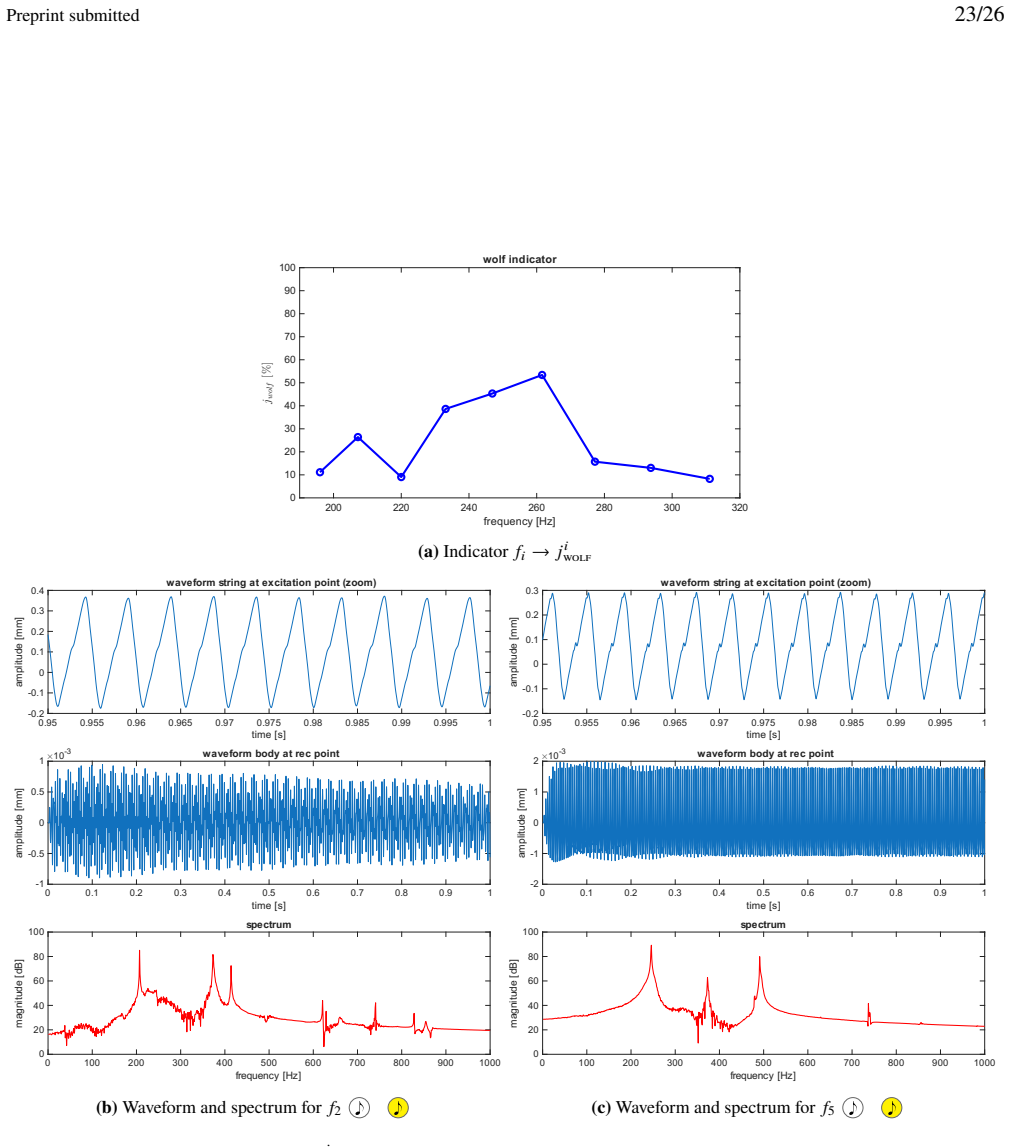
S. Bilbao and M. Ducceschi. Models of musical string vibration.Acoustical Science and Technology, 44(3):194–209, 2023. A Real-life wolf note Here we briefly analyze a recording from a real cello playing a chromatic scale from C3 to C4. Figure 13 shows the waveform for the entire chromatic scale. Figure 14a reports the corresponding values of the wolf indi...
work page 2023
discussion (0)
Sign in with ORCID, Apple, or X to comment. Anyone can read and Pith papers without signing in.