Preemption Revisited: Multi-Threshold Preemption Policies for AoI Minimization
Pith reviewed 2026-05-19 18:32 UTC · model grok-4.3
The pith
Multi-threshold preemption policies using both packet age and system age achieve lower age of information than single-threshold or probabilistic policies under random update arrivals.
A machine-rendered reading of the paper's core claim, the machinery that carries it, and where it could break.
Core claim
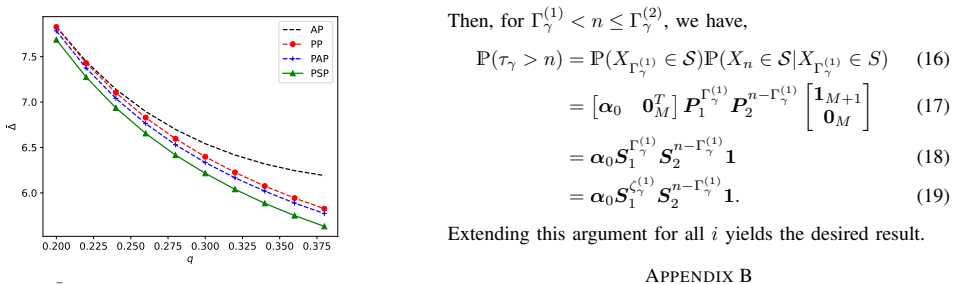
The authors introduce an analytical framework for evaluating the age of information of multi-threshold preemption policies in a system with random update arrivals. They present interesting characteristics of the structure of the optimal preemption policy and demonstrate that significant AoI gains are obtained by utilizing both the age of the packet and the age of the system when designing these preemption policies, outperforming traditional probabilistic preemption policies and single-threshold policies.
What carries the argument
Multi-threshold preemption policy, which applies distinct thresholds on packet age and system age to decide whether an ongoing transmission should be replaced by a newly arrived update.
Load-bearing premise
An analytical framework can accurately evaluate age of information for multi-threshold preemption policies when updates arrive according to a random process.
What would settle it
Numerical evaluation or simulation of average AoI under specific random arrival rates that shows no reduction when switching from single-threshold to multi-threshold preemption rules.
Figures

read the original abstract
The study of optimal preemption policies for status update systems has been a recurring topic in the age of information (AoI) literature, where threshold-based structures have been shown to be optimal under a generate-at-will update generation model under certain assumptions. In this work, we study the effectiveness of threshold-based policies for a system with random update arrivals. In this regard, we introduce an analytical framework for evaluating the AoI of multi-threshold preemption policies and present interesting characteristics of the structure of the optimal preemption policy. We show the effectiveness of these threshold-based policies over the traditional probabilistic preemption policies and single-threshold policies, where we observe that significant gains in terms of AoI can be obtained by utilizing both the age of the packet and the age of the system when designing these preemption policies.
Editorial analysis
A structured set of objections, weighed in public.
Referee Report
Summary. The paper studies threshold-based preemption policies for AoI minimization in status update systems with random update arrivals. It introduces an analytical framework based on a Markov chain over joint packet and system age states to evaluate performance of multi-threshold preemption policies, analyzes the structure of the optimal policy, and shows that these policies outperform probabilistic preemption and single-threshold policies, with significant AoI gains obtained by using both packet age and system age in the design.
Significance. If the analytical framework is accurate, the work extends prior threshold optimality results from generate-at-will models to stochastic arrivals and provides a reproducible evaluation tool. The explicit comparison demonstrating gains from dual-age multi-threshold policies is a concrete contribution that could guide practical preemption design in communication systems.
major comments (2)
- [§3] §3 (Analytical Framework), balance equations for the joint age Markov chain: the state transitions at preemption thresholds must be shown to correctly incorporate arbitrary random arrival processes without hidden memoryless assumptions or approximations; if the derivation restricts to exponential inter-arrivals, the claimed generality for 'random update arrivals' and the resulting AoI gains are not fully supported.
- [§5] §5 (Numerical Evaluation), comparison tables: the reported AoI reductions for multi-threshold policies versus single-threshold and probabilistic baselines must specify the exact threshold sets, arrival rate, and service time parameters used; without these, it is impossible to verify that the gains are attributable to the multi-threshold structure rather than parameter tuning.
minor comments (2)
- [Abstract] The abstract states that 'interesting characteristics of the structure of the optimal preemption policy' are presented, but the introduction or framework section should briefly preview one such structural property (e.g., monotonicity of thresholds) to orient the reader.
- [§2] Notation for the two ages (packet age vs. system age) should be introduced with a single consistent symbol pair early in §2 to avoid later ambiguity when both appear in the same threshold rule.
Simulated Author's Rebuttal
We thank the referee for the careful and constructive review of our manuscript. The comments have helped us identify areas where additional clarification is needed regarding the arrival process assumptions and the reproducibility of our numerical results. We address each major comment below and will incorporate revisions to strengthen the presentation.
read point-by-point responses
-
Referee: [§3] §3 (Analytical Framework), balance equations for the joint age Markov chain: the state transitions at preemption thresholds must be shown to correctly incorporate arbitrary random arrival processes without hidden memoryless assumptions or approximations; if the derivation restricts to exponential inter-arrivals, the claimed generality for 'random update arrivals' and the resulting AoI gains are not fully supported.
Authors: We appreciate the referee highlighting the need for explicit clarification on the arrival process. Our Markov chain is defined over the joint (packet age, system age) state space, with transitions governed by the preemption thresholds. The balance equations are derived under the assumption of Poisson arrivals, which is standard for modeling random update arrivals in the AoI literature and enables the memoryless property for tractable analysis of age evolution and preemption events. We do not claim the framework applies to arbitrary inter-arrival distributions without modification; for general renewal arrivals, additional state information would be required. We will revise Section 3 to explicitly state the Poisson assumption, include a detailed derivation of the balance equations in an appendix to demonstrate how thresholds affect transition rates, and add a remark discussing extensions to non-Poisson cases. The reported AoI gains hold under this model. revision: yes
-
Referee: [§5] §5 (Numerical Evaluation), comparison tables: the reported AoI reductions for multi-threshold policies versus single-threshold and probabilistic baselines must specify the exact threshold sets, arrival rate, and service time parameters used; without these, it is impossible to verify that the gains are attributable to the multi-threshold structure rather than parameter tuning.
Authors: We agree that the absence of explicit parameter values limits verifiability. In the revised version, we will update all tables and associated text in Section 5 to report the precise threshold sets (including the specific packet-age and system-age thresholds for each multi-threshold policy), the arrival rate λ, and the service time parameters (mean and distribution) used for every policy comparison. We will also include these values in the figure captions and add a dedicated parameter table for reproducibility. This ensures the AoI reductions can be directly attributed to the multi-threshold structure. revision: yes
Circularity Check
Analytical framework for multi-threshold preemption is self-contained with no circular reductions
full rationale
The paper introduces an independent analytical framework (likely a Markov chain on joint packet and system age states) to evaluate AoI under multi-threshold policies for random arrivals. No equations or claims reduce by construction to fitted parameters, self-citations, or renamed inputs. The reported AoI gains are outputs of this framework applied to policy comparisons, not tautological re-statements of the model assumptions. Self-citations, if present, are not load-bearing for the central evaluation method. This is the expected non-finding for a modeling paper whose core contribution is the derivation of the evaluation tool itself.
Axiom & Free-Parameter Ledger
axioms (2)
- domain assumption Updates arrive according to a random process (commonly Poisson in AoI literature)
- domain assumption Threshold-based preemption structures can be evaluated analytically for AoI
Reference graph
Works this paper leans on
-
[1]
Kaul, Sanjit and Yates, Roy and Gruteser, Marco , title =. Proc. IEEE INFOCOM , year =
-
[2]
IEEE Transactions on Reliability , volume =
Nakagawa, Toshio and Osaki, Shunji , title =. IEEE Transactions on Reliability , volume =. 1975 , doi =
work page 1975
-
[3]
Stein, William E. and Dattero, Ronald , title =. IEEE Transactions on Reliability , volume =. 1984 , doi =
work page 1984
-
[4]
Jacobs, Irwin M. and Berlekamp, Elwyn R. , title =. IEEE Transactions on Information Theory , volume =. 1967 , doi =
work page 1967
- [5]
-
[6]
arXiv preprint arXiv:2412.06072 , year =
Rowshan, Mohammad and Viterbo, Emanuele , title =. arXiv preprint arXiv:2412.06072 , year =
-
[7]
Darabkh, Khalid A. and others , title =. IET Communications , volume =. 2013 , doi =
work page 2013
-
[8]
IEEE Transactions on Information Theory , volume =
Costa, Maice and Codreanu, Marian and Ephremides, Anthony , title =. IEEE Transactions on Information Theory , volume =. 2016 , doi =
work page 2016
-
[9]
Arafa, Ahmed and Yang, Jing and Ulukus, Sennur and Poor, H. Vincent , title =. IEEE Transactions on Information Theory , volume =. 2020 , doi =
work page 2020
-
[10]
R. D. Yates and Y. Sun and D. R. Brown and S. K. Kaul and E. Modiano and S. Ulukus , title =. IEEE Journal on Selected Areas in Communication , year =
-
[11]
S. Banerjee and S. Ulukus , booktitle =. When to Preempt in a Status Update System? , year =
-
[12]
Taming the Heavy Tail: Age-Optimal Preemption , author=
-
[13]
Moltafet, M. and Sadjadpour, H. R. and Rezki, Z. and Codreanu, M. and Yates, R. D. , booktitle =. AoI in. 2025 , month =
work page 2025
-
[14]
Wang, B. and Feng, S. and Yang, J. , title =. Journal of Communications and Networks , year =
-
[15]
Asvadi, S. and Ashtiani, F. , title =. IEEE Transactions on Communications , year =
-
[16]
Arafa, A. and Yates, R. D. and Poor, H. V. , booktitle =. Timely Cloud Computing: Preemption and Waiting , year =
-
[17]
Kaul, S. K. and Yates, R. D. and Gruteser, M. , booktitle =. Status updates through queues , year =
discussion (0)
Sign in with ORCID, Apple, or X to comment. Anyone can read and Pith papers without signing in.