The problem of relaxation to equilibrium
Pith reviewed 2026-05-20 20:12 UTC · model grok-4.3
The pith
A classical gas reaches thermodynamic equilibrium if wall collisions obey the Heisenberg uncertainty principle.
A machine-rendered reading of the paper's core claim, the machinery that carries it, and where it could break.
Core claim
The authors claim that non-strict boundary conditions, defined so that every interaction between gas particles and container walls must occur in accordance with Heisenberg's uncertainty principle, suffice to drive a classical gaseous system to thermodynamic equilibrium without any further modifications to the dynamics or additional statistical assumptions.
What carries the argument
Non-strict boundary conditions that force every wall collision to respect the Heisenberg uncertainty relation between position and momentum.
If this is right
- The gas particles lose memory of their initial conditions through repeated uncertain wall collisions and settle into a uniform equilibrium distribution.
- No stochastic thermostat or coarse-graining step is required once the boundary rule is changed.
- The same construction applies to any simple classical gas whose only non-conservative events are wall encounters.
- Equilibrium emerges directly from the modified deterministic dynamics rather than from an ensemble average.
Where Pith is reading between the lines
- The approach may offer a route to derive the second law from reversible microscopic rules without invoking external randomness.
- It suggests that similar uncertainty-based boundaries could be tested in other bounded classical systems such as hard-sphere gases or molecular fluids.
- Numerical verification would require tracking both position and momentum spreads at each wall hit rather than using specular reflection rules.
Load-bearing premise
That requiring every wall interaction in an otherwise classical system to obey the Heisenberg uncertainty principle is enough by itself to produce relaxation to equilibrium.
What would settle it
A molecular-dynamics simulation of the same gas in a container where wall collisions are made strictly classical (zero uncertainty) while keeping all other rules identical, showing that equilibrium is not reached.
Figures
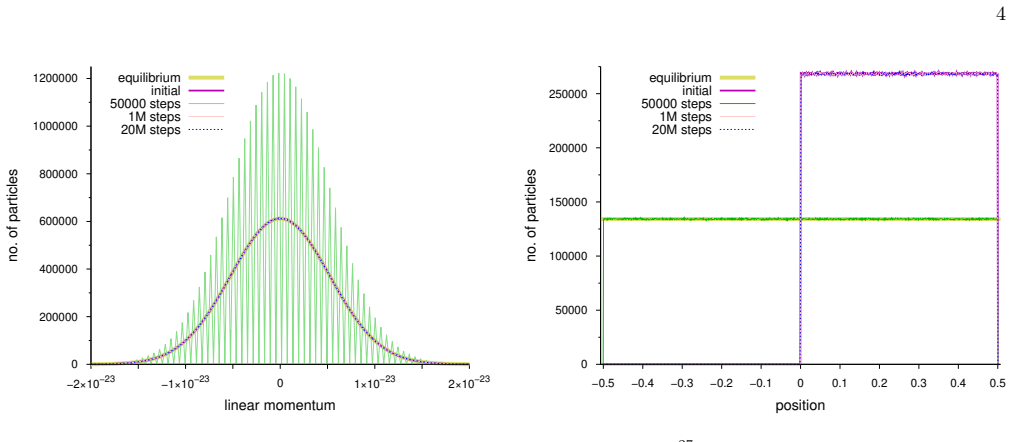


read the original abstract
When a thermodynamic system is released from any constraint, after some time its evolution will render it into an equilibrium state. Although the description of this relaxation to thermodynamic equilibrium has been attempted through both classical (Hamilton's equations) or quantum (Schr\"odinger equation) approaches, no success has been achieved without recurring to additional hypotheses. The present work demonstrates the possibility of reaching equilibrium states in a simple classical gaseous system, by imposing non-strict boundary conditions, in the sense that all interactions with the container walls must occur according to Heisenberg's uncertainty principle.
Editorial analysis
A structured set of objections, weighed in public.
Referee Report
Summary. The manuscript claims to demonstrate that relaxation to thermodynamic equilibrium is possible in a simple classical gaseous system by imposing non-strict boundary conditions, under which all interactions with the container walls must occur according to Heisenberg's uncertainty principle, without recourse to additional hypotheses such as ergodicity or coarse-graining.
Significance. If the central construction were made rigorous and shown to produce relaxation from the underlying reversible dynamics, the result would be significant for the foundations of statistical mechanics. It would provide a concrete mechanism for irreversibility that avoids the extra assumptions the paper criticizes in prior classical and quantum treatments, potentially offering a minimal resolution to the problem of approach to equilibrium.
major comments (3)
- [Abstract] Abstract: The claim that the work 'demonstrates the possibility of reaching equilibrium states' is asserted without any supporting equations, derivation of the modified boundary operator, or numerical evidence that the proposed conditions drive the system toward equilibrium rather than presupposing it.
- [Model and dynamics section] Model and dynamics section: No explicit map is given from the Heisenberg uncertainty principle to a concrete dynamical rule (e.g., a modified collision law, a stochastic term in the Liouville operator, or a phase-space diffusion process). Without this map it is impossible to verify whether relaxation emerges from the time evolution or is built into the definition of the non-strict boundaries.
- [Introduction / comparison with prior work] Comparison with prior work: The manuscript correctly notes that earlier approaches require extra hypotheses, yet the present construction appears to introduce an ad-hoc hybrid classical-quantum boundary condition whose consequences for the phase-space flow are not derived or tested.
minor comments (1)
- [Notation and definitions] The phrase 'non-strict boundary conditions' is introduced without a precise mathematical definition or comparison to standard specular or diffuse reflection rules used in classical kinetic theory.
Simulated Author's Rebuttal
We thank the referee for the careful reading and constructive comments. We address each major comment below and indicate the revisions we will make.
read point-by-point responses
-
Referee: [Abstract] Abstract: The claim that the work 'demonstrates the possibility of reaching equilibrium states' is asserted without any supporting equations, derivation of the modified boundary operator, or numerical evidence that the proposed conditions drive the system toward equilibrium rather than presupposing it.
Authors: The abstract summarizes the central result; the supporting construction appears in the Model and dynamics section. We will revise the abstract to include a concise reference to the modified boundary operator and its derivation from the uncertainty principle, together with a statement that relaxation follows from the resulting time evolution. revision: yes
-
Referee: [Model and dynamics section] Model and dynamics section: No explicit map is given from the Heisenberg uncertainty principle to a concrete dynamical rule (e.g., a modified collision law, a stochastic term in the Liouville operator, or a phase-space diffusion process). Without this map it is impossible to verify whether relaxation emerges from the time evolution or is built into the definition of the non-strict boundaries.
Authors: The non-strict boundary conditions are defined by requiring that wall collisions respect the uncertainty relation, which replaces deterministic specular reflection with a probabilistic scattering kernel. We agree this mapping can be stated more explicitly and will add a short derivation in the Model section showing how the uncertainty directly yields the modified collision rule and the consequent phase-space evolution. revision: yes
-
Referee: [Introduction / comparison with prior work] Comparison with prior work: The manuscript correctly notes that earlier approaches require extra hypotheses, yet the present construction appears to introduce an ad-hoc hybrid classical-quantum boundary condition whose consequences for the phase-space flow are not derived or tested.
Authors: The boundary rule follows from applying the uncertainty principle at the container walls, a physically motivated step rather than an arbitrary hybrid. We will expand the relevant section to derive the effect on the phase-space flow more explicitly and to sharpen the comparison with earlier treatments. revision: partial
- A complete, fully rigorous proof of convergence to equilibrium for arbitrary initial measures under the proposed boundary conditions lies beyond the scope of the present work.
Circularity Check
No circularity: central claim rests on an external dynamical modification rather than redefinition or self-fit
full rationale
The abstract presents the relaxation as emerging from a modification to boundary conditions that incorporates the Heisenberg uncertainty principle into an otherwise classical Hamiltonian system. No equations, fitted parameters, or self-citations appear in the provided text that would reduce the claimed equilibrium to an input by construction. The approach is offered as an alternative to prior hypotheses (ergodicity, coarse-graining), and the uncertainty principle is invoked as an independent physical constraint rather than a renaming or tautological re-expression of the target result. Absent explicit derivation steps or load-bearing self-references in the manuscript, the chain does not collapse to its own premises.
Axiom & Free-Parameter Ledger
axioms (1)
- domain assumption Classical gaseous system dynamics can be modified at boundaries by imposing Heisenberg uncertainty without violating overall classical character.
invented entities (1)
-
non-strict boundary conditions
no independent evidence
Lean theorems connected to this paper
-
IndisputableMonolith/Cost/FunctionalEquation.leanwashburn_uniqueness_aczel unclear?
unclearRelation between the paper passage and the cited Recognition theorem.
every time they bounce on the recipient walls, the uncertainty principle imposes some (tiny) blurring in the returning positions, associated to a consequent spreading of their linear momenta
-
IndisputableMonolith/Foundation/ArrowOfTime.leanarrow_from_z unclear?
unclearRelation between the paper passage and the cited Recognition theorem.
the allowance of slightly changing the particle dynamic state only when bouncing on the walls
What do these tags mean?
- matches
- The paper's claim is directly supported by a theorem in the formal canon.
- supports
- The theorem supports part of the paper's argument, but the paper may add assumptions or extra steps.
- extends
- The paper goes beyond the formal theorem; the theorem is a base layer rather than the whole result.
- uses
- The paper appears to rely on the theorem as machinery.
- contradicts
- The paper's claim conflicts with a theorem or certificate in the canon.
- unclear
- Pith found a possible connection, but the passage is too broad, indirect, or ambiguous to say the theorem truly supports the claim.
Reference graph
Works this paper leans on
-
[1]
H. B. Callen,Thermodynamics and an Introduction to Thermostatistics, 2nd ed. (Wiley, New York, 1991)
work page 1991
-
[2]
Struchtrup,Thermodynamics and energy conversion (Springer, New York, 2014)
H. Struchtrup,Thermodynamics and energy conversion (Springer, New York, 2014)
work page 2014
-
[3]
Liouville, Journal de Math´ ematiques Pures et Ap- pliqu´ ees , 342 (1838)
J. Liouville, Journal de Math´ ematiques Pures et Ap- pliqu´ ees , 342 (1838)
-
[4]
J. von Neumann, Nachrichten von der Gesellschaft der Wissenschaften zu G¨ ottingen, Mathematisch- Physikalische Klasse1927, 245 (1927)
work page 1927
-
[5]
Reichl,A Modern Course in Statistical Physics(John Wiley & Sons, Berlin, 2016)
L. Reichl,A Modern Course in Statistical Physics(John Wiley & Sons, Berlin, 2016)
work page 2016
-
[6]
Gallavotti,Statistical mechanics: A short treatise (Springer Science & Business Media, 1999)
G. Gallavotti,Statistical mechanics: A short treatise (Springer Science & Business Media, 1999)
work page 1999
-
[7]
C. R¨ uter, K. Makris, R. El-Ganainy, D. Christodoulides, M. Segev, and D. Kip, Nature Physics6, 192 (2010)
work page 2010
- [8]
-
[9]
D. ˇSafr´ anek, J. M. Deutsch, and A. Aguirre, Phys. Rev. A99, 012103 (2019)
work page 2019
- [10]
- [11]
-
[12]
W. H. Zurek and J. P. Paz, Physical Review Letters72, 2508 (1994)
work page 1994
-
[13]
J. L. Lebowitz, Reviews of Modern Physics71, S346 (1999)
work page 1999
- [14]
-
[15]
Kovalenko, Nature Nanotech.10, 994 (2015)
M. Kovalenko, Nature Nanotech.10, 994 (2015)
work page 2015
-
[16]
S. Shishodia, B. Chouchene, T. Gries, and R. Schneider, Nanomaterials13, 2889 (2023)
work page 2023
-
[17]
Y.-Y. Liu, J. Stehlik, C. Eichler, M. J. Gullans, J. M. Taylor, and J. R. Petta, Science347, 285 (2015)
work page 2015
-
[18]
M. Mantovani, A. D. Armour, W. Belzig, and G. Rastelli, Phys. Rev. B99, 045442 (2019)
work page 2019
-
[19]
Heisenberg, Zeitschrift f¨ ur Physik43, 172 (1927)
W. Heisenberg, Zeitschrift f¨ ur Physik43, 172 (1927)
work page 1927
-
[20]
R. P. Rambo and J. A. Tainer, Nature496, 477 (2013)
work page 2013
-
[21]
J. C. Kotz, P. Treichel, and G. C. Weaver,Chemistry & chemical reactivity, 6th ed. (Thomson Brooks/Cole, Belmont, CA, 2006)
work page 2006
-
[22]
Marsaglia, Journal of Statistical Software8, 1–6 (2003)
G. Marsaglia, Journal of Statistical Software8, 1–6 (2003)
work page 2003
-
[23]
D. C. Montgomery and G. C. Runger,Applied statistics and probability for engineers, 6th ed. (John Wiley & Sons, 2019)
work page 2019
discussion (0)
Sign in with ORCID, Apple, or X to comment. Anyone can read and Pith papers without signing in.