STRIKE: A Structured Taxonomy of Cybercrime for Risk, Impact, Knowledge, and Evolution
Pith reviewed 2026-05-20 16:27 UTC · model grok-4.3
The pith
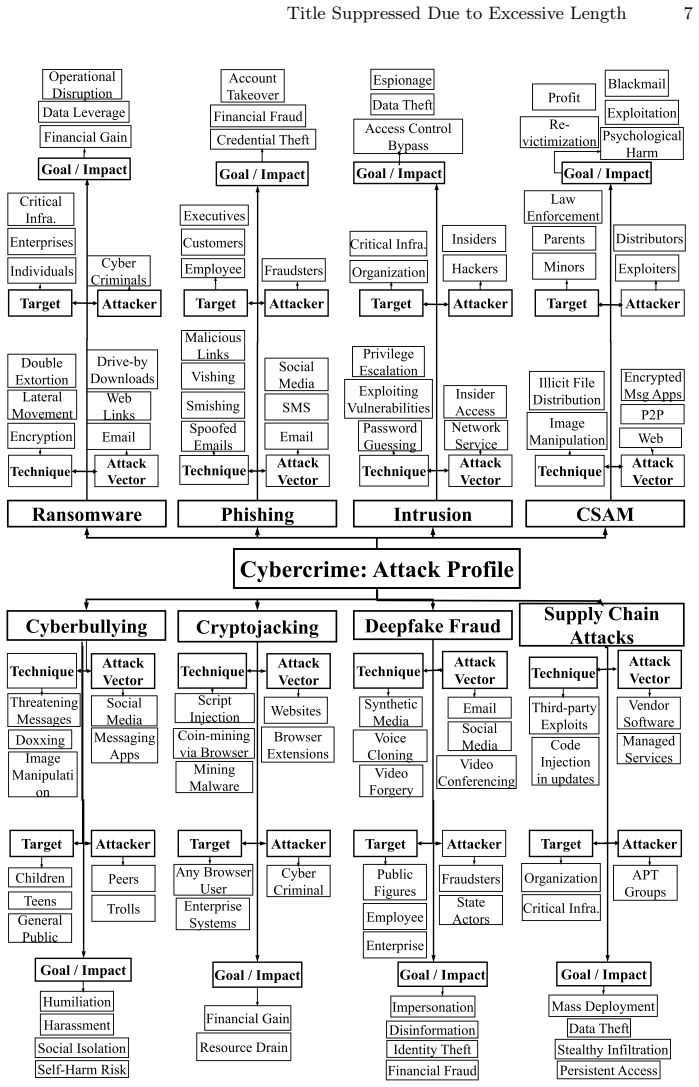
STRIKE introduces a multi-dimensional taxonomy that organizes both conventional and emerging cybercrimes by attack vectors, tactics, impact, detection, and mitigation.
A machine-rendered reading of the paper's core claim, the machinery that carries it, and where it could break.
Core claim
We introduce STRIKE, a Structured Taxonomy for Risk, Impact, Knowledge, and Emerging Threats, which provides a unified, multi-dimensional framework for categorizing cybercrimes. STRIKE spans both conventional and emerging domains, including ransomware, phishing, network intrusion, child sexual abuse material, cryptojacking, deepfakes, and supply chain attacks. It organizes threats using criteria such as attack vectors, adversarial tactics, societal impact, detection techniques, and mitigation strategies. Alongside the taxonomy, we review recent advances in detection methodologies and present a response workflow to assist practitioners under active threat conditions. This work offers a практи
What carries the argument
The STRIKE taxonomy, a multi-dimensional system that classifies cyber threats according to attack vectors, adversarial tactics, societal impact, detection techniques, and mitigation strategies.
If this is right
- Researchers gain a consistent structure for comparing threats across domains.
- Security professionals receive a shared vocabulary for assessing risk and choosing responses.
- Policymakers can map societal impacts more systematically when allocating resources.
- Detection research can be organized around the same criteria used for classification.
- Practitioners gain a concrete workflow for handling active incidents.
Where Pith is reading between the lines
- The taxonomy could serve as a backbone for automated classification tools that ingest incident reports in real time.
- Periodic updates to the taxonomy might reveal patterns in how new threats migrate between categories.
- Cross-referencing STRIKE with legal or regulatory frameworks could highlight gaps in current cybercrime statutes.
- Training datasets built from the taxonomy might improve machine-learning models that predict attack evolution.
Load-bearing premise
Traditional classification schemes cannot capture the full complexity and rapid evolution of current cyber threats.
What would settle it
A newly observed cyber incident that fits none of the STRIKE dimensions or requires an entirely new top-level category would show the taxonomy is incomplete.
Figures
read the original abstract
Cybercrime has grown exponentially in both scale and sophistication, posing significant threats. As attack methods evolve rapidly, traditional classification schemes often fail to capture the complexity and diversity of modern threats. To address this gap, we introduce STRIKE,a Structured Taxonomy for Risk, Impact, Knowledge, and Emerging Threats, which provides a unified, multi-dimensional framework for categorizing cybercrimes. STRIKE spans both conventional and emerging domains, including ransomware, phishing, network intrusion, child sexual abuse material (CSAM), cryptojacking, deepfakes, and supply chain attacks. It organizes threats using criteria such as attack vectors, adversarial tactics, societal impact, detection techniques, and mitigation strategies. Alongside the taxonomy, we review recent advances in detection methodologies and present a response workflow to assist practitioners under active threat conditions. This work offers researchers, security professionals, and policymakers a practical foundation for threat analysis, comparative evaluation, and adaptive cyber defense.
Editorial analysis
A structured set of objections, weighed in public.
Referee Report
Summary. The paper introduces STRIKE, a multi-dimensional taxonomy for categorizing cybercrimes that spans conventional and emerging threats including ransomware, phishing, network intrusion, CSAM, cryptojacking, deepfakes, and supply chain attacks. It organizes threats according to attack vectors, adversarial tactics, societal impact, detection techniques, and mitigation strategies, reviews recent detection advances, and presents a practitioner response workflow.
Significance. If the taxonomy is equipped with explicit, non-redundant classification rules and is demonstrated with concrete worked examples, it could supply a practical foundation for comparative threat analysis and adaptive defense, addressing documented limitations in existing single-dimension schemes.
major comments (2)
- [Abstract and §3] Abstract and §3 (Taxonomy Structure): the central claim that STRIKE supplies a 'unified, multi-dimensional framework' is not supported by any explicit rules or decision procedure for resolving cross-dimensional overlaps. A supply-chain ransomware incident, for example, simultaneously matches network-intrusion, supply-chain, and societal-impact categories; without stated precedence or disambiguation criteria the taxonomy risks inconsistent application.
- [§4] §4 (Validation and Examples): no concrete classification examples, inter-rater agreement metrics, or empirical validation data are provided to demonstrate that the proposed dimensions produce coherent, reproducible assignments. This absence directly undermines the utility claim for 'comparative evaluation and adaptive cyber defense'.
minor comments (2)
- [Abstract] Abstract: 'STRIKE,a' is missing a space after the comma.
- [Title and Abstract] Title vs. abstract: the title ends with 'Evolution' while the abstract expands the acronym as 'Emerging Threats'; the two should be aligned for consistency.
Simulated Author's Rebuttal
We thank the referee for the constructive and detailed feedback, which identifies key opportunities to strengthen the presentation and applicability of the STRIKE taxonomy. We address each major comment below and outline targeted revisions.
read point-by-point responses
-
Referee: [Abstract and §3] Abstract and §3 (Taxonomy Structure): the central claim that STRIKE supplies a 'unified, multi-dimensional framework' is not supported by any explicit rules or decision procedure for resolving cross-dimensional overlaps. A supply-chain ransomware incident, for example, simultaneously matches network-intrusion, supply-chain, and societal-impact categories; without stated precedence or disambiguation criteria the taxonomy risks inconsistent application.
Authors: We agree that the absence of explicit disambiguation rules limits the taxonomy's consistency in practice. The current manuscript describes the dimensions but does not formalize precedence or overlap resolution. In the revised manuscript we will add a new subsection to §3 that specifies a decision procedure, including priority ordering (e.g., attack vector first, then tactics, then impact) and a worked example of the supply-chain ransomware case. This addition will directly support the unified-framework claim. revision: yes
-
Referee: [§4] §4 (Validation and Examples): no concrete classification examples, inter-rater agreement metrics, or empirical validation data are provided to demonstrate that the proposed dimensions produce coherent, reproducible assignments. This absence directly undermines the utility claim for 'comparative evaluation and adaptive cyber defense'.
Authors: We acknowledge that §4 currently contains no worked examples. We will revise this section to include multiple concrete classification examples (ransomware, supply-chain attack, deepfake-enabled fraud) that walk through assignment to each STRIKE dimension. Inter-rater agreement metrics and large-scale empirical validation, however, would require new annotation studies that fall outside the scope of the present conceptual paper; we will therefore add an explicit limitations paragraph and a future-work statement rather than claim such validation has been performed. revision: partial
Axiom & Free-Parameter Ledger
axioms (1)
- domain assumption Cybercrimes can be usefully organized along the dimensions of attack vectors, adversarial tactics, societal impact, detection techniques, and mitigation strategies.
Reference graph
Works this paper leans on
-
[1]
Bullying definition, https://www.stopbullying.gov/bullying/ what-is-bullying
-
[2]
A new way to detect digital child pornography, http://abcnews.go.com/ Technology/detect-digital-child-pornography/story?id=10362616
-
[3]
Report on phishing, https://www.justice.gov/sites/default/files/opa/ legacy/2006/11/21/report_on_phishing.pdf
work page 2006
-
[4]
The solarwinds cyberattack. https://www.gao.gov/blog/ solarwinds-cyberattack-demands-significant-federal-and-private-sector\ -response-infographic, accessed: 2024-07-12
work page 2024
-
[5]
uk/blog/verizons-2017-data-breach-investigations-report
Verizon: 2017 data breach investigations report,https://www.itgovernance.co. uk/blog/verizons-2017-data-breach-investigations-report
work page 2017
-
[6]
Wannacry ransomware attack. https://blog.avast.com/ ransomware-that-infected-telefonica-and-nhs-hospitals-is-spreading-\ aggressively-with-over-50000-attacks-so-far-today , accessed: 2024-07-12
work page 2024
-
[7]
What is cyberbullying, https://www.stopbullying.gov/cyberbullying/ what-is-it/index.html
-
[8]
What is cyberbullying, exactly?,http://www.stopcyberbullying.org/what_is_ cyberbullying_exactly.html Title Suppressed Due to Excessive Length 19
-
[9]
What legally makes it child pornography?,https://www.hg.org/article.asp? id=38082
-
[10]
Phishing: An analysis of a growing problem. SANS Institute InfoSec Read- ing Room (Jan 2007), https://www.sans.org/reading-room/whitepapers/ threats/phishing-analysis-growing-problem-1417
work page 2007
-
[11]
In: International Conference on Information Security Applications
Adeniran,A.,Human,K.,Mohaisen,D.:Dissectingtheinfrastructureusedinweb- based cryptojacking: A measurement perspective. In: International Conference on Information Security Applications. pp. 270–283. Springer (2024)
work page 2024
-
[12]
In: Proceedings of the ACM Workshop on Information Hiding and Multimedia Security
Agarwal, S., Farid, H., Gu, Y., He, M., Nagano, K., Li, H.: Detecting deep-fake videos from appearance and behavior. In: Proceedings of the ACM Workshop on Information Hiding and Multimedia Security. pp. 81–87. ACM (2020)
work page 2020
-
[13]
IEEE Access10, 85493–85517 (2022)
Agarwal, U., Rishiwal, V., Tanwar, S., Chaudhary, R., Sharma, G., Bokoro, P.N., Sharma, R.: Blockchain technology for secure supply chain management: A com- prehensive review. IEEE Access10, 85493–85517 (2022)
work page 2022
-
[14]
Transactions on Emerging Telecommunications Technologies 32(1), e4150 (2021)
Ahmad, Z., Shahid Khan, A., Wai Shiang, C., Abdullah, J., Ahmad, F.: Network intrusion detection system: A systematic study of machine learning and deep learning approaches. Transactions on Emerging Telecommunications Technologies 32(1), e4150 (2021)
work page 2021
-
[15]
IEEE Access8, 137293– 137311 (2020)
Al-Khater, W.A., Al-Maadeed, S., Ahmed, A.A., Sadiq, A.S., Khan, M.K.: Com- prehensive review of cybercrime detection techniques. IEEE Access8, 137293– 137311 (2020). https://doi.org/10.1109/ACCESS.2020.3011259
-
[16]
Journal of Information Security and Applications78, 103529 (2025)
Ali, F., Zhang, W.: Phishing attacks in 2025: Evolution, trends, and countermea- sures. Journal of Information Security and Applications78, 103529 (2025)
work page 2025
-
[17]
Journal of Imaging11(3), 73 (2025)
Amerini, I., Barni, M., Battiato, S., Bestagini, P., Boato, G., Bruni, V., Caldelli, R., De Natale, F., De Nicola, R., Guarnera, L., et al.: Deepfake media forensics: Status and future challenges. Journal of Imaging11(3), 73 (2025)
work page 2025
-
[18]
Babchishin KM, Hanson RK, H.: Child pornography. Child Pornography (Jun 2011), http://research.universalessays.com/ criminal-justice-research-paper/child-abuse-research-paper/ child-pornography-research-paper/
work page 2011
-
[19]
Macmillan Technical Publishing (2000)
Bace, R.: Intrusion Detection. Macmillan Technical Publishing (2000)
work page 2000
-
[20]
Aggression and Violent Behavior45, 93–101 (2019)
Barlett, C.P.: Cyberbullying among youth: A comprehensive review of current international research and its implications and application to policy and practice. Aggression and Violent Behavior45, 93–101 (2019)
work page 2019
-
[21]
In: 2021 IEEE Symposium on Security and Privacy (SP)
Barr-Smith, F., Ugarte-Pedrero, X., Graziano, M., Spolaor, R., Martinovic, I.: Survivalism: Systematic analysis of windows malware living-off-the-land. In: 2021 IEEE Symposium on Security and Privacy (SP). pp. 1557–1574. IEEE (2021)
work page 2021
-
[22]
In: Proceedings of the 2024 7th International Conference on Informa- tion Science and Systems
Blancaflor, E., Dionisio, P.J., Juacalla, D.J., Oraya, A., Yabut, J.A.: Cryptojack- ing:Acomprehensivereviewofattacktechniques,victims,andeffectivemitigation strategies. In: Proceedings of the 2024 7th International Conference on Informa- tion Science and Systems. pp. 42–48 (2024)
work page 2024
-
[23]
Boyens, J., Paulsen, C., Moorthy, R., Bartol, N.: Key practices in cyber supply chain risk management: Observations from industry. Tech. Rep. NISTIR 8276, NIST (2020), https://doi.org/10.6028/NIST.IR.8276
-
[24]
arXiv preprint arXiv:1802.07228 (2018)
Brundage, M., Avin, S., Clark, J., Toner, H., Eckersley, P., Garfinkel, B.: The malicious use of artificial intelligence: Forecasting, prevention, and mitigation. arXiv preprint arXiv:1802.07228 (2018)
-
[25]
Multidisciplinary Reviews8(1), 2025024– 2025024 (2025) 20 M.Pappy et al
Buçaj, E., Idrizaj, K.: The need for cybercrime regulation on a global scale by the international law and cyber convention. Multidisciplinary Reviews8(1), 2025024– 2025024 (2025) 20 M.Pappy et al
work page 2025
-
[26]
IEEE Security Privacy12(1), 28–38 (Jan 2014)
Caputo,D.D.,Pfleeger,S.L.,Freeman,J.D.,Johnson,M.E.:Goingspearphishing: Exploring embedded training and awareness. IEEE Security Privacy12(1), 28–38 (Jan 2014)
work page 2014
-
[27]
IEEE Commu- nications Surveys and Tutorials21(3), 2671–2701 (2019)
Chaabouni, N., Mosbah, M., Zemmari, A., Sauvignac, C., Faruki, P.: Network intrusion detection for iot security based on learning techniques. IEEE Commu- nications Surveys and Tutorials21(3), 2671–2701 (2019)
work page 2019
-
[28]
In- ternational Journal of Accounting Information Systems38, 100467 (2020), 2019 UW CISA Symposium
Chandra, A., Snowe, M.J.: A taxonomy of cybercrime: Theory and design. In- ternational Journal of Accounting Information Systems38, 100467 (2020), 2019 UW CISA Symposium
work page 2020
-
[29]
Inter- national Journal of Accounting Information Systems38, 100467 (2020)
Chandra, A., Snowe, M.J.: A taxonomy of cybercrime: Theory and design. Inter- national Journal of Accounting Information Systems38, 100467 (2020)
work page 2020
-
[30]
https://doi.org/10.13189/ujer.2013.010301,http://www
CharlesE.Notar,SharonPadgett,J.R.:Cyberbullying:Resourcesforintervention and prevention (2013). https://doi.org/10.13189/ujer.2013.010301,http://www. hrpub.org
-
[31]
In: 2016 Dig- ital Media Industry Academic Forum (DMIAF)
Chatzis, V., Panagiotopoulos, F., Mardiris, V.: Face to iris area ratio as a feature for children detection in digital forensics applications. In: 2016 Dig- ital Media Industry Academic Forum (DMIAF). pp. 121–124 (July 2016). https://doi.org/10.1109/DMIAF.2016.7574915
-
[32]
International Journal of Computer Applications (0975 – 8887)93(3) (May 2014)
Chawla, M., Chouhan, S.S.: A survey of phishing attack techniques. International Journal of Computer Applications (0975 – 8887)93(3) (May 2014)
work page 2014
-
[33]
Foreign Affairs 98(1), 147–155 (2019)
Chesney, R., Citron, D.K.: Deepfakes and the new disinformation war. Foreign Affairs 98(1), 147–155 (2019)
work page 2019
-
[34]
Chhikara, J., Dahiya, R., Garg, N., Rani, M.: Phishing and anti-phishing tech- niques: Case study. International Journal of Advanced Research in Computer Science and Software Engineering3(5) (May 2013)
work page 2013
-
[35]
In: Proceedings of the 19th International Conference on Availability, Reliability and Security
Chmiel, K., Rajba, P.: How to evade modern web cryptojacking detection tools? a review of practical findings. In: Proceedings of the 19th International Conference on Availability, Reliability and Security. pp. 1–10 (2024)
work page 2024
-
[36]
ACM Computing Surveys55(3), 1–38 (2022)
Conti, M., Cozzo, D., Gangwal, S., Kumar, N.: A survey on ransomware detection techniques. ACM Computing Surveys55(3), 1–38 (2022)
work page 2022
-
[37]
Cordey, S.: Software supply chain attacks: An illustrated typological review. Tech. rep., ETH Zurich (2023)
work page 2023
-
[38]
Network Security2021(8), 7–11 (2021)
Davidson, R.: The fight against malware as a service. Network Security2021(8), 7–11 (2021)
work page 2021
-
[39]
Ieee Access 10, 36429–36463 (2022)
Do, N.Q., Selamat, A., Krejcar, O., Herrera-Viedma, E., Fujita, H.: Deep learning for phishing detection: Taxonomy, current challenges and future directions. Ieee Access 10, 36429–36463 (2022)
work page 2022
-
[41]
Computers in Human Behavior92, 403–418 (2019)
Donalds, C., Osei-Bryson, K.M.: Toward a cybercrime classification ontology: A knowledge-based approach. Computers in Human Behavior92, 403–418 (2019)
work page 2019
-
[42]
Dsouza, D.S., Hajjar, A.E., Jahankhani, H.: Deepfakes in social engineering at- tacks pp. 153–183 (2024)
work page 2024
-
[43]
A first look at browser-based Cryptojacking
Eskandari, S., Leoutsarakos, A., Mursch, T., Clark, J.: A first look at browser- based cryptojacking. arXiv preprint arXiv:1803.02887 (2018)
work page internal anchor Pith review Pith/arXiv arXiv 2018
-
[44]
Europol: Internet organised crime threat assessment (iocta) 2023 (2023), https://www.europol.europa.eu/publications-events/main-reports/ iocta-report
work page 2023
-
[45]
IEEE Access (2024) Title Suppressed Due to Excessive Length 21
Ferdous,J.,Islam,R.,Mahboubi,A.,Islam,M.Z.:Ai-basedransomwaredetection: A comprehensive review. IEEE Access (2024) Title Suppressed Due to Excessive Length 21
work page 2024
-
[46]
Computers in Human Behavior129, 107141 (2022)
Fido, D., Rao, J., Harper, C.A.: Celebrity status, sex, and variation in psychopa- thy predict judgements of and proclivity to generate and distribute deepfake pornography. Computers in Human Behavior129, 107141 (2022)
work page 2022
-
[47]
World Economic Forum Reports (2023), https://www.weforum.org/reports/global-risks-report-2023
Forum, W.E.: Global risks report 2023. World Economic Forum Reports (2023), https://www.weforum.org/reports/global-risks-report-2023
work page 2023
-
[48]
In: International Con- ference on Machine Learning
Frank, J., Eisenhofer, T., Schönherr, L., Fischer, A., Kolossa, D., Holz, T.: Lever- aging frequency analysis for deep fake image recognition. In: International Con- ference on Machine Learning. pp. 3247–3258. PMLR (2020)
work page 2020
-
[49]
Gina S. Smith, Maria A. Minor, H.M.B.: Cyberbullying in higher education: Im- plications and solutions (2014). https://doi.org/10.5590/JERAP.2014.04.1.05
-
[50]
Greenberg, A.: The untold story of notpetya, the most devastating cyberattack in history. WIRED (2018), https://www.wired.com/story/ notpetya-cyberattack-ukraine-russia-code-crashed-the-world
work page 2018
-
[51]
Cluster Computing26(6), 3753– 3780 (2023)
Heidari, A., Jabraeil Jamali, M.A.: Internet of things intrusion detection systems: a comprehensive review and future directions. Cluster Computing26(6), 3753– 3780 (2023)
work page 2023
-
[52]
Wiley Interdis- ciplinary Reviews: Data Mining and Knowledge Discovery14(2), e1520 (2024)
Heidari, A., Jafari Navimipour, N., Dag, H., Unal, M.: Deepfake detection using deep learning methods: A systematic and comprehensive review. Wiley Interdis- ciplinary Reviews: Data Mining and Knowledge Discovery14(2), e1520 (2024)
work page 2024
-
[53]
Hernandez-Castro, Julio, Cartwright, Edward, Stepanova, A.: Economic analysis of ransomware (Mar 2017)
work page 2017
-
[54]
University of Michigan Press (2016)
Hessick, C.B.: Refining child pornography law. University of Michigan Press (2016)
work page 2016
-
[55]
Archives of sui- cide research 14(3), 206–221 (2010)
Hinduja, S., Patchin, J.W.: Bullying, cyberbullying, and suicide. Archives of sui- cide research 14(3), 206–221 (2010)
work page 2010
-
[56]
Prevention and Re- sponse, Cyberbullying Research Center (2014)
Hinduja, S., Patchin, J.W.: Cyberbullying: identification. Prevention and Re- sponse, Cyberbullying Research Center (2014)
work page 2014
-
[57]
Communications of the ACM 55(1), 74–81 (2012)
Hong, J.: The state of phishing attacks. Communications of the ACM 55(1), 74–81 (2012)
work page 2012
-
[58]
Leading Issues in Information Warfare and Security Research1(1), 80–106 (2011)
Hutchins, E.M., et al.: Intelligence-driven computer network defense informed by analysis of adversary campaigns and intrusion kill chains. Leading Issues in Information Warfare and Security Research1(1), 80–106 (2011)
work page 2011
-
[59]
Institute, P.: Cost of a data breach report 2023 (2023),https://www.ibm.com/ reports/data-breach
work page 2023
-
[60]
Interpol: Interpol: Crimes against children (2021),https://www.interpol.int
work page 2021
-
[61]
Islam, M., Mahmood, A.N., Watters, P., Alazab, M.: Forensic detection of child exploitation material using deep learning pp. 211–219 (2019)
work page 2019
-
[62]
Journal of Applied Security Research pp
Kaur,K.,Jain,A.K.:Asurveyonphishingattacktaxonomy,detectiontechniques, datasets, and security measures. Journal of Applied Security Research pp. 1–52 (2025)
work page 2025
-
[63]
Khalid, A., Zainal, A., Maarof, M.A., Ghaleb, F.A.: Advanced persistent threat detection: A survey pp. 1–6 (2021)
work page 2021
-
[64]
arXiv preprint arXiv:2507.21157 (2025)
Khan, N., Nguyen, T., Bermak, A., Khalil, I.: Unmasking synthetic realities in generative ai: A comprehensive review of adversarially robust deepfake detection systems. arXiv preprint arXiv:2507.21157 (2025)
-
[65]
In: Proceedings of the 25th USENIX Security Symposium
Kharraz, A., Robertson, W., Arshad, S., Kirda, E., Mulliner, C.: Unveil: A large- scale, automated approach to detecting ransomware. In: Proceedings of the 25th USENIX Security Symposium. usenix (2016)
work page 2016
-
[66]
Detection of Intrusions 22 M.Pappy et al
Kharraz, A., Robertson, W., Balzarotti, D., Bilge, L., Kirda, E.: Cutting the gor- dian knot: A look under the hood of ransomware attacks. Detection of Intrusions 22 M.Pappy et al. and Malware, and Vulnerability Assessment Lecture Notes in Computer Science 9148, 3–24 (Jun 2015)
work page 2015
-
[67]
Cybersecurity2(1), 1–22 (2019)
Khraisat, A., Gondal, I., Vamplew, P., Kamruzzaman, J.: Survey of intrusion detection systems: techniques, datasets and challenges. Cybersecurity2(1), 1–22 (2019)
work page 2019
-
[68]
Soft Computing25(15), 9731–9763 (2021)
Kocher, G., Kumar, G.: Machine learning and deep learning methods for intrusion detection systems: recent developments and challenges. Soft Computing25(15), 9731–9763 (2021)
work page 2021
-
[69]
Psychological Bulletin140(4), 1073–1137 (2014)
Kowalski, R.M., et al.: Bullying in the digital age: A critical review and meta- analysis of cyberbullying research among youth. Psychological Bulletin140(4), 1073–1137 (2014)
work page 2014
-
[70]
Kshetri, N., Rahman, M.M., Sayeed, S.A., Sultana, I.: cryptoran: A review on cryptojacking and ransomware attacks in the banking industry—threats, chal- lenges, and problems. In: 2024 2nd International Conference on Advancement in Computation and Computer Technologies (InCACCT). pp. 523–528. IEEE (2024)
work page 2024
-
[71]
Kshetri, N., Rahman, M.M., Sayeed, S.A., Sultana, I.: cryptoran: A review on cryptojacking and ransomware attacks wrt banking industry-threats, challenges, and problems pp. 523–528 (2024)
work page 2024
-
[72]
Ieee Access9, 157761–157779 (2021)
Kumar, S., Gupta, S., Arora, S.: Research trends in network-based intrusion de- tection systems: A review. Ieee Access9, 157761–157779 (2021)
work page 2021
-
[73]
Computers and security105, 102248 (2021)
Lallie, H.S., Shepherd, L.A., Nurse, J.R., Erola, A., Epiphaniou, G., Maple, C., Bellekens, X.: Cyber security in the age of covid-19: A timeline and analysis of cyber-crime and cyber-attacks during the pandemic. Computers and security105, 102248 (2021)
work page 2021
-
[74]
Journal of network and computer applications36(1), 16– 24 (2013)
Liao, H.J., Lin, C.H.R., Lin, Y.C., Tung, K.Y.: Intrusion detection system: A comprehensive review. Journal of network and computer applications36(1), 16– 24 (2013)
work page 2013
- [75]
-
[76]
In: Nordic Conference on Secure IT Systems
Meland, P.H., Johansen, B.H., Sindre, G.: An experimental analysis of cryptojack- ing attacks. In: Nordic Conference on Secure IT Systems. pp. 155–170. Springer (2019)
work page 2019
-
[77]
Microsoft: Photodna technology (2019), https://www.microsoft.com/en-us/ photodna
work page 2019
-
[78]
ACM Computing Surveys 54(1), 1–41 (2021)
Mirsky, Y., Lee, W.: The creation and detection of deepfakes: A survey. ACM Computing Surveys 54(1), 1–41 (2021)
work page 2021
-
[79]
N, R.: Evolution of cyber crimes. Asian School of Cyber Laws pp. 1–2 (2008)
work page 2008
-
[80]
O’Gorman, G., McDonald, G.: Ransomware: A growing menace (Nov 2012)
work page 2012
-
[81]
In: Proceedings of the 24th International Symposium on Research in Attacks, Intrusions and Defenses
Ongun, T., Stokes, J.W., Or, J.B., Tian, K., Tajaddodianfar, F., Neil, J., Seifert, C., Oprea, A., Platt, J.C.: Living-off-the-land command detection using active learning. In: Proceedings of the 24th International Symposium on Research in Attacks, Intrusions and Defenses. pp. 442–455 (2021)
work page 2021
discussion (0)
Sign in with ORCID, Apple, or X to comment. Anyone can read and Pith papers without signing in.