Quantum optics of frequency comb metrology
Pith reviewed 2026-05-20 17:23 UTC · model grok-4.3
The pith
Quantum framework for frequency comb metrology shows the standard quantum limit depends on comb spectral envelope and identifies a cyclostationary noise penalty in dual-comb spectroscopy.
A machine-rendered reading of the paper's core claim, the machinery that carries it, and where it could break.
Core claim
Using continuous-mode field quantization and a comb-line-resolved quantum fluctuation description, the paper derives how quantum noise from the optical comb is transduced into electrical signals, demonstrating that the standard quantum limit for optical frequency division depends on the comb spectral envelope and that dual-comb spectroscopy experiences a cyclostationary noise penalty which hinders straightforward squeezing.
What carries the argument
Continuous-mode field quantization combined with comb-line-resolved description of quantum fluctuations in the conversion from broadband optical fields to finite-bandwidth electrical signals.
If this is right
- Optical frequency division achieves a standard quantum limit that can be tuned by adjusting the comb spectral envelope.
- Dual-comb spectroscopy requires accounting for cyclostationary noise when applying quantum squeezing techniques.
- Engineered quantum states of the comb offer resource-efficient ways to surpass standard quantum limits.
- The framework supports development of integrated and field-deployable frequency combs with improved performance.
Where Pith is reading between the lines
- Similar quantization approaches could extend to other comb-based applications such as ranging and astronomy.
- Practical experiments could optimize comb shapes to minimize the identified quantum noise effects.
- The insights may influence the design of quantum-enhanced sensors in timekeeping and spectroscopy.
Load-bearing premise
The framework relies on the validity of continuous-mode field quantization and a comb-line-resolved description of quantum fluctuations when broadband optical fields are converted to finite-bandwidth electrical signals.
What would settle it
Measuring the standard quantum limit for optical frequency division using combs with varying spectral envelopes and observing no dependence on the envelope would falsify the predicted effect.
Figures


read the original abstract
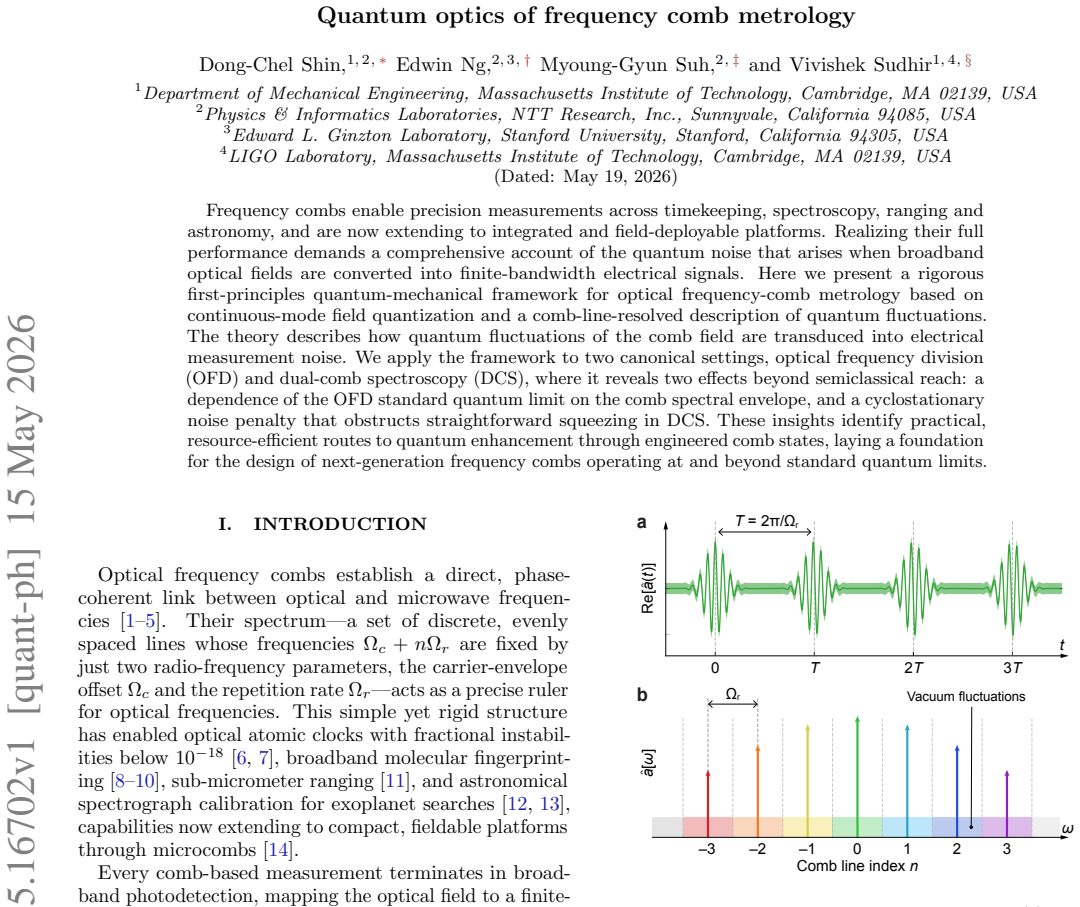
Frequency combs enable precision measurements across timekeeping, spectroscopy, ranging and astronomy, and are now extending to integrated and field-deployable platforms. Realizing their full performance demands a comprehensive account of the quantum noise that arises when broadband optical fields are converted into finite-bandwidth electrical signals. Here we present a rigorous first-principles quantum-mechanical framework for optical frequency-comb metrology based on continuous-mode field quantization and a comb-line-resolved description of quantum fluctuations. The theory describes how quantum fluctuations of the comb field are transduced into electrical measurement noise. We apply the framework to two canonical settings, optical frequency division (OFD) and dual-comb spectroscopy (DCS), where it reveals two effects beyond semiclassical reach: a dependence of the OFD standard quantum limit on the comb spectral envelope, and a cyclostationary noise penalty that obstructs straightforward squeezing in DCS. These insights identify practical, resource-efficient routes to quantum enhancement through engineered comb states, laying a foundation for the design of next-generation frequency combs operating at and beyond standard quantum limits.
Editorial analysis
A structured set of objections, weighed in public.
Referee Report
Summary. The manuscript develops a first-principles quantum framework for frequency-comb metrology based on continuous-mode field quantization together with a comb-line-resolved description of fluctuations. Quantum noise is tracked through photodetection into finite-bandwidth electrical signals. The framework is applied to optical frequency division (OFD) and dual-comb spectroscopy (DCS), where it predicts an envelope dependence of the OFD standard quantum limit and a cyclostationary noise penalty that limits direct squeezing in DCS; both effects are presented as lying outside semiclassical treatments.
Significance. If the derivations are correct, the work supplies a concrete, parameter-free route to identify quantum-limited performance and practical squeezing strategies in comb-based metrology. The explicit separation of envelope-dependent SQL and cyclostationary penalties offers falsifiable predictions that can guide experimental design of next-generation integrated combs. The reliance on standard continuous-mode quantization without ad-hoc parameters or fitted quantities is a methodological strength.
major comments (2)
- [§2] §2 (Framework): the projection from broadband continuous-mode operators onto comb-line-resolved fluctuation operators, followed by finite-bandwidth electrical transduction, is load-bearing for both central claims. A step-by-step expansion showing how the broadband-to-narrowband conversion preserves the reported envelope dependence and cyclostationarity would allow independent verification of the 'beyond semiclassical' distinction.
- [§3.1, Eq. (12)] §3.1, Eq. (12): the OFD SQL expression is stated to depend on the spectral envelope; the derivation should explicitly demonstrate that this dependence survives integration over the photodetection response function, rather than being an artifact of the chosen envelope parametrization.
minor comments (2)
- [Figure 3] Figure 3: axis labels and legend entries should be cross-referenced to the corresponding equations in §4 to clarify which trace corresponds to the cyclostationary penalty.
- Notation: the symbol for the electrical bandwidth appears inconsistently as Δf and B_e in different sections; a single definition in the nomenclature would improve readability.
Simulated Author's Rebuttal
We thank the referee for the positive assessment and the constructive comments aimed at strengthening the clarity of the derivations. We have revised the manuscript to incorporate the requested expansions, which we believe will facilitate independent verification of the central results.
read point-by-point responses
-
Referee: [§2] §2 (Framework): the projection from broadband continuous-mode operators onto comb-line-resolved fluctuation operators, followed by finite-bandwidth electrical transduction, is load-bearing for both central claims. A step-by-step expansion showing how the broadband-to-narrowband conversion preserves the reported envelope dependence and cyclostationarity would allow independent verification of the 'beyond semiclassical' distinction.
Authors: We agree that an expanded derivation of the projection and transduction steps will aid verification. In the revised Section 2 we now provide a detailed, step-by-step account: (i) the continuous-mode operators are projected onto a comb-line basis weighted by the spectral envelope function; (ii) the resulting comb-line-resolved fluctuation operators are defined via a frequency-domain windowing that respects the periodic comb structure; (iii) the finite-bandwidth electrical signal is obtained by integrating the photocurrent operator against the detector response function. The envelope dependence survives because cross-line quantum correlations, which are absent in semiclassical treatments that assign independent noise to each line, are retained by the projection. Cyclostationarity likewise follows directly from the time-periodic modulation of the noise statistics induced by the comb repetition rate. These additions are presented without altering the original equations or conclusions. revision: yes
-
Referee: [§3.1, Eq. (12)] §3.1, Eq. (12): the OFD SQL expression is stated to depend on the spectral envelope; the derivation should explicitly demonstrate that this dependence survives integration over the photodetection response function, rather than being an artifact of the chosen envelope parametrization.
Authors: We appreciate the request for explicit confirmation. The revised derivation of Eq. (12) now includes the intermediate step in which the noise spectral density is integrated against the photodetection response function R(ω). After convolution of the envelope E(ω) with R(ω) and integration over the electrical bandwidth, the resulting SQL retains a nontrivial dependence on the functional form of E(ω). This is verified by repeating the calculation for two distinct envelope shapes (Gaussian and hyperbolic-secant) and confirming that the numerical prefactor changes even after the integration. The dependence is therefore intrinsic to the weighted vacuum fluctuations across the comb spectrum and is not an artifact of parametrization. The updated text and an accompanying footnote make this integration explicit. revision: yes
Circularity Check
No significant circularity
full rationale
The paper constructs its framework from standard continuous-mode field quantization and a comb-line-resolved description of fluctuations, then derives the envelope-dependent OFD SQL and cyclostationary DCS noise penalty as outputs. No step reduces by construction to a fitted input, self-citation, or imported ansatz; the central claims remain independent of the reported effects and rest on externally verifiable quantum-optics methods without load-bearing self-references or renaming of known results.
Axiom & Free-Parameter Ledger
axioms (2)
- domain assumption Continuous-mode field quantization applies to broadband optical frequency comb fields
- domain assumption Quantum fluctuations of the comb field are transduced into electrical measurement noise via standard photodetection
Lean theorems connected to this paper
-
IndisputableMonolith/Foundation/RealityFromDistinction.leanreality_from_one_distinction unclear?
unclearRelation between the paper passage and the cited Recognition theorem.
continuous-mode field quantization and a comb-line-resolved description of quantum fluctuations... comb-line-resolved operator δâ_n[Ω] = f[Ω] â[ω_n + Ω] with rectangular window
-
IndisputableMonolith/Cost/FunctionalEquation.leanwashburn_uniqueness_aczel unclear?
unclearRelation between the paper passage and the cited Recognition theorem.
phase noise PSD S̃ϕ̃ϕ = 1/(4|S|²) Σ (α_{n-1} − α_{n+1})²; cyclostationary noise penalty (G + 1/G)/2
What do these tags mean?
- matches
- The paper's claim is directly supported by a theorem in the formal canon.
- supports
- The theorem supports part of the paper's argument, but the paper may add assumptions or extra steps.
- extends
- The paper goes beyond the formal theorem; the theorem is a base layer rather than the whole result.
- uses
- The paper appears to rely on the theorem as machinery.
- contradicts
- The paper's claim conflicts with a theorem or certificate in the canon.
- unclear
- Pith found a possible connection, but the passage is too broad, indirect, or ambiguous to say the theorem truly supports the claim.
Reference graph
Works this paper leans on
-
[1]
Standard Quantum Limit and spectral shape dependence With the comb-line-resolved field δˆan[Ω] in the vacuum state for every n and Ω, the (symmetrized) power spec- tral densities (PSDs) of the quadrature fluctuations are ¯Sqnqm[Ω] = ¯Spnpm[Ω] = (1/2)δnm. Thus, Eq. (9) yields a phase noise power spectral density: ¯S˜ϕ˜ϕ = 1 4|S|2 X n (αn−1 −α n+1)2 ,(10) w...
-
[2]
(10) can be surpassed by engineer- ing the quantum state of the comb-line-resolved fields
Quantum-enhanced optical frequency division The SQL of Eq. (10) can be surpassed by engineer- ing the quantum state of the comb-line-resolved fields. Because δ ˜ϕ is a weighted linear combination of the inde- pendent phase quadratures {δˆpn}, any state that reduces the variance of this particular linear combination will yield sub-SQL performance. The most...
-
[3]
The symmetric combination ˆP + n is entirely decoupled from the phase measurement; its quantum statistics may take any form without penalty to the OFD measurement. Broadband two-mode squeezing of all sideband pairs (ω+n+Ω, ω −n−Ω) with uniform gainGn over |Ω|< Ωr/2— equivalently, inter-comb-line entanglement of the comb- line-resolved fields ˆa+n[Ω] and ˆ...
-
[4]
Standard quantum limit With the signal field in the vacuum state for every n and Ω, ¯Sqnqn = 1/2, Eq. (16) yields a white photocurrent PSD: ¯SSQL II [Ω] =q 2 e X n α2 L,n.(17) 6 Electrical Comb lines spaced by ΔΩr a I [Ω] ^ Ω Ω0+nΔΩr Optical Vacuum fluctuations Ω0+(n+1)ΔΩr Ωr a[ω] ^ Ωr+ΔΩr Ω0+nΔΩrΩ0+(n–1)ΔΩr LO Comb Signal Comb aS[ω] ^ Signal Comb Intra-c...
-
[5]
Quantum-enhanced dual-comb spectroscopy The structure of Eq. (16) identifies the amplitude quadrature variance ¯SqCR S,nqCR S,n as the relevant quantum resource in suppressing the photocurrent noise. (Squeez- ing the LO comb is not beneficial because the LO vacuum fluctuations do not contribute to the photocurrent noise in the strong-LO limit.) Squeezing ...
-
[6]
T. Udem, J. Reichert, R. Holzwarth, and T. W. H¨ ansch, Absolute optical frequency measurement of the cesium D1 line with a mode-locked laser, Phys. Rev. Lett.82, 3568 (1999)
work page 1999
-
[7]
D. J. Jones, S. A. Diddams, J. K. Ranka, A. Stentz, R. S. Windeler, J. L. Hall, and S. T. Cundiff, Carrier- envelope phase control of femtosecond mode-locked lasers and direct optical frequency synthesis, Science288, 635 (2000)
work page 2000
-
[8]
S. A. Diddams, D. J. Jones, J. Ye, S. T. Cundiff, J. L. Hall, J. K. Ranka, R. S. Windeler, R. Holzwarth, T. Udem, and T. W. H¨ ansch, Direct link between microwave and optical frequencies with a 300 THz femtosecond laser comb, Phys. Rev. Lett.84, 5102 (2000)
work page 2000
-
[9]
T. Udem, R. Holzwarth, and T. W. H¨ ansch, Optical frequency metrology, Nature416, 233 (2002)
work page 2002
-
[10]
S. A. Diddams, K. Vahala, and T. Udem, Optical fre- quency combs: Coherently uniting the electromagnetic 8 spectrum, Science369, eaay3676 (2020)
work page 2020
-
[11]
S. A. Diddams, T. Udem, J. C. Bergquist, E. A. Curtis, R. E. Drullinger, L. Hollberg, W. M. Itano, W. D. Lee, C. W. Oates, K. R. Vogel, and D. J. Wineland, An optical clock based on a single trapped 199Hg+ ion, Science293, 825 (2001)
work page 2001
-
[12]
S. T. Cundiff and J. Ye, Colloquium: Femtosecond optical frequency combs, Rev. Mod. Phys.75, 325 (2003)
work page 2003
-
[13]
I. Coddington, W. C. Swann, and N. R. Newbury, Coher- ent multiheterodyne spectroscopy using stabilized optical frequency combs, Phys. Rev. Lett.100, 013902 (2008)
work page 2008
-
[14]
G. Ycas, F. R. Giorgetta, E. Baumann, I. Coddington, D. Herman, S. A. Diddams, and N. R. Newbury, High- coherence mid-infrared dual-comb spectroscopy spanning 2.6 to 5.2µm, Nat. Photon.12, 202 (2018)
work page 2018
-
[15]
N. Picqu´ e and T. W. H¨ ansch, Frequency comb spec- troscopy, Nature Photonics13, 146 (2019)
work page 2019
-
[16]
I. Coddington, W. C. Swann, L. Nenadovic, and N. R. Newbury, Rapid and spectrally pure absolute distance measurement to a star using a self-referenced frequency comb, Nat. Photon.3, 351 (2009)
work page 2009
-
[17]
T. Steinmetz, T. Wilken, C. Araujo-Hauck, R. Holzwarth, T. W. H¨ ansch, L. Pasquini, A. Manescau, S. D’Odorico, M. T. Murphy, T. Kentischer, W. Schmidt, and T. Udem, Laser frequency combs for astronomical observations, Sci- ence321, 1335 (2008)
work page 2008
-
[18]
M.-G. Suh, X. Yi, Y.-H. Lai, S. Leifer, I. S. Grudinin, G. Vasisht, E. C. Martin, M. P. Fitzgerald, G. Doppmann, J. Wang, D. Mawet, S. B. Papp, S. A. Diddams, C. Be- ichman, and K. Vahala, Searching for exoplanets using a microresonator astrocomb, Nat. Photon.13, 25 (2019)
work page 2019
-
[19]
T. J. Kippenberg, R. Holzwarth, and S. A. Diddams, Dis- sipative Kerr solitons in optical microresonators, Science 361, eaan8083 (2018)
work page 2018
-
[20]
E. D. Caldwell, L. C. Sinclair, N. R. Newbury, and J.- D. Deschˆ enes, The time-programmable frequency comb and its use in quantum-limited ranging, Nature610, 667 (2022)
work page 2022
-
[21]
E. D. Caldwell, J.-D. Deschˆ enes, J. Ellis, W. C. Swann, B. K. Stuhl, H. Bergeron, N. R. Newbury, and L. C. Sinclair, Quantum-limited optical time transfer for future geosynchronous links, Nature618, 721 (2023)
work page 2023
-
[22]
D. I. Herman, M. Walsh, M. K. Kreider, N. Lordi, E. J. Tsao, A. J. Lind, M. Heyrich, J. Combes, J. Genest, and S. A. Diddams, Squeezed dual-comb spectroscopy, Science 387, 653 (2025)
work page 2025
-
[23]
F. Quinlan, T. M. Fortier, H. Jiang, and S. A. Diddams, Analysis of shot noise in the detection of ultrashort optical pulse trains, J. Opt. Soc. Am. B30, 1775 (2013)
work page 2013
-
[24]
N. R. Newbury, I. Coddington, and W. C. Swann, Sensi- tivity of coherent dual-comb spectroscopy, Opt. Express 18, 7929 (2010)
work page 2010
- [25]
- [26]
-
[27]
K. J. Blow, R. Loudon, S. J. D. Phoenix, and T. J. Shep- herd, Continuum fields in quantum optics, Phys. Rev. A 42, 4102 (1990)
work page 1990
- [28]
-
[29]
M. Tseet al.(LIGO Scientific Collaboration), Quantum- enhanced Advanced LIGO detectors in the era of gravitational-wave astronomy, Phys. Rev. Lett.123, 231107 (2019)
work page 2019
-
[30]
C. A. Casacio, L. S. Madsen, A. Terrasson, M. Waleed, K. Barnscheidt, B. Hage, M. A. Taylor, and W. P. Bowen, Quantum-enhanced nonlinear microscopy, Nature594, 201 (2021)
work page 2021
-
[31]
D. Ganapathy, W. Jia, M. Nakano, V. Xu, N. Aritomi, T. Cullen, N. Kijbunchoo, S. Dwyer, A. Mullavey, L. Mc- Culler, and LIGO O4 Detector Collaboration, Broad- band Quantum Enhancement of the LIGO Detectors with Frequency-Dependent Squeezing, Physical Review X13, 041021 (2023)
work page 2023
-
[32]
T. M. Fortier, M. S. Kirchner, F. Quinlan, J. Taylor, J. C. Bergquist, T. Rosenband, N. Lemke, A. Ludlow, Y. Jiang, C. W. Oates, and S. A. Diddams, Generation of ultrastable microwaves via optical frequency division, Nat. Photon.5, 425 (2011)
work page 2011
-
[33]
X. Xie, R. Bouchand, D. Nicolodi, M. Giunta, W. H¨ ansel, M. Lezius, A. Joshi, S. Datta, C. Alexandre, M. Lours, P.- A. Tremblin, G. Santarelli, R. Holzwarth, and Y. Le Coq, Photonic microwave signals with zeptosecond-level abso- lute timing noise, Nat. Photon.11, 44 (2017)
work page 2017
-
[34]
F. Quinlan, T. M. Fortier, H. Jiang, A. Hati, C. Nelson, Y. Fu, J. C. Campbell, and S. A. Diddams, Exploiting shot noise correlations in the photodetection of ultrashort optical pulse trains, Nat. Photonics7, 290 (2013)
work page 2013
-
[35]
I. Coddington, N. Newbury, and W. Swann, Dual-comb spectroscopy, Optica3, 414 (2016)
work page 2016
-
[36]
C. Cohen-Tannoudji, J. Dupont-Roc, and G. Grynberg, Photons and Atoms: Introduction to Quantum Electrody- namics(Wiley-VCH, 1997)
work page 1997
-
[37]
Yurke, Wideband photon counting and homodyne detection, Physical Review A32, 311 (1985)
B. Yurke, Wideband photon counting and homodyne detection, Physical Review A32, 311 (1985)
work page 1985
-
[38]
S. L. Braunstein and H. J. Kimble, Teleportation of Con- tinuous Quantum Variables, Physical Review Letters80, 869 (1998)
work page 1998
- [39]
-
[40]
H. Shi and Q. Zhuang, Theory of quantum comb enhanced interferometry, arXiv preprint arXiv:2508.01513 (2025), arXiv:2508.01513 [quant-ph]
work page internal anchor Pith review arXiv 2025
-
[41]
D. I. Herman, M. K. Kreider, N. Lordi, M. Walsh, E. J. Tsao, A. J. Lind, M. Heyrich, J. Combes, S. A. Did- dams, and J. Genest, Phase-Dependent Squeezing in Dual-Comb Interferometry, Physical Review Letters136, 163601 (2026)
work page 2026
-
[42]
S. Dwyer, L. Barsotti, S. S. Y. Chua, M. Evans, M. Fac- tourovich, D. Gustafson, T. Isogai, K. Kawabe, A. Kha- laidovski, P. K. Lam, M. Landry, N. Mavalvala, D. E. McClelland, G. D. Meadors, C. M. Mow-Lowry, R. Schn- abel, R. M. S. Schofield, N. Smith-Lefebvre, M. Stefszky, C. Vorvick, and D. Sigg, Squeezed quadrature fluctua- tions in a gravitational wav...
work page 2013
-
[43]
Z. Jiang, C.-B. Huang, D. E. Leaird, and A. M. Weiner, Optical arbitrary waveform processing of more than 100 spectral comb lines, Nat. Photon.1, 463 (2007)
work page 2007
-
[44]
J. Roslund, R. M. de Ara´ ujo, S. Jiang, C. Fabre, and N. Treps, Wavelength-multiplexed quantum networks with 9 ultrafast frequency combs, Nat. Photon.8, 109 (2014)
work page 2014
-
[45]
C. Fabre and N. Treps, Modes and states in quantum optics, Rev. Mod. Phys.92, 035005 (2020)
work page 2020
-
[46]
Z. Yang, M. Jahanbozorgi, D. Jeong, S. Sun, O. Pfister, H. Lee, and X. Yi, A squeezed quantum microcomb on a chip, Nat. Commun.12, 4781 (2021)
work page 2021
- [47]
-
[48]
M. Jankowski, C. Langrock, B. Desiatov, A. Marandi, C. Wang, M. Zhang, C. R. Phillips, M. Lonˇ car, and M. M. Fejer, Ultrabroadband nonlinear optics in nanophotonic periodically poled lithium niobate waveguides, Optica7, 40 (2020)
work page 2020
-
[49]
X. Jia, C. Zhai, X. Zhu, C. You, Y. Cao, X. Zhang, Y. Zheng, Z. Fu, J. Mao, T. Dai, L. Chang, X. Su, Q. Gong, and J. Wang, Continuous-variable multipar- tite entanglement in an integrated microcomb, Nature 639, 329 (2025)
work page 2025
-
[50]
Y. K. Chembo, Quantum dynamics of Kerr optical fre- quency combs below and above threshold: Spontaneous four-wave mixing, entanglement, and squeezed states of light, Phys. Rev. A93, 033820 (2016)
work page 2016
- [51]
-
[52]
G. Gwak, C. Roh, Y.-D. Yoon, M. Kim, and Y.- S. Ra, Completely characterizing multimode second- order nonlinear optical quantum processes, Nat. Photon. 10.1038/s41566-025-01787-x (2025)
-
[53]
Gr¨ ochenig,Foundations of Time-Frequency Analysis (Birkh¨ auser, 2001)
K. Gr¨ ochenig,Foundations of Time-Frequency Analysis (Birkh¨ auser, 2001)
work page 2001
-
[54]
T. Herr, V. Brasch, J. D. Jost, C. Y. Wang, N. M. Kon- dratiev, M. L. Gorodetsky, and T. J. Kippenberg, Tem- poral solitons in optical microresonators, Nat. Photon.8, 145 (2014)
work page 2014
-
[55]
A. Hasegawa and F. Tappert, Transmission of stationary nonlinear optical pulses in dispersive dielectric fibers. I. Anomalous dispersion, Appl. Phys. Lett.23, 142 (1973)
work page 1973
-
[56]
L. F. Mollenauer, R. H. Stolen, and J. P. Gordon, Exper- imental observation of picosecond pulse narrowing and solitons in optical fibers, Phys. Rev. Lett.45, 1095 (1980)
work page 1980
-
[57]
L. F. Mollenauer and R. H. Stolen, The soliton laser, Opt. Lett.9, 13 (1984)
work page 1984
- [58]
-
[59]
Quantization of frequency combs 11
-
[60]
Broadband Photodetection 12
-
[61]
Comb-line-resolved field decomposition 13 C. Optical frequency division 15
-
[62]
Effect of spectral shape on the standard quantum limit of OFD 16
-
[63]
Quantum-enhanced optical frequency division 17 Independent intra-comb-line squeezing 17 Inter-comb-line entanglement 18
-
[64]
Classical noise limit of optical frequency division 19 D. Dual-Comb Spectroscopy 20
-
[65]
Sample response model 20
-
[66]
Transmittance estimator and signal-to-noise ratio 20
-
[67]
Self-referred intra-comb-line squeezing 22
-
[68]
Numerical simulation of cyclostationary noise 22
-
[69]
Cross-referred intra-comb-line squeezing 22
-
[70]
Inter-comb-line entanglement 23
-
[71]
Comparison of quantum advantage 24
-
[72]
Numerical simulation of quantum-enhanced DCS 25 Appendix A: Operator conventions and spectral densities We define the Fourier transform of a time-dependent operator ˆA(t) in the Heisenberg picture as ˆA[Ω] = Z +∞ −∞ ˆA(t)eiΩt dt,(A1) with inverse transform ˆA(t) = Z +∞ −∞ ˆA[Ω]e −iΩt dΩ 2π .(A2) The Hermitian conjugate and Fourier transform do not commute...
-
[73]
Quantization of frequency combs The quantum theory of propagating electromagnetic fields is most naturally formulated in a basis of continuous spatiotemporal modes, which avoids artifacts associated with cavity quantization. We review this formalism by quantizing the electromagnetic field in a finite volume and extending this description to an infinite on...
-
[74]
In the frequency domain we write ˆI[Ω] =q e H[Ω] ˆW[Ω], ˆI(t) = Z ∞ 0 dΩ 2π ˆI[Ω]e −iΩt + H.c
Broadband Photodetection We model the photodetection of broadband light using the framework of Yurke [ 32], in which the photodiode is described by a photoemission–rate operator ˆW (t) and the measured current is the filtered version of e ˆW (t). In the frequency domain we write ˆI[Ω] =q e H[Ω] ˆW[Ω], ˆI(t) = Z ∞ 0 dΩ 2π ˆI[Ω]e −iΩt + H.c. ,(B15) where qe...
-
[75]
Comb-line-resolved field decomposition As will be shown in Sections C and D, the quantum noise floor of frequency-comb metrology is determined by the vacuum fluctuation in a narrow baseband window around each comb line. It is therefore natural to decompose the continuous-mode operator ˆa[ω] into a discrete family {ˆan[Ω]}, where ˆan[Ω] describes fluctuati...
-
[76]
Effect of spectral shape on the standard quantum limit of OFD To systematically evaluate how the spectral envelope {αn} shapes the quantum-limited phase noise of OFD, we first establish a natural benchmark and a universal figure of merit. The standard quantum limit (SQL) of the simplest possible microwave generation scheme is set by a two-mode heterodyne ...
-
[77]
Quantum-enhanced optical frequency division The phase-noise analysis of the preceding section assumed that the comb-line-resolved field ˆan[Ω] is in the vacuum state for every n and Ω, establishing the SQL as the baseline. We now evaluate two distinct continuous-variable quantum strategies that exploit non-classical correlations in {δˆpn} to suppress the ...
-
[78]
Classical noise limit of optical frequency division We demonstrate that the comb-line-resolved operator formalism rigorously recovers the classical limit of optical frequency division. Consider a frequency comb whose central line is tightly phase-locked to a classical optical reference, such that its frequency fluctuation tracks the reference, δω0(t) = δω...
-
[79]
Sample response model The interaction of the signal comb with the sample is modeled as a linear, frequency-dependent transformation of the field annihilation operator. To preserve the canonical commutation relations under macroscopic attenuation, any intensity loss must be accompanied by a proportional coupling to environmental vacuum modes. The sample re...
-
[80]
21 The transmittance κm is encoded in the amplitude of the RF beat note at Ω m = Ω0 + m ∆Ωr
Transmittance estimator and signal-to-noise ratio To connect the photocurrent PSDs in DCS to the practical figure of merit—the precision with which the sample transmittance κm can be extracted—we derive the power signal-to-noise ratio (SNR) for κm in terms of ¯SII [Ω] and the measurement timeT. 21 The transmittance κm is encoded in the amplitude of the RF...
discussion (0)
Sign in with ORCID, Apple, or X to comment. Anyone can read and Pith papers without signing in.