Learning inelastic constitutive models from stress-strain data under hard thermodynamic constraints
Pith reviewed 2026-05-19 21:09 UTC · model grok-4.3
The pith
Embedding non-equilibrium thermodynamics, objectivity and stability as hard constraints inside a neural network lets it learn consistent inelastic constitutive models from limited stress-strain data alone.
A machine-rendered reading of the paper's core claim, the machinery that carries it, and where it could break.
Core claim
The thermodynamics-constrained learning framework embeds the principles of non-equilibrium thermodynamics, objectivity and stability as hard, scalable constraints to learn constitutive models from standard macroscopic data. Analytical benchmarks demonstrate that the method learns thermodynamically consistent and robust constitutive models for a range of inelastic materials of increasing complexity. At inference the resulting models generalise to more demanding, unobserved paths and autonomously recover interpretable internal variables that capture path-dependent evolution. When applied to granular media trained on discrete-element simulations, the model discovers the underlying constitutive,
What carries the argument
Neural architecture that treats thermodynamic consistency, objectivity and stability as hard architectural constraints enforced at every step of training and inference.
If this is right
- Models trained on limited paths still predict responses under cyclic loading, including hysteresis loops absent from the training set.
- The framework recovers interpretable internal variables that track path-dependent evolution without being given them explicitly.
- The same architecture works across materials of increasing complexity from simple analytical benchmarks to heterogeneous granular media.
- Constitutive equations can be discovered using only macroscopic stress-strain histories obtained from simulated or real experiments.
Where Pith is reading between the lines
- Similar hard-constraint designs could be tested on other history-dependent systems such as viscoelastic polymers or fatigue in metals where internal variables are also hidden.
- If the approach scales, it would let engineers replace expensive full-field simulations with fast, thermodynamically safe surrogate models trained on sparse experimental curves.
- The recovered internal variables might be compared directly to measurable quantities like fabric tensors in granular experiments to validate their physical meaning.
Load-bearing premise
That making thermodynamic and objectivity rules into hard, scalable constraints inside the network is sufficient to guarantee physical consistency and robust generalization when the only available data are limited macroscopic stress-strain curves for complex, heterogeneous materials.
What would settle it
Train the model on the reported stress-strain paths for a granular specimen, then test it on a cyclic loading sequence that produces clear hysteresis; if the predicted dissipation or loop area deviates significantly from independent discrete-element or laboratory measurements, the central claim fails.
Figures






read the original abstract
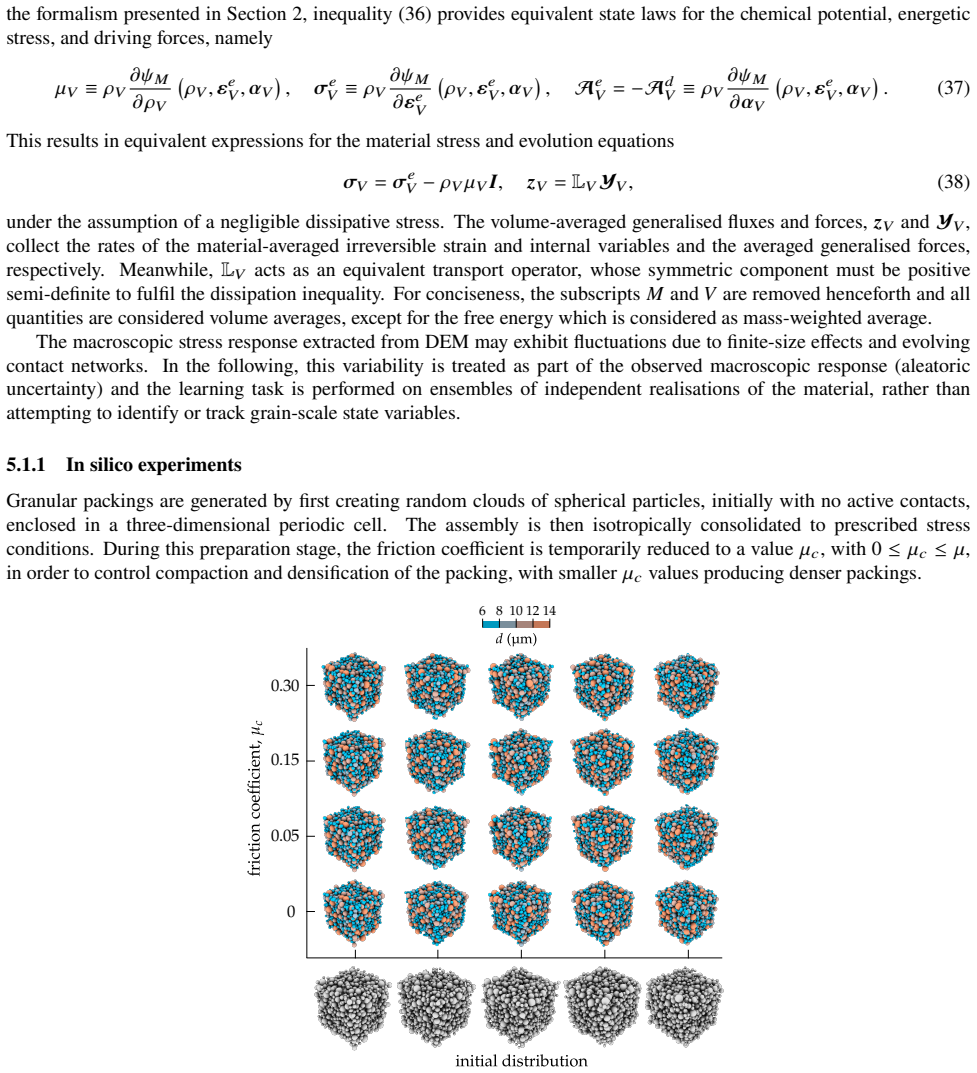
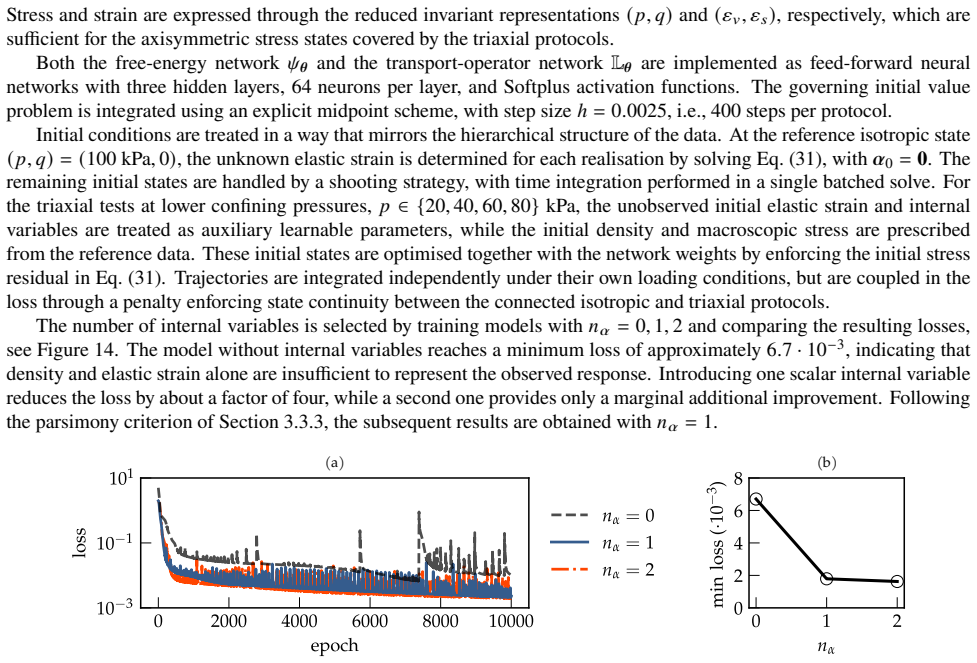
Machine learning approaches informed by physics have offered new insights into the discovery of constitutive models from data, helping overcome some limitations of traditional constitutive modelling while reducing the cost of otherwise computationally intensive simulations. Yet, most existing approaches only partially enforce the requirements of physics and thermodynamics, leaving open questions about their consistency across a broad range of material behaviours and their ability to generalise robustly to unseen loading paths when only limited measurements are available. This work establishes a thermodynamics-constrained learning framework whose architecture embeds the principles of non-equilibrium thermodynamics, objectivity and stability as hard, scalable constraints to learn constitutive models from standard macroscopic data. Analytical benchmarks involving stress-strain loading paths demonstrate that the method learns thermodynamically consistent and robust constitutive models for a range of inelastic materials of increasing complexity. At inference, the resulting models generalise to more demanding, unobserved paths and can autonomously recover interpretable internal variables that capture path-dependent evolution. The framework is then applied to granular media, prototypical heterogeneous and history-dependent materials for which constitutive modelling remains challenging. Trained on numerically simulated experiments based on the discrete element method, the model discovers the underlying constitutive equations and predicts responses under cyclic loading, including the emergence of hysteresis absent from the training data, relying solely on macroscopic stress-strain histories. The findings indicate that enforcing non-equilibrium thermodynamics through hard constraints represents a principled route to robust, consistent, and scalable data-driven discovery of constitutive models.
Editorial analysis
A structured set of objections, weighed in public.
Referee Report
Summary. The manuscript proposes a neural-network framework that embeds non-equilibrium thermodynamics, objectivity, and stability as hard architectural constraints to learn inelastic constitutive models directly from macroscopic stress-strain histories. Analytical benchmarks on materials of increasing complexity are used to verify thermodynamic consistency and generalization; the method is then applied to DEM-simulated granular media, where it recovers internal variables and predicts cyclic responses including emergent hysteresis absent from the training data.
Significance. If the central claims hold, the work supplies a scalable route to thermodynamically consistent constitutive discovery from limited macroscopic measurements, with the hard-constraint design and autonomous recovery of internal variables as particular strengths. Successful extrapolation to unobserved paths for heterogeneous, history-dependent materials would be a meaningful advance over soft-penalty or post-hoc correction approaches.
major comments (2)
- [Granular media application and results] The central claim that hard embedding of thermodynamic principles suffices for robust generalization and unique recovery of interpretable internal variables is load-bearing for the granular-media results. Macroscopic stress-strain data alone are known to be insufficient to uniquely identify micromechanical state evolution; the manuscript should demonstrate (e.g., via additional state-space probes or comparison with known DEM internal quantities) that the learned variables remain physically meaningful outside the training distribution rather than merely satisfying the inequalities on seen paths.
- [Numerical experiments on granular media] The generalization experiments report successful prediction of hysteresis on cyclic paths not present in training. However, the paper must clarify whether the enforced dissipation structure or potential form can produce non-physical responses when loading paths enter regions of state space that are only weakly constrained by the limited macroscopic data; a concrete counter-example or sensitivity test would address this risk.
minor comments (2)
- Notation for the internal variables and the precise form of the hard constraints (e.g., how objectivity is imposed) should be introduced earlier and used consistently across equations and figures.
- Figure captions for the benchmark and granular results should explicitly state the training versus test loading paths to make the generalization claims immediately verifiable.
Simulated Author's Rebuttal
We thank the referee for their constructive and insightful comments on our manuscript. We address each major comment in detail below, outlining our responses and the revisions we plan to incorporate to strengthen the presentation of the granular-media results.
read point-by-point responses
-
Referee: [Granular media application and results] The central claim that hard embedding of thermodynamic principles suffices for robust generalization and unique recovery of interpretable internal variables is load-bearing for the granular-media results. Macroscopic stress-strain data alone are known to be insufficient to uniquely identify micromechanical state evolution; the manuscript should demonstrate (e.g., via additional state-space probes or comparison with known DEM internal quantities) that the learned variables remain physically meaningful outside the training distribution rather than merely satisfying the inequalities on seen paths.
Authors: We agree that stress-strain data alone cannot guarantee unique recovery of micromechanical states, and our manuscript does not claim uniqueness. Instead, the hard thermodynamic constraints restrict admissible evolutions, enabling generalization even when internal variables are not directly observed. In the analytical benchmarks, the autonomously recovered variables match known physical quantities (e.g., equivalent plastic strain or hardening variables). For the DEM granular application, physical meaningfulness is evidenced by the model's ability to predict emergent hysteresis on cyclic paths absent from training. To address the request for further demonstration, we will add state-space probes in a new subsection of the revised manuscript. These will include (i) evolution plots of the learned internal variables along extrapolated paths and (ii) comparison of their trends against expected micromechanical signatures from the underlying DEM simulations, confirming consistency beyond the training distribution. revision: yes
-
Referee: [Numerical experiments on granular media] The generalization experiments report successful prediction of hysteresis on cyclic paths not present in training. However, the paper must clarify whether the enforced dissipation structure or potential form can produce non-physical responses when loading paths enter regions of state space that are only weakly constrained by the limited macroscopic data; a concrete counter-example or sensitivity test would address this risk.
Authors: The architecture embeds a convex free-energy potential and a non-negative dissipation function as hard constraints, which by construction guarantees thermodynamic consistency (non-negative dissipation, frame-indifference, and material stability) for any input state. This prevents many classes of non-physical behavior even in extrapolation. We acknowledge that explicit verification in sparsely sampled regions strengthens the claim. In the revised manuscript we will add a sensitivity analysis subsection that evaluates the trained model on deliberately chosen loading paths entering weakly constrained regions of state space. We will report the resulting stress responses and internal-variable trajectories, confirming they remain physically admissible. No counter-examples of non-physical behavior appeared in our existing tests, but the new analysis will provide the requested clarification and quantify robustness. revision: yes
Circularity Check
No significant circularity: external thermodynamic constraints applied to data-driven learning
full rationale
The paper's core derivation embeds non-equilibrium thermodynamics, objectivity and stability as hard architectural constraints rather than deriving them from or fitting them to the stress-strain data. Training occurs on macroscopic measurements, with generalization and internal-variable recovery presented as emergent outcomes of the constrained architecture. No self-definitional steps, fitted-input predictions, or load-bearing self-citations appear in the abstract or described framework. The approach is self-contained against external thermodynamic principles and does not reduce its claimed predictions to its inputs by construction.
Axiom & Free-Parameter Ledger
axioms (1)
- domain assumption Principles of non-equilibrium thermodynamics, objectivity and stability
Lean theorems connected to this paper
-
IndisputableMonolith/Cost/FunctionalEquation.leanwashburn_uniqueness_aczel echoes?
echoesECHOES: this paper passage has the same mathematical shape or conceptual pattern as the Recognition theorem, but is not a direct formal dependency.
the symmetric part of the transport operator being positive semidefinite, Sym(L) ⪰ 0 ... d = Y ◦ Sym(L)Y ≥ 0
What do these tags mean?
- matches
- The paper's claim is directly supported by a theorem in the formal canon.
- supports
- The theorem supports part of the paper's argument, but the paper may add assumptions or extra steps.
- extends
- The paper goes beyond the formal theorem; the theorem is a base layer rather than the whole result.
- uses
- The paper appears to rely on the theorem as machinery.
- contradicts
- The paper's claim conflicts with a theorem or certificate in the canon.
- unclear
- Pith found a possible connection, but the passage is too broad, indirect, or ambiguous to say the theorem truly supports the claim.
Reference graph
Works this paper leans on
-
[2]
B.Amos,L.Xu,andJ.Z.Kolter. Inputconvexneuralnetworks. InD.PrecupandY.W.Teh,editors,Proceedings of the 34th International Conference on Machine Learning, volume 70 ofProceedings of Machine Learning Research, pages 146–155. PMLR, 06–11 Aug 2017
work page 2017
-
[4]
J. M. Ball. Convexity conditions and existence theorems in nonlinear elasticity.Archive for rational mechanics and Analysis, 63:337–403, 1976. doi: https://doi.org/10.1007/BF00279992
-
[5]
A. Berezovski. Internal variables associated with microstructures in solids.Mechanics Research Communications, 93:30–34, 2018. doi: https://doi.org/10.1016/j.mechrescom.2017.07.011. 28 (a) (c)(b) hardsoft-directsoft-transport FigureB.22: PredictionsontheunseencyclicloadingprotocolofFig.6forthehard-constrained(top)andsoft-constrained implementations,S1(mid...
-
[6]
A. Berezovski and P. Ván. Microinertia and internal variables.Continuum Mechanics and Thermodynamics, 28(4): 1027–1037, 2016. doi: https://doi.org/10.1007/s00161-015-0453-2
-
[7]
J. Bleyer. Learning elastoplasticity with implicit layers.Computer Methods in Applied Mechanics and Engineering, 444:118145, 2025. doi: https://doi.org/10.1016/j.cma.2025.118145
-
[8]
C. Bonatti and D. Mohr. On the importance of self-consistency in recurrent neural network models representing elasto-plastic solids.Journal of the Mechanics and Physics of Solids, 158:104697, 2022. doi: https://doi.org/10. 1016/j.jmps.2021.104697
-
[9]
H. B. G. Casimir. On Onsager’s Principle of Microscopic Reversibility.Reviews of Modern Physics, 17:343–350,
-
[10]
doi: https://doi.org/10.1103/RevModPhys.17.343
-
[11]
Mechanics Research Communications,125:103993,2022
P.ChenandJ.Guilleminot.Polyconvexneuralnetworksforhyperelasticconstitutivemodels: Arectificationapproach. Mechanics Research Communications,125:103993,2022. doi: https://doi.org/10.1016/j.mechrescom.2022.103993
-
[12]
R. T. Chen, Y. Rubanova, J. Bettencourt, and D. K. Duvenaud. Neural ordinary differential equations.Advances in neural information processing systems, 31, 2018
work page 2018
-
[13]
R. T. Q. Chen. TorchDiffEq, 2018. URLhttps://github.com/rtqichen/torchdiffeq
work page 2018
-
[14]
B. D. Coleman and M. E. Gurtin. Thermodynamics with internal state variables.The Journal of Chemical Physics, 47(2):597–613, 1967. doi: https://doi.org/10.1063/1.1711937
-
[15]
Coussy.Mechanics and physics of porous solids
O. Coussy.Mechanics and physics of porous solids. John Wiley & Sons, 2010. doi: https://doi.org/10.1002/ 9780470710388
work page 2010
-
[16]
E.CuetoandF.Chinesta. Thermodynamicsoflearningphysicalphenomena.Archives of Computational Methods in Engineering, 30(8):4653–4666, 2023. doi: https://doi.org/10.1007/s11831-023-09954-5. 29
-
[17]
P. A. Cundall and O. D. Strack. A discrete numerical model for granular assemblies.Géotechnique, 29(1):47–65,
-
[18]
doi: https://doi.org/10.1680/geot.1979.29.1.47
-
[19]
W. M. Czarnecki, S. Osindero, M. Jaderberg, G. Swirszcz, and R. Pascanu. Sobolev training for neural networks. Advances in neural information processing systems, 30, 2017
work page 2017
-
[20]
S. R. De Groot and P. Mazur.Non-equilibrium thermodynamics. Dover Publications, 2013
work page 2013
-
[21]
G. de Saxcé and L. Bousshine.Implicit Standard Materials, pages 59–76. Springer Vienna, Vienna, 2002. ISBN 978-3-7091-2558-8. doi: https://doi.org/10.1007/978-3-7091-2558-8_4
-
[22]
G. de Saxcé and Z.-Q. Feng. New inequality and functional for contact with friction: the implicit standard material approach.Journal of Structural Mechanics,19(3):301–325,1991.doi: https://doi.org/10.1080/08905459108905146
-
[23]
I. Einav. The unification of hypo-plastic and elasto-plastic theories.International Journal of Solids and Structures, 49(11-12):1305–1315, 2012. doi: https://doi.org/10.1016/j.ijsolstr.2012.02.003
-
[24]
I.EinavandM.Liu. Hydrodynamicderivationoftheworkinputtofullyandpartiallysaturatedsoils.Journal of the Mechanics and Physics of Solids, 110:205–217, 2018. doi: https://doi.org/10.1016/j.jmps.2017.10.004
-
[25]
I. Einav and M. Liu. Hydrodynamics of non-equilibrium soil water retention.Water Resources Research, 59(1): e2022WR033409, 2023. doi: https://doi.org/10.1029/2022WR033409
-
[26]
M. Flaschel, S. Kumar, and L. De Lorenzis. Automated discovery of generalized standard material models with EUCLID.Computer Methods in Applied Mechanics and Engineering, 405:115867, 2023. doi: https://doi.org/10. 1016/j.cma.2022.115867
-
[28]
J. N. Fuhg, G. A. Padmanabha, N. Bouklas, B. Bahmani, W. Sun, N. N. Vlassis, M. Flaschel, P. Carrara, and L. De Lorenzis. A review on data-driven constitutive laws for solids.Archives of Computational Methods in Engineering, 32:1841–1883, 2025. doi: https://doi.org/10.1007/s11831-024-10196-2
-
[29]
Ondensegranularflows.The European Physical Journal E,14:341–365,2004
GDRMiDi. Ondensegranularflows.The European Physical Journal E,14:341–365,2004. doi: https://doi.org/10. 1140/epje/i2003-10153-0
work page 2004
-
[30]
M. G. Geers, V. G. Kouznetsova, and W. Brekelmans. Multi-scale computational homogenization: Trends and challenges.Journal of computational and applied mathematics, 234(7):2175–2182, 2010. doi: https://doi.org/10. 1016/j.cam.2009.08.077
work page 2010
-
[31]
P.Germain. Themethodofvirtualpowerincontinuummechanics.Part2: Microstructure.SIAM Journal on Applied Mathematics, 25(3):556–575, 1973. doi: https://doi.org/10.1137/0125053
-
[32]
M. E. Gurtin. Generalized Ginzburg-Landau and Cahn-Hilliard equations based on a microforce balance.Physica D: Nonlinear Phenomena, 92(3-4):178–192, 1996. doi: https://doi.org/10.1016/0167-2789(95)00173-5
-
[33]
B. Halphen and Q. S. Nguyen. Sur les matériaux standard généralisés.Journal de mécanique, 14(1):39–63, 1975
work page 1975
- [34]
-
[35]
Q.Hernandez,A.Badias,D.Gonzalez,F.Chinesta,andE.Cueto. Deeplearningofthermodynamics-awarereduced- order models from data.Computer Methods in Applied Mechanics and Engineering, 379:113763, 2021. doi: https://doi.org/10.1016/j.cma.2021.113763
-
[36]
H. Holthusen, L. Lamm, T. Brepols, S. Reese, and E. Kuhl. Theory and implementation of inelastic constitutive artificial neural networks.Computer Methods in Applied Mechanics and Engineering, 428:117063, 2024. doi: https://doi.org/10.1016/j.cma.2024.117063. 30
-
[37]
H. Holthusen, K. Linka, E. Kuhl, and T. Brepols. A generalized dual potential for inelastic constitutive artificial neural networks: A JAX implementation at finite strains.Journal of the Mechanics and Physics of Solids, 206: 106337, 2025. doi: https://doi.org/10.1016/j.jmps.2025.106337
-
[38]
G. T. Houlsby and A. M. Puzrin.Principles of Hyperplasticity. Springer London, 2007. doi: https://doi.org/10. 1007/978-1-84628-240-9
work page 2007
-
[39]
doi: https://doi.org/10.1016/j.jmps.2022.104856
S.Huang,Z.He,andC.Reina.VariationalOnsagerNeuralNetworks(VONNs): Athermodynamics-basedvariational learningstrategyfornon-equilibriumPDEs.Journal of the Mechanics and Physics of Solids,163:104856,2022. doi: https://doi.org/10.1016/j.jmps.2022.104856
-
[40]
P. Ireman and Q.-S. Nguyen. Using the gradients of temperature and internal parameters in continuum thermody- namics.Comptes Rendus Mécanique, 332(4):249–255, 2004. doi: https://doi.org/10.1016/j.crme.2004.01.012
-
[41]
C. Jailin and E. Baranger. Material-embedding Physics-Augmented Neural Networks: A first application to consti- tutive law parameterization.Computer Methods in Applied Mechanics and Engineering, 445:118188, 2025. doi: https://doi.org/10.1016/j.cma.2025.118188
-
[42]
Y. Jiang and M. Liu. Granular solid hydrodynamics.Granular Matter, 11:139–156, 2009. doi: https://doi.org/10. 1007/s10035-009-0137-3
work page 2009
-
[43]
Y. Jiang and M. Liu. Applying GSH to a wide range of experiments in granular media.The European Physical Journal E, 38:1–27, 2015. doi: https://doi.org/10.1140/epje/i2015-15015-6
-
[44]
K. Karapiperis, L. Stainier, M. Ortiz, and J. E. Andrade. Data-driven multiscale modeling in mechanics.Journal of the Mechanics and Physics of Solids, 147:104239, 2021. doi: https://doi.org/10.1016/j.jmps.2020.104239
-
[45]
Physics-informedmachinelearning
G.E.Karniadakis,I.G.Kevrekidis,L.Lu,P.Perdikaris,S.Wang,andL.Yang. Physics-informedmachinelearning. Nature Reviews Physics, 3(6):422–440, 2021. doi: https://doi.org/10.1038/s42254-021-00314-5
-
[48]
D. Kolymbas. An outline of hypoplasticity.Archive of applied mechanics, 61(3):143–151, 1991. doi: https: //doi.org/10.1007/BF00788048
-
[49]
D. Kolymbas. The misery of constitutive modelling. InConstitutive modelling of granular materials, pages 11–24. Springer, 2000. doi: https://doi.org/10.1007/978-3-642-57018-6_1
-
[50]
J. Kozicki and F. V. Donze. YADE-OPEN DEM: An open-source software using a discrete element method to simulate granular material.Engineering Computations, 26(7):786–805, 2009
work page 2009
-
[51]
L.Linden,D.K.Klein,K.A.Kalina,J.Brummund,O.Weeger,andM.Kästner.Neuralnetworksmeethyperelasticity: A guide to enforcing physics.Journal of the Mechanics and Physics of Solids, 179:105363, 2023. doi: https: //doi.org/10.1016/j.jmps.2023.105363
-
[52]
K. Linka and E. Kuhl. A new family of constitutive artificial neural networks towards automated model discovery. Computer Methods in Applied Mechanics and Engineering, 403:115731, 2023. doi: https://doi.org/10.1016/j.cma. 2022.115731
-
[53]
A. E. H. Love.A treatise on the mathematical theory of elasticity. Cambridge University Press, 1892
-
[54]
F. Masi and I. Einav. Neural integration for constitutive equations using small data.Computer Methods in Applied Mechanics and Engineering, 420:116698, 2024. doi: https://doi.org/10.1016/j.cma.2023.116698
-
[55]
F. Masi and I. Einav. Hydrodynamics of fault gouges from constitutive modelling to the physics of friction.Journal of Geophysical Research: Solid Earth, 130:e2024JB030822, 2025. doi: https://doi.org/10.1029/2024JB030822. 31
-
[56]
F. Masi and I. Stefanou. Multiscale modeling of inelastic materials with Thermodynamics-based Artificial Neural Networks (TANN).Computer Methods in Applied Mechanics and Engineering, 398:115190, 2022. doi: https: //doi.org/10.1016/j.cma.2022.115190
-
[57]
F.MasiandI.Stefanou. EvolutionTANNandtheidentificationofinternalvariablesandevolutionequationsinsolid mechanics.Journal of the Mechanics and Physics of Solids, 174:105245, 2023. doi: https://doi.org/10.1016/j.jmps. 2023.105245
-
[58]
F. Masi and I. Stefanou.Physics-Informed and Thermodynamics-Based Neural Networks, chapter 3, pages 57–100. John Wiley & Sons, Ltd, 2024. ISBN 9781394325665. doi: https://doi.org/10.1002/9781394325665.ch3
- [59]
-
[60]
G. A. Maugin. Internal variables and dissipative structures.Journal of Non-Equilibrium Thermodynamics, 15: 173–192, 1990. doi: https://doi.org/10.1515/jnet.1990.15.2.173
-
[61]
A.McBride,B.D.Reddy,andP.Steinmann.Dissipation-consistentmodellingandclassificationofextendedplasticity formulations.Journal of the Mechanics and Physics of Solids, 119:118–139, 2018. doi: https://doi.org/10.1016/j. jmps.2018.06.002
work page doi:10.1016/j 2018
-
[62]
Data-drivenmodelingandlearninginscienceand engineering.Comptes Rendus Mécanique,347(11):845–855,2019
F.J.Montáns,F.Chinesta,R.Gómez-Bombarelli,andJ.N.Kutz. Data-drivenmodelingandlearninginscienceand engineering.Comptes Rendus Mécanique,347(11):845–855,2019. doi: https://doi.org/10.1016/j.crme.2019.11.009
-
[63]
J. J. Moreau. Sur les lois de frottement, de plasticité et de viscosité.Comptes rendus hebdomadaires des séances de l’Académie des sciences, 271:608–611, 1970
work page 1970
-
[64]
SpringerBerlinHeidelberg,Berlin, Heidelberg, 1973
J.J.Moreau.On Unilateral Constraints, Friction and Plasticity,pages171–322. SpringerBerlinHeidelberg,Berlin, Heidelberg, 1973. doi: https://doi.org/10.1007/978-3-642-10960-7_7
-
[65]
L. Onsager. Reciprocal Relations in Irreversible Processes. I.Physical Review, 37:405–426, 1931. doi: https: //doi.org/10.1103/PhysRev.37.405
-
[66]
L. Onsager. Reciprocal Relations in Irreversible Processes. II.Physical Review, 38:2265–2279, 1931. doi: https: //doi.org/10.1103/PhysRev.38.2265
-
[67]
O’Sullivan.Particulate discrete element modelling: a geomechanics perspective
C. O’Sullivan.Particulate discrete element modelling: a geomechanics perspective. CRC Press, 2011
work page 2011
-
[68]
H. C. Öttinger.Beyond equilibrium thermodynamics. John Wiley & Sons, 2005. doi: https://doi.org/10.1002/ 0471727903
work page 2005
-
[69]
C.PapenfussandS.Forest. Thermodynamicalframeworksforhighergradematerialtheorieswithinternalvariables oradditionaldegreesoffreedom.Journal of Non-Equilibrium Thermodynamics,2006. doi: https://doi.org/10.1515/ jnetdy.2006.014
work page 2006
- [70]
-
[71]
W. Qiu, S. Huang, and C. Reina. Bridging statistical mechanics and thermodynamics away from equilibrium: a data-driven approach for learning internal variables and their dynamics.Journal of the Mechanics and Physics of Solids, page 106211, 2025. doi: https://doi.org/10.1016/j.jmps.2025.106211
-
[72]
W. Ramberg and W. R. Osgood. Description of stress-strain curves by three parameters. NACA-TN-902, National Advisory Committee For Aeronautics, Washington DC, 1943
work page 1943
-
[73]
M.Rosenkranz,K.A.Kalina,J.Brummund,W.Sun,andM.Kästner. Viscoelastictywithphysics-augmentedneural networks: modelformulationandtrainingmethodswithoutprescribedinternalvariables.Computational Mechanics, 74(6):1279–1301, 2024. doi: https://doi.org/10.1007/s00466-024-02477-1
-
[74]
M. Rubin. Plasticity theory formulated in terms of physically based microstructural variables—Part I. Theory. International journal of solids and structures,31(19):2615–2634,1994. doi: https://doi.org/10.1016/0020-7683(94) 90222-4. 32
-
[75]
A. N. Schofield and P. Wroth.Critical state soil mechanics, volume 310. McGraw-hill London, 1968
work page 1968
-
[76]
J. Schröder and P. Neff. Construction of polyconvex, anisotropic free-energy functions. InPAMM: Proceedings in Applied Mathematics and Mechanics, volume 2, pages 172–173. Wiley Online Library, 2003
work page 2003
-
[77]
A. Stathas and I. Stefanou. The role of viscous regularization in dynamical problems, strain localization and mesh dependency.Computer Methods in Applied Mechanics and Engineering, 388:114185, 2022. doi: https: //doi.org/10.1016/j.cma.2021.114185
-
[78]
M. Tafili, J. Duque, D. Mašín, and T. Wichtmann. A hypoplastic model for pre-and post-liquefaction analysis of sands.Computers and Geotechnics, 171:106314, 2024. doi: https://doi.org/10.1016/j.compgeo.2024.106314
-
[79]
M. Taiebat and Y. F. Dafalias. SANISAND: Simple anisotropic sand plasticity model.International Journal for numerical and analytical methods in geomechanics, 32(8):915–948, 2008. doi: https://doi.org/10.1002/nag.651
-
[80]
A. Tengattini, E. Andò, I. Einav, and G. Viggiani. Micromechanically inspired investigation of cemented granular materials: part I—from X-ray micro tomography to measurable model variables.Acta Geotechnica, 18(1):35–55,
-
[81]
doi: https://doi.org/10.1007/s11440-022-01486-9
-
[82]
P. Ván, A. Berezovski, and J. Engelbrecht. Internal variables and dynamic degrees of freedom.Journal of Non- Equilibrium Thermodynamics, 2008. doi: https://doi.org/10.1515/jnetdy.2008.010
-
[83]
I. Vlahinić, E. Andò, G. Viggiani, and J. E. Andrade. Towards a more accurate characterization of granular media: extracting quantitative descriptors from tomographic images.Granular Matter, 16(1):9–21, 2014. doi: https://doi.org/10.1007/s10035-013-0460-6
-
[84]
N. N. Vlassis and W. Sun. Sobolev training of thermodynamic-informed neural networks for interpretable elasto- plasticity models with level set hardening.Computer Methods in Applied Mechanics and Engineering, 377:113695,
-
[85]
doi: https://doi.org/10.1016/j.cma.2021.113695
discussion (0)
Sign in with ORCID, Apple, or X to comment. Anyone can read and Pith papers without signing in.