A Lightweight QR-assisted Zero-knowledge Identification Protocol For Secure Authentication
Pith reviewed 2026-05-19 20:33 UTC · model grok-4.3
pith:UY3BLCPI Add to your LaTeX paper
What is a Pith Number?\usepackage{pith}
\pithnumber{UY3BLCPI}
Prints a linked pith:UY3BLCPI badge after your title and writes the identifier into PDF metadata. Compiles on arXiv with no extra files. Learn more
The pith
The QR-assisted Schnorr protocol verifies secret key knowledge without revealing it, with millisecond proof times and constant 0.5 KB size.
A machine-rendered reading of the paper's core claim, the machinery that carries it, and where it could break.
Core claim
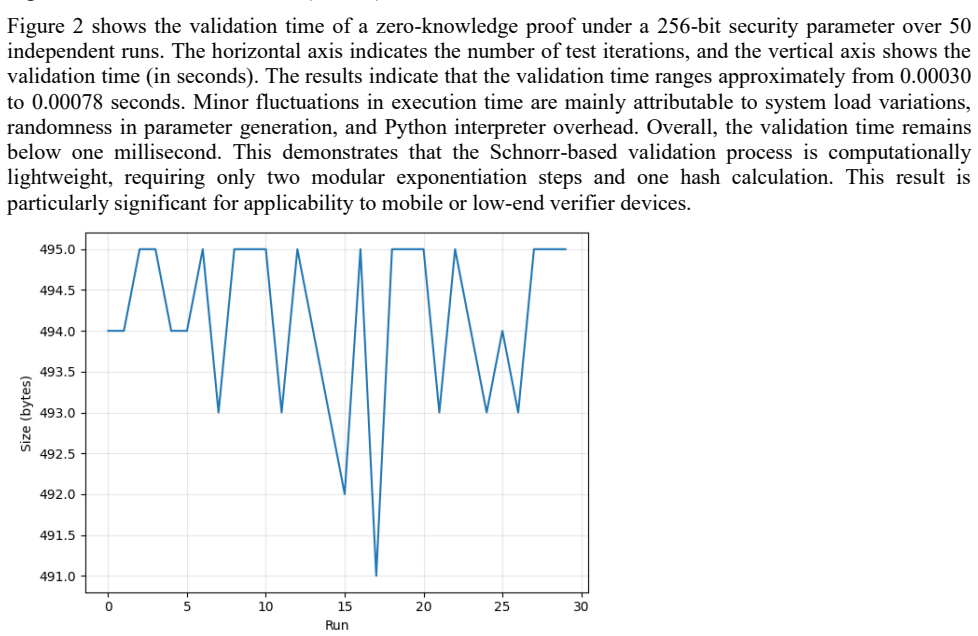
The central claim is that the proposed lightweight zero-knowledge authentication model, based on the Schnorr protocol with nonce and timestamp mechanisms and QR code embedding for proof transmission, enables verification of secret key knowledge without revealing the key. Simulation results show proof generation and verification in the millisecond range under 256-bit security, with constant proof size of approximately 0.5 KB, making it suitable for mobile and low-resource systems.
What carries the argument
Schnorr authentication protocol combined with QR code for proof embedding and nonce-timestamp for replay protection
If this is right
- Knowledge of the secret key can be verified without disclosing the key itself.
- Proof generation and verification occur in milliseconds for 256-bit security.
- Proof size remains constant at about 0.5 KB, fitting within QR code capacity.
- The protocol suits practical use in mobile and low-resource systems.
- Additional security against replay attacks is provided by nonce and timestamp.
Where Pith is reading between the lines
- Integration with smartphone cameras could allow seamless authentication flows without extra hardware.
- Adaptation for other constrained environments like IoT devices might be straightforward due to the lightweight design.
- Real-world testing in network conditions could reveal performance beyond simulation results.
- Comparison with other QR-based auth methods might highlight efficiency gains.
Load-bearing premise
The claims depend on the Schnorr protocol with nonce and timestamp providing sufficient protection against replay and other attacks, despite no formal security reduction being detailed.
What would settle it
An experiment showing a successful replay attack on a captured QR code proof or proof processing times exceeding several milliseconds in a deployed system would falsify the security and performance claims.
Figures


read the original abstract
This study proposes a lightweight Zero-Knowledge authentication model supported by QR codes. The approach is based on the Schnorr authentication protocol and provides an additional security layer against replay attacks through nonce and timestamp mechanisms. The proof data generated by the prover is embedded within a QR code and transmitted to the verifier. Thus, the system enables verification of knowledge of the secret key without revealing it. Simulation results show that proof generation and verification times under a 256-bit security level are in the millisecond range. Additionally, the proof size remains constant at approximately 0.5 KB, making it suitable for practical applications in terms of QR code capacity. The findings indicate that the proposed model is applicable in mobile and low-resource systems in terms of both security and performance.
Editorial analysis
A structured set of objections, weighed in public.
Referee Report
Summary. The manuscript proposes a lightweight zero-knowledge identification protocol based on the Schnorr authentication scheme, enhanced with nonce and timestamp mechanisms for replay attack resistance. The proof is transmitted via QR code, enabling verification of secret key knowledge without disclosure. Simulations under 256-bit security report millisecond proof generation and verification times with a constant proof size of approximately 0.5 KB, positioning the scheme for mobile and low-resource applications.
Significance. If the security properties hold, the work provides a practical, QR-assisted ZK authentication method with low computational overhead and small proof size, which could be valuable for resource-constrained environments. The reported simulation timings and constant size offer concrete performance data supporting practicality claims.
major comments (2)
- [Protocol description] Protocol description (likely §3): the integration of nonce N and timestamp T into the Schnorr transcript (commitment t, challenge c, response s) is described only at a high level without a binding equation (e.g., whether N and T are hashed into c or appended to the commitment). This is load-bearing for the replay-resistance claim, as an unbound transcript could be replayed with fresh N/T values.
- [Security analysis] Security analysis section: no formal security game (e.g., EUF-CMA style for identification or ZK simulator definition) or reduction to discrete-log hardness is supplied to justify that the augmented protocol resists forgery or replay. The claims rely on the established Schnorr properties plus informal nonce/timestamp additions.
minor comments (2)
- [Abstract and results] Abstract and results section: simulation timing and size numbers are reported without error bars, number of runs, hardware platform, or comparison baselines (e.g., plain Schnorr or other QR-ZK schemes), weakening the performance claims.
- [Protocol description] The manuscript invokes the established Schnorr protocol but does not include pseudocode or explicit equations for the full augmented flow, which would improve clarity for implementation.
Simulated Author's Rebuttal
We thank the referee for the constructive comments, which have helped clarify the presentation of our protocol and its security claims. We address each major comment below.
read point-by-point responses
-
Referee: [Protocol description] Protocol description (likely §3): the integration of nonce N and timestamp T into the Schnorr transcript (commitment t, challenge c, response s) is described only at a high level without a binding equation (e.g., whether N and T are hashed into c or appended to the commitment). This is load-bearing for the replay-resistance claim, as an unbound transcript could be replayed with fresh N/T values.
Authors: We agree that the original description in Section 3 was at too high a level and did not explicitly show the binding. In the revised manuscript we have added the precise equation: the challenge is computed as c = H(t || N || T || ID), where ID is the prover identifier and H is the hash function from the underlying Schnorr scheme. The verifier checks both the validity of the response s and the freshness of the supplied N and T. This binding is now stated explicitly together with a protocol diagram that shows the exact computation and verification steps. revision: yes
-
Referee: [Security analysis] Security analysis section: no formal security game (e.g., EUF-CMA style for identification or ZK simulator definition) or reduction to discrete-log hardness is supplied to justify that the augmented protocol resists forgery or replay. The claims rely on the established Schnorr properties plus informal nonce/timestamp additions.
Authors: The referee is correct that the original security section was informal. We have revised Section 4 to define a formal security game for the identification protocol that explicitly includes replay attempts by an adversary. We provide a sketch of the reduction to the discrete-logarithm assumption in the random-oracle model, extending the standard Schnorr argument to account for the nonce and timestamp freshness checks. A more detailed proof outline appears in the new appendix. revision: yes
Circularity Check
No circularity: protocol invokes established Schnorr with nonce/timestamp additions; performance from simulation, not fitted or self-defined
full rationale
The manuscript describes a protocol based on the standard Schnorr identification scheme augmented by nonce and timestamp mechanisms for replay resistance, with proof data embedded in QR codes. No equations or derivations reduce the claimed millisecond-range generation/verification times or constant 0.5 KB proof size to fitted parameters, self-citations, or definitional loops. The performance figures are presented as direct simulation outcomes under 256-bit security, and the security layer is described at the engineering level without invoking uniqueness theorems or ansatzes from prior self-work that would force the result by construction. The derivation chain remains self-contained against external benchmarks such as the known Schnorr protocol properties.
Axiom & Free-Parameter Ledger
axioms (1)
- domain assumption The Schnorr identification protocol satisfies zero-knowledge and soundness properties under standard cryptographic assumptions.
Reference graph
Works this paper leans on
-
[1]
Bonneau, J., Herley, C., van Oorschot, P. C., & Stajano, F. (2012). The quest to replace passwords: A framework for comparative evaluation of web authentication schemes. IEEE Symposium on Security and Privacy, 553–567
work page 2012
-
[2]
Nie, Y. (2025). WAScope: Detecting privacy data leakage with web application -specific API analysis. Journal of Web Systems and Security (Elsevier)
work page 2025
-
[3]
Alotaibi, A. (2025). A review of authentication techniques for Internet of Things (IoT) in smart cities. Sensors, 25(6)
work page 2025
-
[4]
Goldwasser, S., Micali, S., & Rackoff, C. (1985). The knowledge complexity of interactive proof systems. SIAM Journal on Computing, 18(1), 186–208
work page 1985
-
[5]
Fiat, A., & Shamir, A. (1986). How to prove yourself: Practical solutions to identification and signature problems. Advances in Cryptology — CRYPTO ’86, 186–194
work page 1986
-
[6]
Schnorr, C. P. (1991). Efficient signature generation by smart cards. Journal of Cryptology, 4(3), 161–174
work page 1991
-
[7]
Rotem, L., & Segev, G. (2021). Tighter Security for Schnorr Identification and Signatures: A High-Moment Forking Lemma for Σ-Protocols. Cryptology ePrint Archive, Paper 2021/971
work page 2021
-
[8]
Kieseberg, P., Leithner, M., Mulazzani, M., Munroe, P., Huber, M., Weippl, E., & Schrittwieser, S. (2010). QR code security. Proceedings of the 8th International Conference on Advances in Mobile Computing and Multimedia, 430–435
work page 2010
-
[9]
Moya, J. A. B., Ayoade, J., & Uddin, M. A. (2025). A Zero-Knowledge Proof-Enabled Blockchain-Based Academic Record Verification System. Sensors, 25(11), 3450
work page 2025
-
[10]
Maidine, K., EL-Yahyaoui, A., & Trichni, S. (2025). Quantum -Resistant Identity Management via ZK- STARKs and Decentralized Storage. Intelligent Processing and Security of Systems
work page 2025
-
[11]
Al-Karawi, A. L. S., & Akdeniz, R. (2026). Zero-Knowledge Federated Learning for Privacy-Preserving 5G Authentication. Preprints.org
work page 2026
-
[12]
Patil, C., Khare, R. A., & Jain, S. (2025). Age verification using zero -knowledge proof [manuscript]. ResearchGate
work page 2025
-
[13]
Alsuhibany, S. A. (2025). Innovative QR Code System for Tamper-Proof Generation and Fraud-Resistant Verification. Sensors, 25(13), 3855
work page 2025
-
[14]
Abbas, M. (2025). A Novel Two-Factor Authentication Scheme Based on QR Codes. Symmetry, 18(1), 69
work page 2025
-
[15]
Sarkhi, M., & Mishra, S. (2024). Detection of QR Code -based Cyberattacks using a Lightweight Deep Learning Model. Engineering, Technology & Applied Science Research, 14(4), 15209–15216
work page 2024
-
[16]
Gokulakrishnan, D., & Sinha, T. (2025, April). Scalable Supply Chain Product Source Verification Using Zero-Knowledge Proofs. In 2025 International Conference on Computing and Communication Technologies (ICCCT) (pp. 1-5). IEEE
work page 2025
-
[17]
R., Bobde, S., Tripahi, A., & Sahu, M
Raipurkar, A. R., Bobde, S., Tripahi, A., & Sahu, M. (2023, December). Digital identity system using blockchain-based self sovereign identity & zero knowledge proof. In 2023 OITS International Conference on Information Technology (OCIT) (pp. 611-616). IEEE
work page 2023
discussion (0)
Sign in with ORCID, Apple, or X to comment. Anyone can read and Pith papers without signing in.