Achieving α-Fairness in Clustered Cell-Free Networking: A Tight Relaxation Approach
Pith reviewed 2026-05-19 19:00 UTC · model grok-4.3
The pith
Reformulating the clustering problem as a continuous optimization establishes exact equivalence to the integer program for alpha-fairness across four cases.
A machine-rendered reading of the paper's core claim, the machinery that carries it, and where it could break.
Core claim
Using the closed-form deterministic equivalent of the ergodic sum capacity, the combinatorial clustering problem is reformulated as a continuous optimization problem. For each of four cases according to the value of alpha, the exact equivalence between the original integer program and its continuous relaxation is established, and efficient algorithms with guaranteed convergence are developed.
What carries the argument
The tight continuous relaxation of the integer alpha-fair clustering program, which becomes equivalent to the discrete version once the deterministic equivalent of capacity is substituted.
If this is right
- The alpha parameter provides a unified way to tune the balance between aggregate spectral efficiency and inter-subnetwork fairness.
- For each of the four alpha cases the relaxation is tight, so the continuous solution is optimal for the original integer problem.
- Efficient algorithms with guaranteed convergence are obtained for all four cases.
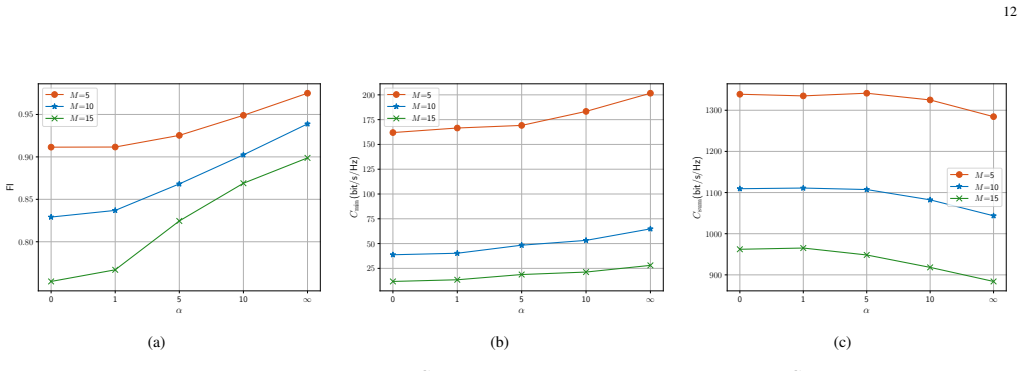
- The approach yields up to 11 percent higher Jain's fairness index and 45 percent higher minimum subnetwork capacity at the cost of only 5 percent lower aggregate throughput.
Where Pith is reading between the lines
- The same tightness argument might apply to other discrete assignment problems such as user-to-subnetwork association or joint clustering and power control.
- Direct validation of the deterministic equivalent on measured channels rather than ideal models would test how much the equivalence survives in practice.
- The method could be paired with low-complexity heuristics for very large networks where even the relaxed problem remains expensive.
Load-bearing premise
The closed-form deterministic equivalent of the ergodic sum capacity remains accurate enough after clustering decisions are made that the relaxed solutions deliver the claimed fairness and rate performance on the true system.
What would settle it
On small networks where every possible clustering can be enumerated, compare the cluster assignment and true ergodic performance obtained from the continuous relaxation against the exact integer optimum to check whether they coincide.
Figures



read the original abstract
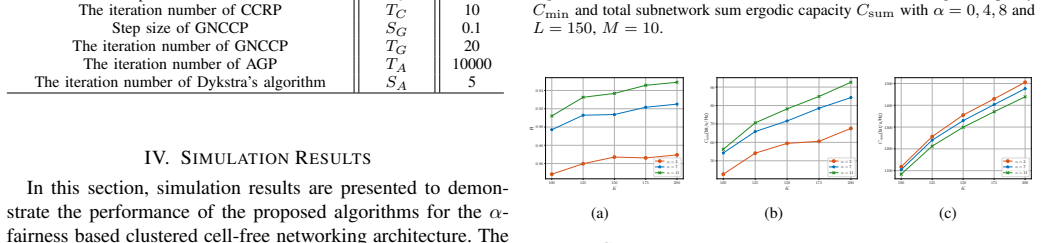
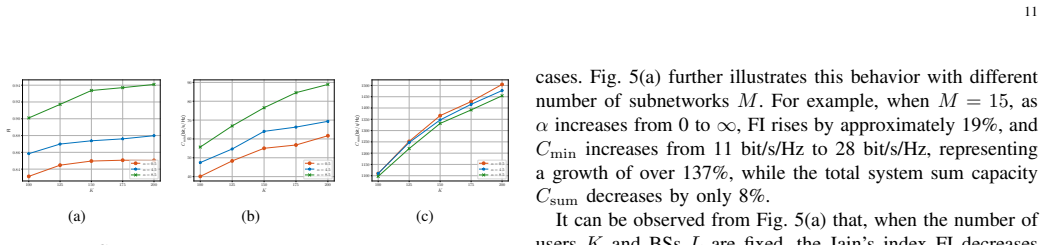
Clustered cell-free networking has emerged as a promising architecture to balance the high performance of cell-free massive MIMO and the scalability of traditional cellular systems. However, achieving fairness across subnetworks remains a critical yet largely unsolved challenge. This paper investigates the fairness problem in clustered cell-free networking and proposes a unified and tunable alpha-fairness scheme that effectively balances overall spectral efficiency and inter-subnetwork fairness. Using the closed-form deterministic equivalent of the ergodic sum capacity, we reformulate the combinatorial clustering problem as a continuous optimization problem. Leveraging the concavity/convexity properties of the alpha-fair objective, we classify the problem into four distinct cases according to the value of alpha. For each case, we establish the exact equivalence between the original integer program and its continuous relaxation, and develop efficient algorithms with guaranteed convergence. Extensive simulations show that the proposed scheme achieves up to 11% improvement in Jain's fairness index and 45% gain in minimum subnetwork capacity, with only a negligible 5% reduction in aggregate throughput.
Editorial analysis
A structured set of objections, weighed in public.
Referee Report
Summary. The paper addresses fairness in clustered cell-free massive MIMO by proposing a tunable α-fairness framework. It replaces the ergodic sum-capacity objective with its closed-form deterministic equivalent, converts the integer clustering problem into a continuous relaxation, and partitions the problem into four cases according to the value of α. For each case the authors claim to prove exact equivalence between the original integer program and the continuous relaxation, then supply convergent algorithms. Simulations report up to 11 % improvement in Jain’s fairness index and 45 % gain in minimum subnetwork rate at a 5 % cost in aggregate throughput.
Significance. If the deterministic-equivalent equivalence and convergence results hold and the approximation error does not materially distort the α-fair optimum, the work supplies a computationally tractable method for controlling the efficiency–fairness trade-off in scalable cell-free deployments. The explicit case-by-case analysis and guaranteed-convergence algorithms constitute concrete algorithmic contributions.
major comments (2)
- [§4] §4 (Equivalence proofs for the four α cases): the claimed exact equivalence is established between the integer program and its continuous relaxation when the objective is the deterministic equivalent of ergodic sum capacity. No error bound, uniform convergence result, or sensitivity analysis is supplied showing that a solution optimal for the approximated objective remains optimal (or near-optimal) for the true ergodic rates once clustering is fixed; in finite-dimensional regimes the approximation error can be non-uniform across subnetworks and directly affects the α-fairness metric.
- [§5] §5 (Simulation setup and evaluation): the optimization is performed with the deterministic equivalent while the reported fairness and rate gains are presumably evaluated with the true ergodic quantities. Without an explicit comparison of the two objectives on the same clustering solutions, it is impossible to verify that the claimed 11 % fairness and 45 % minimum-rate improvements survive the approximation gap.
minor comments (2)
- [§3] Notation for the deterministic equivalent (e.g., the definition of the effective channel matrix after clustering) is introduced without a self-contained reference to the underlying random-matrix result; a short appendix recalling the key steps would improve readability.
- [Fig. 3] Figure 3 caption does not state whether the plotted curves are obtained from the deterministic equivalent or from Monte-Carlo ergodic-rate evaluation.
Simulated Author's Rebuttal
We thank the referee for the constructive comments. We address each major comment below and indicate planned revisions to strengthen the manuscript.
read point-by-point responses
-
Referee: [§4] §4 (Equivalence proofs for the four α cases): the claimed exact equivalence is established between the integer program and its continuous relaxation when the objective is the deterministic equivalent of ergodic sum capacity. No error bound, uniform convergence result, or sensitivity analysis is supplied showing that a solution optimal for the approximated objective remains optimal (or near-optimal) for the true ergodic rates once clustering is fixed; in finite-dimensional regimes the approximation error can be non-uniform across subnetworks and directly affects the α-fairness metric.
Authors: We thank the referee for this observation. The exact equivalence we establish in Section 4 is between the integer clustering program and its continuous relaxation when the objective is the deterministic equivalent of the ergodic sum capacity; this is stated explicitly for each of the four α cases. The deterministic equivalent becomes exact in the large-system limit, but we acknowledge that no formal error bounds or sensitivity analysis for the true ergodic rates in finite dimensions are provided. Our simulations evaluate the final performance metrics with Monte Carlo estimates of the true ergodic rates, and the reported gains are observed under that evaluation. In the revised version we will add a short discussion of the approximation quality in Section 4 together with numerical comparisons of the deterministic-equivalent objective versus the true ergodic objective on the obtained clusterings. revision: partial
-
Referee: [§5] §5 (Simulation setup and evaluation): the optimization is performed with the deterministic equivalent while the reported fairness and rate gains are presumably evaluated with the true ergodic quantities. Without an explicit comparison of the two objectives on the same clustering solutions, it is impossible to verify that the claimed 11 % fairness and 45 % minimum-rate improvements survive the approximation gap.
Authors: We agree that an explicit side-by-side comparison would be helpful. The optimization in Section 5 uses the deterministic equivalent, while the fairness index and minimum-rate figures are computed from Monte Carlo estimates of the true ergodic rates. We will revise the manuscript to include a direct comparison (e.g., a table or additional plot) of the deterministic-equivalent objective value against the true ergodic sum capacity for the same clustering solutions, thereby quantifying the approximation gap and confirming that the reported improvements persist under the true objective. revision: yes
Circularity Check
No significant circularity; equivalence holds for reformulated deterministic-equivalent problem
full rationale
The derivation begins by invoking the closed-form deterministic equivalent of ergodic sum capacity as an external modeling tool to convert the combinatorial clustering task into a continuous optimization problem. For each of the four alpha cases the paper then proves exact equivalence between the resulting integer program and its continuous relaxation, followed by convergent algorithms. This equivalence is a mathematical property internal to the approximated objective and does not reduce to a self-definition, a fitted parameter renamed as prediction, or a load-bearing self-citation chain. The deterministic equivalent is treated as an independent input whose accuracy is an external modeling assumption rather than a derived claim; simulation results are presented separately as empirical validation. No quoted step collapses the claimed result to its own inputs by construction.
Axiom & Free-Parameter Ledger
axioms (1)
- domain assumption The closed-form deterministic equivalent accurately captures the ergodic sum capacity for the purpose of clustering optimization.
Lean theorems connected to this paper
-
IndisputableMonolith/Cost/FunctionalEquation.leanwashburn_uniqueness_aczel unclear?
unclearRelation between the paper passage and the cited Recognition theorem.
Using the closed-form deterministic equivalent of the ergodic sum capacity, we reformulate the combinatorial clustering problem as a continuous optimization problem. Leveraging the concavity/convexity properties of the α-fair objective, we classify the problem into four distinct cases according to the value of α. For each case, we establish the exact equivalence between the original integer program and its continuous relaxation
-
IndisputableMonolith/Foundation/AlphaCoordinateFixation.leanalpha_pin_under_high_calibration unclear?
unclearRelation between the paper passage and the cited Recognition theorem.
u_α(C_m) ≜ ln(C_m) for α=1, C_m^{1-α}/(1-α) otherwise
What do these tags mean?
- matches
- The paper's claim is directly supported by a theorem in the formal canon.
- supports
- The theorem supports part of the paper's argument, but the paper may add assumptions or extra steps.
- extends
- The paper goes beyond the formal theorem; the theorem is a base layer rather than the whole result.
- uses
- The paper appears to rely on the theorem as machinery.
- contradicts
- The paper's claim conflicts with a theorem or certificate in the canon.
- unclear
- Pith found a possible connection, but the passage is too broad, indirect, or ambiguous to say the theorem truly supports the claim.
Reference graph
Works this paper leans on
-
[1]
Towards load- balanced clustered cell-free networking: A tight relaxation approach,
C. Deng, J. Fan, B. Ren, Z. Lyu, J. Wang, and H. Wu, “Towards load- balanced clustered cell-free networking: A tight relaxation approach,” in Proc. IEEE WCNC, Mar. 2025, pp. 1–6
work page 2025
-
[2]
A vision of 6G wireless systems: Applications, trends, technologies, and open research problems,
W. Saad, M. Bennis, and M. Chen, “A vision of 6G wireless systems: Applications, trends, technologies, and open research problems,”IEEE Network, vol. 34, no. 3, pp. 134–142, May/Jun. 2020
work page 2020
-
[3]
Cell edge performance of cellular mobile systems,
X. You, D. Wang, P. Zhu, and B. Sheng, “Cell edge performance of cellular mobile systems,”IEEE J. Sel. Areas Commun., vol. 29, no. 6, pp. 1139–1150, Jun. 2011
work page 2011
- [4]
-
[5]
Shannon-theoretic approach to a Gaussian cellular multiple- access channel,
A. Wyner, “Shannon-theoretic approach to a Gaussian cellular multiple- access channel,”IEEE Trans. Inf. Theory, vol. 40, no. 6, pp. 1713–1727, Nov. 1994
work page 1994
-
[6]
Coordinated multipoint: Concepts, performance, and field trial results,
R. Irmer, H. Droste, P. Marsch, M. Grieger, G. Fettweis, S. Brueck, H.-P. Mayer, L. Thiele, and V . Jungnickel, “Coordinated multipoint: Concepts, performance, and field trial results,”IEEE Commun. Mag., vol. 49, no. 2, pp. 102–111, Feb. 2011
work page 2011
-
[7]
Cell-free massive MIMO versus small cells,
H. Q. Ngo, A. Ashikhmin, H. Yang, E. G. Larsson, and T. L. Marzetta, “Cell-free massive MIMO versus small cells,”IEEE Trans. Wireless Commun., vol. 16, no. 3, pp. 1834–1850, Jan. 2017
work page 2017
-
[8]
Making cell-free massive MIMO competitive with MMSE processing and centralized implementation,
E. Bj ¨ornson and L. Sanguinetti, “Making cell-free massive MIMO competitive with MMSE processing and centralized implementation,” IEEE Trans. Wireless Commun., vol. 19, no. 1, pp. 77–90, Jan. 2020
work page 2020
-
[9]
Ubiquitous cell-free massive MIMO communications,
G. Interdonato, E. Bj ¨ornson, H. Quoc Ngo, P. Frenger, and E. G. Larsson, “Ubiquitous cell-free massive MIMO communications,”EURASIP J. Wireless Commun. Networking, vol. 2019, no. 1, pp. 1–13, Aug. 2019
work page 2019
-
[10]
Scalable cell-free massive MIMO systems,
E. Bj ¨ornson and L. Sanguinetti, “Scalable cell-free massive MIMO systems,”IEEE Trans. Commun., vol. 68, no. 7, pp. 4247–4261, Jul. 2020
work page 2020
-
[11]
Cluster-wise processing in fronthaul-aware cell-free massive MIMO systems,
Z. Mobini, A. H. Gokceoglu, L. Wang, G. Peters, H. Shin, and H. Q. Ngo, “Cluster-wise processing in fronthaul-aware cell-free massive MIMO systems,”IEEE Trans. Wireless Commun., pp. 1–1, Oct. 2025
work page 2025
-
[12]
Optimal decomposition for large-scale infrastructure- based wireless networks,
L. Dai and B. Bai, “Optimal decomposition for large-scale infrastructure- based wireless networks,”IEEE Trans. Wireless Commun., vol. 16, no. 8, pp. 4956–4969, Aug. 2017
work page 2017
-
[13]
Clustered cell-free networking: A graph partitioning approach,
J. Wang, L. Dai, L. Yang, and B. Bai, “Clustered cell-free networking: A graph partitioning approach,”IEEE Trans. Wireless Commun., vol. 22, no. 8, pp. 5349–5364, Aug. 2023
work page 2023
-
[14]
Rate-constrained network decomposition for clustered cell-free networking,
J. Wang, L. Dai, L. Yang, and B. Bai, “Rate-constrained network decomposition for clustered cell-free networking,” inProc. IEEE ICC, May 2022, pp. 2549–2554
work page 2022
-
[15]
A sequential minK-cut approach for sum rate maximization of clustered cell-free networking,
B. Ren, C. Deng, H. Hao, H. Wu, and J. Wang, “A sequential minK-cut approach for sum rate maximization of clustered cell-free networking,” inProc. IEEE ICC, Jun. 2024, pp. 4900–4905
work page 2024
-
[16]
X. Zeng, J. Wang, K. Yue, M. Dong, and B. Bai, “Tunable weighted kernelk-means for clustered cell-free networking acceleration and beam on-off control,” inProc. IEEE ICC, June 2024, pp. 4311–4316
work page 2024
-
[17]
B. Ren, H. Hao, Z. Lyu, J. Peng, J. Wang, and H. Wu, “Tight differ- entiable relaxation of sum ergodic capacity maximization for clustered cell-free networking,” inProc. IEEE ISIT, Jul. 2024, pp. 2448–2453
work page 2024
-
[18]
F. Xia, J. Wang, and L. Dai, “Optimizing clustered cell-free networking for sum ergodic capacity maximization with joint processing constraint,” IEEE Trans. Wireless Commun., vol. 24, no. 1, pp. 571–584, Jan. 2025
work page 2025
-
[19]
C 2: A capacity-centric architecture toward future wireless networking,
L. Yang, P. Li, M. Dong, B. Bai, D. Zaporozhets, X. Chen, W. Han, and B. Li, “C 2: A capacity-centric architecture toward future wireless networking,”IEEE Trans. Wireless Commun., vol. 21, no. 10, pp. 8134– 8147, Oct. 2022
work page 2022
-
[20]
CGN: A capacity-guaranteed network architecture for future ultra-dense wireless systems,
C. Deng, L. Yang, H. Wu, D. Zaporozhets, M. Dong, and B. Bai, “CGN: A capacity-guaranteed network architecture for future ultra-dense wireless systems,” inProc. IEEE ICC, May 2022, pp. 1853–1858
work page 2022
-
[21]
Fair end-to-end window-based congestion control,
J. Mo and J. Walrand, “Fair end-to-end window-based congestion control,”IEEE/ACM Trans. Networking, vol. 8, no. 5, pp. 556–567, Oct. 2000
work page 2000
-
[22]
A quantitative measure of fairness and discrimination,
R. K. Jain, D.-M. W. Chiu, W. R. Haweet al., “A quantitative measure of fairness and discrimination,”Eastern Research Laboratory, Digital Equipment Corporation, Hudson, MA, vol. 21, no. 1, pp. 2022–2023, 1984
work page 2022
-
[23]
Deterministic equivalents for certain functionals of large random matrices,
W. Hachem, P. Loubaton, and J. Najim, “Deterministic equivalents for certain functionals of large random matrices,”Ann. Appl. Probab., vol. 17, no. 3, p. 875–930, June 2007
work page 2007
-
[24]
Optimal power allocation scheme for non- orthogonal multiple access withα-fairness,
P. Xu and K. Cumanan, “Optimal power allocation scheme for non- orthogonal multiple access withα-fairness,”IEEE J. Sel. Areas Com- mun., vol. 35, no. 10, pp. 2357–2369, Oct. 2017
work page 2017
-
[25]
Enhancing user fairness in wireless powered communication networks with STAR-RIS,
G. Zhu, X. Mu, L. Guo, A. Huang, and S. Xu, “Enhancing user fairness in wireless powered communication networks with STAR-RIS,”IEEE Internet Things J., vol. 12, no. 3, pp. 2659–2673, Feb. 2025
work page 2025
-
[26]
Fairness scheduling in user-centric cell-free massive MIMO wireless networks,
F. G ¨ottsch, N. Osawa, I. Kanno, T. Ohseki, and G. Caire, “Fairness scheduling in user-centric cell-free massive MIMO wireless networks,” IEEE Trans. Wireless Commun., vol. 23, no. 9, pp. 11 942–11 957, Sep. 2024
work page 2024
-
[27]
Fairness in wire- less networks:issues, measures and challenges,
H. SHI, R. V . Prasad, E. Onur, and I. Niemegeers, “Fairness in wire- less networks:issues, measures and challenges,”IEEE Commun. Surv. Tutorials, vol. 16, no. 1, pp. 5–24, First Quarter 2014
work page 2014
-
[28]
Fairness for non-orthogonal multiple access in 5G systems,
S. Timotheou and I. Krikidis, “Fairness for non-orthogonal multiple access in 5G systems,”IEEE Signal Process Lett., vol. 22, no. 10, pp. 1647–1651, Oct. 2015
work page 2015
-
[29]
On the outage performance of non-orthogonal multiple access with 1-bit feedback,
P. Xu, Y . Yuan, Z. Ding, X. Dai, and R. Schober, “On the outage performance of non-orthogonal multiple access with 1-bit feedback,” IEEE Trans. Wireless Commun., vol. 15, no. 10, pp. 6716–6730, Oct. 2016
work page 2016
-
[30]
Fairness of user clustering in MIMO non-orthogonal multiple access systems,
Y . Liu, M. Elkashlan, Z. Ding, and G. K. Karagiannidis, “Fairness of user clustering in MIMO non-orthogonal multiple access systems,”IEEE Commun. Lett., vol. 20, no. 7, pp. 1465–1468, Jul. 2016
work page 2016
-
[31]
Proportional fairness-aware task scheduling in space-air-ground integrated networks,
G. Sun, Y . Wang, H. Yu, and M. Guizani, “Proportional fairness-aware task scheduling in space-air-ground integrated networks,”IEEE Trans. Serv. Comput., vol. 17, no. 6, pp. 4125–4137, Nov.-Dec. 2024. 15
work page 2024
-
[32]
An axiomatic theory of fairness in network resource allocation,
T. Lan, D. Kao, M. Chiang, and A. Sabharwal, “An axiomatic theory of fairness in network resource allocation,” inProc. IEEE INFOCOM, Mar. 2010, pp. 1–9
work page 2010
-
[33]
Rate control for com- munication networks: shadow prices, proportional fairness and stability,
F. P. Kelly, A. K. Maulloo, and D. K. H. Tan, “Rate control for com- munication networks: shadow prices, proportional fairness and stability,” Journal of the Operational Research society, vol. 49, no. 3, pp. 237–252, Mar. 1998
work page 1998
-
[34]
Foundations of user- centric cell-free massive MIMO,
¨O. T. Demir, E. Bj ¨ornson, L. Sanguinettiet al., “Foundations of user- centric cell-free massive MIMO,”Found. Trends Signal Process., vol. 14, no. 3-4, pp. 162–472, 2021
work page 2021
-
[35]
Graph matching by simplified convex-concave relaxation procedure,
Z. Liu, H. Qiao, X. Yang, and S. C. Hoi, “Graph matching by simplified convex-concave relaxation procedure,”Int. J. Comput. Vision, vol. 109, pp. 169–186, 2014
work page 2014
-
[36]
GNCCP—graduated nonconvexityand concavity procedure,
Z. Liu and H. Qiao, “GNCCP—graduated nonconvexityand concavity procedure,”IEEE Trans. Pattern Anal. Mach. Intell., vol. 36, no. 6, pp. 1258–1267, 2013
work page 2013
-
[37]
An algorithm for quadratic programming,
M. Frank, P. Wolfeet al., “An algorithm for quadratic programming,” Naval research logistics quarterly, vol. 3, no. 1-2, pp. 95–110, 1956
work page 1956
-
[38]
The optimal production transport: Model and algorithm,
F. Jie, T. Wu, and H. Wu, “The optimal production transport: Model and algorithm,”East Asian Journal on Applied Mathematics, vol. 15, no. 4, pp. 787–816, 2025
work page 2025
-
[39]
W. Pan, J. Shen, and Z. Xu, “An efficient algorithm for nonconvex-linear minimax optimization problem and its application in solving weighted maximin dispersion problem,”Comput. Optim. Appl., vol. 78, pp. 287– 306, 2021
work page 2021
-
[40]
S. P. Boyd and L. Vandenberghe,Convex optimization. Cambridge university press, 2004
work page 2004
-
[41]
S. Martello and P. Toth, “Linear assignment problems,” inNorth-Holland Mathematics Studies. Elsevier, 1987, vol. 132, pp. 259–282
work page 1987
-
[42]
The frank-wolfe algorithm: a short introduction,
S. Pokutta, “The frank-wolfe algorithm: a short introduction,”Jahres- bericht der Deutschen Mathematiker-Vereinigung, vol. 126, no. 1, pp. 3–35, 2024
work page 2024
-
[43]
H. W. Kuhn and A. W. Tucker, “Nonlinear programming,” inTraces and emergence of nonlinear programming. Springer, 2013, pp. 247–258
work page 2013
-
[44]
Sinkhorn distances: Lightspeed computation of optimal transport,
M. Cuturi, “Sinkhorn distances: Lightspeed computation of optimal transport,”Advances in neural information processing systems, vol. 26, 2013
work page 2013
-
[45]
Balanced k-means for clustering,
M. I. Malinen and P. Fr ¨anti, “Balanced k-means for clustering,” in Structural, Syntactic, and Statistical Pattern Recognition: Joint IAPR International Workshop, S+ SSPR 2014, Joensuu, Finland, August 20- 22, 2014. Proceedings. Springer, 2014, pp. 32–41
work page 2014
-
[46]
Solving a class of non-convex min-max games using iterative first order methods,
M. Nouiehed, M. Sanjabi, T. Huang, J. D. Lee, and M. Razaviyayn, “Solving a class of non-convex min-max games using iterative first order methods,” inProc. NeurIPS, vol. 32, Dec. 2019
work page 2019
-
[47]
The theory of max-min, with applications,
J. M. Danskin, “The theory of max-min, with applications,”SIAM J. Appl. Math, vol. 14, no. 4, pp. 641–664, 1966
work page 1966
-
[48]
Nonconvex min-max optimization: Applications, challenges, and recent theoretical advances,
M. Razaviyayn, T. Huang, S. Lu, M. Nouiehed, M. Sanjabi, and M. Hong, “Nonconvex min-max optimization: Applications, challenges, and recent theoretical advances,”IEEE Signal Process Mag., vol. 37, no. 5, pp. 55–66, Sep. 2020
work page 2020
-
[49]
A method for finding projections onto the intersection of convex sets in Hilbert spaces,
J. P. Boyle and R. L. Dykstra, “A method for finding projections onto the intersection of convex sets in Hilbert spaces,” inAdvances in Order Restricted Statistical Inference. Springer, 1986, pp. 28–47
work page 1986
-
[50]
Dykstra’s algorithm with Bregman projections: A convergence proof,
H. H. Bauschke and A. S. Lewis, “Dykstra’s algorithm with Bregman projections: A convergence proof,”Optimization, vol. 48, no. 4, pp. 409– 427, 2000
work page 2000
-
[51]
Two Bregman projection methods for solving variational inequalities,
D. V . Hieu and S. Reich, “Two Bregman projection methods for solving variational inequalities,”Optimization, vol. 71, no. 7, pp. 1777–1802, 2022
work page 2022
discussion (0)
Sign in with ORCID, Apple, or X to comment. Anyone can read and Pith papers without signing in.