WhiteTesseract: Reframing the Interpretation of Cultural Heritage through XR and Conversational AI
Pith reviewed 2026-05-19 20:04 UTC · model grok-4.3
pith:WDO5PSBN Add to your LaTeX paper
What is a Pith Number?\usepackage{pith}
\pithnumber{WDO5PSBN}
Prints a linked pith:WDO5PSBN badge after your title and writes the identifier into PDF metadata. Compiles on arXiv with no extra files. Learn more
The pith
WhiteTesseract combines XR and conversational AI to extend viewing time and deepen visitor inquiries in physical cultural heritage exhibitions.
A machine-rendered reading of the paper's core claim, the machinery that carries it, and where it could break.
Core claim
WhiteTesseract enables in-situ interpretation through artwork recognition, diminished reality to reduce distractions, and large language models for context-aware dialogue, thereby supporting personalized reflection while maintaining the physical and social contexts of the exhibition, as evidenced by increased average viewing duration from 35.3 to 98.3 seconds and 60 percent of 529 interactions extending to analytical, emotional, and comparative inquiries.
What carries the argument
WhiteTesseract's integration of spatial intelligence for artwork recognition, diminished reality via XR to focus attention, and large language models for context-aware dialogue.
If this is right
- Visitors spend significantly longer with artworks when the system modulates the environment and supports adaptive dialogue.
- A majority of AI interactions shift from factual to reflective and comparative types.
- Physical and social contexts of exhibitions remain intact while personal context is strengthened.
- Technical and social constraints must be addressed for broader real-world use in exhibitions.
Where Pith is reading between the lines
- The approach could scale to other types of cultural sites such as historical landmarks or science museums.
- Curators might redesign exhibit layouts to incorporate selective focus tools like diminished reality.
- Longer-term studies could test whether repeated use builds greater cultural literacy across diverse visitor groups.
Load-bearing premise
The effects observed in a controlled study with 26 participants would hold in an uncontrolled public exhibition setting with free movement and varying social contexts.
What would settle it
Observing no significant difference in viewing duration or query depth in a larger field deployment with free-moving visitors would falsify the claim of enriched engagement.
Figures




read the original abstract
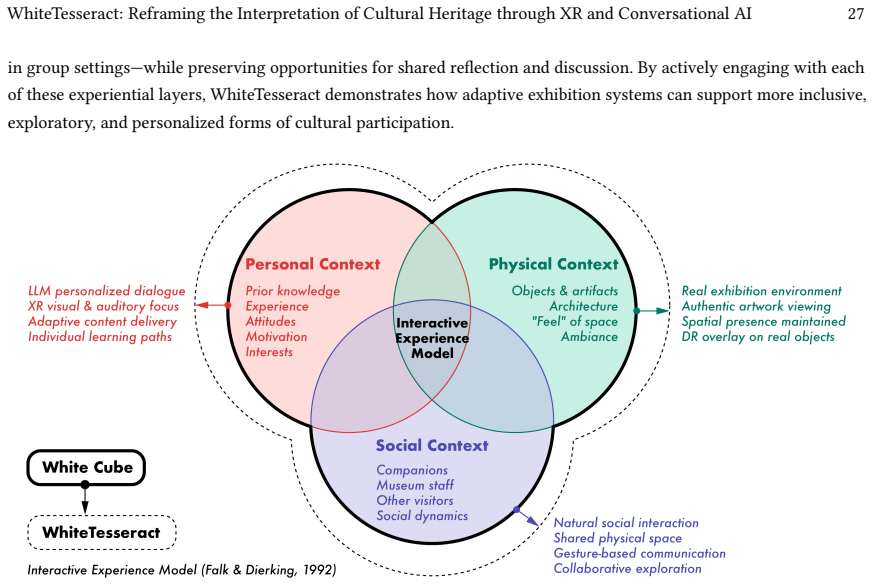
Cultural heritage exhibitions often struggle to sustain attention and support reflective engagement. Physical exhibitions rely on fixed interpretive aids that lack adaptability to individual backgrounds or curiosity, and their effectiveness depends heavily on a visitor's Personal Context, prior knowledge, and cultural literacy. Meanwhile, digital exhibitions prioritize convenience and accessibility but risk weakening the Physical and Social Contexts that define embodied cultural experience. WhiteTesseract addresses this gap by enabling in-situ interpretation through high-resolution XR and conversational AI. The system integrates spatial intelligence via artwork recognition to allow visitors to selectively reduce environmental distractions (via diminished reality) and engage in context-aware dialogue (via large language models). The goal is to preserve the richness of the physical and social environment while providing a flexible space for personal reflection, enhancing Personal Context without compromising physical authenticity. We deployed the system in a Claude Monet exhibition and conducted a controlled user study with 26 participants. Quantitative results showed that WhiteTesseract modulation significantly increased average viewing duration from 35.3 to 98.3 seconds (p < 0.001). Analysis of 529 visitor-AI interactions revealed that 60% extended beyond factual queries to include analytical, emotional, and comparative inquiries. These findings demonstrate how XR and AI can enrich the physical exhibition experience by supporting deeper, more personalized engagement without displacing the embodied value of cultural heritage. We discuss technical and social constraints for real-world deployment and limitations of our controlled setting.
Editorial analysis
A structured set of objections, weighed in public.
Referee Report
Summary. The manuscript introduces WhiteTesseract, an XR and conversational AI system for in-situ cultural heritage interpretation. It uses artwork recognition for diminished reality to reduce distractions and LLMs for context-aware dialogue, aiming to enhance Personal Context while preserving Physical and Social Contexts. A controlled user study with 26 participants at a Claude Monet exhibition reports that the system increased average viewing duration from 35.3 to 98.3 seconds (p < 0.001) and that 60% of 529 visitor-AI interactions involved analytical, emotional, or comparative inquiries beyond factual queries.
Significance. If the quantitative results are robust, the work offers a concrete demonstration of how XR and AI can support deeper, personalized engagement in physical exhibitions. The specific metrics on viewing duration and interaction types provide measurable evidence that could guide future systems balancing digital adaptability with embodied heritage experience.
major comments (2)
- [User Study] User Study section: The controlled deployment with 26 participants reports a significant increase in viewing duration (35.3 s to 98.3 s, p < 0.001) but provides no details on the baseline condition, randomization procedure, participant recruitment, or how the non-modulated control experience was structured. These omissions directly affect the interpretability of the central statistical claim.
- [Results] Results section: The analysis of 529 interactions claims that 60% extended to analytical, emotional, and comparative inquiries, yet no information is given on the classification scheme, inter-rater reliability, or how the post-hoc categorization was performed. This classification underpins the claim of deeper engagement.
minor comments (2)
- [Abstract] Abstract: The mention of 'limitations of our controlled setting' is noted but not expanded with concrete examples of how Personal, Physical, and Social Contexts might interact differently in an uncontrolled exhibition.
- [Discussion] Discussion: Technical constraints for real-world deployment are referenced but could benefit from more explicit discussion of scalability or hardware requirements for the spatial intelligence component.
Simulated Author's Rebuttal
We appreciate the referee's comments, which highlight important areas for improving the transparency of our methodology and analysis. We respond to each major comment below and commit to making the necessary revisions.
read point-by-point responses
-
Referee: [User Study] User Study section: The controlled deployment with 26 participants reports a significant increase in viewing duration (35.3 s to 98.3 s, p < 0.001) but provides no details on the baseline condition, randomization procedure, participant recruitment, or how the non-modulated control experience was structured. These omissions directly affect the interpretability of the central statistical claim.
Authors: We agree that these details are essential for interpreting the results. In the revised manuscript, we will expand the User Study section to provide a complete description of the baseline condition, randomization procedure, participant recruitment methods, and the structure of the control experience. revision: yes
-
Referee: [Results] Results section: The analysis of 529 interactions claims that 60% extended to analytical, emotional, and comparative inquiries, yet no information is given on the classification scheme, inter-rater reliability, or how the post-hoc categorization was performed. This classification underpins the claim of deeper engagement.
Authors: We agree that the Results section requires more information on how the interactions were classified. We will revise the manuscript to include the classification scheme, details on inter-rater reliability, and the process for post-hoc categorization. revision: yes
Circularity Check
No circularity: empirical user study reports direct measurements
full rationale
The paper describes the WhiteTesseract XR/AI system and reports results from a controlled user study with 26 participants, including measured increases in viewing duration (35.3 s to 98.3 s) and classification of 529 interactions. No equations, derivations, fitted parameters, or self-citations appear in the provided text that would reduce any claim to its own inputs by construction. The central findings are presented as empirical observations from the study protocol rather than predictions derived from prior fitted values or uniqueness theorems. This makes the work self-contained against external benchmarks with no load-bearing circular steps.
Axiom & Free-Parameter Ledger
axioms (1)
- domain assumption Increased viewing duration and shift toward analytical queries indicate deeper reflective engagement with cultural heritage.
invented entities (1)
-
WhiteTesseract system
no independent evidence
Lean theorems connected to this paper
-
IndisputableMonolith/Foundation/AbsoluteFloorClosure.leanabsolute_floor_iff_bare_distinguishability unclear?
unclearRelation between the paper passage and the cited Recognition theorem.
WhiteTesseract integrates spatial intelligence via artwork recognition to allow visitors to selectively reduce environmental distractions (via diminished reality) and engage in context-aware dialogue (via large language models).
-
IndisputableMonolith/Cost/FunctionalEquation.leanwashburn_uniqueness_aczel unclear?
unclearRelation between the paper passage and the cited Recognition theorem.
Quantitative results showed that WhiteTesseract modulation significantly increased average viewing duration from 35.3 to 98.3 seconds (p < 0.001).
What do these tags mean?
- matches
- The paper's claim is directly supported by a theorem in the formal canon.
- supports
- The theorem supports part of the paper's argument, but the paper may add assumptions or extra steps.
- extends
- The paper goes beyond the formal theorem; the theorem is a base layer rather than the whole result.
- uses
- The paper appears to rely on the theorem as machinery.
- contradicts
- The paper's claim conflicts with a theorem or certificate in the canon.
- unclear
- Pith found a possible connection, but the passage is too broad, indirect, or ambiguous to say the theorem truly supports the claim.
Reference graph
Works this paper leans on
-
[1]
Panos Achlioptas, Maks Ovsjanikov, Kilichbek Haydarov, Mohamed Elhoseiny, and Leonidas J Guibas. 2021. Artemis: Affective language for visual art. InProceedings of the IEEE/CVF Conference on Computer Vision and Pattern Recognition. 11569–11579
work page 2021
-
[2]
Nasim Ahmed, Peng Wu, Kaiming Huang, Sungchul Jung, Hansol Rheem, Gang Tan, Mahdi Imani, and Rifatul Islam. 2025. Human Task Performance and Associated Internal States in Extended Reality: A Systematic Review of Cognitive, Psychophysiological, and Physiological Dimensions.Frontiers in Virtual Reality6 (2025), 1589256
work page 2025
-
[3]
Ahmed Alnagrat, Rizalafande Che Ismail, Syed Zulkarnain Syed Idrus, and Rawad Mansour Abdulhafith Alfaqi. 2022. A review of extended reality (XR) technologies in the future of human education: Current trend and future opportunity.Journal of Human Centered Technology1, 2 (2022), 81–96
work page 2022
-
[4]
1969.School learning: An introduction to educational psychology
David P Ausubel and Floyd G Robinson. 1969.School learning: An introduction to educational psychology. Holt, Rinehart Winston. 32 Li et al
work page 1969
-
[5]
Mafkereseb Kassahun Bekele, Roberto Pierdicca, Emanuele Frontoni, Eva Savina Malinverni, and James Gain. 2018. A survey of augmented, virtual, and mixed reality for cultural heritage.Journal on Computing and Cultural Heritage (JOCCH)11, 2 (2018), 1–36
work page 2018
-
[6]
Emily M Bender and Batya Friedman. 2018. Data statements for natural language processing: Toward mitigating system bias and enabling better science.Transactions of the Association for Computational Linguistics6 (2018), 587–604
work page 2018
-
[7]
Emily M Bender and Alexander Koller. 2020. Climbing towards NLU: On meaning, form, and understanding in the age of data. InProceedings of the 58th annual meeting of the association for computational linguistics. 5185–5198
work page 2020
-
[8]
Tony Bennett. 1995. The Birth of the Museum: History, Theory, Politics. (1995)
work page 1995
-
[9]
2013.The birth of the museum: History, theory, politics
Tony Bennett. 2013.The birth of the museum: History, theory, politics. Routledge
work page 2013
-
[10]
Gurminder K Bhambra. 2014. Postcolonial and decolonial dialogues.Postcolonial studies17, 2 (2014), 115–121
work page 2014
-
[11]
Mukesh Chand Bharti. 2024. Useful online open-access digital resources and their selection for researchers in the digital information world.IP Indian Journal of Library Science and Information Technology(2024)
work page 2024
-
[12]
Vasudev Bhaskaran and Upal Mahbub. 2024. Immersive User Experiences: Trends and Challenges of Using XR Technologies.Computer Vision (2024), 260–278
work page 2024
-
[13]
Mark Billinghurst, Adrian Clark, Gun Lee, et al. 2015. A survey of augmented reality.Foundations and Trends®in Human–Computer Interaction8, 2-3 (2015), 73–272
work page 2015
-
[14]
Frank Biocca. 1997. The cyborg’s dilemma: Progressive embodiment in virtual environments.Journal of computer-mediated communication3, 2 (1997), JCMC324
work page 1997
-
[15]
Claire Bishop. 2005. Installation art: A critical history.(No Title)(2005)
work page 2005
-
[16]
Stephen Bitgood. 2009. Museum fatigue: A critical review.Visitor studies12, 2 (2009), 93–111
work page 2009
-
[17]
2016.Attention and Value: Keys to understanding museum visitors
Stephen Bitgood. 2016.Attention and Value: Keys to understanding museum visitors. Routledge
work page 2016
-
[18]
David Brieber, Marcos Nadal, and Helmut Leder. 2015. In the white cube: Museum context enhances the valuation and memory of art.Acta psychologica154 (2015), 36–42
work page 2015
-
[19]
David Brieber, Marcos Nadal, Helmut Leder, and Raphael Rosenberg. 2014. Art in time and space: Context modulates the relation between art experience and viewing time.PloS one9, 6 (2014), e99019
work page 2014
-
[20]
Baptiste Caramiaux. 2023. AI with Museums and Cultural Heritage.AI in Museums: Reflections, Perspectives and Applications(2023), 117–130
work page 2023
-
[21]
Claus-Christian Carbon. 2017. Art Perception in the Museum: How We Spend Time and Space in Art Exhibitions.i-Perception8, 1 (2017). https://doi.org/10.1177/2041669517694184
-
[22]
Xi Chen, Xiao Wang, Soravit Changpinyo, AJ Piergiovanni, Piotr Padlewski, Daniel Salz, Sebastian Goodman, Adam Grycner, Basil Mustafa, Lucas Beyer, et al. 2022. Pali: A jointly-scaled multilingual language-image model.arXiv preprint arXiv:2209.06794(2022)
work page internal anchor Pith review Pith/arXiv arXiv 2022
-
[23]
Yi Fei Cheng, Hang Yin, Yukang Yan, Jan Gugenheimer, and David Lindlbauer. 2022. Towards understanding diminished reality. InProceedings of the 2022 CHI Conference on Human Factors in Computing Systems. 1–16
work page 2022
-
[24]
Michelene TH Chi, Stephanie A Siler, Heisawn Jeong, Takashi Yamauchi, and Robert G Hausmann. 2001. Learning from human tutoring.Cognitive science25, 4 (2001), 471–533
work page 2001
-
[25]
Dimitra Christidou. 2010. Re-Introducing Visitors: Thoughts and Discussion on John Falk’s Notion of Visitors’ Identity-Related Visit Motivations. Papers from the Institute of Archaeology20 (2010), 111–122
work page 2010
-
[26]
Stephanie Hui-Wen Chuah. 2018. Why and who will adopt extended reality technology? Literature review, synthesis, and future research agenda. Literature Review, Synthesis, and Future Research Agenda (December 13, 2018)(2018)
work page 2018
-
[27]
Marvin M Chun and Nicholas B Turk-Browne. 2007. Interactions between attention and memory.Current opinion in neurobiology17, 2 (2007), 177–184
work page 2007
-
[28]
Collaboration for Ongoing Visitor Experience Studies (COVES). 2025. Understanding Our Visitors: Multi-Institutional Museum Study (July 2024–June 2025). https://understandingvisitors.org/images/downloads/Reports/coves_aggregate_report_2025_final_digital_single_pages.pdf
work page 2025
-
[29]
Areti Damala, Pierre Cubaud, Anne Bationo, Pascal Houlier, and Isabelle Marchal. 2008. Bridging the gap between the digital and the physical: design and evaluation of a mobile augmented reality guide for the museum visit. InProceedings of the 3rd international conference on Digital Interactive Media in Entertainment and Arts. 120–127
work page 2008
-
[30]
Kohinoor M Darda, Vicente Estrada Gonzalez, Alexander P Christensen, Isabella Bobrow, Amy Krimm, Zuha Nasim, Eileen R Cardillo, William Perthes, and Anjan Chatterjee. 2025. A comparison of art engagement in museums and through digital media.Scientific Reports15, 1 (2025), 8972
work page 2025
-
[31]
Lynn D Dierking and John H Falk. 1992. Redefining the museum experience: the interactive experience model.Visitor Studies4, 1 (1992), 173–176
work page 1992
-
[32]
2001.Where the action is: the foundations of embodied interaction
Paul Dourish. 2001.Where the action is: the foundations of embodied interaction. MIT press
work page 2001
-
[33]
John H. Falk. 2016.Understanding Museum Visitors’ Motivations and Learning. Technical Report. Danish Agency for Cul- ture. https://slks.dk/fileadmin/user_upload/dokumenter/KS/institutioner/museer/Indsatsomraader/Brugerundersoegelse/Artikler/John_Falk_ Understanding_museum_visitors__motivations_and_learning.pdf
work page 2016
-
[34]
2016.The museum experience revisited
John H Falk and Lynn D Dierking. 2016.The museum experience revisited. Routledge
work page 2016
-
[35]
John H Falk and Lynn D Dierking. 2018.Learning from museums. Rowman & Littlefield
work page 2018
-
[36]
Regan Forrest. 2013. Museum atmospherics: The role of the exhibition environment in the visitor experience.Visitor Studies16, 2 (2013), 201–216
work page 2013
-
[37]
2023.Socially Responsible and Factual Reasoning for Equitable AI Systems
Saadia Gabriel. 2023.Socially Responsible and Factual Reasoning for Equitable AI Systems. University of Washington. WhiteTesseract: Reframing the Interpretation of Cultural Heritage through XR and Conversational AI 33
work page 2023
-
[38]
Giuliano Gaia, Stefania Boiano, and Ann Borda. 2019. Engaging museum visitors with AI: The case of chatbots. InMuseums and Digital Culture: New Perspectives and Research. Springer, 309–329
work page 2019
-
[39]
Michael Garbutt, Scott East, Branka Spehar, Vicente Estrada-Gonzalez, Brooke Carson-Ewart, and Josephine Touma. 2020. The embodied gaze: Exploring applications for mobile eye tracking in the art museum.Visitor Studies23, 1 (2020), 82–100
work page 2020
-
[40]
2005.Embodiment and cognitive science
Raymond W Gibbs Jr. 2005.Embodiment and cognitive science. Cambridge University Press
work page 2005
-
[41]
Stephen Greenberg. 2005. The vital museum. InReshaping museum space. Routledge, 226–237
work page 2005
- [42]
-
[43]
Hashini Gunatilake, John Grundy, Rashina Hoda, and Ingo Mueller. 2024. Enablers and barriers of empathy in software developer and user interactions: a mixed methods case study.ACM Transactions on Software Engineering and Methodology33, 4 (2024), 1–41
work page 2024
-
[44]
Seyyed Hadi Hashemi and Jaap Kamps. 2018. Exploiting behavioral user models for point of interest recommendation in smart museums.New Review of Hypermedia and Multimedia24, 3 (2018), 228–261
work page 2018
-
[45]
Hoang Phuoc Ho, Vani Ramesh, Ivo Zaloudek, Delaram Javdani Rikhtehgar, and Shenghui Wang. 2025. Enhancing Visitor Engagement in Interactive Art Exhibitions with Visual-Enhanced Conversational Agents. InProceedings of the 30th International Conference on Intelligent User Interfaces. 660–671
work page 2025
-
[46]
2020.Museums and the interpretation of visual culture
Eilean Hooper-Greenhill. 2020.Museums and the interpretation of visual culture. Routledge
work page 2020
-
[47]
Daniel Kahneman. 1973.Attention and effort. Vol. 1063. Citeseer
work page 1973
-
[48]
Ganesh Kailas and Nachiketa Tiwari. 2021. Design for immersive experience: Role of spatial audio in extended reality applications. InDesign for Tomorrow—Volume 2: Proceedings of ICoRD 2021. Springer, 853–863
work page 2021
-
[49]
Krishnaram Kenthapadi, Mehrnoosh Sameki, and Ankur Taly. 2024. Grounding and evaluation for large language models: Practical challenges and lessons learned (survey). InProceedings of the 30th ACM SIGKDD Conference on Knowledge Discovery and Data Mining. 6523–6533
work page 2024
-
[50]
Yanghee Kim and Amy L Baylor. 2006. A social-cognitive framework for pedagogical agents as learning companions.Educational technology research and development54 (2006), 569–596
work page 2006
-
[51]
Yanghee Kim, Amy L Baylor, and Pals Group. 2006. Pedagogical agents as learning companions: The role of agent competency and type of interaction. Educational technology research and development54 (2006), 223–243
work page 2006
-
[52]
Bettina Laugwitz, Theo Held, and Martin Schrepp. 2008. Construction and evaluation of a user experience questionnaire. InSymposium of the Austrian HCI and usability engineering group. Springer, 63–76
work page 2008
-
[53]
JangHyeon Lee and Lawrence H Kim. 2025. DiminishAR: Diminishing Visual Distractions via Holographic AR Displays. InProceedings of the 2025 CHI Conference on Human Factors in Computing Systems. 1–16
work page 2025
-
[54]
2003.Learning conversations in museums
Gaea Leinhardt, Kevin Crowley, and Karen Knutson. 2003.Learning conversations in museums. Taylor & Francis
work page 2003
-
[55]
2004.Listening in on museum conversations
Gaea Leinhardt and Karen Knutson. 2004.Listening in on museum conversations. Rowman Altamira
work page 2004
-
[56]
Hsin-Yi Liang, Gwo-Jen Hwang, Tien-Yu Hsu, and Jen-Yuan Yeh. 2024. Effect of an AI-based chatbot on students’ learning performance in alternate reality game-based museum learning.British Journal of Educational Technology55, 5 (2024), 2315–2338
work page 2024
-
[57]
Jessica Lindblom, Julia Rosén, Maurice Lamb, and Erik Billing. 2025. “Take Nothing on its Look”: Revealing Users’ Expectations and Experiences in Social Human-Robot Interaction.ACM Transactions on Human-Robot Interaction(2025)
work page 2025
-
[58]
2012.Decolonizing museums: Representing Native America in national and tribal museums
Amy Lonetree. 2012.Decolonizing museums: Representing Native America in national and tribal museums. Univ of North Carolina Press
work page 2012
-
[59]
Ewa Luger and Abigail Sellen. 2016. " Like Having a Really Bad PA" The Gulf between User Expectation and Experience of Conversational Agents. InProceedings of the 2016 CHI conference on human factors in computing systems. 5286–5297
work page 2016
-
[60]
Octavian-Mihai Machidon, Aleš Tavčar, Matjaž Gams, and Mihai Duguleană. 2020. CulturalERICA: A conversational agent improving the exploration of European cultural heritage.Journal of Cultural Heritage41 (2020), 152–165
work page 2020
-
[61]
Guido Makransky and Gustav B Petersen. 2021. The cognitive affective model of immersive learning (CAMIL): A theoretical research-based model of learning in immersive virtual reality.Educational psychology review33, 3 (2021), 937–958
work page 2021
-
[62]
Lorraine E Maxwell and Gary W Evans. 2002. Museums as learning settings: The importance of the physical environment.Journal of Museum Education27, 1 (2002), 3–7
work page 2002
-
[63]
2022.Conversational ai: Dialogue systems, conversational agents, and chatbots
Michael McTear. 2022.Conversational ai: Dialogue systems, conversational agents, and chatbots. Springer Nature
work page 2022
-
[64]
Shohei Mori, Sei Ikeda, and Hideo Saito. 2017. A survey of diminished reality: Techniques for visually concealing, eliminating, and seeing through real objects.IPSJ Transactions on Computer Vision and Applications9 (2017), 1–14
work page 2017
-
[65]
Humza Naveed, Asad Ullah Khan, Shi Qiu, Muhammad Saqib, Saeed Anwar, Muhammad Usman, Naveed Akhtar, Nick Barnes, and Ajmal Mian
-
[66]
A comprehensive overview of large language models.arXiv preprint arXiv:2307.06435(2023)
work page internal anchor Pith review arXiv 2023
- [67]
-
[68]
Marita A O’brien, Wendy A Rogers, and Arthur D Fisk. 2012. Understanding age and technology experience differences in use of prior knowledge for everyday technology interactions.ACM Transactions on Accessible Computing (TACCESS)4, 2 (2012), 1–27
work page 2012
-
[69]
1999.Inside the white cube: The ideology of the gallery space
Brian O’doherty. 1999.Inside the white cube: The ideology of the gallery space. Univ of California Press
work page 1999
-
[70]
2007.Studio and cube: on the relationship between where art is made and where art is displayed
Brian O’Doherty. 2007.Studio and cube: on the relationship between where art is made and where art is displayed. Vol. 1. Princeton Architectural Press
work page 2007
-
[71]
Michael I Posner. 1980. Orienting of attention.Quarterly journal of experimental psychology32, 1 (1980), 3–25. 34 Li et al
work page 1980
-
[72]
Jaziar Radianti, Tim A Majchrzak, Jennifer Fromm, and Isabell Wohlgenannt. 2020. A systematic review of immersive virtual reality applications for higher education: Design elements, lessons learned, and research agenda.Computers & education147 (2020), 103778
work page 2020
-
[73]
2013.Terra infirma: Geography’s visual culture
Irit Rogoff. 2013.Terra infirma: Geography’s visual culture. Routledge
work page 2013
-
[74]
Falola Titilope Rosemary. 2025. Leveraging Artificial Intelligence and Data Analytics for Enhancing Museum Experiences: Exploring Historical Narratives, Visitor Engagement, and Digital Transformation in the Age of Innovation.Int Res J Mod Eng Technol Sci7, 1 (2025)
work page 2025
-
[75]
Sherry Ruan, Liwei Jiang, Justin Xu, Bryce Joe-Kun Tham, Zhengneng Qiu, Yeshuang Zhu, Elizabeth L Murnane, Emma Brunskill, and James A Landay. 2019. Quizbot: A dialogue-based adaptive learning system for factual knowledge. InProceedings of the 2019 CHI conference on human factors in computing systems. 1–13
work page 2019
-
[76]
Stefan Schaffer, Aaron Ruß, Mino Lee Sasse, Louise Schubotz, and Oliver Gustke. 2021. Questions and answers: Important steps to let AI chatbots answer questions in the museum. InInternational Conference on ArtsIT, Interactivity and Game Creation. Springer, 346–358
work page 2021
-
[77]
Stefania Serafin, Federico Avanzini, Amalia De Goetzen, Cumhur Erkut, Michele Geronazzo, Francesco Grani, Niels Christian Nilsson, and Rolf Nordahl. 2020. Reflections from five years of Sonic Interactions in Virtual Environments workshops.Journal of New Music Research49, 1 (2020), 24–34
work page 2020
-
[78]
2015.Exhibit labels: An interpretive approach
Beverly Serrell. 2015.Exhibit labels: An interpretive approach. Rowman & Littlefield
work page 2015
- [79]
-
[80]
Mel Slater and Sylvia Wilbur. 1997. A framework for immersive virtual environments (FIVE): Speculations on the role of presence in virtual environments.Presence: Teleoperators & Virtual Environments6, 6 (1997), 603–616
work page 1997
discussion (0)
Sign in with ORCID, Apple, or X to comment. Anyone can read and Pith papers without signing in.