Incommensurate Antiferromagnetic Order in the Fe-substituted Bi-2201 Cuprate in the Heavily Overdoped Regime
Pith reviewed 2026-05-19 18:42 UTC · model grok-4.3
The pith
Iron substitution induces incommensurate antiferromagnetic order in heavily overdoped non-superconducting Bi-2201.
A machine-rendered reading of the paper's core claim, the machinery that carries it, and where it could break.
Core claim
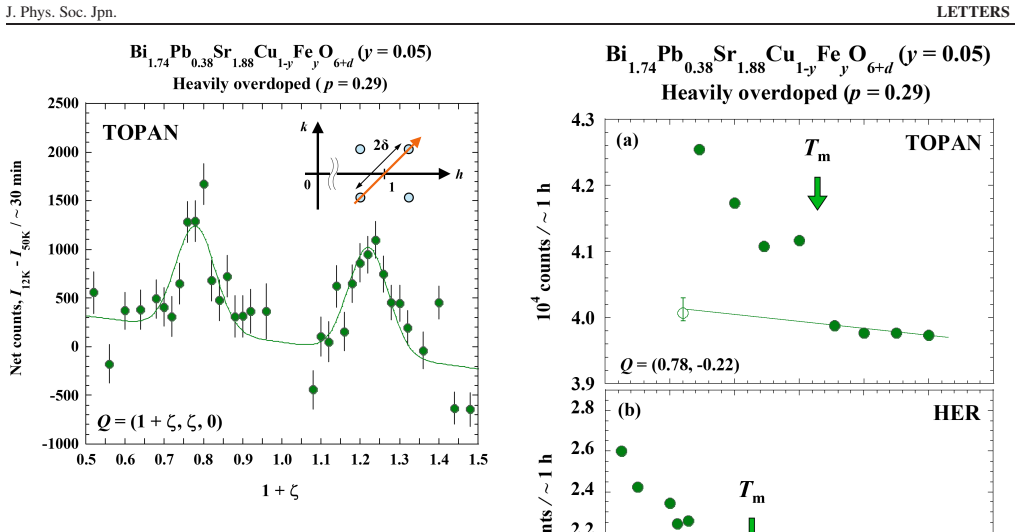
Elastic neutron scattering experiments showed incommensurate antiferromagnetic peaks in 5% Fe-substituted Bi-2201 cuprate in the non-superconducting heavily overdoped regime. The incommensurability delta~0.21 is comparable to that observed in Fe-substituted Bi-2201 in the overdoped regime. The magnetic correlation length is comparable between the overdoped and non-superconducting heavily overdoped regimes.
What carries the argument
Incommensurate antiferromagnetic peaks from elastic neutron scattering, which reveal order stabilized by iron substitution.
If this is right
- Incommensurate antiferromagnetic order can be induced and stabilized by iron in the heavily overdoped regime.
- Antiferromagnetic correlations remain robust beyond the superconducting dome in the phase diagram.
- The magnetic correlation length and incommensurability stay comparable to those in the overdoped regime.
- Iron substitution offers a way to access antiferromagnetic order in cuprates that lack superconductivity.
Where Pith is reading between the lines
- This persistence may mean magnetism influences normal-state properties even deep in the overdoped region.
- Testing other cuprate families with similar iron doping could show whether the effect is widespread.
- The work raises the possibility that the antiferromagnetic phase boundary extends further than the superconducting dome in standard phase diagrams.
- Future measurements at varying iron concentrations could map how much substitution is needed to stabilize the order.
Load-bearing premise
The peaks come from iron stabilizing antiferromagnetic order rather than from uneven doping, sample problems, or measurement issues.
What would settle it
Repeating the neutron scattering on pure Bi-2201 without iron in the same heavily overdoped regime and finding no incommensurate peaks would support that iron is required to induce the order.
Figures


read the original abstract
Elastic neutron scattering experiments showed incommensurate antiferromagnetic peaks in 5% Fe-substituted Bi-2201 cuprate in the non-superconducting heavily overdoped regime. The incommensurability delta~0.21 is comparable to that observed in Fe-substituted Bi-2201 in the overdoped regime. [Hiraka et al., Phys. Rev. B 81, 144501 (2010).] The magnetic correlation length is comparable between the overdoped and non-superconducting heavily overdoped regimes. It is plausible that incommensurate antiferromagnetic order is induced and stabilized by Fe in the heavily overdoped regime, which suggests a robust antiferromagnetic correlation beyond the superconducting dome in the phase diagram.
Editorial analysis
A structured set of objections, weighed in public.
Referee Report
Summary. The paper reports elastic neutron scattering experiments on 5% Fe-substituted Bi-2201 cuprate in the non-superconducting heavily overdoped regime. It observes incommensurate antiferromagnetic peaks with incommensurability δ ≈ 0.21, comparable to prior observations in Fe-substituted Bi-2201 in the overdoped regime (Hiraka et al., Phys. Rev. B 81, 144501 (2010)). The magnetic correlation length is also comparable between the two regimes, leading to the suggestion that incommensurate antiferromagnetic order is induced and stabilized by Fe, implying robust AF correlations beyond the superconducting dome.
Significance. If the observations and interpretation hold, the result would indicate that antiferromagnetic correlations persist and can be stabilized in the heavily overdoped regime of the cuprate phase diagram, even where superconductivity is absent. This has potential implications for understanding the normal-state properties and the interplay between magnetism and doping in high-Tc materials. The experimental comparison to existing Fe-substituted data is a positive aspect.
major comments (2)
- [Results/Discussion] Results/Discussion: The claim that the incommensurate AF order (δ ~ 0.21) is specifically induced and stabilized by Fe substitution lacks support from a direct control comparison to Fe-free Bi-2201 at equivalent heavily overdoped doping. The manuscript compares only to other Fe-substituted overdoped samples; without this contrast, doping-induced stripe-like correlations, oxygen inhomogeneity, or impurity scattering cannot be excluded as origins of the peaks and comparable correlation lengths. This is load-bearing for the central interpretation.
- [Experimental Methods] Experimental Methods: The manuscript provides no details on data reduction procedures, background subtraction, error analysis, or sample characterization (e.g., confirmation of the actual doping level and homogeneity in the heavily overdoped regime). These omissions make it difficult to fully assess the reliability of the reported peaks and the stabilization claim.
minor comments (1)
- [Abstract] The abstract and text use 'comparable' for the correlation length without quoting specific values or uncertainties from the current or prior measurements; adding these would aid quantitative assessment.
Simulated Author's Rebuttal
We thank the referee for the constructive comments on our manuscript. We address the major comments point by point below and outline the revisions we plan to make.
read point-by-point responses
-
Referee: [Results/Discussion] The claim that the incommensurate AF order (δ ~ 0.21) is specifically induced and stabilized by Fe substitution lacks support from a direct control comparison to Fe-free Bi-2201 at equivalent heavily overdoped doping. The manuscript compares only to other Fe-substituted overdoped samples; without this contrast, doping-induced stripe-like correlations, oxygen inhomogeneity, or impurity scattering cannot be excluded as origins of the peaks and comparable correlation lengths. This is load-bearing for the central interpretation.
Authors: We agree that a direct comparison to Fe-free Bi-2201 at the same heavily overdoped doping level would provide stronger evidence for the specific role of Fe. The manuscript compares the observed δ ≈ 0.21 and correlation length to the Fe-substituted overdoped samples in Hiraka et al. (Phys. Rev. B 81, 144501 (2010)) and uses the cautious phrasing 'it is plausible'. We do not have a Fe-free control sample in this study. In the revised manuscript we will expand the discussion to explicitly note the lack of this control, acknowledge that alternative origins such as doping-induced correlations or inhomogeneity cannot be ruled out, and reframe the suggestion of Fe stabilization as tentative rather than definitive. This will reduce the load-bearing nature of the claim while preserving the observational result. revision: partial
-
Referee: [Experimental Methods] The manuscript provides no details on data reduction procedures, background subtraction, error analysis, or sample characterization (e.g., confirmation of the actual doping level and homogeneity in the heavily overdoped regime). These omissions make it difficult to fully assess the reliability of the reported peaks and the stabilization claim.
Authors: We thank the referee for identifying these omissions. In the revised version we will add a dedicated subsection in the Experimental Methods (or supplementary material with explicit reference in the main text) that details the data reduction procedures, background subtraction, error analysis, and sample characterization, including confirmation of the doping level and homogeneity via the methods used in the experiment. revision: yes
Circularity Check
No circularity: experimental report with external literature comparisons
full rationale
This is a straightforward experimental neutron scattering study reporting observed incommensurate antiferromagnetic peaks in Fe-substituted Bi-2201. The manuscript contains no equations, derivations, fitted parameters, or ansatzes. All comparisons are to independent prior literature (e.g., Hiraka et al. 2010) that is externally falsifiable and does not overlap with the present authors. The central interpretation is presented as plausible based on the new data and existing benchmarks rather than reducing to any self-defined input or self-citation chain. The paper is self-contained against external experimental benchmarks with no load-bearing steps that collapse by construction.
Axiom & Free-Parameter Ledger
axioms (1)
- standard math Standard interpretation of elastic neutron scattering peaks as signatures of long-range or short-range antiferromagnetic order in cuprate lattices.
Lean theorems connected to this paper
-
IndisputableMonolith/Foundation/AlexanderDuality.leanalexander_duality_circle_linking unclear?
unclearRelation between the paper passage and the cited Recognition theorem.
Elastic neutron scattering experiments showed incommensurate antiferromagnetic peaks in 5% Fe-substituted Bi-2201 cuprate in the non-superconducting heavily overdoped regime. The incommensurability δ∼0.21...
What do these tags mean?
- matches
- The paper's claim is directly supported by a theorem in the formal canon.
- supports
- The theorem supports part of the paper's argument, but the paper may add assumptions or extra steps.
- extends
- The paper goes beyond the formal theorem; the theorem is a base layer rather than the whole result.
- uses
- The paper appears to rely on the theorem as machinery.
- contradicts
- The paper's claim conflicts with a theorem or certificate in the canon.
- unclear
- Pith found a possible connection, but the passage is too broad, indirect, or ambiguous to say the theorem truly supports the claim.
Reference graph
Works this paper leans on
-
[1]
This raises the possibility that the suppression of su per- conductivity in the HOD regime may be primarily related to the presence of ferromagnetic fluctuations. Further studie s are mandatory to investigate the origin of the IC-AFM order and the relation to ferromagnetic fluctuations in the HOD regime . Acknowledgment The authors would like to thank H. Hi...
-
[2]
R. J. Birgeneau, C. Stock, J. M. Tranquada, and K. Y amada J. Phys. Soc. Jpn. 75, 111003 (2006)
work page 2006
- [3]
-
[4]
K. Y amada, C. H. Lee, K. Kurahashi, J. Wada, S. Wakimoto, S. Ueki, H. Kimura, Y . Endoh, S. Hosoya, G. Shirane, R. J. Birgeneau, M. G reven, M. A. Kastner, and Y . J. Kim, Phys. Rev. B 57, 6165 (1998)
work page 1998
-
[5]
J. M. Tranquada, G. Shirane, B. Keimer, S. Shamoto, and M. S ato, Phys. Rev. B 40, 4503 (1989)
work page 1989
-
[6]
P . Dai, H. A. Mook, R. D. Hunt, and F. Do˘ gan, Phys. Rev. B63, 054525 (2001)
work page 2001
-
[7]
H. F. Fong, P . Bourges, Y . Sidis, L. P . Regnault, A. Ivanov,G. D. Gu, N. Koshizuka, and B. Keimer, Nature (London) 398, 588 (1999)
work page 1999
-
[8]
H. He, Y . Sidis, P . Bourges, G. D. Gu, A. Ivanov, N. Koshizuka, B. Liang, C. T. Lin, L.P . Regnault, E. Schoenherr, and B. Keimer, Phys.Rev. Lett. 86, 1610 (2001)
work page 2001
-
[9]
M. Matsuda, M. Fujita, K. Y amada, R. J. Birgeneau, M. A. Kas tner, H. Hiraka, Y . Endoh, S. Wakimoto, and G. Shirane, Phys. Rev. B 62, 9148 (2000)
work page 2000
- [10]
-
[11]
V . J. Emery, S. A. Kivelson and O. Zachar, Phys. Rev. B56, 6120 (1997)
work page 1997
-
[12]
S. Wakimoto, H. Zhang, K. Y amada, I. Swainson, H. Kim, and R. J. Birgeneau, Phys. Rev. Lett. 92, 217004 (2004)
work page 2004
- [13]
- [14]
-
[15]
M. P . M. Dean, G. Dellea, R. S. Springell, F. Y akhou-Harris, K. Kummer, N. B. Brookes, X. Liu, Y -J. Sun, J. Strle, T. Schmitt, L. Braic ovich, G. Ghiringhelli, I. Boˇ zovi´ c, and J. P . Hill, Nat. Mater.12, 1019 (2013)
work page 2013
-
[16]
A. Kopp, A. Ghosal, and S. Chakravarty, Proc. Natl. Acad. Sci. USA 104, 6123 (2007)
work page 2007
-
[17]
C. J. Jia, E.A. Nowadnick, K. Wohlfeld, Y . F. Kung, C.-C. Chen, S. John- ston, T. Tohyama, B. Moritz, and T. P . Devereaux, Nat. Commun . 5, 3314 (2014)
work page 2014
-
[18]
T. A. Maier, and D. J. Scalapino, J. Supercond. Nov. Magn. 33, 15 (2020)
work page 2020
-
[19]
S. Teranishi, K. Nishiguchi, S. Y unoki, K. Kusakabe, J. P hys. Soc. Jpn. 90, 094707 (2021)
work page 2021
-
[20]
H. Watanabe, T. Shirakawa, K. Seki, H. Sakakibara, T. Kotani, H. Ikeda, S. Y unoki, J. Phys. Condens. Matter 35, 195601(2023)
work page 2023
-
[21]
J. E. Sonier, C. V . Kaiser, V . Pacradouni, S. A. Sabok-Sayr, C. Cochrane, D. E. MacLaughlin, S. Komiya, and N. E. Hussey, Proc. Natl. Acad. Sci. USA 107, 17131 (2010)
work page 2010
-
[22]
K. Kurashima, T. Adachi, K. Suzuki, Y . Fukunaga, T. Kawam ata, T. Noji, H. Miyasaka, I. Watanabe, M. Miyazaki, A. Koda, R. Kado no, and Y . Koike, Phys. Rev. Lett.121, 057002 (2018)
work page 2018
-
[23]
Y . Y . Peng, E. W. Huang, R. Fumagalli, M. Minola, Y . Wang, X. Sun, Y . Ding, K. Kummer, X. J. Zhou, N. B. Brookes, B. Moritz, L. Braicovich, T. P . Devereaux, and G. Ghiringhelli, Phys. Rev. B 98, 144507 (2018)
work page 2018
- [24]
- [25]
- [26]
-
[27]
S. Jung, B. Seok, C. J. Roh, Y . Kim, D. Kim, Y . Lee, S. Kang, S . Ishida, S. Shin, H. Eisaki, T. W. Noh, D. Song, C. Kim, Nat. Phys. 20, 1616 (2024)
work page 2024
-
[28]
I. Watanabe, T. Adachi, K. Takahashi, S. Y airi, Y . Koike, and K. Nagamine, Phys. Rev. B 65, 180516 (2002)
work page 2002
- [29]
- [30]
-
[31]
K. M. Suzuki, T. Adachi, Y . Tanabe, H. Sato, Y . Koike, Risdiana, Y . Ishii, T. Suzuki, and I. Watanabe, Phys. Rev. B 86, 014522 (2012)
work page 2012
-
[32]
R.-H. He, M. Fujita, M. Enoki, M. Hashimoto, S. Iikubo, S. -K. Mo, H. Y ao, T. Adachi, Y . Koike, Z. Hussain, Z.-X. Shen, and K. Y amada, Phys. Rev. Lett. 107, 127002 (2011)
work page 2011
- [33]
-
[34]
S. Wakimoto, H. Hiraka, K. Kudo, D. Okamoto, T. Nishizaki , K. Kaku- rai, T. Hong, A. Zheludev, J. M. Tranquada, N. Kobayashi, and K. Y a- mada, Phys. Rev. B 82, 064507 (2010)
work page 2010
-
[35]
Y . Komiyama, S. Onishi, M. Harada, H. Kuwahara, H. Kuroe, K. Kurashima, T. Kawamata, Y . Koike, I. Watanabe, and T. Adachi, J. Phys. Soc. Jpn. 90, 084701 (2021)
work page 2021
-
[36]
S. D. Obertelli, J. R. Cooper and J. L. Tallon, Phys. Rev. B 46, 14928 (1992)
work page 1992
- [37]
- [38]
-
[39]
S. R. Dunsiger, Y . Zhao, Z. Y amani, W. J. L. Buyers, H. A. Dabkowska, and B. D. Gaulin, Phys. Rev. B 77, 224410 (2008)
work page 2008
-
[40]
S. R. Dunsiger, Y . Zhao, B. D. Gaulin, Y . Qiu, P . Bourges, Y . Sidis, J. R. D. Copley, A. Kallin, E. M. Mazurek, and H. A. Dabkowska, Ph ys. Rev. B 78, 092507 (2008)
work page 2008
- [41]
-
[42]
S. Wakimoto, G. Shirane, Y . Endoh, K. Hirota, S. Ueki, K. Y amada, R. J. Birgeneau, M. A. Kastner, Y . S. Lee, P . M. Gehring, and S. -H . Lee, Phys. Rev. B 60, R769 (1999)
work page 1999
-
[43]
S. Wakimoto, R. J. Birgeneau, M. A. Kastner, Y . S. Lee, R. E rwin, P . M. Gehring, S. -H. Lee, M. Fujita, K. Y amada, Y . Endoh, K. Hirota, and G. Shirane, Phys. Rev. B 61, 3699 (2000)
work page 2000
-
[44]
J. M. Tranquada, B. J. Sternlieb, J. D. Axe, Y . Nakamura, and S. Uchida, Nature (London) 375, 561 (1995)
work page 1995
-
[45]
J. M. Tranquada, J. D. Axe, N. Ichikawa, A. R. Moodenbaugh , Y . Naka- mura, and S. Uchida, Phys. Rev. Lett. 78, 338 (1997)
work page 1997
-
[46]
N. Ichikawa, S. Uchida, J. M. Tranquada, T. Niemller, P . M. Gehring, S. -H. Lee, and J. R. Schneider, Phys. Rev. Lett. 85, 1738 (2000)
work page 2000
-
[47]
S. Wakimoto, J. M. Tranquada, T. Ono, K. M. Kojima, S. Uchi da, S. - H. Lee, P . M. Gehring, and R. J. Birgeneau, Phys. Rev. B 64, 174505 (2001)
work page 2001
- [48]
-
[49]
C. H. Lee, K. Y amada, H. Hiraka, C. R. V enkateswara Rao, an d Y . En- doh, Phys. Rev. B 67, 134521 (2003)
work page 2003
- [50]
- [51]
-
[52]
K. M. Suzuki, T. Adachi, H. Sato, I. Watanabe, and Y . Koike , J. Phys. Soc. Jpn. 85, 124705 (2016). 5
work page 2016
discussion (0)
Sign in with ORCID, Apple, or X to comment. Anyone can read and Pith papers without signing in.