Supercollimating photonic crystal scintillators
Pith reviewed 2026-05-19 19:00 UTC · model grok-4.3
The pith
Three-dimensional photonic crystal scintillators improve spatial resolution by an order of magnitude through supercollimation.
A machine-rendered reading of the paper's core claim, the machinery that carries it, and where it could break.
Core claim
Supercollimating photonic crystal scintillators overcome the efficiency-resolution trade-off by engineering light transport within the bulk material to suppress diffraction-induced lateral spreading, achieving up to an order-of-magnitude improvement in spatial resolution relative to conventional bulk scintillators of equal thickness and thereby increasing detector quantum efficiency at high spatial frequencies while enabling comparable image quality at approximately an order-of-magnitude lower X-ray dose.
What carries the argument
Supercollimation arising from the photonic band structure of three-dimensional crystals, which restricts emitted photon propagation to narrow angles and reduces lateral diffraction.
If this is right
- Spatial resolution improves by up to an order of magnitude for scintillators of equal thickness.
- Detector quantum efficiency rises substantially at high spatial frequencies.
- Comparable image quality is achievable with roughly an order-of-magnitude reduction in X-ray dose.
- Fine spatial features remain visible at lower radiation exposure levels.
Where Pith is reading between the lines
- The same supercollimation principle could be adapted to other scintillator applications such as medical CT or security screening to lower overall radiation exposure.
- Optimization of lattice parameters in the photonic crystal might produce even narrower emission angles and further dose savings.
- Practical fabrication advances for large-area three-dimensional photonic crystals would be needed to translate the simulated gains into working detectors.
Load-bearing premise
The multiscale modeling framework that integrates nanophotonic band-structure simulations with Monte Carlo particle transport accurately predicts performance for physically realizable three-dimensional photonic crystal scintillators.
What would settle it
Direct experimental measurement of the point-spread function or modulation transfer function in a fabricated three-dimensional photonic crystal scintillator sample under X-ray illumination, compared against the same-thickness bulk reference.
Figures

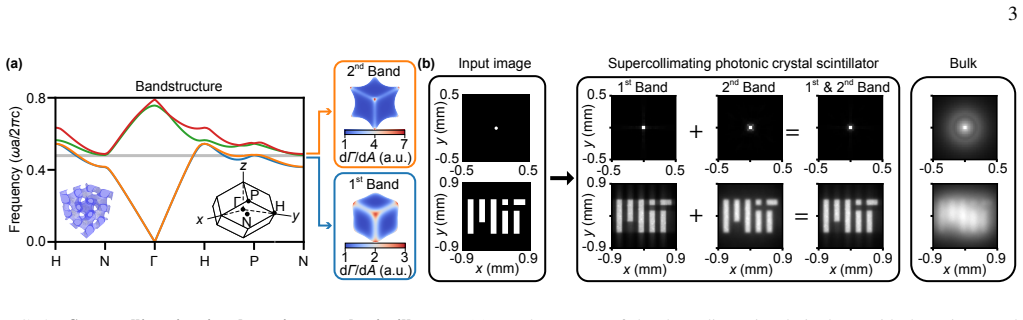


read the original abstract
Scintillators convert X-ray energy into visible or near-visible photons, enabling applications in high-energy particle detection and X-ray imaging. Increasing scintillator thickness improves X-ray absorption but degrades spatial resolution due to diffraction-induced lateral spreading of emitted light, resulting in a fundamental trade-off between detection efficiency and image resolution. Here, we propose a class of three-dimensional photonic crystal scintillators that overcomes this limitation through supercollimation, in which light propagates with suppressed diffraction. We develop a multiscale modeling framework that integrates nanophotonic band-structure simulations with Monte Carlo particle transport to quantitatively evaluate the performance of such scintillators. Our results show that supercollimating photonic crystal scintillators can enhance spatial resolution by up to an order of magnitude relative to conventional bulk scintillators of equal thickness. This improvement leads to a substantial increase in detector quantum efficiency (DQE), particularly at high spatial frequencies, enabling fine features to be preserved at reduced X-ray dose. We further demonstrate that comparable image quality can be achieved with approximately an order-of-magnitude lower X-ray dose. By directly engineering light transport within the bulk of the scintillator, this work establishes a nanophotonic route to simultaneously improving resolution and dose efficiency in X-ray imaging.
Editorial analysis
A structured set of objections, weighed in public.
Referee Report
Summary. The manuscript proposes a class of three-dimensional photonic crystal scintillators that achieve supercollimation to suppress lateral spreading of emitted light, thereby breaking the conventional trade-off between scintillator thickness (for X-ray absorption) and spatial resolution. A multiscale modeling framework is introduced that couples nanophotonic band-structure simulations with Monte Carlo particle transport simulations. The central results claim that these structures can improve spatial resolution by up to an order of magnitude relative to bulk scintillators of equal thickness, yielding higher detector quantum efficiency at high spatial frequencies and enabling comparable image quality at roughly an order-of-magnitude lower X-ray dose.
Significance. If the quantitative predictions of the multiscale framework prove accurate for realizable three-dimensional structures, the work would offer a nanophotonic route to simultaneously higher resolution and lower dose in X-ray imaging, with potential impact on medical, security, and high-energy physics detectors. The modeling approach itself, if validated, could serve as a general design tool for engineered scintillators.
major comments (2)
- [Multiscale Modeling Framework] The headline claim of up to 10× spatial-resolution gain (abstract and Results) rests on the multiscale framework quantitatively capturing transport of isotropically generated, broadband scintillation photons inside a finite 3D lattice. No sensitivity study is presented that quantifies degradation of the flat-band or self-collimation regime once realistic material dispersion, absorption edges, finite-size effects, and fabrication disorder (even at the 1–2 % level) are included; any of these can destroy the predicted collimation benefit over the emission spectrum.
- [Results] The reported performance metrics (resolution gain, DQE improvement, dose reduction) are presented as direct outputs of the simulation framework without accompanying error analysis, convergence checks with respect to lattice size or photon bandwidth, or comparison against limiting cases (e.g., purely diffusive transport or measured data from existing photonic-crystal scintillators). This leaves the central quantitative claims without the detailed support needed to evaluate their robustness.
minor comments (2)
- [Abstract] The abstract states that 'comparable image quality can be achieved with approximately an order-of-magnitude lower X-ray dose' but does not specify the exact spatial-frequency range or DQE threshold used for this comparison.
- [Methods] Notation for the photonic-crystal lattice parameters (period, filling fraction, refractive-index contrast) would benefit from a compact summary table to aid reproducibility of the band-structure calculations.
Simulated Author's Rebuttal
We thank the referee for their constructive and detailed comments on our manuscript. We have carefully addressed the concerns regarding the sensitivity of the multiscale modeling framework to realistic effects and the need for additional validation of the quantitative performance metrics. Our point-by-point responses are provided below.
read point-by-point responses
-
Referee: [Multiscale Modeling Framework] The headline claim of up to 10× spatial-resolution gain (abstract and Results) rests on the multiscale framework quantitatively capturing transport of isotropically generated, broadband scintillation photons inside a finite 3D lattice. No sensitivity study is presented that quantifies degradation of the flat-band or self-collimation regime once realistic material dispersion, absorption edges, finite-size effects, and fabrication disorder (even at the 1–2 % level) are included; any of these can destroy the predicted collimation benefit over the emission spectrum.
Authors: We agree that a dedicated sensitivity analysis is essential to evaluate the robustness of the supercollimation effect under realistic conditions. In the revised manuscript, we will add a new subsection presenting additional simulations that incorporate material dispersion and absorption edges across the scintillation emission spectrum. We have also modeled fabrication disorder by applying 1–2% random perturbations to the lattice parameters and evaluated the resulting impact on photon transport. These results show that the flat-band collimation remains effective, with the spatial resolution gain reduced by only 15–25% depending on disorder amplitude. We will include these findings, along with discussion of implications for fabrication tolerances. revision: yes
-
Referee: [Results] The reported performance metrics (resolution gain, DQE improvement, dose reduction) are presented as direct outputs of the simulation framework without accompanying error analysis, convergence checks with respect to lattice size or photon bandwidth, or comparison against limiting cases (e.g., purely diffusive transport or measured data from existing photonic-crystal scintillators). This leaves the central quantitative claims without the detailed support needed to evaluate their robustness.
Authors: We acknowledge that the original presentation lacked explicit validation steps. In the revision, we will add statistical error analysis from the Monte Carlo photon sampling, demonstrate convergence of results with respect to lattice size and photon bandwidth, and include direct comparisons to the purely diffusive transport limit (obtained by disabling photonic band-structure effects). However, comparison against measured data from existing photonic-crystal scintillators is not feasible, as our work proposes a new class of 3D supercollimating structures for which no experimental realizations have been reported to date. We will explicitly note this as a limitation and identify it as an important direction for future experimental validation. revision: partial
Circularity Check
No circularity: performance predictions are simulation outputs from independent multiscale framework
full rationale
The paper derives its central claims from a multiscale modeling framework that combines nanophotonic band-structure simulations with Monte Carlo particle transport. These are presented as quantitative evaluations of the proposed 3D photonic crystal structure rather than quantities fitted to the target data or defined in terms of the claimed resolution gain. No load-bearing steps reduce by construction to self-citations, ansatzes smuggled via prior work, or renaming of known results; the order-of-magnitude improvement is an output of the described integration applied to the scintillator geometry. The derivation is therefore self-contained against external benchmarks.
Axiom & Free-Parameter Ledger
Lean theorems connected to this paper
-
IndisputableMonolith/Foundation/AlexanderDuality.leanalexander_duality_circle_linking unclear?
unclearRelation between the paper passage and the cited Recognition theorem.
three-dimensional single gyroid photonic crystal ... flat IFCs for its bottom two bands
-
IndisputableMonolith/Cost/FunctionalEquation.leanwashburn_uniqueness_aczel unclear?
unclearRelation between the paper passage and the cited Recognition theorem.
multiscale modeling framework that integrates nanophotonic band-structure simulations with Monte Carlo particle transport
What do these tags mean?
- matches
- The paper's claim is directly supported by a theorem in the formal canon.
- supports
- The theorem supports part of the paper's argument, but the paper may add assumptions or extra steps.
- extends
- The paper goes beyond the formal theorem; the theorem is a base layer rather than the whole result.
- uses
- The paper appears to rely on the theorem as machinery.
- contradicts
- The paper's claim conflicts with a theorem or certificate in the canon.
- unclear
- Pith found a possible connection, but the passage is too broad, indirect, or ambiguous to say the theorem truly supports the claim.
Reference graph
Works this paper leans on
-
[1]
William W Moses. Current trends in scintillator detectors and materials.Nuclear Instruments and Methods in Physics Re- search Section A: Accelerators, Spectrometers, Detectors and Associated Equipment, 487(1-2):123–128, 2002
work page 2002
-
[2]
Alexander Gektin and Mikhail Korzhik.Inorganic scintillators for detector systems. Springer, 2017
work page 2017
-
[3]
Inorganic scintillators in medical imaging
Carel WE Van Eijk. Inorganic scintillators in medical imaging. Physics in medicine & biology, 47(8):R85, 2002
work page 2002
-
[4]
Rebecca Smith-Bindman, Philip W Chu, Hana Azman Firdaus, Carly Stewart, Matthew Malekhedayat, Susan Alber, Wesley E 7 Bolch, Malini Mahendra, Amy Berrington de Gonz ´alez, and Diana L Miglioretti. Projected lifetime cancer risks from cur- rent computed tomography imaging.JAMA internal medicine, 185(6):710–719, 2025
work page 2025
-
[5]
Pallavi Singh, Georgy Dosovitskiy, and Yehonadav Bekenstein. Bright innovations: Review of next-generation advances in scintillator engineering.ACS nano, 18(22):14029–14049, 2024
work page 2024
-
[6]
Hamish Carr Delgado, Parivash Moradifar, Garry Chinn, Craig S Levin, and Jennifer A Dionne. Toward “super- scintillation” with nanomaterials and nanophotonics.Nanopho- tonics, 13(11):1953–1962, 2024
work page 1953
-
[7]
A framework for scintillation in nanophotonics.Science, 375(6583):eabm9293, 2022
Charles Roques-Carmes, Nicholas Rivera, Ali Ghorashi, Steven E Kooi, Yi Yang, Zin Lin, Justin Beroz, Aviram Mas- suda, Jamison Sloan, Nicolas Romeo, et al. A framework for scintillation in nanophotonics.Science, 375(6583):eabm9293, 2022
work page 2022
-
[8]
Louis Martin-Monier, Simo Pajovic, Muluneh G Abebe, Joshua Chen, Sachin Vaidya, Seokhwan Min, Seou Choi, Steven E Kooi, Bjorn Maes, Juejun Hu, et al. Large-scale self-assembled nanophotonic scintillators for x-ray imaging.Nature Commu- nications, 16(1):5750, 2025
work page 2025
-
[9]
Di Yuan, Bo Liu, Zhichao Zhu, Yaozhen Guo, Chuanwei Cheng, Hong Chen, Mu Gu, Mengxuan Xu, Liang Chen, Jin- liang Liu, et al. Directional control and enhancement of light output of scintillators by using microlens arrays.ACS applied materials & interfaces, 12(26):29473–29480, 2020
work page 2020
-
[10]
Spontaneous emission probabilities at radio frequencies.Physical Review, 69(11–12):681, 1946
Edward M Purcell. Spontaneous emission probabilities at radio frequencies.Physical Review, 69(11–12):681, 1946
work page 1946
-
[11]
Wenzheng Ye, Gregory Bizarri, Muhammad Danang Birowosuto, and Liang Jie Wong. Enhancing large-area scintillator detection with photonic crystal cavities.ACS Photonics, 9(12):3917–3925, 2022
work page 2022
-
[12]
Purcell-enhanced x-ray scintillation.Science Advances, 10(44):eadq6325, 2024
Yaniv Kurman, Neta Lahav, Roman Schuetz, Avner Shultz- man, Charles Roques-Carmes, Alon Lifshits, Segev Za- ken, Tom Lenkiewicz, Rotem Strassberg, Orr Be’er, et al. Purcell-enhanced x-ray scintillation.Science Advances, 10(44):eadq6325, 2024
work page 2024
-
[13]
Yaniv Kurman, Avner Shultzman, Ohad Segal, Adi Pick, and Ido Kaminer. Photonic-crystal scintillators: Molding the flow of light to enhance x-ray andγ-ray detection.Physical Review Letters, 125(4):040801, 2020
work page 2020
-
[14]
V olumetrically- patterned nanophotonic scintillators
Marius J ¨urgensen, Sachin Vaidya, Simo Pajovic, John P Gales, Joshua Chen, Shaul Katznelson, Steven E Kooi, Sion Richards, Issy Braddock, Chris D Armstrong, et al. V olumetrically- patterned nanophotonic scintillators. In2025 Conference on Lasers and Electro-Optics (CLEO), pages 1–2. IEEE, 2025
work page 2025
-
[15]
Wenzheng Ye, Zhihua Yong, Michael Go, Dominik Kowal, Francesco Maddalena, Liliana Tjahjana, Hong Wang, Ar- ramel Arramel, Christophe Dujardin, Muhammad Danang Birowosuto, et al. The nanoplasmonic purcell effect in ultrafast and high-light-yield perovskite scintillators.Advanced Materi- als, 36(25):2309410, 2024
work page 2024
-
[16]
Avner Shultzman, Ohad Segal, Yaniv Kurman, Charles Roques- Carmes, and Ido Kaminer. Enhanced imaging using inverse de- sign of nanophotonic scintillators.Advanced Optical Materials, 11(8):2202318, 2023
work page 2023
-
[17]
Self-collimating phenomena in photonic crystals
Hideo Kosaka, Takayuki Kawashima, Akihisa Tomita, Masaya Notomi, Toshiaki Tamamura, Takashi Sato, and Shojiro Kawakami. Self-collimating phenomena in photonic crystals. Applied Physics Letters, 74(9):1212–1214, 1999
work page 1999
-
[18]
Peter T Rakich, Marcus S Dahlem, Sheila Tandon, Mihai Ibanescu, Marin Solja ˇci´c, Gale S Petrich, John D Joannopou- los, Leslie A Kolodziejski, and Erich P Ippen. Achiev- ing centimetre-scale supercollimation in a large-area two- dimensional photonic crystal.Nature materials, 5(2):93–96, 2006
work page 2006
-
[19]
Zhaolin Lu, Shouyuan Shi, Janusz A Murakowski, Gar- rett J Schneider, Christopher A Schuetz, and Dennis W Prather. Experimental demonstration of self-collimation inside a three-dimensional photonic crystal.Physical review letters, 96(17):173902, 2006
work page 2006
-
[20]
Molding the flow of light.Princet
John D Joannopoulos, Steven G Johnson, Joshua N Winn, and Robert D Meade. Molding the flow of light.Princet. Univ. Press. Princeton, NJ [ua], 12:33, 2008
work page 2008
-
[21]
Dispersion-based optical routing in photonic crystals.Optics letters, 29(1):50–52, 2004
Dennis W Prather, Shouyuan Shi, David M Pustai, Cai- hua Chen, Sriram Venkataraman, Ahmed Sharkawy, Garrett J Schneider, and Janusz Murakowski. Dispersion-based optical routing in photonic crystals.Optics letters, 29(1):50–52, 2004
work page 2004
-
[22]
Photonic crystal self-collimation sensor.Optics Express, 20(11):12111–12118, 2012
Yufei Wang, Hailing Wang, Qikun Xue, and Wanhua Zheng. Photonic crystal self-collimation sensor.Optics Express, 20(11):12111–12118, 2012
work page 2012
-
[23]
Photonic flatband reso- nances for free-electron radiation.Nature, 613(7942):42–47, 2023
Yi Yang, Charles Roques-Carmes, Steven E Kooi, Haon- ing Tang, Justin Beroz, Eric Mazur, Ido Kaminer, John D Joannopoulos, and Marin Solja ˇci´c. Photonic flatband reso- nances for free-electron radiation.Nature, 613(7942):42–47, 2023
work page 2023
-
[24]
Firat Yasar, M Kilin, S Dehdashti, Zongfu Yu, Zhenqiang Ma, and Zhehui Wang. Spatially resolved x-ray detection with pho- tonic crystal scintillators.Journal of Applied Physics, 130(4), 2021
work page 2021
-
[25]
Claude A Klein. Bandgap dependence and related features of radiation ionization energies in semiconductors.Journal of Ap- plied Physics, 39(4):2029–2038, 1968
work page 2029
-
[26]
Steven G Johnson and John D Joannopoulos. Block-iterative frequency-domain methods for maxwell’s equations in a planewave basis.Optics express, 8(3):173–190, 2001
work page 2001
-
[27]
Sea Agostinelli, John Allison, K al Amako, John Apostolakis, Henrique Araujo, Pedro Arce, Makoto Asai, D Axen, Swagato Banerjee, GJNI Barrand, et al. Geant4—a simulation toolkit. Nuclear instruments and methods in physics research section A: Accelerators, Spectrometers, Detectors and Associated Equip- ment, 506(3):250–303, 2003
work page 2003
-
[28]
Dionysios Linardatos, Anastasios Konstantinidis, Ioannis Valais, Konstantinos Ninos, Nektarios Kalyvas, Athanasios Bakas, Ioannis Kandarakis, George Fountos, and Christos Michail. On the optical response of tellurium activated zinc selenide ZnSe: Te single crystal.Crystals, 10(11):961, 2020
work page 2020
-
[29]
Debanti Sengupta, Stuart Miller, Zsolt Marton, Frederick Chin, Vivek Nagarkar, and Guillem Pratx. Bright Lu2O3: Eu thin- film scintillators for high-resolution radioluminescence mi- croscopy.Advanced healthcare materials, 4(14):2064–2070, 2015
work page 2064
-
[30]
O Langner, M Karolczak, G Rattmann, and W A Kalender. Bar and point test patterns generated by dry-etching for measure- ment of high spatial resolution in micro-CT. InWorld Congress on Medical Physics and Biomedical Engineering, September 7- 12, 2009, Munich, Germany: V ol. 25/2 Diagnostic Imaging, pages 428–431. Springer, 2009
work page 2009
-
[31]
Anni Suomalainen, Timo Kiljunen, Y Kaser, Jaakko Peltola, and Mika Kortesniemi. Dosimetry and image quality of four dental cone beam computed tomography scanners compared with multislice computed tomography scanners.Dentomaxillo- facial Radiology, 38(6):367–378, 2009
work page 2009
-
[32]
Steven Smith.Digital signal processing: a practical guide for engineers and scientists. Newnes, 2003
work page 2003
-
[33]
F Kharfi, O Denden, A Bourenane, T Bitam, and A Ali. Spa- tial resolution limit study of a CCD camera and scintillator based neutron imaging system according to MTF determination 8 and analysis.Applied Radiation and Isotopes, 70(1):162–166, 2012
work page 2012
-
[34]
Medical imaging systems: An introductory guide
Andreas Maier, Stefan Steidl, Vincent Christlein, and Joachim Hornegger. Medical imaging systems: An introductory guide. 2018
work page 2018
-
[35]
Jacob Beutel.Handbook of medical imaging, volume 3. Spie Press, 2000
work page 2000
-
[36]
Steven Don, Robert MacDougall, Keith Strauss, Quentin T Moore, Marilyn J Goske, Mervyn Cohen, Tracy Herrmann, Su- san D John, Lauren Noble, Greg Morrison, et al. Image gently campaign back to basics initiative: ten steps to help manage ra- diation dose in pediatric digital radiography.American Journal of Roentgenology, 200(5):W431–W436, 2013
work page 2013
-
[37]
Yashvardhan Jain, Claire L Walsh, Ekin Yagis, Shahab Aslani, Sonal Nandanwar, Yang Zhou, Juhyung Ha, Katherine S Gustilo, Joseph Brunet, Shahrokh Rahmani, et al. Vasculature segmentation in 3D hierarchical phase-contrast tomography im- ages of human kidneys.bioRxiv, 2024
work page 2024
-
[38]
Lin Zhang, Lei Zhang, Xuanqin Mou, and David Zhang. FSIM: A feature similarity index for image quality assessment.IEEE transactions on Image Processing, 20(8):2378–2386, 2011
work page 2011
-
[39]
Air ´an R´odenas, Min Gu, Giacomo Corrielli, Petra Pai `e, Sajeev John, Ajoy K Kar, and Roberto Osellame. Three-dimensional femtosecond laser nanolithography of crystals.Nature Photon- ics, 13(2):105–109, 2019
work page 2019
-
[40]
G. Subramania and S. Y . Lin. Fabrication of three-dimensional photonic crystal with alignment based on electron beam lithog- raphy.Applied Physics Letters, 85(21):5037–5039, 11 2004
work page 2004
-
[41]
Minghao Qi, Elefterios Lidorikis, Peter T Rakich, Steven G Johnson, JD Joannopoulos, Erich P Ippen, and Henry I Smith. A three-dimensional optical photonic crystal with designed point defects.Nature, 429(6991):538–542, 2004
work page 2004
-
[42]
Markus Deubel, Georg V on Freymann, Martin Wegener, Suresh Pereira, Kurt Busch, and Costas M Soukoulis. Direct laser writing of three-dimensional photonic-crystal templates for telecommunications.Nature materials, 3(7):444–447, 2004
work page 2004
- [43]
-
[44]
Topolog- ical photonics in 3d micro-printed systems.APL Photonics, 6(8):080901, 08 2021
Julian Schulz, Sachin Vaidya, and Christina J ¨org. Topolog- ical photonics in 3d micro-printed systems.APL Photonics, 6(8):080901, 08 2021
work page 2021
-
[45]
Victoria F. Chernow, Ryan C. Ng, Siying Peng, Harry A. Atwa- ter, and Julia R. Greer. Dispersion mapping in 3-dimensional core–shell photonic crystal lattices capable of negative refrac- tion in the mid-infrared.Nano Letters, 21(21):9102–9107,
-
[46]
Three-dimensional single gyroid photonic crystals with a mid-infrared bandgap
Siying Peng, Runyu Zhang, Valerian H Chen, Emil T Khabi- boulline, Paul Braun, and Harry A Atwater. Three-dimensional single gyroid photonic crystals with a mid-infrared bandgap. Acs Photonics, 3(6):1131–1137, 2016
work page 2016
-
[47]
Lifeng Chen, Katrina A Morgan, Ghada A Alzaidy, Chung-Che Huang, Ying-Lung Daniel Ho, Mike PC Taverne, Xu Zheng, Zhong Ren, Zhuo Feng, Ioannis Zeimpekis, et al. Observation of complete photonic bandgap in low refractive index contrast inverse rod-connected diamond structured chalcogenides.ACS Photonics, 6(5):1248–1254, 2019
work page 2019
-
[48]
Mark D Turner, Matthias Saba, Qiming Zhang, Benjamin P Cumming, Gerd E Schr¨oder-Turk, and Min Gu. Miniature chi- ral beamsplitter based on gyroid photonic crystals.Nature Pho- tonics, 7(10):801–805, 2013
work page 2013
-
[49]
Preparation of photonic crystals made of air spheres in titania.Science, 281(5378):802–804, 1998
Judith EGJ Wijnhoven and Willem L V os. Preparation of photonic crystals made of air spheres in titania.Science, 281(5378):802–804, 1998
work page 1998
-
[50]
Dna origami colloidal crystals: opportunities and challenges.Nano letters, 25(1):16–27, 2024
Jaewon Lee, Jangwon Kim, Gregor Posnjak, Anastasia Er- shova, Daichi Hayakawa, William M Shih, W Benjamin Rogers, Yonggang Ke, Tim Liedl, and Seungwoo Lee. Dna origami colloidal crystals: opportunities and challenges.Nano letters, 25(1):16–27, 2024
work page 2024
-
[51]
Diamond- lattice photonic crystals assembled from dna origami.Science, 384(6697):781–785, 2024
Gregor Posnjak, Xin Yin, Paul Butler, Oliver Bienek, Mihir Dass, Seungwoo Lee, Ian D Sharp, and Tim Liedl. Diamond- lattice photonic crystals assembled from dna origami.Science, 384(6697):781–785, 2024
work page 2024
-
[52]
Colloidal dia- mond.Nature, 585(7826):524–529, 2020
Mingxin He, Johnathon P Gales, ´Etienne Ducrot, Zhe Gong, Gi-Ra Yi, Stefano Sacanna, and David J Pine. Colloidal dia- mond.Nature, 585(7826):524–529, 2020
work page 2020
-
[53]
Yannick Salamin, Gaojie Yang, Brian Mills, Andr´e Grossi Fon- seca, Charles Roques-Carmes, Quansan Yang, Justin Beroz, Steven E Kooi, Marc de Miguel Comella, Kiran Mak, et al. Three-dimensional nanophotonics with spatially modulated op- tical properties.Light: Science & Applications, 15(1):145, 2026
work page 2026
-
[54]
Jun Hyuk Moon, Jamie Ford, and Shu Yang. Fabricating three- dimensional polymeric photonic structures by multi-beam in- terference lithography.Polymers for Advanced Technologies, 17(2):83–93, 2006
work page 2006
-
[55]
Ivan Divliansky, Theresa S Mayer, Kito S Holliday, and Vin- cent H Crespi. Fabrication of three-dimensional polymer pho- tonic crystal structures using single diffraction element interfer- ence lithography.Applied Physics Letters, 82(11):1667–1669, 2003
work page 2003
-
[56]
Shoichi Kubo, Zhong-Ze Gu, Kazuyuki Takahashi, Akira Fu- jishima, Hiroshi Segawa, and Osamu Sato. Control of the opti- cal properties of liquid crystal-infiltrated inverse opal structures using photo irradiation and/or an electric field.Chemistry of Materials, 17(9):2298–2309, 2005
work page 2005
-
[57]
Ying Zhang, Ke Li, Fengyu Su, Zhongyu Cai, Jianxun Liu, Xi- aowen Wu, Huilin He, Zhen Yin, Lihong Wang, Bing Wang, et al. Electrically switchable photonic crystals based on liquid-crystal-infiltrated TiO2-inverse opals.Optics Express, 27(11):15391–15398, 2019
work page 2019
-
[58]
R Iliew, C Etrich, and F Lederer. Self-collimation of light in three-dimensional photonic crystals.Optics Express, 13(18):7076–7085, 2005
work page 2005
-
[59]
X-ray attenuation coef- ficients of elements and mixtures.Physics Reports, 70(3):169– 233, 1981
Daphne F Jackson and David J Hawkes. X-ray attenuation coef- ficients of elements and mixtures.Physics Reports, 70(3):169– 233, 1981
work page 1981
-
[60]
Hans-Georg Menzel. ICRP publication 110. realistic reference phantoms: an ICRP/ICRU joint effort. a report of adult refer- ence computational phantoms. ann.ICRP, 39:1, 2009
work page 2009
discussion (0)
Sign in with ORCID, Apple, or X to comment. Anyone can read and Pith papers without signing in.