Design and Practical Validation of a Novel Modulation Scheme for RIS Detection and Identification
Pith reviewed 2026-05-19 19:19 UTC · model grok-4.3
The pith
A modulation scheme uses passive beamforming to encode RIS identifiers over the air and combines it with beam sweeping to lower miss-detection and false-alarm rates.
A machine-rendered reading of the paper's core claim, the machinery that carries it, and where it could break.
Core claim
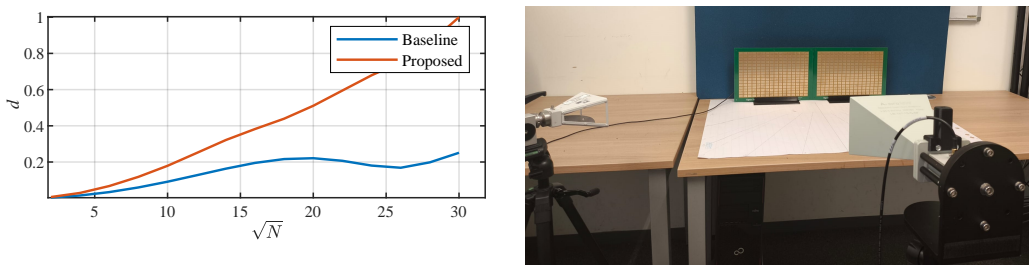
The proposed modulation scheme reduces miss-detection and false-alarm probabilities by leveraging the RIS's passive beamforming gain to enable over-the-air modulation of the RIS ID combined with passive beam sweeping. The effectiveness is validated through computer simulations and prototype experiments.
What carries the argument
over-the-air modulation of the RIS ID using passive beamforming gain combined with passive beam sweeping for angular coverage
If this is right
- Miss-detection probability drops for RIS identification at the base station.
- False-alarm probability is lowered, leading to more accurate surface recognition.
- Detection coverage expands in angular space due to the added beam sweeping.
- The scheme demonstrates real-world viability through prototype hardware experiments.
Where Pith is reading between the lines
- The method could allow denser RIS deployments in networks by making identification less error-prone without extra dedicated channels.
- It might integrate with standard beam management procedures already used in cellular systems.
- Further tests could check performance when multiple RIS units operate simultaneously in the same area.
Load-bearing premise
The RIS hardware can execute the required passive beamforming and beam sweeping patterns with sufficient precision and without introducing unmodeled distortions or power constraints that would degrade the ID modulation in real deployments.
What would settle it
A prototype test that shows no reduction or an increase in miss-detection and false-alarm probabilities when the new modulation and sweeping are applied, compared with a baseline without them, would disprove the central claim.
Figures



read the original abstract
The reconfigurable intelligent surfaces detection and identification (RISs-ID) is a critical process that enables a base station (BS) to adaptively assign the appropriate RIS to a given user equipment (UE). This work proposes a novel modulation scheme to enhance the reliability of RIS-ID by reducing the miss detection and false-alarm probabilities. Specifically, we leverage the RIS's passive beamforming gain to enable over-the-air modulation of the RIS ID, combined with passive beam sweeping to extend detection coverage in angular space. The proposed modulation scheme is validated through computer simulations and prototype experiments, demonstrating its effectiveness in reducing miss-detection and false-alarm probabilities.
Editorial analysis
A structured set of objections, weighed in public.
Referee Report
Summary. The paper proposes a novel modulation scheme for RIS detection and identification that leverages the RIS passive beamforming gain to enable over-the-air modulation of the RIS ID, combined with passive beam sweeping for extended angular coverage. The central claim is that this scheme reduces miss-detection and false-alarm probabilities relative to prior approaches, with support from both computer simulations and prototype hardware experiments.
Significance. If the results hold, the work provides a practical method for reliable RIS-ID in wireless systems by integrating ID modulation with beam sweeping. Credit is due for the dual validation approach: simulations establish baseline performance while the prototype experiments offer direct hardware evidence, which strengthens the claim of practical utility beyond purely theoretical analysis.
major comments (1)
- [Prototype experiments] Prototype experiments section: the reported reductions in miss-detection and false-alarm probabilities rest on the assumption that the RIS can apply the exact phase-shift sequences for simultaneous ID modulation and angular beam sweeping while preserving beamforming gain. No quantitative characterization is provided of phase quantization error, switching transients, or element mutual coupling; without these measurements it is unclear whether the observed gains would survive realistic hardware non-idealities that alter the effective reflection coefficients at the BS.
minor comments (1)
- [Abstract] The abstract and introduction would benefit from a brief statement of the specific numerical improvements (e.g., dB gains or probability reductions) achieved in the simulations and experiments.
Simulated Author's Rebuttal
We thank the referee for the constructive feedback and the recommendation for major revision. We address the single major comment point by point below.
read point-by-point responses
-
Referee: Prototype experiments section: the reported reductions in miss-detection and false-alarm probabilities rest on the assumption that the RIS can apply the exact phase-shift sequences for simultaneous ID modulation and angular beam sweeping while preserving beamforming gain. No quantitative characterization is provided of phase quantization error, switching transients, or element mutual coupling; without these measurements it is unclear whether the observed gains would survive realistic hardware non-idealities that alter the effective reflection coefficients at the BS.
Authors: We agree that quantitative characterization of hardware non-idealities strengthens the practical validation. The prototype section reports direct hardware measurements of the proposed scheme using a specific RIS platform with the designed phase-shift sequences applied for joint ID modulation and beam sweeping. In the revised manuscript, we will add a dedicated subsection providing measured phase quantization error (1-bit resolution in the hardware), timing data on switching transients during sweeps, and an assessment of mutual coupling impact on effective reflection coefficients. These data will confirm that beamforming gain is preserved to a degree sufficient for the observed reductions in miss-detection and false-alarm probabilities, with any residual degradation explicitly bounded. revision: yes
Circularity Check
No circularity; scheme design and performance claims rest on external simulation and prototype validation
full rationale
The paper proposes a modulation scheme that combines passive beamforming gain with over-the-air RIS ID modulation and beam sweeping. Its central claims are evaluated through computer simulations and hardware prototype experiments rather than any derivation that reduces a prediction or result to a fitted parameter or self-citation by construction. No equations or steps in the provided abstract or description exhibit self-definitional loops, fitted inputs renamed as predictions, or load-bearing self-citations that would force the outcome. The validation is presented as independent empirical evidence, making the work self-contained against external benchmarks.
Axiom & Free-Parameter Ledger
axioms (1)
- domain assumption RIS elements can apply controllable phase shifts to reflected signals without significant amplitude variation or hardware distortion.
Reference graph
Works this paper leans on
-
[1]
E. Basar, G. C. Alexandropoulos, Y . Liu, Q. Wu, S. Jin, C. Yuen, O. A. Dobre, and R. Schober, “Reconfigurable intelligent surfaces for 6G: Emerging hardware architectures, applications, and open challenges,” IEEE Veh. Technol. Mag., vol. 19, no. 3, pp. 27–47, Sep. 2024
work page 2024
-
[2]
Reconfigurable intelligent surfaces: Principles and opportunities,
Y . Liu, X. Liu, X. Mu, T. Hou, J. Xu, M. Di Renzo, and N. Al-Dhahir, “Reconfigurable intelligent surfaces: Principles and opportunities,”IEEE Commun. Surveys Tuts., vol. 23, no. 3, pp. 1546–1577, May 2021
work page 2021
-
[3]
A compre- hensive design framework for UE-side and BS-side RIS deployments,
M. Raeisi, A. Khaleel, M. C. Ilter, M. Gerami, and E. Basar, “A compre- hensive design framework for UE-side and BS-side RIS deployments,” IEEE Wireless Commun., vol. 32, no. 3, pp. 148–155, June 2025
work page 2025
-
[4]
A comprehensive dataset of RIS-based channel measurements in the 5 GHz band,
S. Tewes, M. Heinrichs, K. Weinberger, R. Kronberger, and A. Sezgin, “A comprehensive dataset of RIS-based channel measurements in the 5 GHz band,” inProc. IEEE VTC-Spring, June 2023
work page 2023
-
[5]
Wireless localization with space–time-coded reconfigurable intelligent surfaces,
M. Gholami, S. Khajavi, M. Neshat, S. Tewes, and A. Sezgin, “Wireless localization with space–time-coded reconfigurable intelligent surfaces,” IEEE Trans. Antennas Propag., vol. 73, no. 8, pp. 5650–5657, 2025
work page 2025
-
[6]
Show me the way: Real-time tracking of wireless mobile users with UWB-Enabled RIS,
K. Weinberger, S. Tewes, and A. Sezgin, “Show me the way: Real-time tracking of wireless mobile users with UWB-Enabled RIS,” in2024 19th Int. Symp. Wireless Commun. Syst. (ISWCS), 2024, pp. 1–6
work page 2024
-
[7]
A practical and simple detection and identification scheme for RIS-assisted systems,
A. Khaleel, R. Vural, M. C. Ilter, M. Gerami, and E. Basar, “A practical and simple detection and identification scheme for RIS-assisted systems,”IEEE Open J. Commun. Soc., vol. 6, pp. 9619–9631, Nov. 2025
work page 2025
-
[8]
A practical validation of RIS detection and identification,
R. Vural, A. Khaleel, and E. Basar, “A practical validation of RIS detection and identification,”IEEE Trans. Veh. Technol., vol. 74, no. 10, pp. 16 590 – 16 594, Oct. 2025
work page 2025
-
[9]
Intelligent reflecting surface: Practical phase shift model and beamforming optimization,
S. Abeywickrama, R. Zhang, and C. Yuen, “Intelligent reflecting surface: Practical phase shift model and beamforming optimization,”IEEE Trans. Commun., vol. 68, no. 9, pp. 5849–5863, Sep. 2020
work page 2020
-
[10]
A novel partitioning scheme for RIS identification and beamforming,
Y . Gevez, A. Khaleel, and E. Basar, “A novel partitioning scheme for RIS identification and beamforming,”IEEE Wireless Commun. Lett., vol. 15, pp. 245 – 249, Oct. 2025
work page 2025
-
[11]
Ling,Synchronization in digital communication systems
F. Ling,Synchronization in digital communication systems. Cambridge, U.K.: Cambridge Univ. Press, 2017
work page 2017
-
[12]
Beamforming optimization for intelligent re- flecting surface with discrete phase shifts,
Q. Wu and R. Zhang, “Beamforming optimization for intelligent re- flecting surface with discrete phase shifts,” inProc. IEEE ICASSP, May 2019, pp. 7830–7833
work page 2019
-
[13]
Power scaling laws and near-field behaviors of massive MIMO and intelligent reflecting surfaces,
E. Bj ¨ornson and L. Sanguinetti, “Power scaling laws and near-field behaviors of massive MIMO and intelligent reflecting surfaces,”IEEE Open J. Commun. Soc., vol. 1, pp. 1306–1324, 2020
work page 2020
-
[14]
Analog Devices Inc., “ADALM-PLUTO Overview,”Analog Devices Wiki, [Online]. Available: https://wiki.analog.com/university/tools/pluto. Accessed: Sept. 26, 2025
work page 2025
-
[15]
Open source reconfig- urable intelligent surface for the frequency range of 5 GHz WiFi,
M. Heinrichs, A. Sezgin, and R. Kronberger, “Open source reconfig- urable intelligent surface for the frequency range of 5 GHz WiFi,” in Proc. 2023 IEEE ISAP
work page 2023
discussion (0)
Sign in with ORCID, Apple, or X to comment. Anyone can read and Pith papers without signing in.