Beyond Model Readiness: Institutional Readiness for AI Deployment in Public Systems
Pith reviewed 2026-05-19 23:28 UTC · model grok-4.3
The pith
Public AI systems often stall at deployment because institutions lack operational, data, oversight, fiscal, and regulatory readiness.
A machine-rendered reading of the paper's core claim, the machinery that carries it, and where it could break.
Core claim
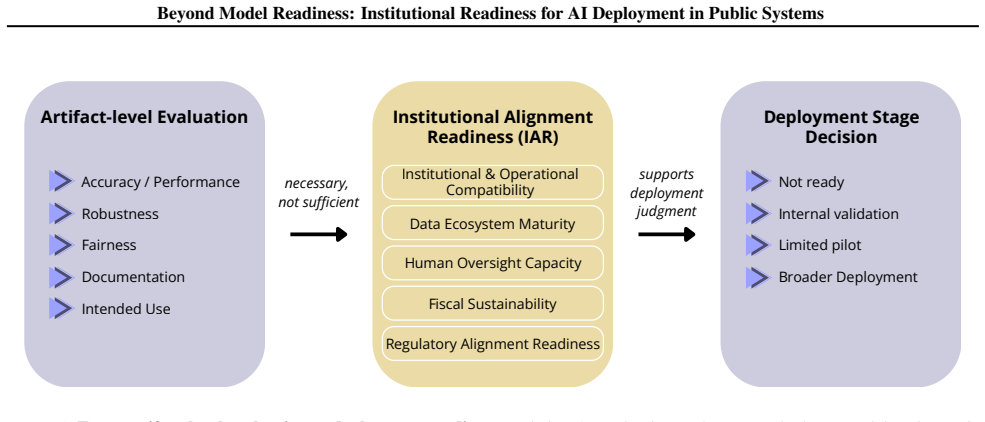
We introduce Institutional Alignment Readiness (IAR), a five-dimensional framework for assessing deployment readiness in public systems. The framework is designed for resource-constrained settings, where gaps between technical viability and responsible deployment are most acute. It is grounded in two anonymized operational cases from a large public education system: an image-based anthropometric screening tool and a speech-analysis system for early learning risk identification. Both reached technically viable stages but could not advance to broader rollout for institutional rather than technical reasons. We use these cases to motivate a practical readiness framework covering institutional, 1
What carries the argument
Institutional Alignment Readiness (IAR), a five-dimensional framework that evaluates the receiving institution across operational compatibility, data ecosystem maturity, human oversight capacity, fiscal sustainability, and regulatory alignment.
Load-bearing premise
Two anonymized cases from a single large public education system provide a sufficient basis for a general framework that applies across other public-sector domains and resource-constrained settings.
What would settle it
A public institution successfully deploying an AI system while failing to meet one or more of the five IAR dimensions would show the framework is not necessary for deployment success.
Figures

read the original abstract
Many public-sector artificial intelligence systems fail not at the point of model development, but at the point of deployment. Systems that perform well in internal testing may still stall because the receiving institution lacks the approvals, data arrangements, human oversight, operational capacity, fiscal continuity, or legal clarity needed for broader rollout. Existing responsible AI and model evaluation frameworks are valuable, but they primarily assess models, datasets, and developer-side processes, not the readiness of the institution that must use the system in practice. We introduce Institutional Alignment Readiness (IAR), a five-dimensional framework for assessing deployment readiness in public systems. The framework is designed for resource-constrained settings, where gaps between technical viability and responsible deployment are most acute. It is grounded in two anonymized operational cases from a large public education system: an image-based anthropometric screening tool and a speech-analysis system for early learning risk identification. Both reached technically viable stages but could not advance to broader rollout for institutional rather than technical reasons. We use these cases to motivate a practical readiness framework covering institutional and operational compatibility, data ecosystem maturity, human oversight capacity, fiscal sustainability, and regulatory alignment readiness. IAR is designed to complement, not replace, established AI evaluation tools. It assesses the receiving institution rather than the artifact alone and supports staging decisions such as no-go, pilot-only, or readiness for broader deployment.
Editorial analysis
A structured set of objections, weighed in public.
Referee Report
Summary. The manuscript argues that public-sector AI systems frequently fail at deployment rather than model development due to institutional shortcomings, and introduces the Institutional Alignment Readiness (IAR) framework—a five-dimensional construct covering institutional/operational compatibility, data ecosystem maturity, human oversight capacity, fiscal sustainability, and regulatory alignment—to assess receiving institutions in resource-constrained settings. The framework is motivated by two anonymized cases from a single large public education system (image-based anthropometric screening and speech-analysis for early learning risk), both of which reached technical viability but stalled for non-technical reasons. IAR is positioned as complementary to existing model-focused responsible AI tools and intended to inform staging decisions such as no-go, pilot-only, or broader deployment.
Significance. If the framework can be operationalized and tested more broadly, it would address a genuine gap by shifting focus from model performance to institutional capacity in public AI deployments, particularly in under-resourced contexts. The practical orientation toward staging decisions and the grounding in real operational examples are strengths that could make the work useful for practitioners, though its value hinges on demonstrating transportability beyond the motivating cases.
major comments (2)
- [Abstract / Motivating Cases] Abstract and motivating cases section: the framework is derived from only two anonymized cases within a single public education system, with no cross-sector examples, derivation process, or test of exhaustiveness provided. This makes the claim of applicability to broader public systems (e.g., healthcare allocation or infrastructure) a load-bearing assumption that requires explicit discussion of domain adaptations or limitations to support the central contribution.
- [IAR Framework Description] Framework presentation: the five dimensions are introduced without explicit mapping to barriers observed in the two cases, inclusion/exclusion criteria, or validation metrics, leaving the comprehensiveness of the construct conceptually motivated but not empirically anchored in the manuscript.
minor comments (2)
- [Framework] Clarify potential overlaps between dimensions (e.g., how 'institutional/operational compatibility' differs from 'human oversight capacity') to improve usability for practitioners.
- [Discussion] Add a brief limitations subsection discussing the education-domain origin and any steps taken to anonymize or generalize the cases.
Simulated Author's Rebuttal
We thank the referee for their constructive comments, which help clarify the boundaries of our contribution. We respond to each major comment below and indicate the revisions we will make to address the concerns about scope and empirical anchoring.
read point-by-point responses
-
Referee: [Abstract / Motivating Cases] Abstract and motivating cases section: the framework is derived from only two anonymized cases within a single public education system, with no cross-sector examples, derivation process, or test of exhaustiveness provided. This makes the claim of applicability to broader public systems (e.g., healthcare allocation or infrastructure) a load-bearing assumption that requires explicit discussion of domain adaptations or limitations to support the central contribution.
Authors: We agree that the motivating cases are limited to two anonymized examples from a single public education system. In the revised manuscript we will add a dedicated 'Scope, Limitations, and Domain Adaptations' subsection. This will explicitly discuss how the five IAR dimensions may require modification when applied to other sectors (e.g., adjusting regulatory-alignment considerations for healthcare data-protection regimes or infrastructure procurement rules) and will trace the derivation of each dimension to the concrete institutional barriers observed in the two cases. While we cannot introduce new cross-sector empirical cases or conduct a formal exhaustiveness test within the scope of this revision, the added discussion will replace the current load-bearing assumption with a more cautious and transparent statement of intended applicability. revision: yes
-
Referee: [IAR Framework Description] Framework presentation: the five dimensions are introduced without explicit mapping to barriers observed in the two cases, inclusion/exclusion criteria, or validation metrics, leaving the comprehensiveness of the construct conceptually motivated but not empirically anchored in the manuscript.
Authors: We accept that the current presentation would be strengthened by tighter empirical linkage. We will revise the framework section to include a mapping table that directly connects each dimension to the specific non-technical barriers that halted deployment in the anthropometric-screening and speech-analysis cases. We will also articulate the inclusion criteria used to select the five dimensions, explaining how they emerged from the observed gaps between technical viability and institutional capacity. As the paper presents a conceptual framework rather than a psychometrically validated instrument, we will not add quantitative validation metrics; instead we will note this as an important direction for future empirical work while clarifying the qualitative grounding already present in the cases. revision: yes
Circularity Check
No circularity in IAR framework derivation from case observations
full rationale
The paper introduces the IAR five-dimensional framework by synthesizing observations from two anonymized operational cases in a single public education system, where technically viable AI tools failed to deploy due to institutional factors. The dimensions are explicitly motivated by the specific barriers encountered in those cases rather than being defined in terms of themselves, fitted to parameters, or derived via equations that loop back to inputs. No self-citations, uniqueness theorems, or ansatzes are invoked as load-bearing elements; the framework is presented as a qualitative, practical complement to existing model-focused tools. The derivation chain is self-contained as an empirical-to-conceptual mapping without reduction by construction.
Axiom & Free-Parameter Ledger
axioms (1)
- domain assumption Institutional factors beyond model performance are the dominant reason public AI systems fail to reach broader rollout.
invented entities (1)
-
Institutional Alignment Readiness (IAR) framework
no independent evidence
Lean theorems connected to this paper
-
IndisputableMonolith/Foundation/RealityFromDistinction.leanreality_from_one_distinction unclear?
unclearRelation between the paper passage and the cited Recognition theorem.
We introduce Institutional Alignment Readiness (IAR), a five-dimensional framework for assessing deployment readiness in public systems... grounded in two anonymized operational cases from a large public education system
-
IndisputableMonolith/Cost/FunctionalEquation.leanwashburn_uniqueness_aczel unclear?
unclearRelation between the paper passage and the cited Recognition theorem.
The framework comprises five dimensions... institutional and operational compatibility, data ecosystem maturity, human oversight capacity, fiscal sustainability, and regulatory alignment readiness
What do these tags mean?
- matches
- The paper's claim is directly supported by a theorem in the formal canon.
- supports
- The theorem supports part of the paper's argument, but the paper may add assumptions or extra steps.
- extends
- The paper goes beyond the formal theorem; the theorem is a base layer rather than the whole result.
- uses
- The paper appears to rely on the theorem as machinery.
- contradicts
- The paper's claim conflicts with a theorem or certificate in the canon.
- unclear
- Pith found a possible connection, but the passage is too broad, indirect, or ambiguous to say the theorem truly supports the claim.
Reference graph
Works this paper leans on
-
[1]
Richard Dreyling and Juhani Lemmik and Tanel Tammet and Ingrid Pappel , doi =. An Artificial Intelligence Maturity Model for the Public Sector: A Design Science Approach , journal =. 2024 , pages =
work page 2024
-
[2]
Artificial Intelligence Risk Management Framework (AI RMF 1.0) , institution =. 2023 , type =
work page 2023
-
[3]
Information technology --- Artificial intelligence --- Management system , institution =. 2023 , number =
work page 2023
-
[4]
Angèle Christin , title =. Big Data & Society , volume =. 2017 , doi =
work page 2017
-
[5]
Algorithmic realism: expanding the boundaries of algorithmic thought , year =
Green, Ben and Viljoen, Salom\'. Algorithmic realism: expanding the boundaries of algorithmic thought , year =. doi:10.1145/3351095.3372840 , booktitle =
-
[6]
Tinkering toward Utopia: A Century of Public School Reform , author=. 1995 , publisher=
work page 1995
-
[7]
Reading Research Quarterly , volume=
Introduction to Response to Intervention: What, why, and how valid is it? , author=. Reading Research Quarterly , volume=
-
[8]
Advances in Neural Information Processing Systems , pages=
Hidden technical debt in machine learning systems , author=. Advances in Neural Information Processing Systems , pages=
-
[9]
Street-level Bureaucracy: Dilemmas of the Individual in Public Services , author=. 1980 , publisher=
work page 1980
-
[10]
Arizona State Law Journal , volume=
The Structural Consequences of Educational Privacy , author=. Arizona State Law Journal , volume=
-
[11]
The global landscape of AI ethics guidelines,
Anna Jobin and Marcello Ienca and Effy Vayena , title =. Nature Machine Intelligence , volume =. doi:10.1038/s42256-019-0088-2 , pages =
-
[12]
URL https://cacm.acm.org/research/ datasheets-for-datasets/
Gebru, Timnit and Morgenstern, Jamie and Vecchione, Briana and Vaughan, Jennifer Wortman and Wallach, Hanna and III, Hal Daum\'. Datasheets for datasets , year =. doi:10.1145/3458723 , journal =
-
[13]
The Information Society , volume =
Richard Heeks , title =. The Information Society , volume =
-
[14]
Model Cards for Model Reporting,
Mitchell, Margaret and Wu, Simone and Zaldivar, Andrew and Barnes, Parker and Vasserman, Lucy and Hutchinson, Ben and Spitzer, Elena and Raji, Inioluwa Deborah and Gebru, Timnit , title =. 2019 , isbn =. doi:10.1145/3287560.3287596 , booktitle =
-
[15]
Proceedings of the 2020 Conference on Fairness, Accountability, and Transparency , location =
Raji, Inioluwa Deborah and Smart, Andrew and White, Rebecca N. and Mitchell, Margaret and Gebru, Timnit and Hutchinson, Ben and Smith-Loud, Jamila and Theron, Daniel and Barnes, Parker , title =. 2020 , isbn =. doi:10.1145/3351095.3372873 , booktitle =
-
[16]
and Boyd, Danah and Friedler, Sorelle A
Selbst, Andrew D. and Boyd, Danah and Friedler, Sorelle A. and Venkatasubramanian, Suresh and Vertesi, Janet , title =. Proceedings of the Conference on Fairness, Accountability, and Transparency , pages =. 2019 , isbn =
work page 2019
- [17]
-
[18]
Nithya Sambasivan and Shivani Kapania and Hannah Highfill and Diana Akrong, Praveen Paritosh and Lora M Aroyo , title =. 2021 , pages =
work page 2021
-
[19]
P. Langley , title =. Proceedings of the 17th International Conference on Machine Learning (ICML 2000) , address =. 2000 , pages =
work page 2000
-
[20]
T. M. Mitchell. The Need for Biases in Learning Generalizations. 1980
work page 1980
-
[21]
M. J. Kearns , title =
-
[22]
Machine Learning: An Artificial Intelligence Approach, Vol. I. 1983
work page 1983
-
[23]
R. O. Duda and P. E. Hart and D. G. Stork. Pattern Classification. 2000
work page 2000
-
[24]
Suppressed for Anonymity , author=
-
[25]
A. Newell and P. S. Rosenbloom. Mechanisms of Skill Acquisition and the Law of Practice. Cognitive Skills and Their Acquisition. 1981
work page 1981
-
[26]
A. L. Samuel. Some Studies in Machine Learning Using the Game of Checkers. IBM Journal of Research and Development. 1959
work page 1959
-
[27]
Damschroder, Laura J and Aron, David C and Keith, Rosalind E and Kirsh, Susan R and Alexander, Jeffery A and Lowery, Julie C , month =. Fostering Implementation of Health Services Research Findings into practice: a Consolidated Framework for Advancing Implementation Science , doi =. 2009 , journal =
work page 2009
- [28]
discussion (0)
Sign in with ORCID, Apple, or X to comment. Anyone can read and Pith papers without signing in.