Experimental observation of entropic-singularity-induced nonadditive quantum communication in a qutrit platypus channel
Pith reviewed 2026-05-20 12:57 UTC · model grok-4.3
The pith
Six-dimensional photonic entanglement reveals a violation of additivity in coherent information for a qutrit platypus channel.
A machine-rendered reading of the paper's core claim, the machinery that carries it, and where it could break.
Core claim
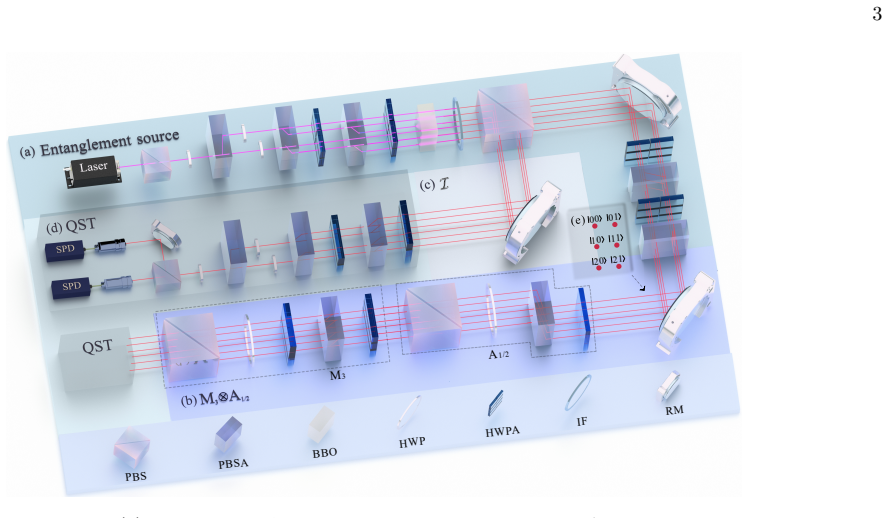
By preparing six-dimensional photonic entanglement, we directly measure the coherent information of a platypus channel, a qubit amplitude damping channel, and their joint uses, revealing a clear violation of additivity. Quantum process tomography further reveals the entropic singularity responsible for this effect, demonstrating how singular entropy landscapes in low-dimensional channels can enhance quantum communication beyond additive limits.
What carries the argument
The entropic singularity in the qutrit platypus channel, a non-smooth point in the von Neumann entropy of the output state that produces superadditive coherent information when the channel is combined with another.
If this is right
- Joint use of the platypus channel and qubit amplitude damping channel produces higher coherent information than the sum of the two used separately.
- Low-dimensional quantum channels can exceed additive capacity bounds when their entropy landscapes contain singularities.
- Photonic entanglement enables direct experimental access to coherent information and its nonadditive behavior.
- Quantum process tomography can identify the specific entropy features that drive nonadditivity.
Where Pith is reading between the lines
- The same singularity mechanism might appear in other physical realizations such as trapped ions or superconducting circuits, allowing similar gains.
- Searching for entropic singularities could become a design principle when constructing quantum communication links or networks.
- The size of the observed violation offers a quantitative target for testing whether higher-dimensional or multi-use scenarios produce even larger effects.
Load-bearing premise
The photonic hardware accurately reproduces the ideal mathematical model of the qutrit platypus channel so the measured coherent-information values reflect the theoretical entropic singularity rather than noise or mismatch.
What would settle it
Repeating the coherent-information measurements with substantially lower experimental noise and finding that the joint-use value equals the sum of the separate values would disprove the claimed violation.
Figures


read the original abstract
The nonadditivity of channel capacity is a defining feature that distinguishes quantum communication from classical communication. In the quantum realm, the channel capacity is determined by coherent information, which is defined through the von Neumann entropies of the output and its environment. Despite its fundamental importance, experimental evidence of such nonadditive quantum communication has been elusive because of the complexity of the required quantum channel. Here, we experimentally observe entropic-singularity-induced coherent-information nonadditivity using the qutrit platypus channel implemented on a photonic platform. By preparing six-dimensional photonic entanglement, we directly measure the coherent information of a platypus channel, a qubit amplitude damping channel, and their joint uses, revealing a clear violation of additivity. Quantum process tomography further reveals the entropic singularity responsible for this effect, demonstrating how singular entropy landscapes in low-dimensional channels can enhance quantum communication beyond additive limits.
Editorial analysis
A structured set of objections, weighed in public.
Referee Report
Summary. The manuscript reports an experimental demonstration of coherent-information nonadditivity in a qutrit platypus channel combined with a qubit amplitude-damping channel. Using six-dimensional photonic entanglement, direct measurements, and quantum process tomography on a photonic platform, the authors claim to observe I_c(N ⊗ M) > I_c(N) + I_c(M) and attribute the violation to an entropic singularity in the channel's output and environment entropy landscape.
Significance. If the photonic implementation is shown to faithfully reproduce the theoretical platypus channel at the critical damping parameter, the result would constitute the first direct experimental observation of entropic-singularity-induced nonadditivity. This would strengthen understanding of quantum channel capacities beyond the additive regime and demonstrate a viable photonic route to realizing low-dimensional channels with singular entropy features.
major comments (1)
- [Experimental Methods / Results section (process tomography and coherent-information measurements)] Experimental Methods / Results section (process tomography and coherent-information measurements): The central claim requires that the observed violation arises specifically from the entropic singularity of the ideal qutrit platypus channel. The manuscript describes six-dimensional entanglement and tomography but provides no quantitative bound (e.g., diamond-norm distance, average gate fidelity, or Kraus-operator overlap) between the reconstructed channel and the theoretical model at the damping parameter where the singularity is predicted. Without this metric, deviations in effective environment dimension or Kraus operators could alter the relevant entropies and produce an apparent violation unrelated to the singularity.
minor comments (2)
- [Abstract] Abstract: The statement that a 'clear violation' was observed should be accompanied by the measured numerical values of I_c(N), I_c(M), and I_c(N ⊗ M) together with their uncertainties so that the magnitude and statistical significance of the nonadditivity can be assessed immediately.
- [Figures] Figure captions and data presentation: All plots of coherent information or entropy landscapes should explicitly state the number of experimental repetitions, the method used to extract error bars, and whether the reported violation exceeds the combined uncertainties.
Simulated Author's Rebuttal
We thank the referee for the careful review and for recognizing the potential significance of our experimental demonstration of entropic-singularity-induced nonadditivity. We address the major comment below and will revise the manuscript to incorporate the requested quantitative analysis.
read point-by-point responses
-
Referee: The central claim requires that the observed violation arises specifically from the entropic singularity of the ideal qutrit platypus channel. The manuscript describes six-dimensional entanglement and tomography but provides no quantitative bound (e.g., diamond-norm distance, average gate fidelity, or Kraus-operator overlap) between the reconstructed channel and the theoretical model at the damping parameter where the singularity is predicted. Without this metric, deviations in effective environment dimension or Kraus operators could alter the relevant entropies and produce an apparent violation unrelated to the singularity.
Authors: We agree that an explicit quantitative comparison between the reconstructed channel and the ideal theoretical model strengthens the attribution of the observed nonadditivity to the entropic singularity. The quantum process tomography data already presented in the manuscript allow us to compute such metrics. In the revised manuscript we will add the diamond-norm distance and average gate fidelity between the experimentally reconstructed channel and the ideal qutrit platypus channel at the critical damping parameter, together with the Kraus-operator overlap. These quantities will be reported in the Experimental Methods section. We note that the direct coherent-information measurements for the single and joint channels remain independent evidence of the violation, while the tomography results exhibit the characteristic singular behavior in the output and environment entropies. revision: yes
Circularity Check
No circularity: experimental measurement of coherent information and nonadditivity
full rationale
The paper reports direct experimental measurements of coherent information using six-dimensional photonic entanglement and quantum process tomography on a photonic platform implementing the qutrit platypus channel. No derivation chain, first-principles prediction, or theoretical result is claimed that reduces by construction to fitted parameters, self-definitions, or self-citation load-bearing premises. The observed violation of additivity and identification of the entropic singularity follow from the reconstructed channel maps and entropy calculations on measured data, which are independent of any internal fitting that would force the outcome. This is a standard empirical observation paper with no load-bearing self-referential steps.
Axiom & Free-Parameter Ledger
axioms (1)
- standard math Standard quantum mechanics and the definition of coherent information via von Neumann entropies
Lean theorems connected to this paper
-
IndisputableMonolith/Cost/FunctionalEquation.leanwashburn_uniqueness_aczel unclear?
unclearRelation between the paper passage and the cited Recognition theorem.
entropic-singularity-induced coherent-information nonadditivity using the qutrit platypus channel
What do these tags mean?
- matches
- The paper's claim is directly supported by a theorem in the formal canon.
- supports
- The theorem supports part of the paper's argument, but the paper may add assumptions or extra steps.
- extends
- The paper goes beyond the formal theorem; the theorem is a base layer rather than the whole result.
- uses
- The paper appears to rely on the theorem as machinery.
- contradicts
- The paper's claim conflicts with a theorem or certificate in the canon.
- unclear
- Pith found a possible connection, but the passage is too broad, indirect, or ambiguous to say the theorem truly supports the claim.
Reference graph
Works this paper leans on
-
[1]
C. E. Shannon, A mathematical theory of communica- tion, The Bell system technical journal27, 379 (1948)
work page 1948
-
[2]
A. S. Holevo, Bounds for the quantity of information transmitted by a quantum communication channel, Prob- lemy Peredachi Informatsii9, 3 (1973)
work page 1973
-
[3]
B. Schumacher and M. D. Westmoreland, Sending clas- sical information via noisy quantum channels, Physical Review A56, 131 (1997)
work page 1997
-
[4]
A. S. Holevo, The capacity of the quantum channel with general signal states, IEEE Transactions on Information Theory44, 269 (2002)
work page 2002
-
[5]
C. H. Bennett, D. P. DiVincenzo, J. A. Smolin, and W. K. Wootters, Mixed-state entanglement and quantum error correction, Physical Review A54, 3824 (1996)
work page 1996
-
[6]
C. H. Bennett, P. W. Shor, J. A. Smolin, and A. V. Thap- liyal, Entanglement-assisted classical capacity of noisy quantum channels, Physical Review Letters83, 3081 (1999)
work page 1999
-
[7]
N. Cai, A. Winter, and R. W. Yeung, Quantum privacy and quantum wiretap channels, problems of information transmission40, 318 (2004)
work page 2004
-
[8]
I. Devetak, The private classical capacity and quantum capacity of a quantum channel, IEEE Transactions on Information Theory51, 44 (2005)
work page 2005
-
[9]
Lloyd, Capacity of the noisy quantum channel, Phys- ical Review A55, 1613 (1997)
S. Lloyd, Capacity of the noisy quantum channel, Phys- ical Review A55, 1613 (1997)
work page 1997
-
[10]
D. P. DiVincenzo, P. W. Shor, and J. A. Smolin, Quantum-channel capacity of very noisy channels, Phys- ical Review A57, 830 (1998)
work page 1998
- [11]
-
[12]
C. Macchiavello and M. F. Sacchi, Detecting lower bounds to quantum channel capacities, Physical Review Letters116, 140501 (2016)
work page 2016
-
[13]
F. Leditzky, D. Leung, and G. Smith, Dephrasure chan- nel and superadditivity of coherent information, Physical review letters121, 160501 (2018)
work page 2018
-
[14]
B. Schumacher and M. A. Nielsen, Quantum data pro- cessing and error correction, Physical Review A54, 2629 6 (1996)
work page 1996
- [15]
-
[16]
G. Smith and J. A. Smolin, Degenerate quantum codes for pauli channels, Physical review letters98, 030501 (2007)
work page 2007
-
[17]
G. Smith and J. A. Smolin, Extensive nonadditivity of privacy, Physical Review Letters103, 120503 (2009)
work page 2009
-
[18]
G. Smith and J. A. Smolin, Can nonprivate channels transmit quantum information?, Physical Review Letters 102, 010501 (2009)
work page 2009
-
[19]
D. Elkouss and S. Strelchuk, Superadditivity of private information for any number of uses of the channel, Phys- ical Review Letters115, 040501 (2015)
work page 2015
-
[20]
M. B. Hastings, Superadditivity of communication capac- ity using entangled inputs, Nature Physics5, 255 (2009)
work page 2009
-
[21]
G. Smith and J. Yard, Quantum communication with zero-capacity channels, Science321, 1812 (2008)
work page 2008
-
[22]
Oppenheim, For quantum information, two wrongs can make a right, Science321, 1783 (2008)
J. Oppenheim, For quantum information, two wrongs can make a right, Science321, 1783 (2008)
work page 2008
- [23]
-
[24]
F. G. Brand˜ ao, J. Oppenheim, and S. Strelchuk, When does noise increase the quantum capacity?, Physical re- view letters108, 040501 (2012)
work page 2012
-
[25]
Y. Lim, R. Takagi, G. Adesso, and S. Lee, Activation and superactivation of single-mode gaussian quantum chan- nels, Physical Review A99, 032337 (2019)
work page 2019
-
[26]
K. Horodecki, M. Horodecki, P. Horodecki, and J. Op- penheim, Secure key from bound entanglement, Physical review letters94, 160502 (2005)
work page 2005
- [27]
-
[28]
S. Yu, Y. Meng, R. B. Patel, Y.-T. Wang, Z.-J. Ke, W. Liu, Z.-P. Li, Y.-Z. Yang, W.-H. Zhang, J.-S. Tang, et al., Experimental observation of coherent-information superadditivity in a dephrasure channel, Physical Review Letters125, 060502 (2020)
work page 2020
-
[29]
V. Siddhu, Entropic singularities give rise to quantum transmission, Nature Communications12, 5750 (2021)
work page 2021
-
[30]
F. Leditzky, D. Leung, V. Siddhu, G. Smith, and J. A. Smolin, Generic nonadditivity of quantum capacity in simple channels, Physical review letters130, 200801 (2023)
work page 2023
-
[31]
F. Leditzky, D. Leung, V. Siddhu, G. Smith, and J. A. Smolin, The platypus of the quantum channel zoo, IEEE Transactions on Information Theory69, 3825 (2023)
work page 2023
-
[32]
See Supplemental Material for more details
discussion (0)
Sign in with ORCID, Apple, or X to comment. Anyone can read and Pith papers without signing in.