Exact solution and pair correlation functions for a generalized three-chain Ising tube with multispin interactions
Pith reviewed 2026-05-19 22:28 UTC · model grok-4.3
The pith
An 8x8 transfer matrix supplies the exact partition function and all thermodynamic quantities in the infinite-length limit for a three-chain Ising tube with 20 independent couplings.
A machine-rendered reading of the paper's core claim, the machinery that carries it, and where it could break.
Core claim
For the most general C3-symmetric Hamiltonian on the elementary prism the partition function of a tube of length L is obtained exactly as the trace of the 8x8 transfer matrix raised to L. In the thermodynamic limit the free energy per site equals the logarithm of the largest eigenvalue lambda_max, which satisfies a quartic characteristic equation in the general case and reduces to a quadratic in the principal even-spin-interaction subfamily. Magnetization is expressed directly in terms of the components of the corresponding eigenvector; it vanishes identically in the even-spin case at zero field. Pair correlation functions are derived explicitly for all mirror-symmetric subfamilies.
What carries the argument
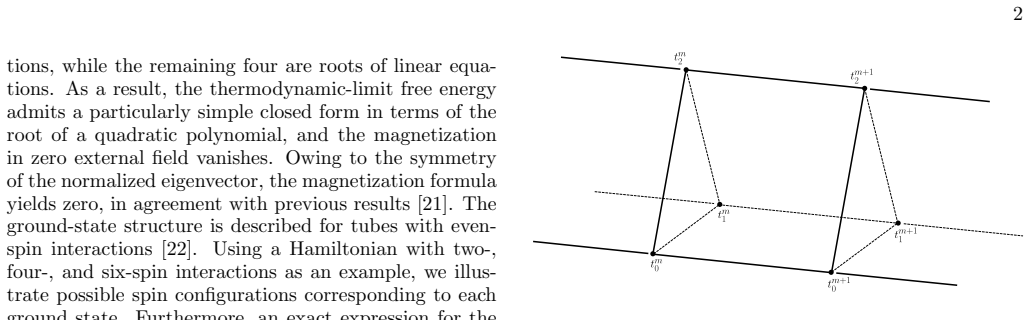
The 8x8 transfer matrix that assembles the Boltzmann weights for every spin configuration on a single C3-symmetric prism and propagates them along the tube.
If this is right
- Free energy, internal energy, specific heat, magnetization, susceptibility and entropy are available in closed form from the largest eigenvalue and its eigenvector for any choice of the twenty couplings.
- In the principal even-spin subfamily the characteristic polynomial factorizes and lambda_max is the root of a quadratic equation.
- Pair correlation functions admit explicit formulas in every mirror-symmetric subfamily and can be written in terms of transfer-matrix eigenvectors.
- Magnetization vanishes for the even-spin subfamily at zero external field.
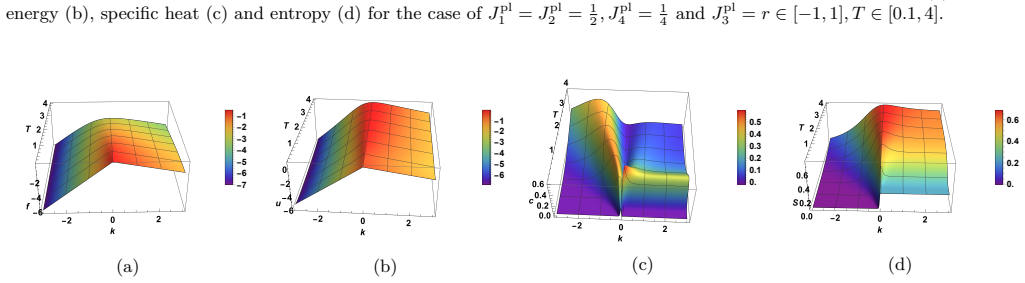
- Zero-temperature entropy equals (ln 2)/3 per site for the width-three planar model when the plaquette coupling k is nonnegative and equals zero when k is negative.
Where Pith is reading between the lines
- The same transfer-matrix construction could be tested on other discrete symmetries or on tubes of width four or five to see whether exact solvability persists.
- The explicit eigenvector expressions for magnetization supply a direct route to checking sum rules or fluctuation-dissipation relations in the presence of multispin terms.
- Results for the width-three triangular lattice with distinct nearest-neighbor couplings and three-spin interactions offer a benchmark against which approximate methods for frustrated planar Ising models can be calibrated.
Load-bearing premise
The 8x8 transfer matrix is assumed to incorporate every Boltzmann weight arising from the twenty independent couplings without missing terms or hidden constraints that would invalidate eigenvalue extraction for arbitrary parameter values.
What would settle it
Direct enumeration of the partition function for small L and arbitrary couplings, followed by comparison with the trace of the 8x8 matrix raised to L, would immediately show whether the matrix construction is complete.
Figures




read the original abstract
We obtain an exact solution for a generalized three-chain Ising tube (TCGIT) of length $L$ with toroidal boundary conditions and the most general $C_3$-invariant Hamiltonian on an elementary prism, containing 20 independent coupling constants, including an external magnetic field. Using an $8\times 8$ transfer matrix, we derive the exact partition function of the finite system and obtain the free energy, internal energy, specific heat, magnetization, magnetic susceptibility, and entropy in the thermodynamic limit $L\to\infty$. In the general case, $\lambda_{\max}$ is determined by a quartic equation, whereas in the principal special case with even-spin interactions (PSC) the spectrum simplifies substantially: the characteristic polynomial factorizes, and $\lambda_{\max}$ is given by the root of a quadratic equation. For mirror-symmetric subfamilies, we derive explicit formulas for the pair correlation functions and express the magnetization in terms of the components of the eigenvector associated with $\lambda_{\max}$; in the even-spin case with $h=0$, the magnetization vanishes. Important special cases include the width-three planar model with nearest-neighbor, next-nearest-neighbor, and plaquette interactions, including the entropy limit $S(T\to0^+)=(\ln 2)/3$ for $k\ge 0$ and $S(T\to0^+)=0$ for $k<0$, as well as the width-three planar triangular model with distinct nearest-neighbor couplings, three-spin interactions involving neighboring triangles, and an external field.
Editorial analysis
A structured set of objections, weighed in public.
Referee Report
Summary. The manuscript claims to obtain an exact solution for a generalized three-chain Ising tube of finite length L with toroidal boundary conditions and the most general C3-invariant Hamiltonian on an elementary prism containing 20 independent coupling constants (including an external field). An 8×8 transfer matrix is constructed whose entries are the Boltzmann weights; the partition function is Z = Tr(T^L), and the thermodynamic limit L→∞ is controlled by the largest eigenvalue λ_max. Thermodynamic quantities (free energy, internal energy, specific heat, magnetization, susceptibility, entropy) are derived from λ_max. In the general case λ_max satisfies a quartic; for the principal special case of even-spin interactions the characteristic polynomial factorizes to a quadratic. Explicit pair-correlation formulas and magnetization expressions are given for mirror-symmetric subfamilies, with magnetization vanishing when h=0 in the even-spin case. Reductions to width-three planar models with nearest-neighbor, next-nearest-neighbor, plaquette, and three-spin interactions are discussed, including the zero-temperature entropy limits S(T→0+)=(ln 2)/3 for k≥0 and S=0 for k<0.
Significance. If the transfer-matrix construction is correct for arbitrary values of the twenty couplings, the work supplies an exactly solvable quasi-one-dimensional model with an unusually large number of independent multispin interactions under C3 symmetry. This enlarges the set of solvable Ising tubes and permits systematic exploration of competing interactions, correlation decay, and thermodynamic singularities. The explicit reduction to known planar models and the verifiable factorization in the even-spin case constitute concrete strengths; the absence of fitted parameters or post-hoc adjustments further supports reproducibility.
minor comments (3)
- [Abstract] The abstract states that λ_max is determined by a quartic equation in the general case; a brief remark on the explicit form of the characteristic polynomial (or its reduction under C3 symmetry) would help readers verify the counting of independent roots without consulting the full 8×8 matrix.
- [Pair-correlation section] The derivation of pair correlation functions is restricted to mirror-symmetric subfamilies. A short statement clarifying whether the eigenvector components used for magnetization remain well-defined outside these subfamilies would improve completeness.
- [Special-cases paragraph] The entropy limits S(T→0+)=(ln 2)/3 and S=0 are quoted for the width-three planar model; an explicit reference to the corresponding coupling regime (k≥0 or k<0) in the general Hamiltonian would make the reduction transparent.
Simulated Author's Rebuttal
We thank the referee for the careful and accurate summary of our manuscript, which correctly identifies the construction of the 8×8 transfer matrix, the quartic characteristic equation in the general case, the factorization in the even-spin principal special case, the explicit pair-correlation and magnetization formulas, and the reductions to known planar models. The positive assessment of the work's significance is appreciated. No specific major comments or requests for clarification were raised in the report, so we have no points requiring detailed rebuttal or additional justification. We are happy to implement any minor editorial changes or clarifications during the revision process.
Circularity Check
No significant circularity; derivation is self-contained
full rationale
The paper constructs an explicit 8×8 transfer matrix whose entries are the Boltzmann weights of the C3-invariant Hamiltonian on consecutive prisms. The partition function is obtained directly as Z = Tr(T^L) for finite L, and the thermodynamic limit follows from the largest eigenvalue of this matrix via the standard transfer-matrix formalism. No fitted parameters are renamed as predictions, no self-citations close a load-bearing loop, and the characteristic equation (quartic or quadratic in special cases) is derived from the matrix entries without reduction to prior results by the same authors. All quantities (free energy, correlations, magnetization) are expressed in terms of the matrix spectrum and eigenvectors, making the derivation independent of external benchmarks or self-referential assumptions.
Axiom & Free-Parameter Ledger
axioms (2)
- standard math The partition function is exactly Z = Tr(T^L) where T is the 8×8 transfer matrix whose entries are the Boltzmann weights of the prism Hamiltonian.
- standard math In the thermodynamic limit the free energy per site is given by -kT ln(λ_max) where λ_max is the largest eigenvalue of T.
Lean theorems connected to this paper
-
IndisputableMonolith/Foundation/AlexanderDuality.leanalexander_duality_circle_linking (D=3) and 8-tick period from 2^D=8 matches?
matchesMATCHES: this paper passage directly uses, restates, or depends on the cited Recognition theorem or module.
Using an 8×8 transfer matrix... C3-invariant Hamiltonian on an elementary prism... λ_max determined by a quartic equation... even-spin interactions (PSC) the spectrum simplifies... quadratic equation
-
IndisputableMonolith/Foundation/DimensionForcing.lean (and 8-tick modules)reality_from_one_distinction → 8-tick + D=3 echoes?
echoesECHOES: this paper passage has the same mathematical shape or conceptual pattern as the Recognition theorem, but is not a direct formal dependency.
three-chain Ising tube... toroidal boundary conditions... mirror-symmetric subfamilies... pair correlation functions
What do these tags mean?
- matches
- The paper's claim is directly supported by a theorem in the formal canon.
- supports
- The theorem supports part of the paper's argument, but the paper may add assumptions or extra steps.
- extends
- The paper goes beyond the formal theorem; the theorem is a base layer rather than the whole result.
- uses
- The paper appears to rely on the theorem as machinery.
- contradicts
- The paper's claim conflicts with a theorem or certificate in the canon.
- unclear
- Pith found a possible connection, but the passage is too broad, indirect, or ambiguous to say the theorem truly supports the claim.
Reference graph
Works this paper leans on
-
[1]
M. A. Yurishchev, Statistical Mechanics of a Triple Ising Chain, Sov. J. Low Temp. Phys.10, 625 (1984), DOI:10.1063/10.0031127
-
[2]
M. Yurishchev, Ising Model Consisting of Central and Three Side Chains, Physica Status Solidi (b)153, 703 (1989), DOI:10.1002/pssb.2221530229
-
[3]
M. Yurishchev, Ising models on the 2×2× ∞lattices, Journal of Experimental and Theoretical Physics104, 461 (2007), DOI:10.1134/s1063776107030120
-
[4]
E. N. Cirillo, G. Gonnella, and A. Pelizzola, Criti- cal behavior of the three-dimensional Ising model with nearest-neighbor, next-nearest-neighbor, and plaque- tte interactions, Physical Review E55, R17 (1997), DOI:10.1103/physreve.55.r17
-
[5]
L. Kalok and L. De Menezes, Competing interac- tions in double-chains: Ising and spherical models, Zeitschrift f¨ ur Physik B Condensed Matter20, 223 (1975), DOI:10.1007/bf01315695
-
[6]
T. Yokota, Pair correlations for double-chain and triple-chain Ising models with competing inter- actions, Physical Review B39, 12312 (1989), DOI:10.1103/physrevb.39.12312
-
[7]
P. Khrapov and S. Shchurenkov, Exact solution and cor- relation functions of generalized double Ising chains, In- ternational Journal of Open Information Technologies 14, 37 (2026)
work page 2026
-
[8]
G. K. Savvidy and F. J. Wegner, Geometrical string and spin systems, Nuclear Physics B413, 605 (1994), DOI: 10.1016/0550-3213(94)90003-5
-
[9]
G. K. Savvidy, K. G. Savvidy, and F. Wegner, Geometri- cal string and dual spin systems, Nuclear Physics B443, 565 (1995), DOI: 10.1016/0550-3213(95)00151-H
-
[10]
G. Savvidy, The gonihedric paradigm extension of the Ising model, Modern Physics Letters B29, 1550203 (2015), DOI: 10.1142/S0217984915502036
-
[11]
G. Bathas, E. Floratos, G. K. Savvidy, and K. G. 22 Savvidy, Two-and three-dimensional spin systems with gonihedric action, Modern Physics Letters A10, 2695 (1995), DOI:10.1142/S0217732395002829
-
[12]
A. Farchakh, A. Boubekri, and M. El Hafidi, Magneti- zation plateaus at low temperature in a triangular spin tube, Journal of Low Temperature Physics206, 131 (2022), DOI:10.1007/s10909-021-02644-1
-
[13]
A. Farchakh, Z. Elmaddahi, and M. El Hafidi, Magnetic modeling of a straight triangular single-walled nanotube with mixed spins (1/2, 1), Journal of Low Temperature Physics210, 406 (2023), DOI:10.1007/s10909-022-02924- 4
-
[14]
N. S ¸arlı, Band structure of the susceptibility, internal energy and specific heat in a mixed core/shell Ising nan- otube, Physica B: Condensed Matter411, 12 (2013), DOI:10.1016/j.physb.2012.08.046
-
[15]
B. Deviren and M. Keskin, Thermal behavior of dynamic magnetizations, hysteresis loop areas and correlations of a cylindrical Ising nanotube in an oscillating magnetic field within the effective-field theory and the glauber-type stochastic dynamics approach, Physics Letters A376, 1011 (2012), DOI:10.1016/j.physleta.2012.02.001
-
[16]
B. Deviren, Y. S ¸ener, and M. Keskin, Dynamic magnetic properties of the kinetic cylindrical Ising nanotube, Phys- ica A: Statistical Mechanics and its Applications392, 3969 (2013), DOI:10.1016/j.physa.2013.05.017
-
[17]
T. Kaneyoshi, Some characteristic properties of ini- tial susceptibility in a Ising nanotube, Journal of Magnetism and Magnetic Materials323, 1145 (2011), DOI:10.1016/j.jmmm.2010.12.026
-
[18]
E. W. Montroll, Statistical mechanics of nearest neighbor systems, The Journal of Chemical Physics9, 706 (1941), DOI:10.1063/1.1750981
-
[19]
H. A. Kramers and G. H. Wannier, Statistics of the Two- Dimensional Ferromagnet. Part I, Physical Review60, 252 (1941), DOI:10.1103/physrev.60.252
-
[20]
H. A. Kramers and G. H. Wannier, Statistics of the Two- Dimensional Ferromagnet. Part II, Physical Review60, 263 (1941), DOI:10.1103/physrev.60.263
-
[21]
A. Fedro, New method for obtaining exact solutions of the Ising problem for finite arrays of coupled chains, Physical Review B14, 2983 (1976), DOI: 10.1103/Phys- RevB.14.2983
-
[22]
I. A. Kashapov, Structure of ground states in three- dimensional Ising model with three-step interaction, Theoretical and Mathematical Physics33, 912 (1977), DOI:10.1007/bf01039015
-
[23]
R. J. Baxter,Exactly solved models in statistical mechan- ics(World Scientific, 1985)
work page 1985
-
[24]
H. W. Turnbull,Theory of equations, Vol. 6 (Oliver and Boyd, 1947)
work page 1947
-
[25]
L. E. Dickson,First course in the theory of equations(J. Wiley & sons, Incorporated, 1922)
work page 1922
-
[26]
H. Anton and C. Rorres,Elementary linear algebra: ap- plications version(John Wiley & Sons, 2013)
work page 2013
-
[27]
R. A. Horn and C. R. Johnson,Matrix analysis(Cam- bridge University Press, 2012)
work page 2012
-
[28]
M. E. Fisher and R. J. Burford, Theory of critical-point scattering and correlations. I. The Ising model, Physical Review156, 583 (1967), DOI:10.1103/PhysRev.156.583
-
[29]
A. L. Andrew, Eigenvectors of certain matrices, Lin- ear Algebra and its Applications7, 151 (1973), DOI: 10.1016/0024-3795(73)90049-9
-
[30]
Cajori,An introduction to the modern theory of equa- tions(Macmillan, 1912)
F. Cajori,An introduction to the modern theory of equa- tions(Macmillan, 1912)
work page 1912
discussion (0)
Sign in with ORCID, Apple, or X to comment. Anyone can read and Pith papers without signing in.