A comparative first-principles investigation of bilayer NbOX2 (X=Cl, Br, I) for Photocatalytic water splitting applications
Pith reviewed 2026-05-20 22:50 UTC · model grok-4.3
The pith
Bilayer NbOX2 materials position their energy bands to split water using visible and ultraviolet light.
A machine-rendered reading of the paper's core claim, the machinery that carries it, and where it could break.
Core claim
The authors establish that 2D homo bilayers of NbOX2 are dynamically, thermally, and mechanically stable, with NbOCl2 and NbOBr2 favoring AC stacking and NbOI2 favoring AB stacking. Electronic structure analysis reveals a decreasing band gap trend from Cl to I, high carrier mobility comparable to known 2D materials, anisotropic charge transfer for efficient separation, and absorption coefficients of 10^5 cm-1. These properties align the materials with the requirements for photocatalytic water splitting in the visible and ultraviolet regions, following trends seen in BiOI and PtSe2 where multilayer formation improves efficiency.
What carries the argument
Density functional theory calculations of electronic band alignment to water redox potentials combined with optical absorption spectra.
If this is right
- The decreasing band gap from chlorine to iodine allows the materials to be selected or tuned for different portions of the solar spectrum.
- Anisotropic carrier mobility promotes spatial separation of electrons and holes, which reduces recombination losses during photocatalysis.
- Absorption coefficients near 10^5 cm-1 indicate that even few-layer films can harvest enough visible and ultraviolet photons for practical hydrogen production.
- Stacking-dependent stability suggests that device fabrication routes must control layer registry to maintain the desired electronic properties.
- The similarity to BiOI and PtSe2 implies that adding more layers could further enhance photocatalytic rates in these NbOX2 systems.
Where Pith is reading between the lines
- If the band alignments hold in real samples, these bilayers could be integrated into thin-film reactors that operate without external bias under sunlight.
- The high carrier mobility and stability open the possibility of combining these layers with other 2D materials to form heterostructures that further improve charge extraction.
- Because the bulk parent compounds already show strong dielectric polarization, the bilayer versions may also exhibit useful piezoelectric effects that assist carrier separation under mechanical strain.
Load-bearing premise
The chosen density functional theory approach places the valence and conduction band edges at the correct energies relative to the water oxidation and reduction potentials.
What would settle it
Direct experimental measurement of sustained hydrogen evolution when a bilayer NbOX2 sample is illuminated by visible light in contact with water would support the claim, while zero or negligible gas production would falsify it.
Figures




read the original abstract
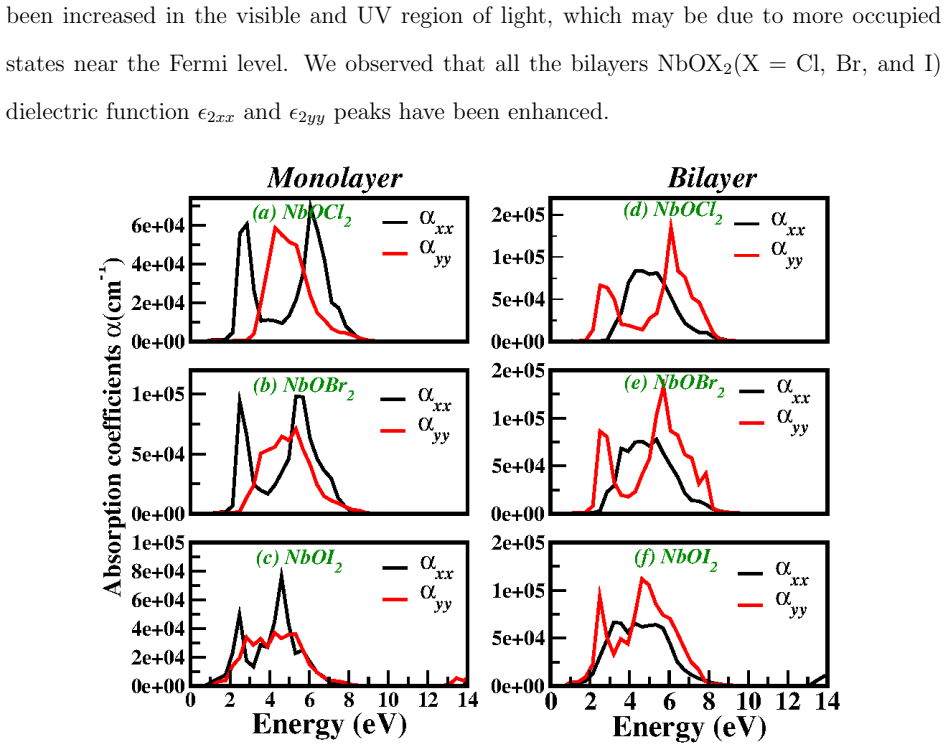
Motivated by our previous work on bulk NbOX2 , where we have reported its high 1dielectric polarisation and finite piezoelectric response, this work extends to its 2D homo bilayer system to explore its potential for photocatalytic water splitting. Herein, density functional theory (DFT) were employed in probing the structural, electronic, optical, and photocatalytic properties of 2D homo bilayer NbOX2 (X = Cl, Br, and I). Our results show that structurally, NbOCl2 and NbOBr2 prefer AC bilayer stacking,while AB stacking was preferred by NbOI2 . All the considered bilayers are dynamically, thermally, and mechanically stable. From the analysis of electronic structure we have found a decreasing trend in the energy band gap as X goes down the group from Cl to I, with the position of the valence band maximum shifting upward along the high symmetry points. In terms of carrier mobility, all 2D bilayer systems possess high carrier mobility comparable to known 2D materials. It also exhibits an anisotropic carrier transfer property by which charge carriers are separated efficiently. These materials show similar trends to BiOI and PtSe2 , in which photocatalytic efficiency was increased by forming the multiple layers. The materials under investigation are suitable for photocatalytic water splitting under visible and ultraviolet regions with absorption coefficients of 105 cm-1.
Editorial analysis
A structured set of objections, weighed in public.
Referee Report
Summary. The manuscript extends prior bulk NbOX2 work to 2D homo-bilayers (X=Cl, Br, I) using DFT to examine structural preferences (AC for Cl/Br, AB for I), dynamical/thermal/mechanical stability, electronic structure (decreasing band gap from Cl to I with upward VBM shift), high anisotropic carrier mobility for charge separation, and optical absorption. It concludes that the bilayers are suitable for photocatalytic water splitting in visible and UV regions, with absorption coefficients of 10^5 cm^{-1}, drawing parallels to BiOI and PtSe2.
Significance. If the band-edge alignments and carrier dynamics hold under more accurate methods, the work would add to the catalog of 2D photocatalysts by documenting halogen-dependent trends and anisotropy-driven separation in a previously studied family, potentially guiding experimental synthesis of stable bilayers.
major comments (2)
- [electronic structure analysis] Electronic structure analysis (abstract): the suitability claim for water splitting rests on VBM lying below the O2/H2O potential and CBM above the H+/H2 potential with sufficient overpotential, yet the reported band-gap trend and VBM shifts are obtained from (presumably semi-local) DFT without reference to hybrid functionals, GW corrections, or explicit vacuum alignment; such functionals typically misalign edges by 0.3–1 eV, directly undermining the central photocatalytic conclusion.
- [methods] Methods and computational details (implied throughout): no convergence tests, k-point sampling, cutoff energies, or error estimates are provided for the stability, mobility, or absorption results, leaving the quantitative claims (e.g., absorption of 10^5 cm^{-1} and high mobility comparable to known 2D materials) without verifiable support.
minor comments (2)
- [abstract] Abstract: '1dielectric polarisation' appears to be a typographical error; 'DFT were employed' should read 'DFT was employed'.
- [abstract] Abstract: absorption coefficient is written as '105 cm-1'; this should be formatted as 10^5 cm^{-1} for clarity.
Simulated Author's Rebuttal
We thank the referee for their careful reading and constructive comments on our manuscript. We address each major comment below, indicating revisions where appropriate to strengthen the presentation of our results.
read point-by-point responses
-
Referee: Electronic structure analysis (abstract): the suitability claim for water splitting rests on VBM lying below the O2/H2O potential and CBM above the H+/H2 potential with sufficient overpotential, yet the reported band-gap trend and VBM shifts are obtained from (presumably semi-local) DFT without reference to hybrid functionals, GW corrections, or explicit vacuum alignment; such functionals typically misalign edges by 0.3–1 eV, directly undermining the central photocatalytic conclusion.
Authors: We acknowledge that semi-local DFT (PBE) can introduce errors of 0.3–1 eV in absolute band-edge positions relative to vacuum and that hybrid functionals or GW corrections would improve quantitative accuracy for photocatalytic alignment. Our study emphasizes reliable trends in band-gap reduction and VBM upward shifts across the Cl–Br–I series within a consistent computational framework, which remain valid for qualitative assessment. We will add an explicit discussion of these DFT limitations in the revised manuscript, including a recommendation for future GW studies, while retaining the trend-based conclusions. revision: partial
-
Referee: Methods and computational details (implied throughout): no convergence tests, k-point sampling, cutoff energies, or error estimates are provided for the stability, mobility, or absorption results, leaving the quantitative claims (e.g., absorption of 10^5 cm^{-1} and high mobility comparable to known 2D materials) without verifiable support.
Authors: We agree that explicit documentation of computational parameters is required for reproducibility and verification of quantitative results. Although our settings followed converged values from our earlier bulk NbOX2 study, the revised manuscript will expand the Methods section to include k-point sampling details, plane-wave cutoff energies, convergence tests, and error estimates supporting the reported absorption coefficients and carrier mobilities. revision: yes
Circularity Check
No circularity; results from direct DFT computations on bilayers
full rationale
The paper motivates the bilayer study by referencing prior bulk NbOX2 work but performs independent DFT calculations for the new bilayer structures. Structural preferences, band gaps, carrier mobilities, and absorption coefficients are reported as outputs of these calculations. No equations, predictions, or conclusions reduce by construction to fitted parameters, self-citations, or ansatzes from the prior work. The photocatalytic suitability assessment follows from the computed electronic and optical properties without circular reduction.
Axiom & Free-Parameter Ledger
axioms (1)
- domain assumption Density functional theory with standard approximations yields reliable structural stability, electronic band structures, and optical absorption for these bilayer systems.
Lean theorems connected to this paper
-
IndisputableMonolith/Foundation/RealityFromDistinction.leanreality_from_one_distinction unclear?
unclearRelation between the paper passage and the cited Recognition theorem.
density functional theory (DFT) were employed in probing the structural, electronic, optical, and photocatalytic properties... HSE06 hybrid functional... band edge potentials... Ecb = −χ + 0.5×Eg
-
IndisputableMonolith/Cost/FunctionalEquation.leanwashburn_uniqueness_aczel unclear?
unclearRelation between the paper passage and the cited Recognition theorem.
The materials under investigation are suitable for photocatalytic water splitting under visible and ultraviolet regions with absorption coefficients of 10^5 cm−1
What do these tags mean?
- matches
- The paper's claim is directly supported by a theorem in the formal canon.
- supports
- The theorem supports part of the paper's argument, but the paper may add assumptions or extra steps.
- extends
- The paper goes beyond the formal theorem; the theorem is a base layer rather than the whole result.
- uses
- The paper appears to rely on the theorem as machinery.
- contradicts
- The paper's claim conflicts with a theorem or certificate in the canon.
- unclear
- Pith found a possible connection, but the passage is too broad, indirect, or ambiguous to say the theorem truly supports the claim.
Reference graph
Works this paper leans on
-
[1]
Colin D. Abernethy and Gareth M. Codd and Mark D. Spicer and Michelle K. Taylor , title =. 2003 , volume =
work page 2003
-
[2]
Arduengo, III, Anthony J. and H. V. Rasika Dias and Richard L. Harlow and Michael Kline , title =. 1992 , volume =
work page 1992
-
[3]
Arduengo, III, Anthony J. and Siegfried F. Gamper and Joseph C. Calabrese and Fredric Davidson , title =. 1994 , volume =
work page 1994
-
[4]
and Zuccaccia, Daniele and Kovacevic, Anes and Chianese, Anthony R
Appelhans, Leah N. and Zuccaccia, Daniele and Kovacevic, Anes and Chianese, Anthony R. and Miecznikowski, John R. and Macchioni, Aleco and Clot, Eric and Eisenstein, Odile and Crabtree, Robert H. , title =. 2005 , volume =
work page 2005
-
[5]
Communication from the European Commission to the European Council and the European Parliament: 20 20 by 2020: Europe's climate change opportunity , year =
work page 2020
-
[6]
E. Friedman-Hill , booktitle =. Writing Rules in Jess , edition =
-
[7]
1-(Alkylsubstituted phenyl)imidazoles useful in ACTH reverse assay , type =
Johnson, Alexander Lawrence , organization =. 1-(Alkylsubstituted phenyl)imidazoles useful in ACTH reverse assay , type =
-
[8]
M. J. Frisch and G. W. Trucks and H. B. Schlegel and G. E. Scuseria and M. A. Robb and J. R. Cheeseman and Montgomery and Jr. and J. A. and T. Vreven and K. N. Kudin and J. C. Burant and J. M. Millam and S. S. Iyengar and J. Tomasi and V. Barone and B. Mennucci and M. Cossi and G. Scalmani and N. Rega and G. A. Petersson and H. Nakatsuji and M. Hada and M...
work page 2004
-
[9]
Angel Abarca and Pilar G\'omez-Sal and Avelino Mart\'in and Miguel Mena and Josep Mar\'ia Poblet and Carlos Y\'elamos , title =. Inorg. Chem. , year =
-
[10]
Monthly Notices of the Royal Astronomical Society , volume=
Deep learning-based super-resolution and de-noising for XMM-newton images , author=. Monthly Notices of the Royal Astronomical Society , volume=. 2022 , publisher=
work page 2022
-
[11]
Monthly Notices of the Royal Astronomical Society , volume=
Learning to denoise astronomical images with U-nets , author=. Monthly Notices of the Royal Astronomical Society , volume=. 2021 , publisher=
work page 2021
-
[12]
Advances and perspectives in biohydrogen production from palm oil mill effluent , author=. Fermentation , volume=. 2024 , publisher=
work page 2024
-
[13]
Journal of Power Sources , volume=
Key challenges and recent progress in batteries, fuel cells, and hydrogen storage for clean energy systems , author=. Journal of Power Sources , volume=. 2006 , publisher=
work page 2006
-
[14]
Renewable and sustainable energy reviews , volume=
Energy, environment and sustainable development , author=. Renewable and sustainable energy reviews , volume=. 2008 , publisher=
work page 2008
-
[15]
Journal of the American Chemical Society , volume=
Storage of hydrogen, methane, and carbon dioxide in highly porous covalent organic frameworks for clean energy applications , author=. Journal of the American Chemical Society , volume=. 2009 , publisher=
work page 2009
-
[16]
Electric field effect in atomically thin carbon films , author=. science , volume=. 2004 , publisher=
work page 2004
-
[17]
Electrochemical photolysis of water at a semiconductor electrode , author=. nature , volume=. 1972 , publisher=
work page 1972
-
[18]
The Journal of Physical Chemistry C , volume=
Janus structures of transition metal dichalcogenides as the heterojunction photocatalysts for water splitting , author=. The Journal of Physical Chemistry C , volume=. 2018 , publisher=
work page 2018
-
[19]
Polymeric photocatalysts based on graphitic carbon nitride , author=. Advanced Materials , volume=. 2015 , publisher=
work page 2015
-
[20]
Journal of Materials Chemistry A , volume=
Two-dimensional AlXY (X= S, Se, and Y= Cl, Br, I) monolayers: promising photocatalysts for water splitting with high-anisotropic carrier mobilities , author=. Journal of Materials Chemistry A , volume=. 2022 , publisher=
work page 2022
-
[21]
The band structures of some transition metal dichalcogenides. III. Group VIA: trigonal prism materials , author=. Journal of Physics C: Solid State Physics , volume=. 1972 , publisher=
work page 1972
-
[22]
The Journal of Physical Chemistry C , volume=
Diffraction from disordered stacking sequences in MoS2 and WS2 fullerenes and nanotubes , author=. The Journal of Physical Chemistry C , volume=. 2012 , publisher=
work page 2012
-
[23]
Large in-plane and vertical piezoelectricity in Janus transition metal dichalchogenides , author=. ACS nano , volume=. 2017 , publisher=
work page 2017
-
[24]
The journal of physical chemistry letters , volume=
Electronic and optical properties of pristine and vertical and lateral heterostructures of Janus MoSSe and WSSe , author=. The journal of physical chemistry letters , volume=. 2017 , publisher=
work page 2017
-
[25]
Computational Materials Science , volume=
Predicted Janus monolayer ZrSSe with enhanced n-type thermoelectric properties compared with monolayer ZrS2 , author=. Computational Materials Science , volume=. 2019 , publisher=
work page 2019
-
[26]
Band gap-tunable molybdenum sulfide selenide monolayer alloy , author=. small , volume=. 2014 , publisher=
work page 2014
-
[27]
Niobium oxide dihalides NbOX 2: a new family of two-dimensional van der Waals layered materials with intrinsic ferroelectricity and antiferroelectricity , author=. Nanoscale Horizons , volume=. 2019 , publisher=
work page 2019
-
[28]
Journal of Materials chemistry A , volume=
Arising applications of ferroelectric materials in photovoltaic devices , author=. Journal of Materials chemistry A , volume=. 2014 , publisher=
work page 2014
-
[29]
Photocatalysts with internal electric fields , author=. Nanoscale , volume=. 2014 , publisher=
work page 2014
-
[30]
Efficient iterative schemes for ab initio total-energy calculations using a plane-wave basis set , author=. Physical review B , volume=. 1996 , publisher=
work page 1996
-
[31]
Projector augmented-wave method , author=. Physical review B , volume=. 1994 , publisher=
work page 1994
-
[32]
From ultrasoft pseudopotentials to the projector augmented-wave method , author=. Physical review b , volume=. 1999 , publisher=
work page 1999
-
[33]
Improving photocatalytic hydrogen generation of g-C3N4 via efficient charge separation imposed by Bi2O2Se nanosheets , author=. Carbon , volume=. 2024 , publisher=
work page 2024
-
[34]
Physical review letters , volume=
Generalized gradient approximation made simple , author=. Physical review letters , volume=. 1996 , publisher=
work page 1996
-
[35]
Aufbau der halogenide und oxydhalogenide von Nb und Mo , author=. Angewandte Chemie , volume=. 1963 , publisher=
work page 1963
-
[36]
Journal of alloys and compounds , volume=
Structural and scanning microscopy studies of layered compounds mcl3 (m= mo, ru, cr) and mocl2 (m= v, nb, mo, ru, os) , author=. Journal of alloys and compounds , volume=. 1997 , publisher=
work page 1997
-
[37]
2D NbOI2: a chiral semiconductor with highly in-plane anisotropic electrical and optical properties , author=. Advanced Materials , volume=. 2021 , publisher=
work page 2021
-
[38]
Nature communications , volume=
Measurement of the cleavage energy of graphite , author=. Nature communications , volume=. 2015 , publisher=
work page 2015
-
[39]
Highly anisotropic mechanical and optical properties of 2D NbOX2 (X= Cl, Br, I) revealed by first-principle , author=. Nanotechnology , volume=. 2022 , publisher=
work page 2022
-
[40]
Importance of the out-of-plane niobium displacement for the semiconducting property of NbOX2 net , author=. Inorganic Chemistry , volume=. 1982 , publisher=
work page 1982
-
[41]
Journal of the Less Common Metals , volume=
The crystal structure of niobium oxide diiodide NbOI2 , author=. Journal of the Less Common Metals , volume=. 1978 , publisher=
work page 1978
-
[42]
Many-body quantum Monte Carlo study of 2D materials: cohesion and band gap in single-layer phosphorene , author=. Physical Review X , volume=. 2019 , publisher=
work page 2019
-
[43]
Chemistry of Materials , volume=
Ultrahigh carrier mobility in the two-dimensional semiconductors B8Si4, B8Ge4, and B8Sn4 , author=. Chemistry of Materials , volume=. 2021 , publisher=
work page 2021
-
[44]
Chemistry of Materials , volume=
B2P6: a two-dimensional anisotropic Janus material with potential in photocatalytic water splitting and metal-ion batteries , author=. Chemistry of Materials , volume=. 2020 , publisher=
work page 2020
-
[45]
Ultrathin quantum light source with van der Waals NbOCl2 crystal , author=. Nature , volume=. 2023 , publisher=
work page 2023
-
[46]
Journal of Materials Chemistry C , volume=
Computational screening of MOX 2 transition metal oxydihalides with M= V, Nb, Ta, Mo, Ru, or Os, and X= Cl, Br, or I , author=. Journal of Materials Chemistry C , volume=. 2025 , publisher=
work page 2025
-
[47]
Electronic, structural, mechanical, and piezoelectric properties of bulk NbOX _2 (X= Cl, Br, I): A DFT study , author=. AIP Advances , volume=. 2025 , publisher=
work page 2025
-
[48]
Applied Surface Science , volume=
Two-dimensional BiP3 with high carrier mobility and moderate band gap for hydrogen generation from water splitting , author=. Applied Surface Science , volume=. 2020 , publisher=
work page 2020
-
[49]
Surfaces and Interfaces , volume=
Two-dimensional TeX (X= C, Si, Ge) monolayers with strong intrinsic electric field for efficiency hydrogen evolution reaction , author=. Surfaces and Interfaces , volume=. 2022 , publisher=
work page 2022
-
[50]
Sustainable hydrogen production , author=. Science , volume=. 2004 , publisher=
work page 2004
-
[51]
Coupling of solid-solution and heterojunction in a 2D-1D core-shell-like BiOCl0. 5I0. 5/Bi5O7I hierarchy for promoting full-spectrum photocatalysis and molecular oxygen activation , author=. Journal of Colloid and Interface Science , volume=. 2017 , publisher=
work page 2017
-
[52]
Environmental Pollution , volume=
Photocatalytic oxidation of NOx gases using TiO2: a surface spectroscopic approach , author=. Environmental Pollution , volume=. 2002 , publisher=
work page 2002
-
[53]
Synthesis of novel kaolin-supported g-C3N4/CeO2 composites with enhanced photocatalytic removal of ciprofloxacin , author=. Materials , volume=. 2020 , publisher=
work page 2020
-
[54]
Advanced Materials (Deerfield Beach, Fla.) , volume=
Dye-sensitized solar cell with energy storage function through PVDF/ZnO nanocomposite counter electrode , author=. Advanced Materials (Deerfield Beach, Fla.) , volume=
-
[55]
American Journal of optics and Photonics , volume=
Types of solar cells and application , author=. American Journal of optics and Photonics , volume=. 2015 , publisher=
work page 2015
-
[56]
Precursor-reforming protocol to 3D mesoporous g-C3N4 established by ultrathin self-doped nanosheets for superior hydrogen evolution , author=. Nano Energy , volume=. 2017 , publisher=
work page 2017
-
[57]
Energy & Environmental Science , volume=
Ni 2 P as a Janus catalyst for water splitting: the oxygen evolution activity of Ni 2 P nanoparticles , author=. Energy & Environmental Science , volume=. 2015 , publisher=
work page 2015
-
[58]
Applied Physics Letters , volume=
First-principles computational analysis of the electronic and charge transport anisotropy of NbOX2 (X= Cl, Br, I) nanoribbons and nanosheets , author=. Applied Physics Letters , volume=. 2025 , publisher=
work page 2025
-
[59]
Applied System Innovation , volume=
Photovoltaic solar cells: a review , author=. Applied System Innovation , volume=. 2022 , publisher=
work page 2022
-
[60]
Renewable and Sustainable Energy Reviews , volume=
Hydropower for sustainable water and energy development , author=. Renewable and Sustainable Energy Reviews , volume=. 2010 , publisher=
work page 2010
-
[61]
Renewable and sustainable energy reviews , volume=
Geothermal energy technology and current status: an overview , author=. Renewable and sustainable energy reviews , volume=. 2002 , publisher=
work page 2002
-
[62]
Progress in energy and combustion science , volume=
Progress and recent trends in wind energy , author=. Progress in energy and combustion science , volume=. 2004 , publisher=
work page 2004
-
[63]
Journal of electroceramics , volume=
Piezoelectric sensors and sensor materials , author=. Journal of electroceramics , volume=. 1998 , publisher=
work page 1998
-
[64]
The Journal of Physical Chemistry Letters , volume=
Photocatalytic water splitting: recent progress and future challenges , author=. The Journal of Physical Chemistry Letters , volume=. 2010 , publisher=
work page 2010
-
[65]
2D polymers as emerging materials for photocatalytic overall water splitting , author=. Advanced materials , volume=. 2018 , publisher=
work page 2018
-
[66]
C. B. Subba and Prasad Mattipally and J. Sivakumar and A. Laref and A. Yvaz and D. P. Rai and Z. Pachuau , title =. Journal of the Iranian Chemical Society , year =. doi:10.1007/s13738-025-03273-1 , url =
-
[67]
C. B. Subba and D. P. Rai and Mukhriddin E. Tursunov and Avazbek T. Dekhkonov and Z. Pachuau , title =. Carbon Letters , year =. doi:10.1007/s42823-025-00979-3 , url =
-
[68]
Phosphorene: an unexplored 2D semiconductor with a high hole mobility , author=. ACS nano , volume=. 2014 , publisher=
work page 2014
-
[69]
Beilstein journal of nanotechnology , volume=
Nanostructure sensitization of transition metal oxides for visible-light photocatalysis , author=. Beilstein journal of nanotechnology , volume=. 2014 , publisher=
work page 2014
-
[70]
Nature communications , volume=
Widely tunable black phosphorus mid-infrared photodetector , author=. Nature communications , volume=. 2017 , publisher=
work page 2017
-
[71]
High-electron-mobility and air-stable 2D layered PtSe2 FETs , author=. Advanced Materials , volume=. 2017 , publisher=
work page 2017
-
[72]
Large-scale growth of few-layer two-dimensional black phosphorus , author=. Nature materials , volume=. 2021 , publisher=
work page 2021
-
[73]
Deformation potentials and mobilities in non-polar crystals , author=. Physical review , volume=. 1950 , publisher=
work page 1950
-
[74]
Journal of Materials Chemistry A , volume=
A comprehensive study on carrier mobility and artificial photosynthetic properties in group VI B transition metal dichalcogenide monolayers , author=. Journal of Materials Chemistry A , volume=. 2018 , publisher=
work page 2018
-
[75]
High and anisotropic carrier mobility in experimentally possible Ti 2 CO 2 (MXene) monolayers and nanoribbons , author=. Nanoscale , volume=. 2015 , publisher=
work page 2015
-
[76]
Chemistry of Materials , volume=
Many-body effect, carrier mobility, and device performance of hexagonal arsenene and antimonene , author=. Chemistry of Materials , volume=. 2017 , publisher=
work page 2017
-
[77]
Bandgap engineering of strained monolayer and bilayer MoS2 , author=. Nano letters , volume=. 2013 , publisher=
work page 2013
-
[78]
Catalyzing the hydrogen evolution reaction (HER) with molybdenum sulfide nanomaterials , author=. Acs Catalysis , volume=. 2014 , publisher=
work page 2014
-
[79]
Catalysis Science & Technology , volume=
A comparative study of hydrogen evolution reaction on pseudo-monolayer WS 2 and PtS 2: insights based on the density functional theory , author=. Catalysis Science & Technology , volume=. 2017 , publisher=
work page 2017
-
[80]
Catalysis Science & Technology , volume=
Rational design of MoS 2 catalysts: tuning the structure and activity via transition metal doping , author=. Catalysis Science & Technology , volume=. 2015 , publisher=
work page 2015
discussion (0)
Sign in with ORCID, Apple, or X to comment. Anyone can read and Pith papers without signing in.