From Documents to Segments: A Contextual Reformulation for Topic Assignment
Pith reviewed 2026-05-19 21:55 UTC · model grok-4.3
The pith
Assigning topics to short coherent segments rather than whole documents yields cleaner and more interpretable topics.
A machine-rendered reading of the paper's core claim, the machinery that carries it, and where it could break.
Core claim
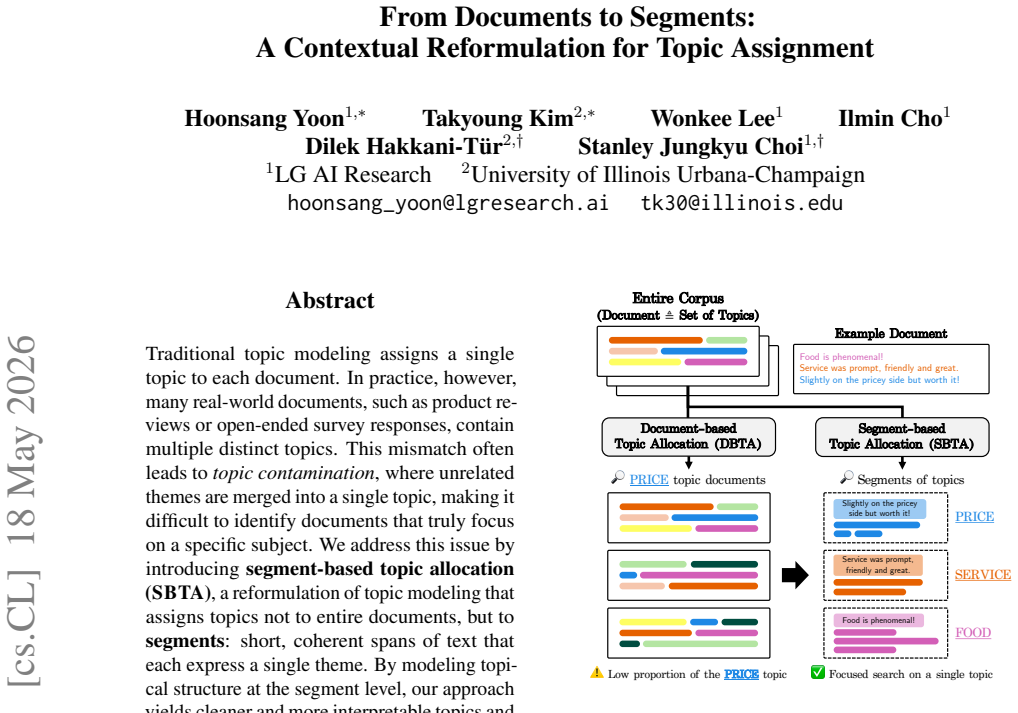
Segment-based topic allocation (SBTA) assigns topics to segments instead of entire documents. Segments are short, coherent spans of text that each express a single theme. This reformulation prevents topic contamination in multi-theme documents such as reviews or survey responses. The SemEval-STM dataset is constructed by first decomposing documents into topical segments with large language models and then applying human refinement. A segment-level word intrusion task supports evaluation at the granularity where topics are assigned. Experiments across models show that SBTA improves clustering quality and interpretability.
What carries the argument
Segment-based topic allocation (SBTA), the reformulation that moves topic assignment from full documents to short coherent segments expressing one theme.
If this is right
- Multi-theme documents can be represented as combinations of distinct, focused topics rather than forced into a single contaminated label.
- Topics remain interpretable because each is learned only from segments that share one theme.
- Clustering quality and human interpretability improve when models and evaluation operate at the segment level.
- A scalable framework exists for fine-grained topic analysis in heterogeneous corpora such as reviews and open-ended responses.
Where Pith is reading between the lines
- The segment view could be used to study how topics shift across the length of a single long document.
- SBTA may combine naturally with aspect-based sentiment analysis since both work at the level of short coherent spans.
- Existing large topic-modeling collections could be reprocessed with SBTA to surface topics that were previously merged.
- End-to-end models that learn both segmentation and topic assignment together become a natural next step.
Load-bearing premise
Documents can be reliably decomposed into high-quality topical segments using large language models followed by human refinement.
What would settle it
If standard document-level topic models produce higher human coherence ratings or better clustering scores than SBTA when both are run on the same multi-theme corpus, the central claim would be falsified.
Figures



read the original abstract
Traditional topic modeling assigns a single topic to each document. In practice, however, many real-world documents, such as product reviews or open-ended survey responses, contain multiple distinct topics. This mismatch often leads to topic contamination, where unrelated themes are merged into a single topic, making it difficult to identify documents that truly focus on a specific subject. We address this issue by introducing segment-based topic allocation (SBTA), a reformulation of topic modeling that assigns topics not to entire documents, but to segments: short, coherent spans of text that each express a single theme. By modeling topical structure at the segment level, our approach yields cleaner and more interpretable topics and better supports analysis of multi-theme documents. To support systematic evaluation, we construct a SemEval-STM, a new dataset inspired by aspect-based sentiment analysis. Documents are first decomposed into topical segments using large language models (LLMs), followed by human refinement to ensure segment quality. We also propose a segment-level extension of the word intrusion task, enabling human evaluation of topical coherence at the granularity where topics are actually assigned. Across multiple models and evaluation metrics, we show that SBTA improves clustering quality and interpretability. Overall, this work provides a practical, scalable framework for fine-grained topic analysis in heterogeneous text corpora where documents naturally span multiple topics. URL: https://huggingface.co/datasets/LG-AI-Research/SemEval-STM
Editorial analysis
A structured set of objections, weighed in public.
Referee Report
Summary. The paper proposes segment-based topic allocation (SBTA), reformulating topic modeling to assign topics to short coherent segments rather than whole documents in order to reduce topic contamination in multi-theme texts such as reviews and surveys. It introduces the SemEval-STM dataset, constructed by LLM-based decomposition of documents into topical segments followed by human refinement for single-theme coherence, and a segment-level word intrusion task for human evaluation of topical coherence. Experiments across multiple topic models report improvements in clustering quality and interpretability metrics, claiming that modeling at the segment level yields cleaner topics and better supports analysis of heterogeneous documents.
Significance. If the improvements can be shown to arise from the segment-level reformulation itself rather than from the quality of the LLM+human-curated input segments, the work would provide a practical framework for fine-grained topic analysis in real-world corpora where documents span multiple themes. The release of the SemEval-STM dataset and the segment-level evaluation protocol constitute concrete contributions that could enable more systematic future comparisons; these strengths are noted explicitly.
major comments (1)
- [Evaluation / experimental setup] Evaluation / experimental setup: The reported gains in clustering quality and segment-level word intrusion scores are obtained exclusively on the SemEval-STM segments produced by LLM decomposition followed by human refinement. No ablation is described that reapplies the same topic models to automatically derived segments (sentence splits, fixed windows, or unsupervised boundary detection) on the identical source documents. This control is load-bearing for the central claim that SBTA improves topic quality; without it, the observed benefits cannot be confidently attributed to the reformulation rather than to the high-quality input units.
minor comments (2)
- [Dataset construction] Dataset construction section: Provide more quantitative details on inter-annotator agreement and the exact criteria used during human refinement to allow readers to assess segment quality independently.
- [Abstract / Introduction] Abstract and introduction: Clarify whether the claimed improvements hold under standard topic-model hyperparameters or require any retuning when moving from document-level to segment-level assignment.
Simulated Author's Rebuttal
We appreciate the referee's detailed review and recommendation for major revision. We address the concern about the experimental setup in our point-by-point response.
read point-by-point responses
-
Referee: The reported gains in clustering quality and segment-level word intrusion scores are obtained exclusively on the SemEval-STM segments produced by LLM decomposition followed by human refinement. No ablation is described that reapplies the same topic models to automatically derived segments (sentence splits, fixed windows, or unsupervised boundary detection) on the identical source documents. This control is load-bearing for the central claim that SBTA improves topic quality; without it, the observed benefits cannot be confidently attributed to the reformulation rather than to the high-quality input units.
Authors: We thank the referee for highlighting this important aspect of the evaluation. The SemEval-STM dataset was specifically designed using LLM-based decomposition and human refinement to create a reliable testbed for segment-level topic modeling, ensuring that each segment expresses a single coherent theme. This allows for a fair assessment of SBTA's ability to produce cleaner topics at the appropriate granularity. While we did not include ablations with automatic segmentation in the original submission, we agree that such controls would help attribute the improvements more directly to the segment-based reformulation. In the revised version, we will add experiments applying the topic models to segments derived automatically via sentence splits, fixed windows, and unsupervised boundary detection on the same source documents, and compare the resulting clustering quality and word intrusion scores. This will provide additional evidence regarding the robustness of the approach across varying segment qualities. revision: yes
Circularity Check
No circularity in segment-based topic modeling reformulation
full rationale
The paper proposes SBTA as a reformulation that assigns topics to segments rather than full documents, constructs the SemEval-STM dataset via LLM decomposition plus human refinement, and reports empirical gains in clustering quality and word-intrusion interpretability. No equations, fitted parameters, or derivations are presented that reduce by construction to the inputs or to self-citations. The central claims rest on new data and comparative evaluations rather than tautological re-labeling or load-bearing self-references. This is a standard methodological contribution with independent empirical content.
Axiom & Free-Parameter Ledger
Reference graph
Works this paper leans on
-
[1]
Blei, David M. and Ng, Andrew Y. and Jordan, Michael I. , title =. J. Mach. Learn. Res. , month = mar, pages =. 2003 , issue_date =
work page 2003
-
[2]
T opic GPT : A Prompt-based Topic Modeling Framework
Pham, Chau Minh and Hoyle, Alexander and Sun, Simeng and Resnik, Philip and Iyyer, Mohit. T opic GPT : A Prompt-based Topic Modeling Framework. Proceedings of the 2024 Conference of the North American Chapter of the Association for Computational Linguistics: Human Language Technologies (Volume 1: Long Papers). 2024. doi:10.18653/v1/2024.naacl-long.164
-
[3]
Are Neural Topic Models Broken?
Hoyle, Alexander Miserlis and Sarkar, Rupak and Goel, Pranav and Resnik, Philip. Are Neural Topic Models Broken?. Findings of the Association for Computational Linguistics: EMNLP 2022. 2022. doi:10.18653/v1/2022.findings-emnlp.390
-
[4]
Revisiting Automated Topic Model Evaluation with Large Language Models
Stammbach, Dominik and Zouhar, Vil \'e m and Hoyle, Alexander and Sachan, Mrinmaya and Ash, Elliott. Revisiting Automated Topic Model Evaluation with Large Language Models. Proceedings of the 2023 Conference on Empirical Methods in Natural Language Processing. 2023. doi:10.18653/v1/2023.emnlp-main.581
-
[5]
S em E val-2016 Task 5: Aspect Based Sentiment Analysis
Pontiki, Maria and Galanis, Dimitris and Papageorgiou, Haris and Androutsopoulos, Ion and Manandhar, Suresh and AL-Smadi, Mohammad and Al-Ayyoub, Mahmoud and Zhao, Yanyan and Qin, Bing and De Clercq, Orph. S em E val-2016 Task 5: Aspect Based Sentiment Analysis. Proceedings of the 10th International Workshop on Semantic Evaluation ( S em E val-2016). 2016...
-
[6]
Reading Tea Leaves: How Humans Interpret Topic Models , url =
Chang, Jonathan and Gerrish, Sean and Wang, Chong and Boyd-graber, Jordan and Blei, David , booktitle =. Reading Tea Leaves: How Humans Interpret Topic Models , url =
-
[7]
BERTopic: Neural topic modeling with a class-based TF-IDF procedure , author=. 2022 , eprint=
work page 2022
-
[8]
Proceedings of the 10th annual joint conference on Digital libraries , pages=
Evaluating topic models for digital libraries , author=. Proceedings of the 10th annual joint conference on Digital libraries , pages=
-
[9]
Optimizing Semantic Coherence in Topic Models
Mimno, David and Wallach, Hanna and Talley, Edmund and Leenders, Miriam and McCallum, Andrew. Optimizing Semantic Coherence in Topic Models. Proceedings of the 2011 Conference on Empirical Methods in Natural Language Processing. 2011
work page 2011
-
[10]
Machine Reading Tea Leaves: Automatically Evaluating Topic Coherence and Topic Model Quality
Lau, Jey Han and Newman, David and Baldwin, Timothy. Machine Reading Tea Leaves: Automatically Evaluating Topic Coherence and Topic Model Quality. Proceedings of the 14th Conference of the E uropean Chapter of the Association for Computational Linguistics. 2014. doi:10.3115/v1/E14-1056
-
[11]
Knowledge Discovery and Data Mining , year=
Automatic labeling of multinomial topic models , author=. Knowledge Discovery and Data Mining , year=
-
[12]
Three Gaps in Computational Text Analysis Methods for Social Sciences: A Research Agenda , volume =
Baden, Christian and Pipal, Christian and Schoonvelde, Martijn and van der Velden, Mariken , year =. Three Gaps in Computational Text Analysis Methods for Social Sciences: A Research Agenda , volume =. Communication Methods and Measures , doi =
-
[13]
L atent D irichlet A llocation with Topic-in-Set Knowledge
Andrzejewski, David and Zhu, Xiaojin. L atent D irichlet A llocation with Topic-in-Set Knowledge. Proceedings of the NAACL HLT 2009 Workshop on Semi-supervised Learning for Natural Language Processing. 2009
work page 2009
-
[14]
and Reing, Kyle and Kale, David and Ver Steeg, Greg
Gallagher, Ryan J. and Reing, Kyle and Kale, David and Ver Steeg, Greg. Anchored Correlation Explanation: Topic Modeling with Minimal Domain Knowledge. Transactions of the Association for Computational Linguistics. 2017. doi:10.1162/tacl_a_00078
-
[15]
Proceedings of The Web Conference 2020 , pages =
Meng, Yu and Huang, Jiaxin and Wang, Guangyuan and Wang, Zihan and Zhang, Chao and Zhang, Yu and Han, Jiawei , title =. Proceedings of The Web Conference 2020 , pages =. 2020 , isbn =. doi:10.1145/3366423.3380278 , abstract =
-
[16]
Hierarchical Topic Models and the Nested Chinese Restaurant Process , url =
Griffiths, Thomas and Jordan, Michael and Tenenbaum, Joshua and Blei, David , booktitle =. Hierarchical Topic Models and the Nested Chinese Restaurant Process , url =
-
[17]
Journal of the American Statistical Association , volume =
Yee Whye Teh and Michael I Jordan and Matthew J Beal and David M Blei and , title =. Journal of the American Statistical Association , volume =. 2006 , publisher =. doi:10.1198/016214506000000302 , URL =. https://doi.org/10.1198/016214506000000302 , abstract =
-
[18]
Rethinking LDA: Why Priors Matter , url =
Wallach, Hanna and Mimno, David and McCallum, Andrew , booktitle =. Rethinking LDA: Why Priors Matter , url =
-
[19]
Hu, Yuening and Boyd-Graber, Jordan and Satinoff, Brianna and Smith, Alison , title =. Mach. Learn. , month = jun, pages =. 2014 , issue_date =. doi:10.1007/s10994-013-5413-0 , abstract =
-
[20]
International Conference on Learning Representations , year=
Autoencoding Variational Inference For Topic Models , author=. International Conference on Learning Representations , year=
-
[21]
Dieng, Adji B. and Ruiz, Francisco J. R. and Blei, David M. Topic Modeling in Embedding Spaces. Transactions of the Association for Computational Linguistics. 2020. doi:10.1162/tacl_a_00325
-
[22]
Li, Chenliang and Wang, Haoran and Zhang, Zhiqian and Sun, Aixin and Ma, Zongyang , title =. Proceedings of the 39th International ACM SIGIR Conference on Research and Development in Information Retrieval , pages =. 2016 , isbn =. doi:10.1145/2911451.2911499 , abstract =
-
[23]
Mitigating Data Sparsity for Short Text Topic Modeling by Topic-Semantic Contrastive Learning
Wu, Xiaobao and Luu, Anh Tuan and Dong, Xinshuai. Mitigating Data Sparsity for Short Text Topic Modeling by Topic-Semantic Contrastive Learning. Proceedings of the 2022 Conference on Empirical Methods in Natural Language Processing. 2022. doi:10.18653/v1/2022.emnlp-main.176
-
[24]
Neural Discrete Representation Learning , url =
van den Oord, Aaron and Vinyals, Oriol and kavukcuoglu, koray , booktitle =. Neural Discrete Representation Learning , url =
-
[25]
In: Inui, K., Jiang, J., Ng, V., Wan, X
Reimers, Nils and Gurevych, Iryna. Sentence- BERT : Sentence Embeddings using S iamese BERT -Networks. Proceedings of the 2019 Conference on Empirical Methods in Natural Language Processing and the 9th International Joint Conference on Natural Language Processing (EMNLP-IJCNLP). 2019. doi:10.18653/v1/D19-1410
- [26]
-
[27]
TopicGPT: A Prompt-based Topic Modeling Framework , author=. 2024 , eprint=
work page 2024
-
[28]
Topic Modeling for Short Texts with Large Language Models
Doi, Tomoki and Isonuma, Masaru and Yanaka, Hitomi. Topic Modeling for Short Texts with Large Language Models. Proceedings of the 62nd Annual Meeting of the Association for Computational Linguistics (Volume 4: Student Research Workshop). 2024. doi:10.18653/v1/2024.acl-srw.3
-
[29]
Exploring the space of topic coherence measures
R\". Exploring the Space of Topic Coherence Measures , year =. Proceedings of the Eighth ACM International Conference on Web Search and Data Mining , pages =. doi:10.1145/2684822.2685324 , abstract =
-
[30]
Nikolenko, Sergey I. , title =. Proceedings of the 39th International ACM SIGIR Conference on Research and Development in Information Retrieval , pages =. 2016 , isbn =. doi:10.1145/2911451.2914720 , abstract =
-
[31]
Measuring Topic Coherence through Optimal Word Buckets
Ramrakhiyani, Nitin and Pawar, Sachin and Hingmire, Swapnil and Palshikar, Girish. Measuring Topic Coherence through Optimal Word Buckets. Proceedings of the 15th Conference of the E uropean Chapter of the Association for Computational Linguistics: Volume 2, Short Papers. 2017
work page 2017
-
[32]
Document-based topic coherence measures for news media text , journal =
Damir Korenčić and Strahil Ristov and Jan Šnajder , keywords =. Document-based topic coherence measures for news media text , journal =. 2018 , issn =. doi:https://doi.org/10.1016/j.eswa.2018.07.063 , url =
-
[33]
Revisiting Automated Topic Model Evaluation with Large Language Models , author=. 2023 , eprint=
work page 2023
-
[34]
Contextualized Topic Coherence Metrics
Rahimi, Hamed and Mimno, David and Hoover, Jacob and Naacke, Hubert and Constantin, Camelia and Amann, Bernd. Contextualized Topic Coherence Metrics. Findings of the Association for Computational Linguistics: EACL 2024. 2024
work page 2024
- [35]
- [36]
-
[37]
Journal of cybernetics , volume=
Well-separated clusters and optimal fuzzy partitions , author=. Journal of cybernetics , volume=. 1974 , publisher=
work page 1974
-
[38]
Davies, David L. and Bouldin, Donald W. , journal=. A Cluster Separation Measure , year=
-
[39]
Communications in Statistics-theory and Methods , volume=
A dendrite method for cluster analysis , author=. Communications in Statistics-theory and Methods , volume=. 1974 , publisher=
work page 1974
-
[40]
Journal of computational and applied mathematics , volume=
Silhouettes: a graphical aid to the interpretation and validation of cluster analysis , author=. Journal of computational and applied mathematics , volume=. 1987 , publisher=
work page 1987
-
[41]
IEEE Transactions on Pattern Analysis & Machine Intelligence , volume=
A validity measure for fuzzy clustering , author=. IEEE Transactions on Pattern Analysis & Machine Intelligence , volume=. 1991 , publisher=
work page 1991
- [42]
-
[43]
Shannon, C. E. , journal=. A mathematical theory of communication , year=
-
[44]
A comparison of extrinsic clustering evaluation metrics based on formal constraints , year =
Amig\'. A comparison of extrinsic clustering evaluation metrics based on formal constraints , year =. Inf. Retr. , month = aug, pages =. doi:10.1007/s10791-008-9066-8 , abstract =
-
[45]
Proceedings of the 26th Annual International Conference on Machine Learning , pages =
Vinh, Nguyen Xuan and Epps, Julien and Bailey, James , title =. Proceedings of the 26th Annual International Conference on Machine Learning , pages =. 2009 , isbn =. doi:10.1145/1553374.1553511 , abstract =
-
[46]
Journal of Classification , year=1985, volume=
Lawrence Hubert and Phipps Arabie , title=. Journal of Classification , year=1985, volume=. doi:10.1007/BF01908075 , abstract=
-
[47]
Cluster Ensembles - A Knowledge Reuse Framework for Combining Partitionings , volume =
Strehl, Alexander and Ghosh, Joydeep , year =. Cluster Ensembles - A Knowledge Reuse Framework for Combining Partitionings , volume =
-
[48]
Uncovering the Potential of ChatGPT for Discourse Analysis in Dialogue: An Empirical Study , author=. 2024 , eprint=
work page 2024
-
[49]
Hearst, Marti A. , title =. Proceedings of the 32nd Annual Meeting on Association for Computational Linguistics , pages =. 1994 , publisher =. doi:10.3115/981732.981734 , abstract =
-
[50]
How Text Segmentation Algorithms Gain from Topic Models
Riedl, Martin and Biemann, Chris. How Text Segmentation Algorithms Gain from Topic Models. Proceedings of the 2012 Conference of the North A merican Chapter of the Association for Computational Linguistics: Human Language Technologies. 2012
work page 2012
-
[51]
Text segmentation via topic modeling: an analytical study , year =
Misra, Hemant and Yvon, Fran. Text segmentation via topic modeling: an analytical study , year =. Proceedings of the 18th ACM Conference on Information and Knowledge Management , pages =. doi:10.1145/1645953.1646170 , abstract =
-
[52]
doi:10.5281/zenodo.4744399 , url =
Iacopo Ghinassi , title =. doi:10.5281/zenodo.4744399 , url =
-
[53]
and Bhattarai, Manish and Rasmussen, Kim
Wanna, Selma and Solovyev, Nicholas and Barron, Ryan and Eren, Maksim E. and Bhattarai, Manish and Rasmussen, Kim. TopicTag: Automatic Annotation of NMF Topic Models Using Chain of Thought and Prompt Tuning with LLMs , year =. Proceedings of the ACM Symposium on Document Engineering 2024 , articleno =. doi:10.1145/3685650.3685667 , abstract =
-
[54]
IEEE Transactions on pattern analysis and machine intelligence , volume=
Performance evaluation of some clustering algorithms and validity indices , author=. IEEE Transactions on pattern analysis and machine intelligence , volume=. 2003 , publisher=
work page 2003
-
[55]
Stephen Merity and Nitish Shirish Keskar and Richard Socher , booktitle=. Regularizing and Optimizing. 2018 , url=
work page 2018
-
[56]
SECTOR : A Neural Model for Coherent Topic Segmentation and Classification
Arnold, Sebastian and Schneider, Rudolf and Cudr. SECTOR : A Neural Model for Coherent Topic Segmentation and Classification. Transactions of the Association for Computational Linguistics. 2019. doi:10.1162/tacl_a_00261
-
[57]
Topic Intrusion for Automatic Topic Model Evaluation
Bhatia, Shraey and Lau, Jey Han and Baldwin, Timothy. Topic Intrusion for Automatic Topic Model Evaluation. Proceedings of the 2018 Conference on Empirical Methods in Natural Language Processing. 2018. doi:10.18653/v1/D18-1098
-
[58]
MALLET: A Machine Learning for Language Toolkit
Andrew Kachites McCallum. MALLET: A Machine Learning for Language Toolkit
-
[59]
Topic Modeling: Contextual Token Embeddings Are All You Need
Angelov, Dimo and Inkpen, Diana. Topic Modeling: Contextual Token Embeddings Are All You Need. Findings of the Association for Computational Linguistics: EMNLP 2024. 2024. doi:10.18653/v1/2024.findings-emnlp.790
-
[60]
and Teoh, Janice and Landay, James A
Lam, Michelle S. and Teoh, Janice and Landay, James A. and Heer, Jeffrey and Bernstein, Michael S. , year=. Concept Induction: Analyzing Unstructured Text with High-Level Concepts Using LLooM , url=. doi:10.1145/3613904.3642830 , booktitle=
discussion (0)
Sign in with ORCID, Apple, or X to comment. Anyone can read and Pith papers without signing in.