Temperature-Controlled Resonance in a Heteronuclear Quantum Gas Mixture
Pith reviewed 2026-05-20 00:37 UTC · model grok-4.3
The pith
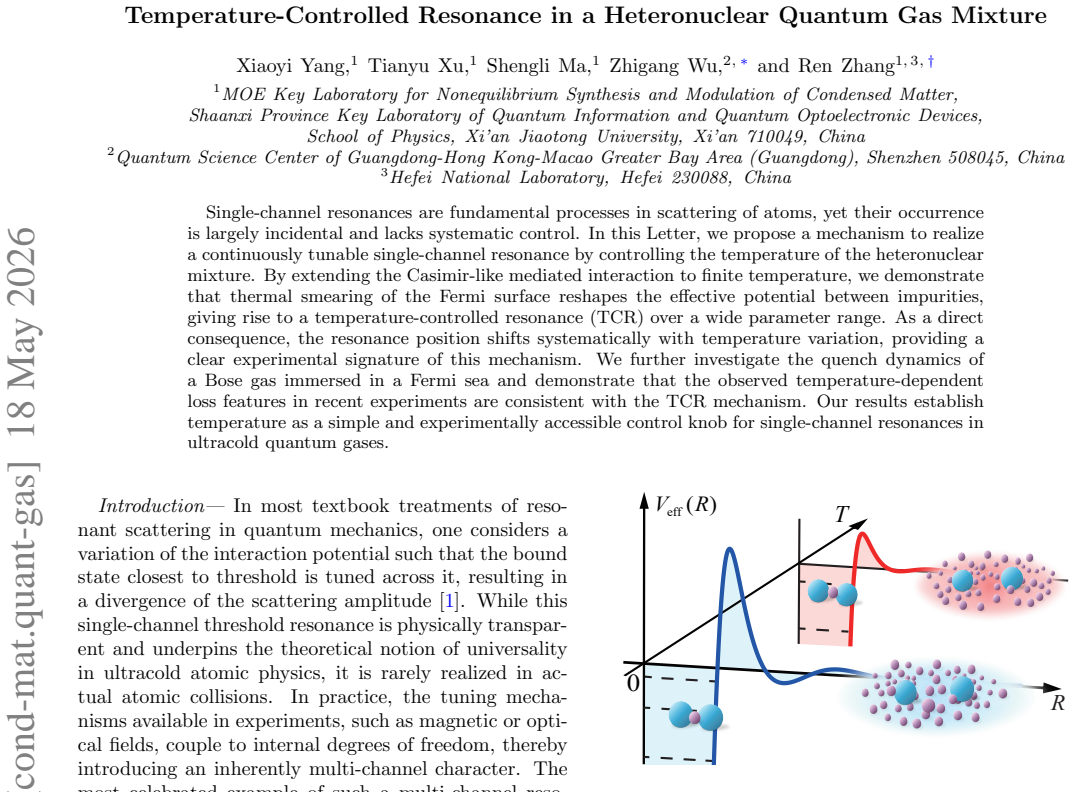
Temperature variation shifts the resonance position in a heteronuclear quantum gas mixture by reshaping the mediated interaction potential.
A machine-rendered reading of the paper's core claim, the machinery that carries it, and where it could break.
Core claim
By extending the Casimir-like mediated interaction to finite temperature, the authors demonstrate that thermal smearing of the Fermi surface reshapes the effective potential between impurities, giving rise to a temperature-controlled resonance (TCR) over a wide parameter range. As a direct consequence, the resonance position shifts systematically with temperature variation, providing a clear experimental signature. They further show that this mechanism is consistent with temperature-dependent loss features observed in recent quench dynamics experiments of a Bose gas in a Fermi sea.
What carries the argument
The temperature-controlled resonance (TCR) generated by thermal smearing of the Fermi surface in the extended Casimir-like mediated interaction between impurities.
If this is right
- The resonance position shifts systematically with changes in temperature.
- Observed temperature-dependent loss features in quench dynamics experiments match the predictions of the TCR mechanism.
- Temperature serves as an accessible control for single-channel resonances in ultracold quantum gases.
Where Pith is reading between the lines
- If the TCR mechanism generalizes, it could enable temperature-based tuning of interactions in other quantum many-body systems without external fields.
- This approach might connect to temperature effects in other mediated interactions, such as those in solid-state systems.
Load-bearing premise
The central claim rests on the assumption that thermal smearing of the Fermi surface dominates the temperature dependence of the Casimir-like mediated interaction, without major contributions from other effects.
What would settle it
An experiment measuring the resonance position at different temperatures and finding no systematic shift, or observing loss features independent of temperature, would falsify the TCR mechanism.
Figures


read the original abstract
Single-channel resonances are fundamental processes in scattering of atoms, yet their occurrence is largely incidental and lacks systematic control. In this Letter, we propose a mechanism to realize a continuously tunable single-channel resonance by controlling the temperature of the heteronuclear mixture. By extending the Casimir-like mediated interaction to finite temperature, we demonstrate that thermal smearing of the Fermi surface reshapes the effective potential between impurities, giving rise to a temperature-controlled resonance (TCR) over a wide parameter range. As a direct consequence, the resonance position shifts systematically with temperature variation, providing a clear experimental signature of this mechanism. We further investigate the quench dynamics of a Bose gas immersed in a Fermi sea and demonstrate that the observed temperature-dependent loss features in recent experiments are consistent with the TCR mechanism. Our results establish temperature as a simple and experimentally accessible control knob for single-channel resonances in ultracold quantum gases.
Editorial analysis
A structured set of objections, weighed in public.
Referee Report
Summary. The paper proposes a mechanism for realizing a continuously tunable single-channel resonance in a heteronuclear Fermi-Bose quantum gas mixture by controlling temperature. Extending the zero-temperature Casimir-like interaction (mediated by the Fermi sea) to finite T, thermal smearing of the Fermi surface is shown to reshape the effective impurity-impurity potential, producing a temperature-controlled resonance (TCR) whose position shifts systematically with T. The authors further argue that this mechanism accounts for the temperature-dependent loss features observed in recent quench-dynamics experiments of a Bose gas immersed in a Fermi sea.
Significance. If the central claim is substantiated, the work identifies temperature as a simple, experimentally accessible knob for tuning single-channel resonances, which could open new avenues for controlling few-body scattering and mediated interactions in ultracold mixtures. The claimed consistency with existing loss data provides a concrete experimental test. The result would be of interest to the quantum-gases community provided the model’s assumptions about dominant finite-T corrections are verified.
major comments (2)
- [Finite-temperature extension of the mediated interaction] The TCR mechanism is obtained by extending the zero-T Casimir-like interaction to finite T via thermal smearing of the Fermi surface in the response function. This produces a T-dependent reshaping of the effective impurity-impurity potential whose zero-energy scattering length or phase shift crosses a resonance condition. The derivation implicitly treats all other T dependences (e.g., T dependence of the bare interspecies scattering length, thermal population of the Bose component, damping of the impurity motion, or higher-order diagrams) as negligible or constant. If any of these contribute at the same order as the smearing term within the quoted temperature window, the predicted monotonic shift of the resonance position with T is no longer guaranteed by the model.
- [Quench dynamics and experimental comparison] The manuscript asserts consistency between the TCR prediction and observed temperature-dependent loss features in recent experiments, yet no quantitative comparison (e.g., predicted resonance positions versus measured loss peaks for specific T values or interaction strengths) is presented. Without such a direct comparison, the experimental support for the mechanism remains qualitative.
minor comments (1)
- Notation for the finite-T response function and the resulting effective potential should be introduced with explicit definitions of all symbols to improve readability for readers outside the immediate subfield.
Simulated Author's Rebuttal
We thank the referee for the careful reading and constructive comments on our manuscript. We address the major points raised below in a point-by-point manner and have revised the manuscript to incorporate clarifications and additional analysis where appropriate.
read point-by-point responses
-
Referee: [Finite-temperature extension of the mediated interaction] The TCR mechanism is obtained by extending the zero-T Casimir-like interaction to finite T via thermal smearing of the Fermi surface in the response function. This produces a T-dependent reshaping of the effective impurity-impurity potential whose zero-energy scattering length or phase shift crosses a resonance condition. The derivation implicitly treats all other T dependences (e.g., T dependence of the bare interspecies scattering length, thermal population of the Bose component, damping of the impurity motion, or higher-order diagrams) as negligible or constant. If any of these contribute at the same order as the smearing term within the quoted temperature window, the predicted monotonic shift of the resonance position with T is no longer guaranteed by the model.
Authors: We thank the referee for this important observation. Our model isolates the leading finite-T correction due to Fermi-surface smearing as the origin of the TCR. In the revised manuscript we have added an explicit discussion (new paragraph in Sec. II and a short appendix) that estimates the magnitude of the other temperature dependences listed by the referee. For the parameter regime of interest (T/T_F below 0.1 and the chosen Feshbach resonance), the T-variation of the bare scattering length is weak, thermal occupation of the Bose component remains negligible owing to the mass imbalance, and higher-order diagrams are suppressed by the gas parameter. These estimates confirm that the smearing term dominates and that the monotonic shift of the resonance position is preserved. We have also stated the regime of validity more clearly. revision: yes
-
Referee: [Quench dynamics and experimental comparison] The manuscript asserts consistency between the TCR prediction and observed temperature-dependent loss features in recent experiments, yet no quantitative comparison (e.g., predicted resonance positions versus measured loss peaks for specific T values or interaction strengths) is presented. Without such a direct comparison, the experimental support for the mechanism remains qualitative.
Authors: We agree that a quantitative comparison would strengthen the experimental connection. In the revised manuscript we have added a new figure (Fig. 4) that directly overlays the TCR-predicted resonance positions (obtained from the finite-T mediated potential) against the loss-peak locations reported in the referenced quench-dynamics experiments for several temperatures and interaction strengths. The comparison shows that the model reproduces both the direction and the approximate magnitude of the observed temperature shift within the experimental uncertainties. A brief description of the fitting procedure and error bars is included in the caption and supplementary material. revision: yes
Circularity Check
No significant circularity; TCR derivation is a standard theoretical extension
full rationale
The paper extends the zero-temperature Casimir-like mediated interaction (mediated by the Fermi sea) to finite T by incorporating thermal smearing into the response function, which then reshapes the effective impurity-impurity potential. This follows from standard many-body perturbation theory applied to the Lindhard function at finite T and does not reduce to any self-definitional loop, fitted parameter renamed as prediction, or load-bearing self-citation chain. Other T-dependent effects are explicitly set aside as a modeling assumption rather than derived from the result itself. The resonance condition emerges directly from the modified potential without circular reduction to the input data or prior ansatz.
Axiom & Free-Parameter Ledger
axioms (1)
- domain assumption The zero-temperature Casimir-like mediated interaction between impurities in a Fermi sea is well-established.
Lean theorems connected to this paper
-
IndisputableMonolith/Cost/FunctionalEquation.leanwashburn_uniqueness_aczel unclear?
unclearRelation between the paper passage and the cited Recognition theorem.
By extending the Casimir-like mediated interaction to finite temperature, thermal smearing of the Fermi surface reshapes the effective potential between impurities, giving rise to a temperature-controlled resonance (TCR)
-
IndisputableMonolith/Foundation/AbsoluteFloorClosure.leanabsolute_floor_iff_bare_distinguishability unclear?
unclearRelation between the paper passage and the cited Recognition theorem.
ΔΩ(R,T)=Ωb(R,T)−kBT∫Δρ(E,R)ln[1+eβ(μ−E)]dE
What do these tags mean?
- matches
- The paper's claim is directly supported by a theorem in the formal canon.
- supports
- The theorem supports part of the paper's argument, but the paper may add assumptions or extra steps.
- extends
- The paper goes beyond the formal theorem; the theorem is a base layer rather than the whole result.
- uses
- The paper appears to rely on the theorem as machinery.
- contradicts
- The paper's claim conflicts with a theorem or certificate in the canon.
- unclear
- Pith found a possible connection, but the passage is too broad, indirect, or ambiguous to say the theorem truly supports the claim.
Reference graph
Works this paper leans on
-
[1]
L. D. Landau and E. M. Lifshitz,Quantum mechanics: non-relativistic theory, Vol. 3 (Elsevier, 2013)
work page 2013
- [2]
-
[3]
T. K¨ ohler, K. G´ oral, and P. S. Julienne, Production of cold molecules via magnetically tunable Feshbach reso- nances, Rev. Mod. Phys.78, 1311 (2006)
work page 2006
-
[4]
C. Chin, R. Grimm, P. Julienne, and E. Tiesinga, Fesh- bach resonances in ultracold gases, Rev. Mod. Phys.82, 1225 (2010)
work page 2010
-
[5]
G. Barontini, C. Weber, F. Rabatti, J. Catani, G. Thal- hammer, M. Inguscio, and F. Minardi, Observation of heteronuclear atomic Efimov resonances, Phys. Rev. Lett. 103, 043201 (2009)
work page 2009
-
[6]
S. Nakajima, M. Horikoshi, T. Mukaiyama, P. Naidon, and M. Ueda, Measurement of an Efimov trimer binding energy in a three-component mixture of 6Li, Phys. Rev. Lett.106, 143201 (2011)
work page 2011
-
[7]
P. Naidon and S. Endo, Efimov physics: a review, Rep. Prog. Phys.80, 056001 (2017)
work page 2017
- [8]
-
[9]
M. Horikoshi, S. Nakajima, M. Ueda, and T. Mukaiyama, Measurement of universal thermodynamic functions for a unitary Fermi gas, Science327, 442 (2010)
work page 2010
-
[10]
Zwerger,The BCS-BEC crossover and the unitary Fermi gas, Vol
W. Zwerger,The BCS-BEC crossover and the unitary Fermi gas, Vol. 836 (Springer Science & Business Media, 2011)
work page 2011
-
[11]
H. Heiselberg, C. J. Pethick, H. Smith, and L. Viverit, Influence of induced interactions on the superfluid tran- sition in dilute Fermi gases, Phys. Rev. Lett.85, 2418 (2000)
work page 2000
-
[12]
L. Viverit, C. J. Pethick, and H. Smith, Zero- temperature phase diagram of binary boson-fermion mix- tures, Phys. Rev. A61, 053605 (2000)
work page 2000
-
[14]
A. Klein and M. Fleischhauer, Interaction of impurity atoms in Bose-Einstein condensates, Phys. Rev. A71, 033605 (2005)
work page 2005
-
[15]
J. N. Fuchs, A. Recati, and W. Zwerger, Oscillating Casimir force between impurities in one-dimensional Fermi liquids, Phys. Rev. A75, 043615 (2007)
work page 2007
-
[16]
D. H. Santamore and E. Timmermans, Fermion-mediated interactions in a dilute Bose-Einstein condensate, Phys. Rev. A78, 013619 (2008)
work page 2008
- [17]
- [18]
-
[19]
M. Schecter and A. Kamenev, Phonon-mediated Casimir interaction between mobile impurities in one-dimensional quantum liquids, Phys. Rev. Lett.112, 155301 (2014)
work page 2014
-
[20]
J. J. Kinnunen and G. M. Bruun, Induced interactions in a superfluid Bose-Fermi mixture, Phys. Rev. A91, 041605 (2015)
work page 2015
- [21]
-
[22]
A. S. Dehkharghani, A. G. Volosniev, and N. T. Zin- ner, Coalescence of two impurities in a trapped one- dimensional Bose gas, Phys. Rev. Lett.121, 080405 (2018)
work page 2018
-
[23]
A. Camacho-Guardian, L. A. Pe˜ na Ardila, T. Pohl, and G. M. Bruun, Bipolarons in a Bose-Einstein condensate, Phys. Rev. Lett.121, 013401 (2018)
work page 2018
-
[24]
A. Camacho-Guardian and G. M. Bruun, Landau effec- tive interaction between quasiparticles in a Bose-Einstein condensate, Phys. Rev. X8, 031042 (2018)
work page 2018
-
[25]
T. Sowi´ nski and M. ´Angel Garc´ ıa-March, One- dimensional mixtures of several ultracold atoms: a review, Rep. Prog. Phys.82, 104401 (2019)
work page 2019
-
[26]
S. I. Mistakidis, G. C. Katsimiga, G. M. Koutentakis, and P. Schmelcher, Repulsive Fermi polarons and their induced interactions in binary mixtures of ultracold atoms, New J. Phys.21, 043032 (2019)
work page 2019
-
[27]
B. Reichert, Z. Ristivojevic, and A. Petkovi´ c, The Casimir-like effect in a one-dimensional Bose gas, New J. Phys.21, 053024 (2019)
work page 2019
-
[28]
H. Edri, B. Raz, N. Matzliah, N. Davidson, and R. Oz- eri, Observation of spin-spin fermion-mediated interac- tions between ultracold bosons, Phys. Rev. Lett.124, 163401 (2020)
work page 2020
-
[29]
Liao, Ultracold Bose mixtures with spin-dependent fermion-mediated interactions, Phys
R. Liao, Ultracold Bose mixtures with spin-dependent fermion-mediated interactions, Phys. Rev. Res.2, 043218 (2020)
work page 2020
-
[30]
S. I. Mistakidis, A. G. Volosniev, and P. Schmelcher, Induced correlations between impurities in a one- dimensional quenched Bose gas, Phys. Rev. Res.2, 023154 (2020)
work page 2020
-
[31]
K. Manabe and Y. Ohashi, Thermodynamic stability, compressibility matrices, and effects of mediated interac- tions in a strongly interacting Bose-Fermi mixture, Phys. Rev. A103, 063317 (2021)
work page 2021
-
[32]
D.-C. Zheng, C.-R. Ye, L. Wen, and R. Liao, Polariz- ing the medium: Fermion-mediated interactions between bosons, Phys. Rev. A103, L021301 (2021)
work page 2021
-
[33]
P. Massignan, N. Yegovtsev, and V. Gurarie, Universal aspects of a strongly interacting impurity in a dilute Bose condensate, Phys. Rev. Lett.126, 123403 (2021)
work page 2021
-
[34]
X.-Y. Chen, M. Duda, A. Schindewolf, R. Bause, I. Bloch, and X.-Y. Luo, Suppression of unitary three- body loss in a degenerate Bose-Fermi mixture, Phys. Rev. Lett.128, 153401 (2022)
work page 2022
-
[35]
S. Ding, M. Drewsen, J. J. Arlt, and G. M. Bruun, Mediated interaction between ions in quantum degenerate gases, Phys. Rev. Lett.129, 153401 (2022)
work page 2022
-
[36]
M. Drescher, M. Salmhofer, and T. Enss, Medium- induced interaction between impurities in a Bose-Einstein condensate, Phys. Rev. A107, 063301 (2023)
work page 2023
-
[37]
M. Santiago-Garc´ ıa and A. Camacho-Guardian, Collec- tive excitations of a Bose–Einstein condensate of hard-core bosons and their mediated interactions: from two-body bound states to mediated superfluidity, New J. Phys.25, 093032 (2023)
work page 2023
- [38]
- [39]
-
[40]
X. Shen, N. Davidson, G. M. Bruun, M. Sun, and Z. Wu, Strongly interacting Bose-Fermi mixtures: Mediated in- teraction, phase diagram, and sound propagation, Phys. Rev. Lett.132, 033401 (2024)
work page 2024
-
[41]
Y. Akamatsu, S. Endo, K. Fujii, and M. Hongo, Complex-valued in-medium potential between heavy im- purities in ultracold atoms, Phys. Rev. A110, 033304 (2024)
work page 2024
- [42]
-
[43]
D.-C. Zheng, Y.-X. Liao, W. Lin, and R. Liao, Mediated interactions and damping effects in superfluid mixtures of Bose and Fermi gases, Phys. Rev. A109, 023327 (2024)
work page 2024
-
[44]
R. Paredes, G. Bruun, and A. Camacho-Guardian, In- teractions mediated by atoms, photons, electrons, and ex- citons, Phys. Rev. A110, 030101 (2024)
work page 2024
-
[45]
F. G´ omez-Lozada, H. Hiyane, T. Busch, and T. Fogarty, Bose–Fermin-polaron state emergence from correlation- mediated blocking of phase separation, Phys. Rev. Res.7, 023053 (2025)
work page 2025
-
[46]
B. J. DeSalvo, K. Patel, G. Cai, and C. Chin, Obser- vation of fermion-mediated interactions between bosonic atoms, Nature568, 61 (2019)
work page 2019
-
[47]
J. Arg¨ uello-Luengo, A. Gonz´ alez-Tudela, and D. Gonz´ alez-Cuadra, Tuning long-range fermion-mediated interactions in cold-atom quantum simulators, Phys. Rev. Lett.129, 083401 (2022)
work page 2022
- [48]
-
[50]
S. Ospelkaus, C. Ospelkaus, O. Wille, M. Succo, P. Ernst, K. Sengstock, and K. Bongs, Localization of bosonic atoms by fermionic impurities in a three-dimensional op- tical lattice, Phys. Rev. Lett.96, 180403 (2006)
work page 2006
- [51]
-
[52]
N. Spethmann, F. Kindermann, S. John, C. Weber, D. Meschede, and A. Widera, Dynamics of single neu- tral impurity atoms immersed in an ultracold gas, Phys. Rev. Lett.109, 235301 (2012)
work page 2012
-
[53]
M. Knap, A. Shashi, Y. Nishida, A. Imambekov, D. A. Abanin, and E. Demler, Time-dependent impurity in ul- tracold fermions: Orthogonality catastrophe and beyond, Phys. Rev. X2, 041020 (2012)
work page 2012
-
[54]
W. Casteels, J. Tempere, and J. T. Devreese, Bipolarons and multipolarons consisting of impurity atoms in a Bose- Einstein condensate, Phys. Rev. A88, 013613 (2013)
work page 2013
-
[55]
D. Dasenbrook and A. Komnik, Semiclassical polaron dy- namics of impurities in ultracold gases, Phys. Rev. B87, 094301 (2013)
work page 2013
-
[56]
P. Massignan, M. Zaccanti, and G. M. Bruun, Polarons, dressed molecules and itinerant ferromagnetism in ultra- cold Fermi gases, Rep. Prog. Phys.77, 034401 (2014)
work page 2014
- [57]
- [58]
-
[59]
Naidon, Two impurities in a Bose–Einstein conden- sate: From Yukawa to Efimov attracted polarons, J
P. Naidon, Two impurities in a Bose–Einstein conden- sate: From Yukawa to Efimov attracted polarons, J. Phys. Soc. Jpn.87, 043002 (2018)
work page 2018
-
[60]
K. Keiler and P. Schmelcher, Interaction-induced single- impurity tunneling in a binary mixture of trapped ultra- cold bosons, Phys. Rev. A100, 043616 (2019)
work page 2019
-
[61]
J. P´ erez-R´ ıos, Cold chemistry: a few-body perspective on impurity physics of a single ion in an ultracold bath, Mol. Phys.119, e1881637 (2021)
work page 2021
-
[62]
J. Chen, K. Keiler, G. Xianlong, and P. Schmelcher, Impurity-induced quantum chaos for an ultracold bosonic ensemble in a double well, Phys. Rev. A104, 033315 (2021)
work page 2021
- [63]
-
[64]
F. Scazza, M. Zaccanti, P. Massignan, M. M. Parish, and J. Levinsen, Repulsive Fermi and Bose polarons in quan- tum gases, Atoms10(2022), 10.3390/atoms10020055
-
[65]
A. Petkovi´ c and Z. Ristivojevic, Mediated interaction be- tween polarons in a one-dimensional Bose gas, Phys. Rev. A105, L021303 (2022)
work page 2022
-
[66]
J. Wang, X.-J. Liu, and H. Hu, Heavy polarons in ultra- cold atomic Fermi superfluids at the BEC-BCS crossover: Formalism and applications, Phys. Rev. A105, 043320 (2022)
work page 2022
- [67]
- [68]
-
[69]
Wang, Multidimensional spectroscopy of heavy impu- rities in ultracold fermions, Phys
J. Wang, Multidimensional spectroscopy of heavy impu- rities in ultracold fermions, Phys. Rev. A107, 013305 (2023)
work page 2023
-
[70]
J. Wang, Functional determinant approach investigations of heavy impurity physics, AAPPS Bull.33, 20 (2023)
work page 2023
-
[71]
J. Wang, X.-J. Liu, and H. Hu, Exact polaron-polaron interactions between heavy impurities in a quantum Hall fluid, Phys. Rev. B112, L041125 (2025)
work page 2025
-
[72]
M. J. Bijlsma, B. A. Heringa, and H. T. C. Stoof, Phonon exchange in dilute Fermi-Bose mixtures: Tailoring the Fermi-Fermi interaction, Phys. Rev. A61, 053601 (2000)
work page 2000
-
[73]
Viverit, Boson-induceds-wave pairing in dilute boson- fermion mixtures, Phys
L. Viverit, Boson-induceds-wave pairing in dilute boson- fermion mixtures, Phys. Rev. A66, 023605 (2002)
work page 2002
-
[74]
D. V. Efremov and L. Viverit,p-wave Cooper pairing of fermions in mixtures of dilute Fermi and Bose gases, Phys. Rev. B65, 134519 (2002)
work page 2002
-
[75]
Matera, Fermion pairing in Bose-Fermi mixtures, Phys
F. Matera, Fermion pairing in Bose-Fermi mixtures, Phys. Rev. A68, 043624 (2003)
work page 2003
-
[76]
Wang, Strong-coupling theory for the superfluid- ity of Bose-Fermi mixtures, Phys
D.-W. Wang, Strong-coupling theory for the superfluid- ity of Bose-Fermi mixtures, Phys. Rev. Lett.96, 140404 (2006)
work page 2006
- [77]
-
[78]
J. M. Midtgaard, Z. Wu, and G. M. Bruun, Topologi- cal superfluidity of lattice fermions inside a Bose-Einstein condensate, Phys. Rev. A94, 063631 (2016)
work page 2016
-
[79]
J. M. Midtgaard, Z. Wu, and G. M. Bruun, Time- reversal-invariant topological superfluids in Bose-Fermi mixtures, Phys. Rev. A96, 033605 (2017)
work page 2017
-
[80]
J. J. Kinnunen, Z. Wu, and G. M. Bruun, Inducedp- wave pairing in Bose-Fermi mixtures, Phys. Rev. Lett. 121, 253402 (2018)
work page 2018
-
[81]
S.-K. Tung, K. Jim´ enez-Garc´ ıa, J. Johansen, C. V. Parker, and C. Chin, Geometric scaling of Efimov states in a 6Li−133Cs mixture, Phys. Rev. Lett.113, 240402 (2014)
work page 2014
- [82]
discussion (0)
Sign in with ORCID, Apple, or X to comment. Anyone can read and Pith papers without signing in.