Anderson Transition and Mobility Edges in a Family of 3D Fractal Lattices
Pith reviewed 2026-05-20 00:44 UTC · model grok-4.3
The pith
Spectral dimension primarily sets the Anderson transition class in fractal lattices with tunable non-integer dimensions.
A machine-rendered reading of the paper's core claim, the machinery that carries it, and where it could break.
Core claim
In this family of fractal lattices, the Anderson transition is controlled predominantly by the spectral dimension ds. The critical disorder strength Wc evolves continuously from 0 to 16.6 as ds increases from 2 to 3, and the critical exponent nu shows an approximate inverse dependence on ds. Mobility edges are present across the family, and the universality class is governed mainly by ds while microscopic geometry affects the exact critical disorder.
What carries the argument
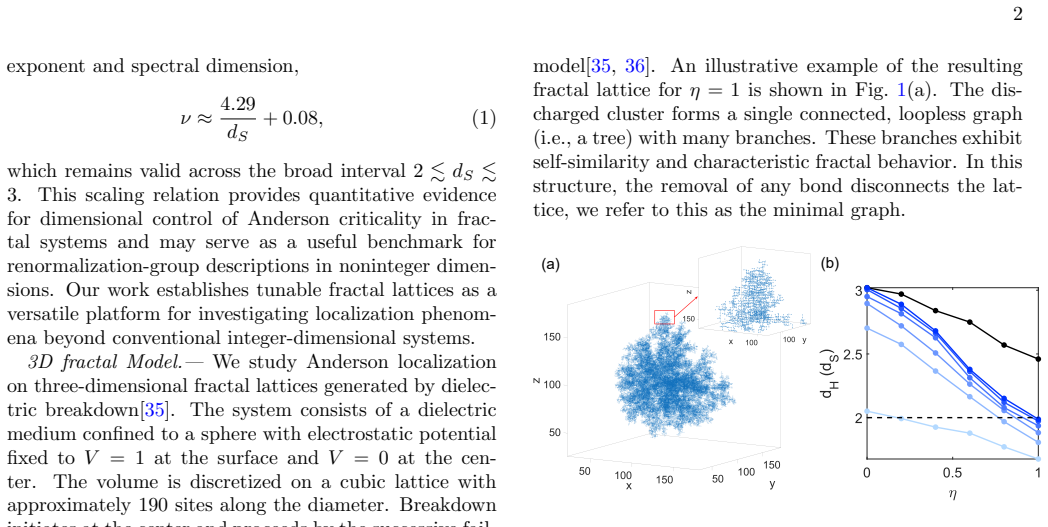
Family of 3D fractal lattices with continuously tunable spectral dimension ds, analyzed via large-scale finite-size scaling to locate mobility edges and critical points.
If this is right
- The Anderson transition can be tracked continuously across the lower critical dimension of ds=2.
- The critical exponent decreases as spectral dimension increases toward 3.
- Microscopic lattice details shift the critical disorder but leave the universality class intact.
- Localization phenomena become accessible in controlled non-integer dimensions.
Where Pith is reading between the lines
- This approach could be extended to other quantum critical phenomena like the quantum Hall transition in fractal geometries.
- Experimental realizations in photonic or cold-atom systems with fractal structures might test these predictions.
- Similar scaling might hold for other disorder-driven transitions where spectral dimension replaces Euclidean dimension.
Load-bearing premise
The finite-size scaling analysis on these finite fractal lattices correctly identifies the thermodynamic-limit mobility edges and critical exponents without substantial boundary or size artifacts.
What would settle it
A calculation or simulation for a fractal lattice at spectral dimension 2.5 that finds a critical exponent significantly different from the expected inverse dependence on ds would falsify the claimed scaling.
Figures


read the original abstract
Anderson localization is fundamentally controlled by dimensionality, yet the nature of the Anderson transition in continuously tunable noninteger dimensions remains largely unexplored. Here, we introduce a family of three-dimensional fractal lattices with continuously tunable spectral dimension $d_s\in[2,3]$, providing a controlled platform for studying localization physics beyond integer dimensions and across the lower critical dimension $d_s=2$. Using large-scale finite-size scaling analysis, we systematically investigate the Anderson transition and identify mobility edges throughout the fractal family. The critical disorder strength evolves continuously from $0$ to $16.6$ as the spectral dimension increases from $2$ to $3$. We show that the spectral dimension predominantly governs the universality class of the transition, while the precise critical point is additionally influenced by microscopic geometric details of the underlying fractal lattice. The critical exponent exhibits an approximate inverse dependence on $d_s$, providing quantitative insight into scaling theory in noninteger dimensions. Our results establish tunable fractal lattices as a versatile framework for exploring localization and quantum critical phenomena beyond conventional integer-dimensional systems.
Editorial analysis
A structured set of objections, weighed in public.
Referee Report
Summary. The paper introduces a family of three-dimensional fractal lattices with continuously tunable spectral dimension ds in [2,3]. Using large-scale finite-size scaling analysis of the Anderson model, the authors identify mobility edges and report that the critical disorder strength evolves continuously from 0 to 16.6 as ds increases from 2 to 3. They claim that the spectral dimension predominantly governs the universality class of the transition, with the critical exponent showing an approximate inverse dependence on ds, while microscopic geometric details additionally influence the precise critical point.
Significance. If the finite-size scaling results prove robust, this work provides a controlled numerical platform for exploring Anderson localization across non-integer dimensions and the lower critical dimension ds=2. The continuous tuning of ds and the reported inverse dependence of the critical exponent offer quantitative tests of scaling theory in fractional dimensions and establish fractal lattices as a versatile setting for quantum critical phenomena beyond Euclidean lattices.
major comments (2)
- [Finite-size scaling analysis] The effective linear size L used as the scaling variable in the finite-size scaling analysis is not defined. For self-similar fractal lattices the generation index, site count N, or embedding diameter may yield inequivalent scaling; without an explicit definition and robustness checks against alternative choices, the extracted mobility edges and the claimed ds dependence of the critical exponent risk geometry-specific artifacts and persistent corrections that mimic or distort the reported inverse relation.
- [Critical exponent results] The approximate inverse dependence of the critical exponent on ds is central to the universality-class claim, yet no details are given on the fitting procedure, system-size range per ds value, goodness-of-fit metrics, or uncertainties. This information is required to establish that the relation is not an artifact of post-hoc scaling choices or limited data.
minor comments (2)
- [Abstract] The abstract states that 'large-scale' simulations were performed but omits the range of system sizes and number of disorder realizations; including these quantitative details would allow readers to assess statistical reliability.
- [Introduction] Notation for the spectral dimension ds and the critical disorder W_c should be introduced consistently in the main text with a brief reminder of their definitions to aid readability.
Simulated Author's Rebuttal
We thank the referee for the careful reading of our manuscript and the constructive comments. We address each major comment below and will revise the manuscript to incorporate the requested clarifications and checks.
read point-by-point responses
-
Referee: [Finite-size scaling analysis] The effective linear size L used as the scaling variable in the finite-size scaling analysis is not defined. For self-similar fractal lattices the generation index, site count N, or embedding diameter may yield inequivalent scaling; without an explicit definition and robustness checks against alternative choices, the extracted mobility edges and the claimed ds dependence of the critical exponent risk geometry-specific artifacts and persistent corrections that mimic or distort the reported inverse relation.
Authors: We agree that an explicit definition of the effective linear size L is necessary for clarity. In our analysis the scaling variable is the generation index g of the fractal construction, which provides a natural linear-size measure because the lattices are self-similar and the embedding diameter grows exponentially with g. To address the referee's concern we will add a dedicated paragraph in the Methods section that defines L = 2^g (or the equivalent embedding length) and presents explicit robustness checks performed with the alternative variables sqrt(N) and the embedding diameter. These checks confirm that the locations of the mobility edges and the reported ds dependence of the critical exponent are insensitive to the choice of scaling variable within the statistical uncertainties of the data. revision: yes
-
Referee: [Critical exponent results] The approximate inverse dependence of the critical exponent on ds is central to the universality-class claim, yet no details are given on the fitting procedure, system-size range per ds value, goodness-of-fit metrics, or uncertainties. This information is required to establish that the relation is not an artifact of post-hoc scaling choices or limited data.
Authors: We acknowledge that additional details on the fitting procedure are required. The critical exponents were obtained from nonlinear least-squares fits of the finite-size scaling ansatz to data spanning fractal generations 5 to 9 for each ds. We will include in the revised manuscript the precise system-size ranges used for every ds value, the chi-squared per degree of freedom for each fit, and the one-sigma uncertainties on the extracted exponents. These additions will allow readers to verify that the approximate inverse dependence on ds is robust across the available data range and is not an artifact of the fitting window. revision: yes
Circularity Check
Numerical finite-size scaling study is self-contained with no circularity
full rationale
The paper reports results obtained via direct large-scale numerical simulations and finite-size scaling on explicitly constructed fractal lattices with tunable spectral dimension. Critical disorder values, mobility edges, and exponents are extracted from the computed spectra and scaling collapses rather than from any fitted parameters, self-citations, or prior ansatzes. No load-bearing step in the presented chain reduces by construction to an input or to a self-referential definition; the work is therefore self-contained against external benchmarks and receives the default non-circularity finding.
Axiom & Free-Parameter Ledger
free parameters (1)
- critical disorder strength
axioms (1)
- domain assumption Finite-size scaling analysis can reliably extract critical points and exponents in these fractal systems
invented entities (1)
-
family of 3D fractal lattices with tunable spectral dimension
no independent evidence
Lean theorems connected to this paper
-
IndisputableMonolith/Foundation/AlexanderDuality.leanalexander_duality_circle_linking unclear?
unclearRelation between the paper passage and the cited Recognition theorem.
We show that the spectral dimension predominantly governs the universality class... ν≈4.29/ds +0.08
-
IndisputableMonolith/Foundation/AbsoluteFloorClosure.leanreality_from_one_distinction unclear?
unclearRelation between the paper passage and the cited Recognition theorem.
fractal lattices with continuously tunable spectral dimension ds∈[2,3]
What do these tags mean?
- matches
- The paper's claim is directly supported by a theorem in the formal canon.
- supports
- The theorem supports part of the paper's argument, but the paper may add assumptions or extra steps.
- extends
- The paper goes beyond the formal theorem; the theorem is a base layer rather than the whole result.
- uses
- The paper appears to rely on the theorem as machinery.
- contradicts
- The paper's claim conflicts with a theorem or certificate in the canon.
- unclear
- Pith found a possible connection, but the passage is too broad, indirect, or ambiguous to say the theorem truly supports the claim.
Reference graph
Works this paper leans on
-
[1]
This scaling relation provides quantitative evidence for dimensional control of Anderson criticality in frac- tal systems and may serve as a useful benchmark for renormalization-group descriptions in noninteger dimen- sions. Our work establishes tunable fractal lattices as a versatile platform for investigating localization phenom- ena beyond conventional...
work page 2000
-
[2]
(b) Critical exponents corresponding to panel (a)
+ 13.11(dS −2) 2 andW c = 4.71(d S −2) + 9.23(d S −2) 2 respectively. (b) Critical exponents corresponding to panel (a). The two datasets are combined, and the black line shows the fitted result withν= 4.29/D s + 0.08. parameters, we obtain the best fit ν= 4.29 dS + 0.08.(7) Remarkably, this relation remains valid over a broad range of spectral dimensions...
-
[3]
P. W. Anderson, Absence of diffusion in certain random lattices, Phys. Rev.109, 1492 (1958). doi: 10.1103/PhysRev.109.1492
-
[4]
P. A. Lee and T. V. Ramakrishnan, Disordered elec- tronic systems, Rev. Mod. Phys.57, 287 (1985). doi: 10.1103/RevModPhys.57.287
-
[5]
B. Kramer and A. MacKinnon, Localization: theory and experiment, Rep. Prog. Phys.56, 1469 (1993). doi: 10.1088/0034-4885/56/12/001
-
[6]
F. Evers and A. D. Mirlin, Anderson transitions, Rev. Mod. Phys.80, 1355 (2008). doi:10.1103/Rev Mod- Phys.80.1355
work page doi:10.1103/rev 2008
-
[7]
A. Lagendijk, B. Tiggelen and D. S. Wiersma, Fifty years of Anderson localization, Phys. Today62, 24 (2009).doi: 10.1063/1.3206091
-
[9]
E. Abrahams, P. W. Anderson, D. C. Licciardello, and T. V. Ramakrishnan, Scaling Theory of Localization: Ab- sence of Quantum Diffusion in Two Dimensions, Phys. Rev. Lett.42,673(1979).doi:10.1103/PhysRevLett.42.673
-
[10]
Billy, J., Josse, V., Zuo, Z. et al. Direct observa- 6 tion of Anderson localization of matter waves in a controlled disorder. Nature453, 891–894 (2008).doi: 10.1038/nature07000
-
[11]
A. Aspect and M. Inguscio, Anderson localization of ultracold atoms, Phys. Today 62, 30(2009).doi: 10.1063/1.3206092
-
[12]
Modugno,Anderson localization in Bose–Einstein con- densates, Rep
G. Modugno,Anderson localization in Bose–Einstein con- densates, Rep. Prog. Phys.73, 102401 (2010).doi: 10.1088/0034-4885/73/10/102401
-
[14]
Chabanov, A., Stoytchev, M. and Genack, A. Statistical signatures of photon localization. Nature404, 850–853 (2000). doi:10.1038/354053a0
-
[15]
Weaver,Anderson localization of ultrasound,Wave Motion 12,129–142 (1990)
R.L. Weaver,Anderson localization of ultrasound,Wave Motion 12,129–142 (1990). doi:10.1016/0165- 2125(90)90034-2
-
[16]
A. M. Garc´ ıa-Garc´ ıa and E. Cuevas, Dimensional depen- dence of the metal-insulator transition, Phys. Rev. B75, 174203(2007).doi:10.1103/PhysRevB.75.174203
-
[17]
R. Abou-Chacra, D. J. Thouless and P. W. Anderson, A selfconsistent theory of localization, J. Phys. C: Solid State Phys.61734. doi:10.1088/0022-3719/6/10/009
-
[18]
M. R. Zirnbauer, Localization transition on the Bethe lattice, Phys. Rev. B34,6394(1986).doi: 10.1103/PhysRevB.34.6394
-
[19]
Y. V. Fyodorov, A. Ossipov and A. Rodriguez, The Anderson localization transition and eigenfunction mul- tifractality in an ensemble of ultrametric random ma- trices, J. Stat. Mech. L12001 (2009). doi:10.1088/1742- 5468/2009/12/L12001
-
[20]
A. D. Luca, B. L. Altshuler, V. E. Kravtsov and A. Scardicchio, Anderson Localization on the Bethe Lattice: Nonergodicity of Extended States, Phys. Rev. Lett.113, 046806 (2014). doi:10.1103/PhysRevLett.113.046806
-
[21]
V. Kravtsov, B. Altshuler and L. Ioffe, Non-ergodic de- localized phase in anderson model on bethe lattice and regular graph, Annals of Physics v. 389 (2018). doi: 10.1016/j.aop.2017.12.009
-
[22]
K. S. Tikhonov, A. D. Mirlin and M. A. Skvortsov, Anderson localization and ergodicity on random reg- ular graphs, Phys. Rev. B94, 220203 (2016), doi: 10.1103/PhysRevB.94.220203
-
[23]
K. S. Tikhonov and A. D. Mirlin, Fractality of wave func- tions on a cayley tree: Difference between tree and lo- cally treelike graph without boundary, Phys. Rev. B94, 184203 (2016).doi:10.1103/PhysRevB.94.184203
-
[24]
K. S. Tikhonov and A. D. Mirlin, Statistics of eigen- states near the localization transition on random reg- ular graphs, Phys. Rev. B99, 024202 (2019). doi: 10.1103/PhysRevB.99.024202
-
[25]
K. Tikhonov and A. Mirlin, From anderson localiza- tion on random regular graphs to many-body local- ization, Annals of Physics 435, 168525 (2021). doi: 10.1016/j.aop.2021.168525
-
[26]
G. Biroli, A. K. Hartmann and M. Tarzia, Critical be- havior of the anderson model on the bethe lattice via a large-deviation approach, Phys. Rev. B105, 094202 (2022). doi:10.1103/PhysRevB.105.094202
-
[27]
G. Parisi, S. Pascazio, F. Pietracaprina, V. Ros and A. Scardicchio, Anderson transition on the bethe lattice: an approach with real energies, J. Phys. A: Math. Theor.53 014003 (2019), doi:10.1088/1751-8121/ab56e8
-
[28]
P. Sierant, M. Lewenstein, A. Scardicchio, Universal- ity in Anderson localization on random graphs with varying connectivity, SciPost Phys.15, 045 (2023). doi: 10.21468/SciPostPhys.15.2.045
-
[29]
C. Monthus and T. Garel, Anderson transition on the Cayley tree as a traveling wave critical point for various probability distributions, J. Phys. A42, 075002 (2009). doi:10.1088/1751-8113/42/7/075002
-
[30]
G. Biroli, G. Semerjian, M. Tarzia, Anderson model on Bethe lattices: density of states, localization properties and isolated eigenvalue, Prog. Theor. Phys. Suppl.184, 187 (2010). doi:10.1143/PTPS.184.187
-
[31]
I. Garcıa-Mata, J. Martin, O. Giraud, B. Georgeot, R. Dubertrand and G. Lemarie, Critical properties of the anderson transition on random graphs: Two-parameter scaling theory, kosterlitz-thouless type flow, and many- body localization, Phys. Rev. B106, 214202 (2022), doi: 10.1103/PhysRevB.106.214202
-
[32]
T. Li, Y. Peng, Y. Wang, H. Hu, Anderson transition and mobility edges on hyperbolic lattices with randomly connected boundaries. Commun. Phys.7, 371 (2024).doi: 10.1038/s42005-024-01848-7
-
[33]
A. Chen, J. Maciejko, I. Boettcher, Anderson localization transition in disordered hyperbolic lattices, Phys. Rev. Lett.133, 066101(2024).doi: 10.1103/PhysRevLett.133.066101
-
[34]
A. Kosior, and K. Sacha, Localization in random fractal lattices, Phy. Rev. B95, 104206(2017).doi: 10.1103/PhysRevB.95.104206
-
[35]
M. Schreiber, H. Grussbach, Dimensionality Dependence of the Metal-Insulator Transition in the Anderson Model of Localization, Phys. Rev. Lett.76, 1687(1996).doi: 10.1103/PhysRevLett.76.1687
-
[36]
R. Burioni and D. Cassi,Fractals without anomalous diffusion, Phys. Rev. E49, R1785(R) (1994).doi: 10.1103/PhysRevE.49.R1785
-
[37]
L. Niemeyer, L. Pietronero, and H. J. Wiesmann, Fractal Dimension of Dielectric Breakdown, Phys. Rev. Lett.52, 1033 (1984).doi:10.1103/PhysRevLett.52.1033
-
[38]
S.Satpathy, Dielectric breakdown in three dimensions: Results of numerical simulation, Phys. Rev. B33, 5093(1986).doi:10.1103/PhysRevB.33.5093
-
[39]
R. Rammal and G. Toulouse,Random walks on fractal structures and percolation clusters, J. Phys. Lett. 44, 13 (1983)
work page 1983
-
[40]
Anderson Localization and Mobility Edges in Family of 3D Fractal Lattices
B. L. Altshuler, V. E. Kravtsov, A. Scardicchio, P. Sierant and C. Vanoni, Renormalization group for An- derson localization on high-dimensional lattices, Proc. Natl. Acad. Sci. U.S.A. 122 (35):e2423763122 (2025).doi: 10.1073/pnas.2423763122 7 Supplemental Material for “Anderson Localization and Mobility Edges in Family of 3D Fractal Lattices” This Supple...
discussion (0)
Sign in with ORCID, Apple, or X to comment. Anyone can read and Pith papers without signing in.