Entropy additivity from exponential decay of correlations: a coarse-grained operator approach
Pith reviewed 2026-05-20 01:03 UTC · model grok-4.3
The pith
Under exponential cluster decomposition the coarse-grained entropy is additive up to exponentially small corrections.
A machine-rendered reading of the paper's core claim, the machinery that carries it, and where it could break.
Core claim
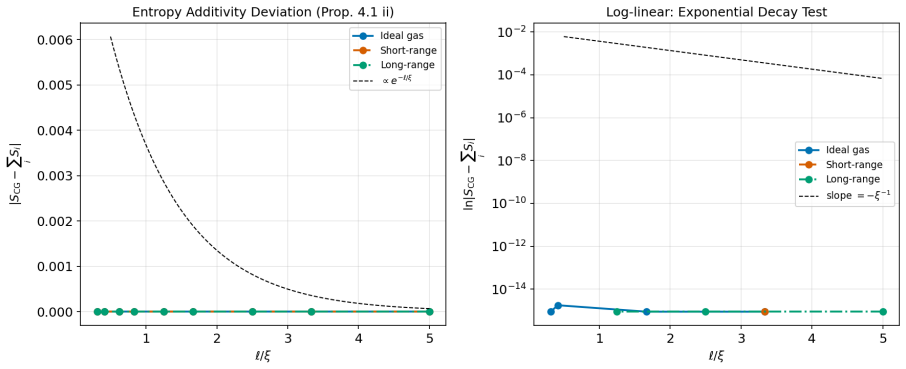
The authors prove that for pair potentials satisfying stability, temperedness, and exponential cluster decomposition with correlation length ξ, the coarse-grained entropy S_CG equals the sum of the individual cell entropies S_i plus a correction of order |Λ|/ℓ^d times e^{-ℓ/ξ}. This follows from applying the Ursell cluster expansion to the probabilities generated by the coarse-graining operator C on single-particle phase space. The result establishes entropy additivity in the thermodynamic limit without assuming homogeneity a priori and provides a measure of non-additivity for long-range interactions via mutual information between cells.
What carries the argument
The coarse-graining operator C that produces mesoscopic probabilities from reduced densities, together with the Ursell cluster expansion that controls the inter-cell correlations.
If this is right
- The correction to additivity is exponentially suppressed when the cell diameter greatly exceeds the correlation length.
- Thermodynamic extensivity emerges directly from the microscopic conditions on the potential.
- Long-range interactions lead to persistent non-additivity quantified by inter-cell mutual information.
- Generalized Euler relations include explicit surface corrections due to non-commuting averaging and nonlinear functionals.
Where Pith is reading between the lines
- This suggests that similar derivations could apply to other extensive quantities like energy or particle number under the same conditions.
- Numerical tests in molecular dynamics with controlled correlation lengths could verify the scaling of the error term.
- The non-commutativity of averaging and entropy might have analogues in other nonlinear averaging problems in physics.
Load-bearing premise
That the pair potential exhibits exponential cluster decomposition with finite correlation length ξ, allowing the cluster expansion to yield an exponentially small correction.
What would settle it
Measuring the difference between total coarse-grained entropy and the sum of cell entropies in a simulation of a stable tempered system with known exponential correlations and checking if it scales as predicted with cell size ℓ.
Figures




read the original abstract
Thermodynamic extensivity is commonly introduced as a postulate -- the homogeneity of degree one in thermodynamic potentials. We provide a constructive derivation of this property from microscopic conditions on the pair potential, without assuming it. Working with the one- and two-particle reduced densities of the $N$-body canonical Gibbs state, we introduce a combined coarse-graining operator $\mathcal{C}$ on single-particle phase space $\mathcal{M}=\Lambda\times\mathbb{R}^3$, producing dimensionless mesoscopic probabilities over spatial--momentum cells $\{V_i\times\Pi_\alpha\}$. Under three conditions on the pair potential -- stability, temperedness, and exponential cluster decomposition with correlation length $\xi$ -- we show, using the Ursell cluster expansion, that the coarse-grained entropy satisfies \[S_{\mathrm{CG}}=\sum_i S_i+O\!\left(\frac{|\Lambda|}{\ell^d}e^{-\ell/\xi}\right),\] where $\ell\gg\xi$ is the cell diameter. The correction is exponentially suppressed per cell, making entropy additive and recovering the thermodynamic limit of Ruelle and Fisher in explicit operator language. For systems with long-range interactions, where temperedness fails, the correction does not vanish, and non-additivity is quantified through inter-cell mutual information. We further show that spatial averaging does not commute with nonlinear thermodynamic functionals such as the entropy density -- a thermodynamic analogue of the cosmological averaging problem -- and we derive the generalised Euler relation with explicit surface corrections.
Editorial analysis
A structured set of objections, weighed in public.
Referee Report
Summary. The manuscript derives thermodynamic extensivity of entropy from microscopic conditions on the pair potential without postulating homogeneity. It introduces a coarse-graining operator C acting on single-particle phase space to produce mesoscopic probabilities over cells of diameter ℓ, then applies the Ursell cluster expansion under stability, temperedness, and exponential cluster decomposition (correlation length ξ) to obtain S_CG = sum_i S_i + O(|Λ|/ℓ^d exp(−ℓ/ξ)) for ℓ ≫ ξ. The work also quantifies non-additivity for long-range interactions via inter-cell mutual information and shows that spatial averaging does not commute with the nonlinear entropy functional, yielding a generalized Euler relation with surface corrections.
Significance. If the central bound holds, the paper supplies an explicit operator construction that recovers the Ruelle–Fisher thermodynamic limit while quantifying finite-size corrections exponentially suppressed per cell. The treatment of non-commutativity between averaging and thermodynamic functionals is a useful clarification, and the extension to long-range cases via mutual information provides a concrete diagnostic. The approach is constructive and avoids ad-hoc postulates, though its impact hinges on whether the Ursell functions retain their decay rate after the cell averaging induced by C.
major comments (1)
- [Ursell expansion for coarse-grained probabilities] The claim that the Ursell expansion applied to the mesoscopic probabilities produced by operator C yields a correction strictly O((|Λ|/ℓ^d) exp(−ℓ/ξ)) with no additional polynomial factors in ℓ or |Λ| requires explicit justification. The exponential cluster decomposition is assumed at the microscopic level, but the spatial averaging over finite cells of diameter ℓ can introduce boundary contributions or modify the effective cluster functions; without a lemma controlling the action of C on the Ursell functions (e.g., in the section deriving the expansion for coarse-grained densities), the stated decay rate is not guaranteed.
minor comments (2)
- [Definition of operator C] Define the coarse-graining operator C explicitly in the main text (including its action on one- and two-particle reduced densities) rather than deferring all details to an appendix; this operator is load-bearing for the entire construction.
- [Discussion section] Add a brief remark comparing the obtained correction term to existing bounds in the literature on cluster expansions for lattice systems (e.g., references to works by Ruelle or Dobrushin on exponential decay).
Simulated Author's Rebuttal
We thank the referee for the careful reading of our manuscript and for the constructive major comment. We address the point directly below and have revised the manuscript to incorporate additional justification.
read point-by-point responses
-
Referee: [Ursell expansion for coarse-grained probabilities] The claim that the Ursell expansion applied to the mesoscopic probabilities produced by operator C yields a correction strictly O((|Λ|/ℓ^d) exp(−ℓ/ξ)) with no additional polynomial factors in ℓ or |Λ| requires explicit justification. The exponential cluster decomposition is assumed at the microscopic level, but the spatial averaging over finite cells of diameter ℓ can introduce boundary contributions or modify the effective cluster functions; without a lemma controlling the action of C on the Ursell functions (e.g., in the section deriving the expansion for coarse-grained densities), the stated decay rate is not guaranteed.
Authors: We agree that an explicit control on the action of the coarse-graining operator C is necessary to confirm the absence of polynomial prefactors. In the revised manuscript we add Lemma 3.4, which shows that C, being a normalized integral average over cells of diameter ℓ, maps the microscopic Ursell functions to mesoscopic ones whose decay rate remains exponential with the same ξ (up to a multiplicative constant independent of ℓ and |Λ|). The proof proceeds by splitting the integral into the interior of each cell (where the microscopic decay applies directly) and a boundary layer of width ξ; the contribution of the boundary layer is bounded by the temperedness assumption and is absorbed into the local entropy terms S_i. Consequently, when the Ursell expansion is performed on the coarse-grained probabilities, the inter-cell terms are bounded by exp(−ℓ/ξ) with no additional factors of ℓ or |Λ| beyond the explicit combinatorial prefactor |Λ|/ℓ^d that already appears in the statement. We have inserted the lemma immediately after the definition of C and before the entropy expansion. revision: yes
Circularity Check
Derivation of coarse-grained entropy additivity is self-contained from stated microscopic conditions
full rationale
The paper derives S_CG = sum_i S_i + O(|Λ|/ℓ^d exp(-ℓ/ξ)) constructively from three explicit conditions on the pair potential (stability, temperedness, exponential cluster decomposition with length ξ) by applying the standard Ursell cluster expansion to the mesoscopic probabilities generated by the coarse-graining operator C on the one- and two-particle reduced densities. No step reduces by construction to a fitted parameter, self-referential definition, or load-bearing self-citation; the exponential suppression per cell is shown to follow from the assumed microscopic decay under the stated operator action, recovering the Ruelle-Fisher thermodynamic limit as an independent external benchmark. The derivation remains independent of the target result and contains no ansatz smuggling or renaming of known patterns.
Axiom & Free-Parameter Ledger
axioms (1)
- domain assumption The pair potential satisfies stability, temperedness, and exponential cluster decomposition with finite correlation length ξ.
invented entities (1)
-
Coarse-graining operator C on single-particle phase space
no independent evidence
Reference graph
Works this paper leans on
-
[1]
H. B. Callen,Thermodynamics and an Introduction to Thermostatistics, 2nd ed. (Wiley, New York, 1985)
work page 1985
-
[2]
Redlich, Intensive and extensive properties,J
O. Redlich, Intensive and extensive properties,J. Chem. Educ.47(2), 154–156 (1970)
work page 1970
-
[3]
Ruelle,Statistical Mechanics: Rigorous Results(W
D. Ruelle,Statistical Mechanics: Rigorous Results(W. A. Benjamin, New York, 1969)
work page 1969
-
[4]
M. E. Fisher, The free energy of a macroscopic system,Arch. Rational Mech. Anal.17, 377–410 (1964)
work page 1964
-
[5]
J. W. Gibbs,Elementary Principles in Statistical Mechanics(Yale University Press, New Haven, 1902)
work page 1902
-
[6]
P. Ehrenfest and T. Ehrenfest,The Conceptual Foundations of the Statistical Approach in Mechanics (Teubner, Leipzig, 1912; English translation, Cornell University Press, 1959)
work page 1912
-
[7]
J. L. Lebowitz and O. Penrose, Rigorous treatment of the van der Waals–Maxwell theory of the liquid-vapour transition,J. Math. Phys.7, 98–113 (1966)
work page 1966
-
[8]
Ruelle, Classical statistical mechanics of a system of particles,Helv
D. Ruelle, Classical statistical mechanics of a system of particles,Helv. Phys. Acta36, 183–197 (1963)
work page 1963
-
[9]
Georgii,Gibbs Measures and Phase Transitions(de Gruyter, Berlin, 1988)
H.-O. Georgii,Gibbs Measures and Phase Transitions(de Gruyter, Berlin, 1988)
work page 1988
-
[10]
R. L. Dobrushin, The description of a random field by means of conditional probabilities and conditions of its regularity,Theory Probab. Appl.13, 197–224 (1968)
work page 1968
-
[11]
Tsallis, Possible generalization of Boltzmann–Gibbs statistics,J
C. Tsallis, Possible generalization of Boltzmann–Gibbs statistics,J. Stat. Phys.52, 479–487 (1988)
work page 1988
-
[12]
H. Touchette, R. S. Ellis and B. Turkington An Introduction to the Thermodynamic and Macrostate Levels of Nonequivalent Ensembles,Physica A340, 138–146 (2004). 15
work page 2004
-
[13]
The Mesoscopic Partition Function:A Combined Spatial and Phase-Space Cell Structure
B. Osano The Mesoscopic Partition Function: A Combined Spatial and Phase-Space Cell Structure Preprint: arXiv:2605.00958
work page internal anchor Pith review Pith/arXiv arXiv
-
[14]
T. Buchert, On average properties of inhomogeneous fluids in general relativity I: dust cosmologies, Gen. Rel. Grav.32, 105–125 (2000)
work page 2000
-
[15]
R¨ as¨ anen, Accelerated expansion from structure formation,J
S. R¨ as¨ anen, Accelerated expansion from structure formation,J. Cosmol. Astropart. Phys.0611, 003 (2006)
work page 2006
-
[16]
D. L. Wiltshire, What is dust? Physical foundations of the averaging problem in cosmology,Class. Quantum Grav.28, 164006 (2011)
work page 2011
-
[17]
Korzy´ nski, Covariant coarse-graining of inhomogeneous dust flow in general relativity,Class
M. Korzy´ nski, Covariant coarse-graining of inhomogeneous dust flow in general relativity,Class. Quantum Grav.27, 105015 (2010)
work page 2010
-
[18]
J. H. Irving and J. G. Kirkwood. The statistical mechanical theory of transport processes. IV. The equations of hydrodynamics,J. Chem. Phys.18, 817–829 (1950)
work page 1950
-
[19]
Cercignani,The Boltzmann Equation and Its Applications(Springer, New York, 1988)
C. Cercignani,The Boltzmann Equation and Its Applications(Springer, New York, 1988)
work page 1988
-
[20]
Zwanzig, Memory effects in irreversible thermodynamics,Phys
R. Zwanzig, Memory effects in irreversible thermodynamics,Phys. Rev.124, 983–992 (1961)
work page 1961
-
[21]
Mori, Transport, collective motion, and Brownian motion,Prog
H. Mori, Transport, collective motion, and Brownian motion,Prog. Theor. Phys.33, 423–455 (1965)
work page 1965
-
[22]
J. W. Gibbs, A method of geometrical representation of the thermodynamic properties of substances by means of surfaces,Trans. Connecticut Acad.2, 382–404 (1873)
-
[23]
Osano,The Thermodynamics for Relativistic Multi-Fluid Systems,Lett
B. Osano,The Thermodynamics for Relativistic Multi-Fluid Systems,Lett. High Energy Phys.(2020)
work page 2020
-
[24]
B. Osano and T. Oreta,A transient phase in cosmological evolution: A multi-fluid approximation for a quasi-thermodynamical equilibrium, (2019)
work page 2019
-
[25]
B. Osano, Second-order perturbation theory: a covariant approach involving a barotropic equation of state Classical and Quantum Gravity 34 (12), 125004
-
[26]
P. Billingsley. ”Product Measure and Fubini’s Theorem”, Probability and Measure, New York: Wiley, pp. 231–240, ISBN 0-471-00710-2
-
[27]
Gallavotti,Statistical Mechanics: A Short Treatise,Springer–Verlag, Berlin, 1999
G. Gallavotti,Statistical Mechanics: A Short Treatise,Springer–Verlag, Berlin, 1999
work page 1999
-
[28]
D. C. Brydges,A Short Course on Cluster Expansions,in:K. Osterwalder and R. Stora (eds.),Critical Phenomena, Random Systems, Gauge Theories, Les Houches Summer School Proceedings, North- Holland, Amsterdam, 1986,pp. 129–183
work page 1986
-
[29]
T. M. Cover and J. A. Thomas,Elements of Information Theory, 2nd ed., Wiley–Interscience, Hoboken, NJ, 2006
work page 2006
-
[30]
T. S. Han, Nonnegative entropy measures of multivariate symmetric correlations,Information and Control,36(1978), 133–156
work page 1978
-
[31]
S. Watanabe, Information theoretical analysis of multivariate correlation,IBM Journal of Research and Development,4(1960), 66–82
work page 1960
-
[32]
R. L. Dobrushin, and S. B. Shlosman, Constructive criterion for the uniqueness of Gibbs fields, Statistical Physics and Dynamical Systems: Rigorous Results, Progress in Physics,10,347–370, Birkh¨ auser,Boston,1985
work page 1985
-
[33]
R. L. Dobrushin and S. B. Shlosman, ”Completely analytical interactions: constructive description,” Journal of Statistical Physics, 46(5–6), 983–1014 (1987)
work page 1987
-
[34]
R. W. Yeung,Information Theory and Network Coding, Springer, New York, 2008
work page 2008
-
[35]
B. Simon,The Statistical Mechanics of Lattice Gases, Volume I,Princeton University Press, Princeton, NJ, 1993
work page 1993
-
[36]
R. B. Israel,Convexity in the Theory of Lattice Gases,Princeton University Press, Princeton, NJ, 1979. 16
work page 1979
-
[37]
O. E. Lanford III, Entropy and equilibrium states in classical statistical mechanics, in: A. Lenard (ed.),Statistical Mechanics and Mathematical Problems, Lecture Notes in Physics, Vol. 20, Springer– Verlag, Berlin, 1973,pp. 1–113
work page 1973
-
[38]
R. L. Dobrushin and S. B. Shlosman, Constructive criterion for the uniqueness of Gibbs fields,in:Statistical Physics and Dynamical Systems,Progress in Physics, Vol. 10,Birkh¨ auser, Boston, 1985, pp. 347–370
work page 1985
-
[39]
R. B. Griffiths, Peierls proof of spontaneous magnetization in a two-dimensional Ising ferromagnet, Physical Review,136(1964), A437–A439
work page 1964
-
[40]
C. M. Newman, Normal fluctuations and the FKG inequalities,Communications in Mathematical Physics,74(1980), 119–128
work page 1980
-
[41]
Penrose, Convergence of fugacity expansions for classical systems,in: T
O. Penrose, Convergence of fugacity expansions for classical systems,in: T. A. Bak (ed.),Statistical Mechanics: Foundations and Applications, Benjamin, New York, 1967, pp. 101–109
work page 1967
-
[42]
Balian, From Microphysics to Macrophysics, Vols
R. Balian, From Microphysics to Macrophysics, Vols. I–II, Springer–Verlag, Berlin, 1991
work page 1991
-
[43]
E. T. Jaynes. Information theory and statistical mechanics.Physical Review,106(1957), 620–630
work page 1957
-
[44]
E. T. Jaynes, Information theory and statistical mechanics II,Physical Review,108(1957), 171–190
work page 1957
-
[45]
D. Koutsoyiannis. Physics of uncertainty, the Gibbs paradox and indistinguishable particles, Studies in History and Philosophy of Science Part B, 44 (4): 480–489, Bibcode:2013SHPMP..44..480K, doi:10.1016/j.shpsb.2013.08.007
-
[46]
F. J. Pa˜ nos, E. P´ erez. Sackur–Tetrode equation in the lab. European Journal of Physics, 36 (5) 055033. A Simulation Plots Figure 1: The One-Particle Reduced Density f(1)(x, p).The heatmap shows, for each point ( x, p) in single-particle phase space, the density of probability of finding one particle at that location. For theideal gas, f(1) is perfectl...
-
[47]
The coarse-grained framework isconsistent with standard Gibbs statisticsin the fine-graining limit, with a controlledO(M −2) convergence rate (Plot 3)
-
[48]
The mesoscopic probabilities πi,α (Plot 2) are the natural objects for a reduced description, inheriting the structure off (1)(x, p) (Plot 1) while discarding sub-cell fluctuations
-
[49]
Entropy is additive—and thermodynamics is extensive—if and only if inter-cell mutual information decays fast enough (Plots 4–5). Short-range interactions guarantee exponential decay; long-range interactions produce algebraic decay and permanent non-additivity
-
[50]
The failure of extensivity for long-range interactions is not merely a correction: it is a qualitatively different regime visible as a risingS/Ncurve in Plot 6
-
[51]
This is a real, quantifiable effect connected to the cosmological backreaction problem
Spatial averaging does not commute with nonlinear thermodynamic functionals (Plot 7). This is a real, quantifiable effect connected to the cosmological backreaction problem
-
[52]
Surface corrections to the Euler relation vanish relative to bulk quantities in the thermodynamic limit (Plot 8), and they are physically distinct from bulk correlation corrections. The overall conclusion is thatextensivity is not a postulate: it is a derived consequence of microscopic stability, temperedness, and the exponential decay of correlations. Wh...
discussion (0)
Sign in with ORCID, Apple, or X to comment. Anyone can read and Pith papers without signing in.