Electrolyte flows under magnetic fields: Manning-like counterion condensation in one dimension
Pith reviewed 2026-05-20 00:54 UTC · model grok-4.3
The pith
A magnetic field induces a Manning-Oosawa-like condensation transition in one-dimensional shear-driven electrolyte flows.
A machine-rendered reading of the paper's core claim, the machinery that carries it, and where it could break.
Core claim
In planar Couette shear, the Lorentz-force-induced potential produces a Manning-Oosawa-like condensation transition in one dimension, a phenomenon absent in classical electrostatics. An eigenvalue equation predicts a sharp threshold between counterion enrichment and depletion at the charged wall. In cylindrical Taylor-Couette flow, the same effect shifts the classical Manning criterion by a magnetic parameter.
What carries the argument
The hydrodynamic potential generated from the Lorentz force acting on the Stokes-derived velocity profile inside the Nernst-Planck ion description.
If this is right
- The condensation threshold is set by a tunable magnetic parameter rather than electrostatic strength alone.
- In cylindrical geometry the classical Manning criterion is shifted, allowing external magnetic control of condensation.
- The framework extends Manning-Oosawa phenomenology from equilibrium to driven non-equilibrium flows.
- Magnetic manipulation of ionic screening becomes possible in microfluidic and electrochemical devices.
Where Pith is reading between the lines
- Ion-density profiles measured near walls under controlled shear and magnetic field could directly test the predicted threshold.
- The mechanism may generalize to other driven flows or time-dependent fields for dynamic ion control.
- Applications could include magnetic tuning of double-layer structure in lab-on-chip devices.
- Nonlinear feedback from ions to the flow field remains an open extension of the sequential decoupling.
Load-bearing premise
Ion distributions exert negligible back-coupling on the velocity profile obtained by solving the Stokes equation first.
What would settle it
Direct measurement of counterion density at the wall in a planar Couette cell that shows a discontinuous jump when the applied magnetic field crosses the critical value given by the eigenvalue equation.
Figures


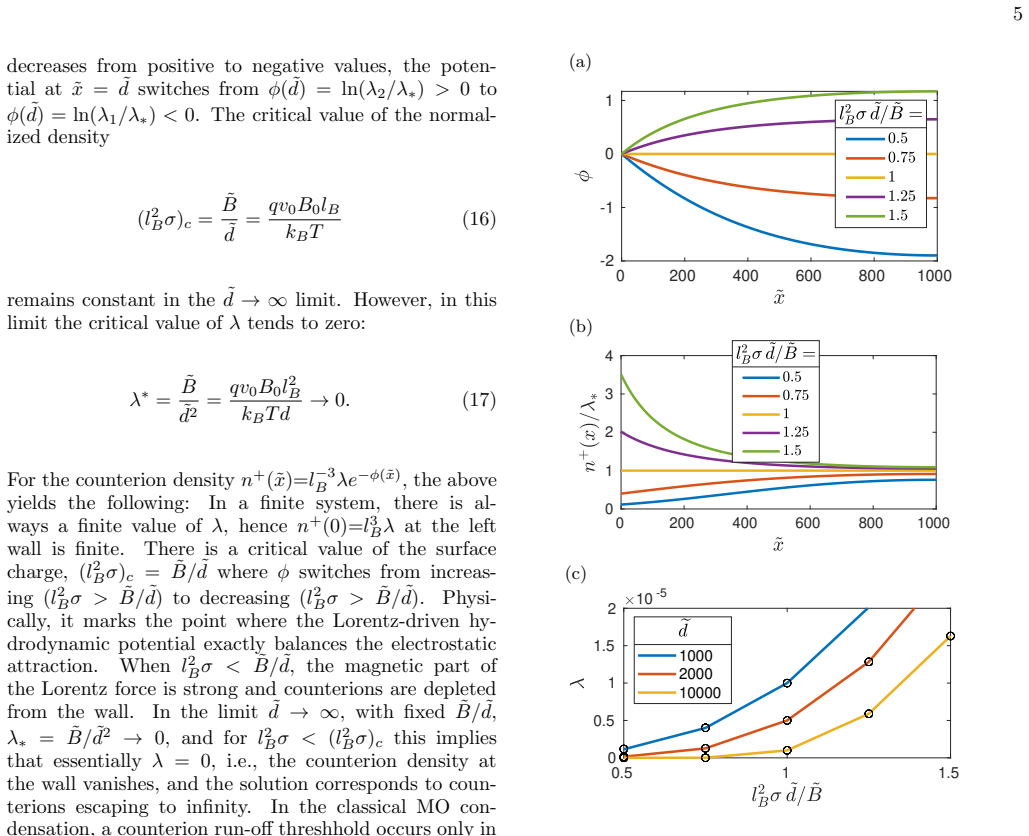


read the original abstract
We present a theoretical framework for unidirectional electromagnetohydrodynamic flow of dilute electrolytes under perpendicular magnetic fields. Starting from the Navier--Stokes equation coupled with the Poisson--Nernst--Planck formulation, we show that the problem admits a sequential decoupling: the Stokes equation is solved first to obtain the velocity profile, which defines a hydrodynamic potential entering the Nernst--Planck description of ions. This Lorentz-force-induced potential competes with electrostatic attraction and significantly alters ionic distributions. We analyze this mechanism in two canonical geometries. In planar Couette shear, it produces a Manning--Oosawa-like condensation transition in one dimension, a phenomenon absent in classical electrostatics. We derive an eigenvalue equation predicting a sharp threshold between counterion enrichment and depletion at the charged wall. In cylindrical Taylor--Couette flow, the same effect shifts the classical Manning criterion by a magnetic parameter, enabling tunable control of condensation. These findings extend Manning--Oosawa phenomenology to driven, non-equilibrium systems and provide a basis for magnetic manipulation of screening in electrolytes, with implications for microfluidics, electrochemical systems, and nonlinear boundary-value theory.
Editorial analysis
A structured set of objections, weighed in public.
Referee Report
Summary. The manuscript develops a theoretical framework for unidirectional electromagnetohydrodynamic flow of dilute electrolytes under perpendicular magnetic fields. Starting from the Navier-Stokes equation coupled to the Poisson-Nernst-Planck formulation with Lorentz force, it shows that the problem admits a sequential decoupling: the Stokes equation is solved first for the velocity profile, which defines a hydrodynamic potential inserted into the Nernst-Planck ion equations. In planar Couette shear this produces a Manning-Oosawa-like condensation transition in one dimension, predicted by an eigenvalue equation for a sharp threshold between counterion enrichment and depletion at the charged wall. In cylindrical Taylor-Couette flow the same mechanism shifts the classical Manning criterion by a magnetic parameter.
Significance. If the decoupling holds and the eigenvalue threshold is robust, the result would be significant by extending Manning-Oosawa phenomenology from equilibrium electrostatics to driven non-equilibrium MHD flows, providing an analytical route to magnetic control of ionic screening. The eigenvalue formulation offers a clean, potentially parameter-free prediction in terms of the magnetic parameter, which is a methodological strength. This could inform microfluidic and electrochemical applications, though the absence of self-consistent solutions or numerical checks limits immediate applicability.
major comments (2)
- [Decoupling procedure] The sequential decoupling (described in the abstract and the derivation of the velocity profile) assumes the Stokes solution for u(y) can be obtained independently of the ion densities n_i(y). However, the Lorentz body force depends on the current density, whose conductivity contribution is proportional to sum z_i^2 n_i; a sharp condensation or depletion layer would therefore perturb J and feed back into the momentum balance. No estimate of this perturbation relative to the imposed shear or magnetic parameter is given, which is load-bearing for the claimed sharp eigenvalue threshold.
- [Eigenvalue equation] The eigenvalue equation for the condensation threshold (in the planar Couette analysis) requires explicit statement of the boundary conditions, the precise definition of the hydrodynamic potential, and its coupling to the electrostatic potential. Without these details or accompanying numerical solutions of the decoupled system, it is difficult to confirm that the transition remains sharp rather than smoothed by the neglected back-coupling.
minor comments (2)
- [Abstract] The abstract and introduction could more precisely state the range of validity of the dilute-electrolyte and low-Reynolds-number assumptions.
- [Notation] All symbols, including the magnetic parameter and the form of the hydrodynamic potential, should be defined at first use with an equation reference.
Simulated Author's Rebuttal
We thank the referee for the careful reading and constructive comments on our manuscript. We address each major comment below and have revised the manuscript to improve clarity and rigor where appropriate.
read point-by-point responses
-
Referee: The sequential decoupling (described in the abstract and the derivation of the velocity profile) assumes the Stokes solution for u(y) can be obtained independently of the ion densities n_i(y). However, the Lorentz body force depends on the current density, whose conductivity contribution is proportional to sum z_i^2 n_i; a sharp condensation or depletion layer would therefore perturb J and feed back into the momentum balance. No estimate of this perturbation relative to the imposed shear or magnetic parameter is given, which is load-bearing for the claimed sharp eigenvalue threshold.
Authors: We agree that a fully self-consistent treatment would include feedback from ion-density-dependent conductivity into the current density J and thus the Lorentz force. In the dilute-electrolyte regime of the manuscript, however, the bulk conductivity dominates and the relative perturbation from the thin layer is O(δn/n_bulk) ≪ 1 near the transition. We have added an order-of-magnitude estimate (new paragraph in Section 3) showing that this correction remains smaller than the leading magnetic-parameter term for the parameter range considered, thereby justifying the sequential decoupling to the order at which the eigenvalue threshold is derived. A fully coupled numerical solution lies beyond the present analytical scope but is noted as a natural extension. revision: yes
-
Referee: The eigenvalue equation for the condensation threshold (in the planar Couette analysis) requires explicit statement of the boundary conditions, the precise definition of the hydrodynamic potential, and its coupling to the electrostatic potential. Without these details or accompanying numerical solutions of the decoupled system, it is difficult to confirm that the transition remains sharp rather than smoothed by the neglected back-coupling.
Authors: We have revised Section 4 to state the boundary conditions explicitly (no-flux at the charged wall y=0 and n_i → n_bulk, Φ → 0 as y → ∞) and to define the hydrodynamic potential as Φ_h(y) = −(B/η) ∫_0^y u(s) ds, obtained by direct integration of the Stokes solution. This potential enters the Nernst–Planck equation additively with the electrostatic potential, yielding an effective potential whose bound-state condition produces the eigenvalue equation. The mathematical structure is identical to the classical Manning problem, so the transition remains sharp within the decoupled approximation; any smoothing arises only at higher order from the back-coupling already estimated above. We have added a short paragraph discussing this point and the expected robustness of the threshold. revision: yes
Circularity Check
No significant circularity; derivation remains self-contained
full rationale
The paper starts from the standard Navier-Stokes and Poisson-Nernst-Planck equations augmented by the Lorentz force. It explicitly adopts a sequential decoupling in which the Stokes equation is solved first for the velocity profile u(y), which then supplies a hydrodynamic potential that enters the Nernst-Planck ion equations. The eigenvalue problem that locates the condensation threshold is obtained by substituting this potential into the ion transport equations and is therefore a derived consequence rather than a re-statement of the inputs. No parameter is fitted to the target condensation result, no self-citation supplies a load-bearing uniqueness theorem, and the central claim does not reduce to a tautology by construction. The decoupling is presented as an approximation valid in the dilute-electrolyte limit; any back-coupling through conductivity is an external validity question, not a circularity within the given derivation chain.
Axiom & Free-Parameter Ledger
free parameters (1)
- magnetic parameter
axioms (2)
- domain assumption Unidirectional flow with perpendicular magnetic field permitting sequential decoupling of Stokes from Nernst-Planck
- domain assumption Dilute electrolyte limit allowing standard PNP treatment
Reference graph
Works this paper leans on
-
[1]
J. Goedbloed and S. Poedts,Principles of Magnetohy- drodynamics: With Applications to Laboratory and As- trophysical Plasmas(Cambridge University Press, Cam- bridge, UK, 2004)
work page 2004
-
[2]
A. Srivastava, M. Goossens, and I. Arregui,Magnetohy- drodynamic Processes in Solar Plasmas(Springer, Cham, 2024)
work page 2024
-
[3]
Priest,Magnetohydrodynamics of the Sun(Cambridge University Press, 2014)
E. Priest,Magnetohydrodynamics of the Sun(Cambridge University Press, 2014)
work page 2014
-
[4]
P. Roberts and E. King, The geodynamo and the origin of earth’s magnetic field, Rep. Prog. Phys.76, 096801 (2013)
work page 2013
-
[5]
R. J. Rosa,Magnetohydrodynamic Energy Conversion (McGraw-Hill, New York, 1968)
work page 1968
-
[6]
Matinde, Metallurgical slags: A drive to circularity and search for new research agenda, J
E. Matinde, Metallurgical slags: A drive to circularity and search for new research agenda, J. South Afr. Inst. Min. Metall.124, 491 (2024)
work page 2024
-
[7]
H. H. Bau, Applications of magneto electrochemistry and magnetohydrodynamics in microfluidics, Magnetochem- istry8, 140 (2022)
work page 2022
-
[8]
N.-T. Nguyen, Micro-magnetofluidics: interactions be- tween magnetism and fluid flow on the microscale, Mi- crofluid. Nanofluid.12, 1 (2012)
work page 2012
-
[9]
Nguyen, Special issue on magnetic-based microflu- idics, Microfluid
N.-T. Nguyen, Special issue on magnetic-based microflu- idics, Microfluid. Nanofluid.13, 527 (2012)
work page 2012
-
[10]
Davidson,An Introduction to Magnetohydrodynamics, 2nd ed
P. Davidson,An Introduction to Magnetohydrodynamics, 2nd ed. (Cambridge University Press, Cambridge, UK, 2016)
work page 2016
-
[11]
U. M¨ uller and L. B¨ uhler,Magnetofluiddynamics in Chan- nels and Containers(Springer, Berlin, 2001)
work page 2001
-
[12]
T. Z. Fahidy, Magnetoelectrolysis, J. Appl. Electrochem. 13, 553 (1983)
work page 1983
- [13]
-
[14]
X. Chen, Y. Jian, Z. Xie, and Z. Ding, Thermal trans- port of electromagnetohydrodynamic in a microtube with electrokinetic effect and interfacial slip, Colloids Surf., A 540, 194 (2018)
work page 2018
-
[15]
A. Rana, M. Reza, and G. C. Shit, Electromagnetohydro- dynamic thermo-fluidic transport in a porous microchan- nel with wall roughness, Colloids Surf., A650, 129336 (2022)
work page 2022
-
[16]
M. Z. Bazant, Exact solutions and physical analogies for unidirectional flows, Phys. Rev. Fluids1, 024001 (2016)
work page 2016
-
[17]
G. S. Manning, Limiting laws and counterion condensa- tion in polyelectrolyte solutions I. Colligative properties, J. Chem. Phys.51, 924 (1969)
work page 1969
-
[18]
Oosawa,Polyelectrolytes(Marcel Dekker, New York, 1971)
F. Oosawa,Polyelectrolytes(Marcel Dekker, New York, 1971)
work page 1971
-
[19]
J. G. Hedley, K. Coshic, A. Aksimentiev, and A. A. Ko- rnyshev, Electric field of DNA in solution: Who is in charge?, Phys. Rev. X14, 031042 (2024)
work page 2024
-
[20]
R. R. Netz and J.-F. Joanny, Complexation behavior of polyampholytes and charged objects, Macromolecules 31, 5123 (1998)
work page 1998
-
[21]
Y. Burak and H. Orland, Manning condensation in two dimensions, Phys. Rev. E73, 010501 (2006)
work page 2006
-
[22]
R. R. Netz and H. Orland, Beyond poisson-boltzmann: Fluctuation effects and correlation functions, Eur. Phys. J. E1, 203 (2000)
work page 2000
-
[23]
E. Trizac and G. T´ ellez, Onsager-Manning-Oosawa con- densation phenomenon and the effect of salt, Phys. Rev. Lett.96, 038302 (2006)
work page 2006
- [24]
-
[25]
L. ˇSamaj and E. Trizac, Counterions at highly charged in- terfaces: From one plate to like-charge attraction, Phys. Rev. Lett106, 078301 (2011)
work page 2011
-
[26]
G. Ariel and D. Andelman, Polyelectrolyte persistence length: Attractive effect of counterion correlations and fluctuations, Europhys. Lett.61, 67 (2003)
work page 2003
-
[27]
D. Andelman, Introduction to electrostatics in soft and biological matter, Soft condensed matter physics in molecular and cell biology59, 97 (2006)
work page 2006
-
[28]
P. S. Kuhn, Y. Levin, and M. C. Barbosa, Rodlike poly- electrolytes in the presence of monovalent salt, Macro- molecules31, 8347 (1998)
work page 1998
-
[29]
R. F. Probstein,Physicochemical Hydrodynamics: An In- troduction(John Wiley & Sons, Hoboken, NJ, 2003)
work page 2003
-
[30]
M. V. Fedorov and A. A. Kornyshev, Ionic liquid near a charged wall: Structure and capacitance of electrical double layer, J. Phys. Chem. B112, 11868 (2008)
work page 2008
-
[31]
R. B. Bird, W. E. Stewart, and E. N. Lightfoot,Transport Phenomena, 2nd ed. (John Wiley & Sons, New York, 2002)
work page 2002
-
[32]
A. A. Kornyshev, Double-layer in ionic liquids: paradigm change?, J. Phys. Chem. B111, 5545 (2007)
work page 2007
-
[33]
S. Qian and H. H. Bau, Magneto-hydrodynamics based microfluidics, Mech. Res. Commun.36, 10 (2009)
work page 2009
-
[34]
Levin, Kosterlitz–Thouless and Manning condensa- tion, Physica A257, 408 (1998)
Y. Levin, Kosterlitz–Thouless and Manning condensa- tion, Physica A257, 408 (1998)
work page 1998
discussion (0)
Sign in with ORCID, Apple, or X to comment. Anyone can read and Pith papers without signing in.