Quantum signatures and semiclassical limitations in the transmission of Fock states
Pith reviewed 2026-05-20 11:07 UTC · model grok-4.3
The pith
Fock states transmit through barriers with maximum probability set by their initial positive-energy fraction.
A machine-rendered reading of the paper's core claim, the machinery that carries it, and where it could break.
Core claim
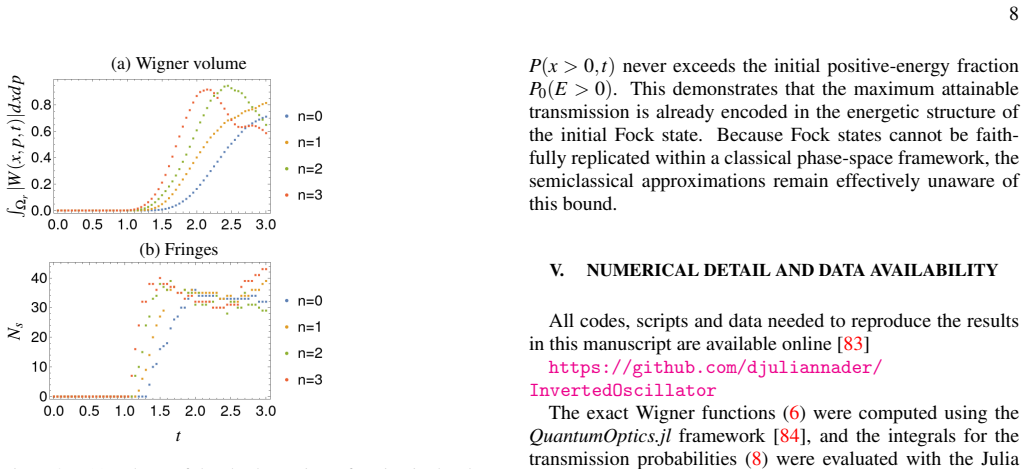
Transmission of displaced Fock states through an inverted-oscillator barrier shows that semiclassical simulations reproduce the overall transmission probability but miss short-time plateaus caused when Wigner-function negativity crosses the barrier. A Kerr nonlinearity introduces reflections from nonlinear boundaries that drive interference into classically forbidden regions, an effect inaccessible to semiclassical approaches. The maximum transmission probability itself remains bounded by the initial positive-energy fraction and is therefore already encoded in the phase-space structure of the Fock states. Because Fock states cannot be faithfully represented within classical phase space, the
What carries the argument
The positive-energy fraction of the initial Fock state in phase space, which directly bounds the achievable transmission probability.
If this is right
- Semiclassical trajectory methods will systematically omit the short-time transmission plateaus generated by Wigner negativity.
- The transmission bound set by the positive-energy fraction persists even when Kerr nonlinearity adds forbidden-region interference.
- Exact quantum propagation is required to resolve the dynamics while negativity regions cross the barrier.
- Kerr media offer an experimental route to observe the quantum signatures that semiclassical models miss.
Where Pith is reading between the lines
- Comparable short-time quantum features may appear in other scattering problems that involve states possessing Wigner negativity.
- High-resolution experiments in Kerr-coupled systems could directly measure the transmission plateaus and test the energy-fraction bound.
- Semiclassical techniques may need explicit corrections for negativity to improve accuracy on short time scales.
Load-bearing premise
The numerical exact quantum dynamics and the semiclassical trajectory ensemble are computed with sufficient resolution that the reported short-time plateaus and interference patterns are not erased by uncontrolled approximations.
What would settle it
An exact quantum calculation in which the maximum transmission probability exceeds the initial positive-energy fraction, or a semiclassical ensemble that reproduces the short-time plateaus once resolution is increased.
Figures


read the original abstract
Transmission through potential barriers is a fundamental problem in quantum mechanics. While semiclassical methods can approximate certain aspects of transmission, they fail to capture the intrinsically quantum interference associated with Wigner-function negativity. We numerically study the transmission of displaced Fock states through an inverted-oscillator barrier, with and without a Kerr nonlinearity that offers a potential route to experimental realization. These states allow only an approximate classical description, since their characteristic Wigner-function negativity is absent in phase space. The semiclassical simulation reproduces the overall transmission but deviate from exact results and fail to capture short-time plateaus that arise when regions of Wigner-function negativity cross the barrier. With the Kerr nonlinearity, reflections from nonlinear boundaries drive interference into classically forbidden regions, an effect that is inaccessible to semiclassical approaches. We find that these interference effects do not alter the maximum transmission probability, which is bounded by the initial positive-energy fraction and therefore already encoded in the phase-space structure of the Fock states. Because Fock states cannot be faithfully represented within classical phase space, the transmission through a barrier reveals fundamental limitations of semiclassical approaches.
Editorial analysis
A structured set of objections, weighed in public.
Referee Report
Summary. The manuscript numerically compares exact quantum dynamics to semiclassical trajectory ensembles for the transmission of displaced Fock states through an inverted-oscillator barrier, with and without Kerr nonlinearity. It reports that semiclassical methods reproduce overall transmission probabilities but fail to capture short-time plateaus that appear when regions of Wigner-function negativity cross the barrier. Kerr nonlinearity induces reflections that drive interference into classically forbidden regions, an effect inaccessible semiclassically. The maximum transmission is bounded by the initial positive-energy fraction visible in the Wigner function prior to propagation, a quantity already encoded in the phase-space structure of the Fock states. The work concludes that these observations reveal intrinsic limitations of semiclassical approaches for states without faithful classical phase-space representations.
Significance. If the numerical distinctions are robust, the paper supplies concrete evidence that Wigner negativity produces observable short-time signatures in barrier transmission that semiclassical ensembles miss, while also identifying a simple phase-space bound on maximum transmission. The Kerr case adds a potential experimental route via nonlinear media. These findings could help delineate the regime where semiclassical methods remain reliable in quantum optics and mesoscopic physics.
major comments (2)
- [Numerical Methods] Numerical Methods section: the manuscript provides no information on spatial grid size, time-step size, convergence tests, or boundary conditions for the exact quantum propagator (split-operator or equivalent). Because the central distinction between exact and semiclassical results rests on the visibility of short-time plateaus, uncontrolled discretization errors could either fabricate or suppress these features; the same applies to the number of trajectories and sampling procedure in the semiclassical ensemble.
- [Results on Kerr nonlinearity] Kerr nonlinearity results: the assertion that boundary reflections produce interference inside the forbidden region (and that this does not change the maximum transmission) is stated without quantitative support such as time-resolved Wigner snapshots or integrated probability measures at specific times. This leaves open whether the reported effect is numerically resolved or an artifact of the chosen barrier and Kerr parameters.
minor comments (2)
- [Abstract and Introduction] The abstract and introduction should explicitly state the displacement amplitude and barrier height used, together with the precise definition of the positive-energy fraction extracted from the initial Wigner function.
- [Figures] Figure captions and axis labels should indicate the time window over which plateaus are observed and the ensemble size for each semiclassical curve to allow direct assessment of statistical significance.
Simulated Author's Rebuttal
We thank the referee for the constructive comments on our manuscript. We address each major point below and will incorporate the requested clarifications and supporting material in the revised version.
read point-by-point responses
-
Referee: [Numerical Methods] Numerical Methods section: the manuscript provides no information on spatial grid size, time-step size, convergence tests, or boundary conditions for the exact quantum propagator (split-operator or equivalent). Because the central distinction between exact and semiclassical results rests on the visibility of short-time plateaus, uncontrolled discretization errors could either fabricate or suppress these features; the same applies to the number of trajectories and sampling procedure in the semiclassical ensemble.
Authors: We agree that the Numerical Methods section requires additional detail to ensure reproducibility and to rule out discretization artifacts in the short-time plateaus. In the revised manuscript we will specify the spatial grid size and spacing, the time-step size employed in the split-operator propagator, the results of convergence tests performed by varying both grid and time-step parameters, and the form of the absorbing boundary conditions used at the edges of the computational domain. For the semiclassical ensemble we will report the total number of trajectories and the precise Monte-Carlo sampling procedure from the initial Wigner function of the displaced Fock state. These additions will confirm that the reported distinctions between exact and semiclassical dynamics are robust. revision: yes
-
Referee: [Results on Kerr nonlinearity] Kerr nonlinearity results: the assertion that boundary reflections produce interference inside the forbidden region (and that this does not change the maximum transmission) is stated without quantitative support such as time-resolved Wigner snapshots or integrated probability measures at specific times. This leaves open whether the reported effect is numerically resolved or an artifact of the chosen barrier and Kerr parameters.
Authors: We accept that the Kerr-nonlinearity discussion would benefit from explicit quantitative support. In the revision we will insert time-resolved Wigner-function snapshots at selected propagation times that illustrate the emergence of interference inside the classically forbidden region following boundary reflections. We will also add a supplementary figure showing the time-dependent integrated probability density in the forbidden region, thereby quantifying the effect and demonstrating that it is resolved for the chosen parameters. The claim that maximum transmission remains unchanged follows directly from the fact that it is bounded by the initial positive-energy fraction visible in the Wigner function; this bound is a static phase-space property and is unaffected by the subsequent Kerr-induced dynamics. revision: yes
Circularity Check
No circularity: bound follows directly from input phase-space structure via numerics
full rationale
The paper reports a numerical study of Fock-state transmission through an inverted-oscillator barrier (with and without Kerr term) and states that the observed maximum transmission equals the initial positive-energy fraction visible in the Wigner function prior to evolution. This relation is presented as an empirical finding from exact quantum dynamics versus semiclassical ensembles rather than a fitted parameter renamed as a prediction or a self-definitional equivalence. No load-bearing step reduces to a self-citation chain, imported uniqueness theorem, or ansatz smuggled via prior work; the central distinction between quantum plateaus and semiclassical failure is grounded in the computed trajectories and Wigner negativity crossing, which remain independent of the target bound. The derivation is therefore self-contained against external benchmarks.
Axiom & Free-Parameter Ledger
axioms (1)
- standard math Quantum mechanics in the Wigner representation correctly describes the dynamics of displaced Fock states under the inverted-oscillator Hamiltonian with optional Kerr term.
Lean theorems connected to this paper
-
IndisputableMonolith/Cost/FunctionalEquation.leanwashburn_uniqueness_aczel unclear?
unclearRelation between the paper passage and the cited Recognition theorem.
We find that these interference effects do not alter the maximum transmission probability, which is bounded by the initial positive-energy fraction and therefore already encoded in the phase-space structure of the Fock states.
-
IndisputableMonolith/Foundation/AlexanderDuality.leanalexander_duality_circle_linking unclear?
unclearRelation between the paper passage and the cited Recognition theorem.
short-time plateaus that arise when regions of Wigner-function negativity cross the barrier
What do these tags mean?
- matches
- The paper's claim is directly supported by a theorem in the formal canon.
- supports
- The theorem supports part of the paper's argument, but the paper may add assumptions or extra steps.
- extends
- The paper goes beyond the formal theorem; the theorem is a base layer rather than the whole result.
- uses
- The paper appears to rely on the theorem as machinery.
- contradicts
- The paper's claim conflicts with a theorem or certificate in the canon.
- unclear
- Pith found a possible connection, but the passage is too broad, indirect, or ambiguous to say the theorem truly supports the claim.
Reference graph
Works this paper leans on
-
[1]
for Fock states, defined as Pn(q,p) = r 2 π exp (q2/2+p 2/2−n−1/2) 2 1/2 ,(12) wherenis the Fock state index. This distribution approxi- mates the Wigner function of the initial displaced Fock state and is used to generate the initial ensemble for TW A simula- tions, as illustrated in Figure 5. Within the TW A framework, only those phase-space points (qi,...
-
[2]
Merzbacher, The early history of quantum tunneling, Physics Today55, 44 (2002)
E. Merzbacher, The early history of quantum tunneling, Physics Today55, 44 (2002)
work page 2002
-
[3]
Hund, Zur deutung der molekelspektren
F. Hund, Zur deutung der molekelspektren. i, Zeitschrift für Physik40, 742 (1927)
work page 1927
-
[4]
L. Nordheim, Zur theorie der thermischen emission und der re- flexion von elektronen an metallen, Zeitschrift für Physik46, 833 (1928)
work page 1928
-
[5]
Gamow, The quantum theory of nuclear disintegration, Na- ture122, 805 (1928)
G. Gamow, The quantum theory of nuclear disintegration, Na- ture122, 805 (1928)
work page 1928
-
[6]
G.-R. Feng, Y . Lu, L. Hao, F.-H. Zhang, and G.-L. Long, Ex- perimental simulation of quantum tunneling in small systems, Scientific Reports3, 2232 (2013)
work page 2013
-
[7]
M. H. Devoret, J. M. Martinis, and J. Clarke, Measurements of macroscopic quantum tunneling out of the zero-voltage state of a current-biased josephson junction, Physical review letters55, 1908 (1985)
work page 1908
-
[8]
M. Fiske and I. Giaever, Superconductive tunneling, Proceed- ings of the IEEE52, 1155 (1964). 9
work page 1964
- [9]
- [10]
-
[11]
R. Ferreira and G. Bastard, Tunnelling and relaxation in semiconductor double quantum wells, Reports on Progress in Physics60, 345 (1997)
work page 1997
-
[12]
D.-Y . Song, Localization or tunneling in asymmetric double- well potentials, Annals of Physics362, 609 (2015)
work page 2015
-
[13]
D. Braun and J. Martin, Spontaneous emission from a two- level atom tunneling in a double-well potential, Physical Re- view A—Atomic, Molecular, and Optical Physics77, 032102 (2008)
work page 2008
-
[14]
H. Hasegawa, Gaussian wavepacket dynamics and quantum tunneling in asymmetric double-well systems, Physica A: Sta- tistical Mechanics and its Applications392, 6232 (2013)
work page 2013
-
[15]
M. A. P. Reynoso, D. J. Nader, J. Chávez-Carlos, B. E. Ordaz- Mendoza, R. G. Cortiñas, V . S. Batista, S. Lerma-Hernández, F. Pérez-Bernal, and L. F. Santos, Quantum tunneling and level crossings in the squeeze-driven kerr oscillator, Phys. Rev. A 108, 033709 (2023)
work page 2023
-
[16]
M. Marthaler and M. Dykman, Quantum interference in the classically forbidden region: A parametric oscillator, Physi- cal Review A—Atomic, Molecular, and Optical Physics76, 010102 (2007)
work page 2007
-
[17]
D. J. Nader, C. A. González-Rodríguez, and S. Lerma- Hernández, Avoided crossings and dynamical tunneling close to excited-state quantum phase transitions, Phys. Rev. E104, 064116 (2021)
work page 2021
-
[18]
G. Chen and J. Liang, Unconventional quantum phase transition in the finite-size lipkin–meshkov–glick model, New Journal of Physics8, 297 (2006)
work page 2006
-
[19]
G. Milburn, J. Corney, E. M. Wright, and D. Walls, Quantum dynamics of an atomic bose-einstein condensate in a double- well potential, Physical Review A55, 4318 (1997)
work page 1997
-
[20]
S. Zöllner, H.-D. Meyer, and P. Schmelcher, Tunneling dy- namics of a few bosons in a double well, Physical Re- view A—Atomic, Molecular, and Optical Physics78, 013621 (2008)
work page 2008
-
[21]
N. Kluksdahl, A. Kriman, and D. Ferry, Wigner function simu- lation of quantum tunneling, Superlattices and Microstructures 4, 127 (1988)
work page 1988
-
[22]
K. G. Kay, Time-dependent semiclassical tunneling through barriers, Phys. Rev. A88, 012122 (2013)
work page 2013
-
[23]
K. L. Jensen, J. L. Lebowitz, J. M. Riga, D. A. Shiffler, and R. Seviour, Wigner wave packets: Transmission, reflection, and tunneling, Phys. Rev. B103, 155427 (2021)
work page 2021
-
[24]
C. S. Tautermann, A. F. V oegele, T. Loerting, and K. R. Liedl, An accurate semiclassical method to predict ground-state tun- neling splittings, The Journal of chemical physics117, 1967 (2002)
work page 1967
-
[25]
G. Rastelli, Semiclassical formula for quantum tunnel- ing in asymmetric double-well potentials, Physical Review A—Atomic, Molecular, and Optical Physics86, 012106 (2012)
work page 2012
-
[26]
L. Aragón-Muñoz, G. Chacón-Acosta, and H. Hernandez- Hernandez, Effective quantum tunneling from a semiclassical momentous approach, International Journal of Modern Physics B34, 2050271 (2020)
work page 2020
-
[27]
J. Le Deunff, A. Mouchet, and P. Schlagheck, Semiclassical description of resonance-assisted tunneling in one-dimensional integrable models, Phys. Rev. E88, 042927 (2013)
work page 2013
-
[28]
M. Hillery, R. F. O’Connell, M. O. Scully, and E. P. Wigner, Distribution functions in physics: Fundamentals, Physics re- ports106, 121 (1984)
work page 1984
-
[29]
Y . Lu, I. Strandberg, F. Quijandría, G. Johansson, S. Gas- parinetti, and P. Delsing, Propagating wigner-negative states generated from the steady-state emission of a superconducting qubit, Physical Review Letters126, 253602 (2021)
work page 2021
-
[30]
S. Rahimi-Keshari, T. C. Ralph, and C. M. Caves, Sufficient conditions for efficient classical simulation of quantum optics, Physical Review X6, 021039 (2016)
work page 2016
- [31]
-
[32]
F. Toscano, D. A. R. Dalvit, L. Davidovich, and W. H. Zurek, Sub-planck phase-space structures and heisenberg-limited mea- surements, Phys. Rev. A73, 023803 (2006)
work page 2006
-
[33]
Y . L. Lin and O. C. O. Dahlsten, Necessity of negative wigner function for tunneling, Phys. Rev. A102, 062210 (2020)
work page 2020
-
[34]
C. Chen and S. Zhou, Insights into quantum tunneling via a phase-space approach, Phys. Rev. A109, 032227 (2024)
work page 2024
-
[35]
I. F. Valtierra and A. B. Klimov, Tunneling currents in the hy- perbolic phase space, Entropy26, 639 (2024)
work page 2024
-
[36]
A. Ono, Phase-space consideration on barrier transmission in a time-dependent variational approach with superposed wave packets, Physics Letters B826, 136931 (2022)
work page 2022
-
[37]
G. Breitenbach, S. Schiller, and J. Mlynek, Measurement of the quantum states of squeezed light, Nature387, 471 (1997)
work page 1997
-
[38]
U. Leonhardt and H. Paul, Measuring the quantum state of light, Progress in Quantum Electronics19, 89 (1995)
work page 1995
-
[39]
A. I. Lvovsky, H. Hansen, T. Aichele, O. Benson, J. Mlynek, and S. Schiller, Quantum state reconstruction of the single- photon fock state, Physical Review Letters87, 10.1103/Phys- RevLett.87.050402 (2001)
-
[40]
J. Park, Y . Lu, J. Lee, Y . Shen, K. Zhang, S. Zhang, M. S. Zubairy, K. Kim, and H. Nha, Revealing nonclassicality be- yond Gaussian states via a single marginal distribution, Pro- ceedings of the National Academy of Science114, 891 (2017), arXiv:1702.01387 [quant-ph]
work page internal anchor Pith review Pith/arXiv arXiv 2017
-
[41]
Polkovnikov, Phase space representation of quantum dynam- ics, Annals of Physics325, 1790 (2010)
A. Polkovnikov, Phase space representation of quantum dynam- ics, Annals of Physics325, 1790 (2010)
work page 2010
-
[42]
J. Schachenmayer, A. Pikovski, and A. M. Rey, Many-body quantum spin dynamics with monte carlo trajectories on a dis- crete phase space, Phys. Rev. X5, 011022 (2015)
work page 2015
-
[43]
P. D. Drummond and C. W. Gardiner, Generalised p- representations in quantum optics, Journal of Physics A: Math- ematical and General13, 2353 (1980)
work page 1980
-
[44]
J. F. Corney and M. K. Olsen, Non-gaussian pure states and positive wigner functions, Phys. Rev. A91, 023824 (2015)
work page 2015
-
[45]
A. Kenfack and K. ˙Zyczkowski, Negativity of the wigner func- tion as an indicator of non-classicality, Journal of Optics B: Quantum and Semiclassical Optics6, 396 (2004)
work page 2004
-
[46]
X.-B. Wang, T. Hiroshima, A. Tomita, and M. Hayashi, Quan- tum information with gaussian states, Physics reports448, 1 (2007)
work page 2007
-
[47]
B. Wielinga and G. J. Milburn, Quantum tunneling in a kerr medium with parametric pumping, Phys. Rev. A48, 2494 (1993)
work page 1993
- [48]
-
[49]
X. He, Y . Lu, D. Bao, H. Xue, W. Jiang, Z. Wang, A. Roudsari, P. Delsing, J. Tsai, and Z. Lin, Fast generation of schrödinger cat states using a kerr-tunable superconducting resonator, Na- 10 ture communications14, 6358 (2023)
work page 2023
-
[50]
Barton, Quantum mechanics of the inverted oscillator poten- tial, Annals of Physics166, 322 (1986)
G. Barton, Quantum mechanics of the inverted oscillator poten- tial, Annals of Physics166, 322 (1986)
work page 1986
-
[51]
Yuce, Quantum inverted harmonic potential, Physica Scripta 96, 105006 (2021)
C. Yuce, Quantum inverted harmonic potential, Physica Scripta 96, 105006 (2021)
work page 2021
-
[52]
F. Ullinger, M. Zimmermann, and W. P. Schleich, The logarith- mic phase singularity in the inverted harmonic oscillator, A VS Quantum Science4(2022)
work page 2022
-
[53]
A. Albrecht, P. Ferreira, M. Joyce, and T. Prokopec, Infla- tion and squeezed quantum states, Physical Review D50, 4807 (1994)
work page 1994
- [54]
-
[55]
P. Romatschke, Out-of-time-ordered-correlators for the pure in- verted quartic oscillator: classical chaos meets quantum stabil- ity, Journal of High Energy Physics2024, 1 (2024)
work page 2024
-
[56]
M. Maamache and J. R. Choi, Quantum-classical correspon- dence for the inverted oscillator, Chinese Physics C41, 113106 (2017)
work page 2017
-
[57]
D. F. Walls and J. D. Harvey,Quantum Optics VI: Proceedings of the Sixth International Symposium on Quantum Optics, Ro- torua, New Zealand, January 24–28, 1994, V ol. 77 (Springer Science & Business Media, 2012)
work page 1994
-
[58]
S. Puri, S. Boutin, and A. Blais, Engineering the quantum states of light in a kerr-nonlinear resonator by two-photon driving, npj Quantum Information3, 18 (2017)
work page 2017
-
[59]
J. Chávez-Carlos, T. L. Lezama, R. G. Cortiñas, J. Venkatra- man, M. H. Devoret, V . S. Batista, F. Pérez-Bernal, and L. F. Santos, Spectral kissing and its dynamical consequences in the squeeze-driven kerr oscillator, npj Quantum Information9, 76 (2023)
work page 2023
-
[60]
Y . Cai, X. Deng, L. Zhang, Z. Ni, J. Mai, P. Huang, P. Zheng, L. Hu, S. Liu, Y . Xu,et al., Quantum squeezing amplifi- cation with a weak kerr nonlinear oscillator, arXiv preprint arXiv:2503.08197 (2025)
work page internal anchor Pith review Pith/arXiv arXiv 2025
-
[61]
J. Venkatraman, R. G. Cortiñas, N. E. Frattini, X. Xiao, and M. H. Devoret, A driven kerr oscillator with two-fold degenera- cies for qubit protection, Proceedings of the National Academy of Sciences121, e2311241121 (2024)
work page 2024
- [62]
- [63]
- [64]
- [65]
-
[66]
F. Iachello, R. G. Cortiñas, F. Pérez-Bernal, and L. F. Santos, Symmetries of the squeeze-driven kerr oscillator, Journal of Physics A: Mathematical and Theoretical56, 495305 (2023)
work page 2023
- [67]
-
[68]
M. Marthaler and M. Dykman, Switching via quantum acti- vation: A parametrically modulated oscillator, Physical Re- view A—Atomic, Molecular, and Optical Physics73, 042108 (2006)
work page 2006
-
[69]
A. C. Oliveira, J. G. Peixoto de Faria, and M. C. Nemes, Quantum-classical transition of the open quartic oscillator: The role of the environment, Phys. Rev. E73, 046207 (2006)
work page 2006
-
[70]
D. Nader and E. Serrano-Ensástiga, Critical energies and wigner functions of the stationary states of the bose einstein condensates in a double-well trap, Advanced Quantum Tech- nologies , 2400451 (2025)
work page 2025
- [71]
-
[72]
S. Deléglise, I. Dotsenko, C. Sayrin, J. Bernu, M. Brune, J.- M. Raimond, and S. Haroche, Reconstruction of non-classical cavity field states with snapshots of their decoherence, Nature 455, 510—514 (2008)
work page 2008
-
[73]
M. Hofheinz, E. Weig, M. Ansmann, R. C. Bialczak, E. Lucero, M. Neeley, A. O’Connell, H. Wang, J. M. Martinis, and A. Cle- land, Generation of fock states in a superconducting quantum circuit, Nature454, 310—314 (2008)
work page 2008
-
[74]
W. B. Case, Wigner functions and Weyl transforms for pedes- trians, American Journal of Physics76, 937 (2008)
work page 2008
-
[75]
E. Colomés, Z. Zhan, and X. Oriols, Comparing wigner, husimi and bohmian distributions: which one is a true probability dis- tribution in phase space?, Journal of Computational Electronics 14, 894 (2015)
work page 2015
- [76]
- [77]
-
[78]
C. Gardiner and P. Zoller,Quantum noise: a handbook of Markovian and non-Markovian quantum stochastic methods with applications to quantum optics(Springer Science & Busi- ness Media, 2004)
work page 2004
-
[79]
M. Olsen and A. Bradley, Numerical representation of quan- tum states in the positive-p and wigner representations, Optics Communications282, 3924 (2009)
work page 2009
-
[80]
Koh, Wigner Function of a Time-dependent Inverted Har- monic Oscillator, New Phys
S. Koh, Wigner Function of a Time-dependent Inverted Har- monic Oscillator, New Phys. Sae Mulli73, 74 (2023)
work page 2023
discussion (0)
Sign in with ORCID, Apple, or X to comment. Anyone can read and Pith papers without signing in.