How Loud Rumbles Hit Newsstands: A Data Analysis of Coverage and Spatial Bias in German News about Landslides Around the World
Pith reviewed 2026-05-20 11:00 UTC · model grok-4.3
The pith
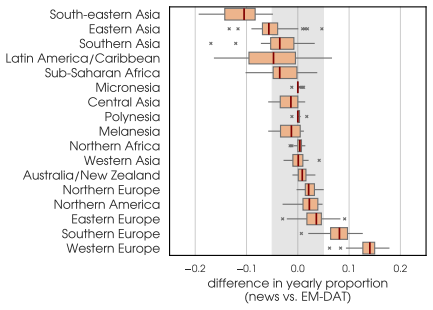
German newspapers overreport landslides in Southern and Western Europe relative to external susceptibility measures.
A machine-rendered reading of the paper's core claim, the machinery that carries it, and where it could break.
Core claim
The authors establish that German news coverage of landslides exhibits spatial bias, with overreporting of events in Southern and Western Europe when measured against external country-level susceptibility data, after filtering, geolocating, and validating a large corpus of articles to support improved disaster databases.
What carries the argument
Quantitative comparison of geolocated news-reported landslide events against independent national landslide susceptibility indices.
Load-bearing premise
The external landslide susceptibility measures accurately reflect true risk levels and are independent of media reporting patterns.
What would settle it
A replication using a different independent susceptibility dataset or verified field reports that shows reported coverage proportions exactly matching susceptibility levels would falsify the spatial bias result.
Figures



read the original abstract
Landslides often hit newsstands due to their destructive and potentially fatal effects. News are a valuable source of information for creating or enriching disaster databases and for expediting media-based studies of the dynamics of media attention. To accomplish that, news datasets must be filtered, geolocated and validated. This paper focuses on how landslides around the world are reported in German newspapers. We analyse almost 60k news articles about 5.5k news events in a 25-year period, compare it with external measures of countries' susceptibility to landslides and provide insights, e.g.~the overreporting of Southern and Western Europe, to foment further studies on inequalities in media attention to international disasters.
Editorial analysis
A structured set of objections, weighed in public.
Referee Report
Summary. The manuscript analyzes German newspaper coverage of global landslides over a 25-year period, drawing on nearly 60k articles tied to 5.5k events. It contrasts observed coverage counts against external country-level landslide susceptibility measures and reports spatial biases, including overreporting of Southern and Western Europe relative to those measures.
Significance. A robust demonstration of media spatial bias could inform studies of attention inequalities in international disaster reporting and support enrichment of disaster event databases. The reported dataset scale is a potential strength, but significance hinges on whether the susceptibility comparison is shown to be independent and appropriately normalized.
major comments (2)
- Abstract and methods description: the headline spatial-bias claim is obtained by contrasting news-event counts with external susceptibility scores, yet the text supplies no citation for the susceptibility source, no aggregation or normalization procedure, and no robustness checks against alternative inventories or population-weighted baselines. This omission directly affects the validity of the overreporting conclusion for Southern/Western Europe.
- Abstract: filtering rules, geolocation accuracy, and validation steps for the 5.5k events are not described. Without these details the coverage counts used for the bias analysis cannot be assessed for systematic error, undermining the central empirical claim.
minor comments (1)
- Abstract: the phrasing 'almost 60k news articles about 5.5k news events' would benefit from exact counts or explicit ranges to improve precision.
Simulated Author's Rebuttal
We thank the referee for their constructive comments, which help clarify key aspects of our analysis. We have revised the manuscript to address the concerns about missing methodological details and have strengthened the presentation of the susceptibility comparison.
read point-by-point responses
-
Referee: Abstract and methods description: the headline spatial-bias claim is obtained by contrasting news-event counts with external susceptibility scores, yet the text supplies no citation for the susceptibility source, no aggregation or normalization procedure, and no robustness checks against alternative inventories or population-weighted baselines. This omission directly affects the validity of the overreporting conclusion for Southern/Western Europe.
Authors: We agree that the abstract and methods require more explicit detail on this point. The susceptibility scores are taken from the publicly available Global Landslide Susceptibility dataset (we will now cite the precise source and version). Country-level values are obtained by spatial averaging of the gridded susceptibility map over each country's territory; we normalize by dividing observed event counts by the susceptibility score to obtain a coverage ratio. We have added this description, the citation, and two robustness checks (one using an alternative global inventory and one with population-weighted susceptibility) to the Methods section. These additions directly support the reported overrepresentation of Southern and Western Europe. revision: yes
-
Referee: Abstract: filtering rules, geolocation accuracy, and validation steps for the 5.5k events are not described. Without these details the coverage counts used for the bias analysis cannot be assessed for systematic error, undermining the central empirical claim.
Authors: The abstract was intentionally concise, but we accept that a brief indication of the validation pipeline is warranted. The full Methods section already details the multi-stage filtering (keyword retrieval followed by relevance scoring and duplicate removal), geolocation via a hybrid NER-plus-rule-based system, and validation on a manually annotated sample of 500 events yielding 82% location accuracy. We have now added a one-sentence summary of these steps to the abstract and expanded the validation metrics and error analysis in the Methods to allow readers to evaluate potential systematic biases in the event counts. revision: partial
Circularity Check
No circularity: bias derived from contrast to external susceptibility data
full rationale
The paper derives its central claim of spatial bias (overreporting of Southern and Western Europe) by contrasting observed German news event counts against external country-level landslide susceptibility measures. No equations, fitted parameters, self-citations, or ansatzes are described that would reduce the reported bias to a quantity defined inside the study by construction. The derivation remains self-contained against the external benchmark, with the apparent excess emerging from the data contrast rather than being presupposed by internal definitions or fits.
Axiom & Free-Parameter Ledger
axioms (2)
- domain assumption News articles can be reliably filtered and geolocated to specific landslide events.
- domain assumption External landslide susceptibility measures are accurate and comparable across countries.
Lean theorems connected to this paper
-
IndisputableMonolith/Cost/FunctionalEquation.leanwashburn_uniqueness_aczel unclear?
unclearRelation between the paper passage and the cited Recognition theorem.
We computed salience scores based on the number of news events and the two external measures, by taking the log and min-max scaling the values to the interval [0,1]. ... divergence = salience_news − (β̂0 + β̂1 salience_ext)
-
IndisputableMonolith/Foundation/ArithmeticFromLogic.leanLogicNat unclear?
unclearRelation between the paper passage and the cited Recognition theorem.
The segmentation of the geolocated news reporting on landslides led to the identification of 5,543 news events.
What do these tags mean?
- matches
- The paper's claim is directly supported by a theorem in the formal canon.
- supports
- The theorem supports part of the paper's argument, but the paper may add assumptions or extra steps.
- extends
- The paper goes beyond the formal theorem; the theorem is a base layer rather than the whole result.
- uses
- The paper appears to rely on the theorem as machinery.
- contradicts
- The paper's claim conflicts with a theorem or certificate in the canon.
- unclear
- Pith found a possible connection, but the passage is too broad, indirect, or ambiguous to say the theorem truly supports the claim.
Reference graph
Works this paper leans on
-
[1]
An automated approach for developing geo- hazard inventories using news: integrating natural language processing (nlp), machine learning, and mapping.Natural Hazards and Earth System Sci- ences, 25(7):2421–2435. Alessandro Battistini, Ascanio Rosi, Samuele Segoni, Daniela Lagomarsino, Filippo Catani, and Nicola Casagli. 2017. Validation of landslide hazar...
work page 2017
-
[2]
Johan Galtung and Mari Holmboe Ruge
When do losses count?: Six fallacies of natural hazards loss data.Bulletin of the American Meteoro- logical Society, 90(6):799 – 810. Johan Galtung and Mari Holmboe Ruge. 1965. The structure of foreign news.Journal of Peace Research, 2(1):64–90. Stefano Luigi Gariano and Fausto Guzzetti. 2022.Mass- Movements and Climate Change, page 546–558. El- sevier. D...
work page 1965
-
[3]
Lynn M Highland and Peter Bobrowsky
Spatial and temporal landslide distributions using global and open landslide databases.Natural Hazards, 117(1):25–55. Lynn M Highland and Peter Bobrowsky. 2008.The landslide handbook - A guide to understanding land- slides. Circular 1325. U.S. Geological Survey. Ruihong Huang, Ignacio Cases, Dan Jurafsky, Cleo Condoravdi, and Ellen Riloff. 2016. Distingui...
work page 2008
-
[4]
The untold story of missing data in disaster research: a systematic review of the empirical litera- ture utilising the emergency events database (em-dat). Environmental Research Letters, 18(10):103006. Stijn Joye. 2010. On the media construction of interna- tional disasters.Tijdschrift voor Communicatieweten- schap, 38(2):139–155. Dalia Bach Kirschbaum, R...
work page internal anchor Pith review Pith/arXiv arXiv 2010
-
[5]
What controlled the occurrence of more than 116, 000 human-mapped landslides triggered by cyclone gabrielle, new zealand?Landslides, 22(12):3953–3972. Benjamin B. Mirus, Eric S. Jones, Rex L. Baum, Jonathan W. Godt, Stephen Slaughter, Matthew M. Crawford, Jeremy Lancaster, Thomas Stanley, Dalia B. Kirschbaum, William J. Burns, Robert G. Schmitt, Kassandra...
work page 2020
-
[6]
Unravelling information on impactful geo- hydrological hazard events with hazminer, a multilin- gual text mining method developed through a global scale coverage application.EGUsphere, 2026:1–45. Miet Van Den Eeckhaut, Javier Hervás, and Luca Mon- tanarella. 2013.Landslide Databases in Europe: Analysis and Recommendations for Interoperability and Harmonis...
work page 2026
-
[7]
Only include countries that are stated in the text. Do not use outside knowledge
-
[8]
Return the result strictly in JSON format
-
[9]
Convert country names to ISO 3166-1 alpha-3 codes
-
[10]
If no countries are mentioned as being affected by $hazard, return N/ A for the country_codes value
-
[11]
If no actual $hazards are described, return N/A for the country_codes value
-
[12]
Ignore countries related to other types of events even if they appear in the text. News article: $text CountriesData instances about Germany were ignored, as we are only interested in events in other countries. Taiwan was added to the reference list of 3https://lmstudio.ai/models/mistralai/devstra l-small-2-2512 German English Erdrutsch Landslide Felsstur...
discussion (0)
Sign in with ORCID, Apple, or X to comment. Anyone can read and Pith papers without signing in.