Non-Colliding Biometric Identities for Digital Entities: Geometry, Capacity, and Million-Scale Virtual Identity Provisioning
Pith reviewed 2026-05-20 10:47 UTC · model grok-4.3
The pith
Real face identities leave unclaimed gaps in embedding space that can host at least 10 million non-colliding virtual identities realizable as photorealistic images.
A machine-rendered reading of the paper's core claim, the machinery that carries it, and where it could break.
Core claim
Because real face identities occupy a low-dimensional subspace of the embedding hypersphere, the remaining gaps within the real face manifold can be used to allocate virtual identity embeddings that never collide with any enrolled real identity and maintain inter-class separability. These embeddings are obtained by repulsion-based placement that is not limited by any fixed capacity bound, and they are realized as high-fidelity images by GapGen, a generator trained with a curriculum that progressively moves synthesis into the identified gaps.
What carries the argument
Repulsion-based allocation of points placed in the unclaimed gaps inside the real face manifold on the embedding hypersphere.
If this is right
- Virtual identities can be provisioned at scales exceeding any practical enrollment of real identities without an upper bound.
- Once allocated, the virtual set stays non-colliding with all future real identities that are added.
- The same embeddings support multiple protocols including virtual verification, cross-reality matching, and real-versus-virtual detection.
- A virtual counterpart dataset can be built that mirrors standard face benchmarks while adding cross-reality tasks.
Where Pith is reading between the lines
- Existing face recognition pipelines could treat virtual identities as an additional class without retraining the core embedding model.
- The gap-packing approach might extend to other biometric modalities such as voice or gait where similar manifold structure is observed.
- If the generator continues to work at larger scales, digital entities could receive unique biometric credentials that integrate directly with human-centric security systems.
Load-bearing premise
A curriculum-trained generator can synthesize high-fidelity face images from points in those gaps without creating collisions or losing separability when the real identity gallery grows.
What would settle it
Add new real identities to the original gallery and verify whether any of the previously provisioned virtual embeddings now fall inside the decision boundary of a real identity or produce matching scores above the verification threshold.
Figures




read the original abstract
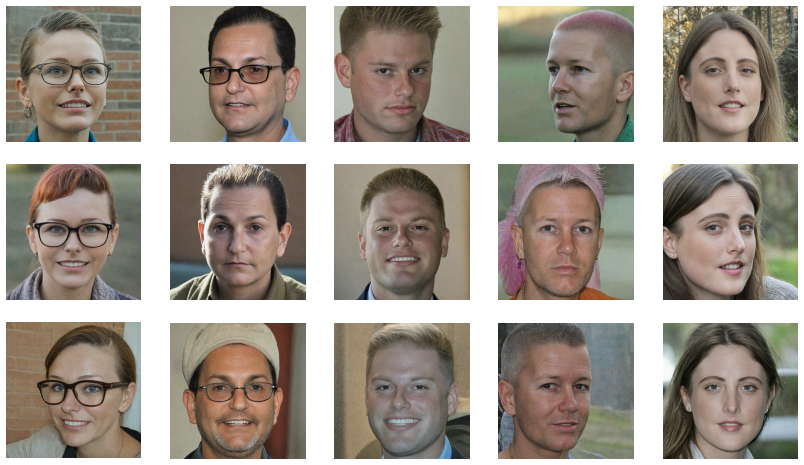
Digital entities such as AI agents and humanoid robots increasingly operate alongside real humans, yet their identity infrastructure is based on credentials rather than embodied biometric identity. We introduce Biometric Identity Provisioning (BIP), a new problem and solution framework that addresses: given an enrollment gallery of real human identities, provision virtual identities that are non-colliding with every enrolled identity, maintain sufficient inter-class separability, and are realizable as high-fidelity face images. The key geometric insight is that real face identities occupy a low-dimensional subspace of the embedding hypersphere, leaving no residual subspace for virtual identities. Hence, virtual identities must instead be allocated as unclaimed gaps within the real face manifold itself. BIP is therefore a constrained packing problem: available gaps vastly exceed any foreseeable enrollment scale, and provisioned identities remain non-colliding even as new real identities are subsequently enrolled. Grounded in this geometry, our repulsion-based allocation is not bounded by any fixed provisioning count; we demonstrate 10M non-colliding virtual identity embeddings against a gallery of 360K real identities. Realizing these embeddings as face images requires a generator that operates outside the training distribution of real face images; we introduce GapGen, a gap-aware generator trained with a curriculum that progressively extends synthesis into non-colliding regions, validated at 1M photorealistic virtual face images. We further construct v-LFW, a virtual counterpart to LFW face dataset, with protocols for virtual face verification, cross-reality matching, real-vs-virtual detection, and unified recognition and detection.
Editorial analysis
A structured set of objections, weighed in public.
Referee Report
Summary. The paper introduces Biometric Identity Provisioning (BIP), a framework for allocating non-colliding virtual face identities for digital entities given a gallery of real identities. It claims that real face embeddings occupy a low-dimensional subspace of the embedding hypersphere, leaving gaps that can be filled via repulsion-based allocation to produce at least 10M non-colliding virtual embeddings against 360K real identities. These are realized as 1M photorealistic images using a curriculum-trained GapGen generator that extends synthesis outside the real distribution. The work also presents the v-LFW dataset with protocols for virtual verification, cross-reality matching, and detection.
Significance. If the geometric allocation and GapGen synthesis are rigorously validated with quantitative metrics, this could provide a scalable approach to biometric identity management for AI agents and robots, addressing a growing need for embodied virtual identities distinct from real humans. The low-dimensional subspace insight and large-scale provisioning numbers would represent a notable contribution to face embedding geometry and generative modeling in computer vision, particularly if the non-collision guarantees hold under gallery growth.
major comments (3)
- [Abstract] Abstract: The central claims of demonstrating 10M non-colliding virtual identity embeddings against 360K real identities and realizing 1M photorealistic images via GapGen are presented without any quantitative metrics, error analysis, baseline comparisons, collision rate measurements, or separability margins. This absence directly undermines verification of the non-collision and photorealism guarantees that support the headline provisioning results.
- [Abstract] The repulsion-based allocation and GapGen curriculum are introduced as new components, yet the claimed provisioning counts (10M embeddings, 1M images) are not reduced to quantities derived from fitted parameters or empirical measurements on the same data; this creates a circularity risk for the capacity claims.
- [Abstract] The load-bearing assumption that GapGen maps allocated embedding gaps back to images whose re-embedded vectors remain non-colliding and photorealistic (without drift exceeding the separability margin) lacks supporting analysis of post-generation embedding distances, collision checks, or fidelity degradation as the real gallery scales.
minor comments (1)
- The notation for 'Biometric Identity Provisioning (BIP)' and 'GapGen' is introduced without a clear early definition or comparison to related packing or generative methods in the literature.
Simulated Author's Rebuttal
We thank the referee for the detailed and constructive report. We address each major comment below and indicate planned revisions to the manuscript.
read point-by-point responses
-
Referee: [Abstract] Abstract: The central claims of demonstrating 10M non-colliding virtual identity embeddings against 360K real identities and realizing 1M photorealistic images via GapGen are presented without any quantitative metrics, error analysis, baseline comparisons, collision rate measurements, or separability margins. This absence directly undermines verification of the non-collision and photorealism guarantees that support the headline provisioning results.
Authors: We agree that the abstract, due to its length constraints, does not convey the supporting quantitative details. The experimental sections of the manuscript report collision rates, separability margins, baseline comparisons, and photorealism metrics. We will revise the abstract to include a concise summary of these key quantitative results to better support the central claims. revision: yes
-
Referee: [Abstract] The repulsion-based allocation and GapGen curriculum are introduced as new components, yet the claimed provisioning counts (10M embeddings, 1M images) are not reduced to quantities derived from fitted parameters or empirical measurements on the same data; this creates a circularity risk for the capacity claims.
Authors: The 10M and 1M figures are produced by running the repulsion allocation on the 360K gallery and then synthesizing a subset with GapGen; they are not presupposed. We will add an explicit derivation subsection that shows how the counts follow from the fitted subspace parameters and empirical allocation runs on the same data, eliminating any appearance of circularity. revision: yes
-
Referee: [Abstract] The load-bearing assumption that GapGen maps allocated embedding gaps back to images whose re-embedded vectors remain non-colliding and photorealistic (without drift exceeding the separability margin) lacks supporting analysis of post-generation embedding distances, collision checks, or fidelity degradation as the real gallery scales.
Authors: We acknowledge that stronger post-generation verification is needed to confirm the assumption holds under scaling. We will expand the experimental section with additional quantitative analysis of re-embedding distances, collision checks after synthesis, and fidelity degradation curves as gallery size increases. revision: yes
Circularity Check
No significant circularity; derivation introduces independent allocation logic and generator
full rationale
The paper's core chain begins with an empirical geometric observation that real-face embeddings occupy a low-dimensional subspace on the hypersphere, from which it logically follows that virtual identities are placed in the remaining gaps via a newly defined repulsion-based packing procedure. This allocation is executed directly on the 360K real gallery to produce the 10M non-colliding points, without the counts being recovered from any fitted parameter of the same data. GapGen is introduced as a separate curriculum-trained model whose training objective and validation (1M images) are defined independently of the allocation counts. No self-citation is invoked as a load-bearing uniqueness theorem, no ansatz is smuggled, and no known result is merely renamed; the provisioning guarantees and v-LFW protocols rest on the explicit construction and synthesis steps rather than reducing to the inputs by definition.
Axiom & Free-Parameter Ledger
axioms (1)
- domain assumption Real face identities occupy a low-dimensional subspace of the embedding hypersphere, leaving usable gaps for virtual identities.
invented entities (2)
-
Biometric Identity Provisioning (BIP)
no independent evidence
-
GapGen
no independent evidence
Lean theorems connected to this paper
-
IndisputableMonolith/Cost/FunctionalEquation.leanwashburn_uniqueness_aczel unclear?
unclearRelation between the paper passage and the cited Recognition theorem.
real face identities occupy a low-dimensional subspace of the embedding hypersphere, leaving unclaimed gaps... repulsion-based allocation... cos(vj, ci)<τ
-
IndisputableMonolith/Foundation/AlexanderDuality.leanalexander_duality_circle_linking unclear?
unclearRelation between the paper passage and the cited Recognition theorem.
PCA energy distribution... top k=269 principal components... spherical cap volume μ(τ,d) via regularized incomplete beta
What do these tags mean?
- matches
- The paper's claim is directly supported by a theorem in the formal canon.
- supports
- The theorem supports part of the paper's argument, but the paper may add assumptions or extra steps.
- extends
- The paper goes beyond the formal theorem; the theorem is a base layer rather than the whole result.
- uses
- The paper appears to rely on the theorem as machinery.
- contradicts
- The paper's claim conflicts with a theorem or certificate in the canon.
- unclear
- Pith found a possible connection, but the passage is too broad, indirect, or ambiguous to say the theorem truly supports the claim.
Reference graph
Works this paper leans on
-
[1]
Partial FC: Training 10 million identities on a single machine
Xiang An, Xuhan Zhu, Yuan Gao, Yang Xiao, Yongle Zhao, Ziyong Feng, Lan Wu, Bin Qin, Ming Zhang, Debing Zhang, et al. Partial FC: Training 10 million identities on a single machine. InICCV, 2021
work page 2021
-
[2]
Digiface-1m: 1 million digital face images for face recognition
Gwangbin Bae, Martin de La Gorce, Tadas Baltrušaitis, Charlie Hewitt, Dong Chen, Julien Valentin, Roberto Cipolla, and Jingjing Shen. Digiface-1m: 1 million digital face images for face recognition. InWACV, 2023
work page 2023
-
[3]
Idiff-face: Synthetic-based face recognition through fizzy identity-conditioned diffusion model
Fadi Boutros, Jonas Henry Grebe, Arjan Kuijper, and Naser Damer. Idiff-face: Synthetic-based face recognition through fizzy identity-conditioned diffusion model. InICCV, 2023
work page 2023
-
[4]
Sface: Privacy- friendly and accurate face recognition using synthetic data
Fadi Boutros, Marco Huber, Patrick Siebke, Tim Rieber, and Naser Damer. Sface: Privacy- friendly and accurate face recognition using synthetic data. InIJCB, 2022
work page 2022
-
[5]
Cloud Security Alliance. Securing autonomous AI agents. https:// cloudsecurityalliance.org/artifacts/securing-autonomous-ai-agents , Febru- ary 2026. Accessed April 29, 2026
work page 2026
-
[6]
Id-reveal: Identity-aware deepfake video detection
Davide Cozzolino, Andreas Rössler, Justus Thies, Matthias Nießner, and Luisa Verdoliva. Id-reveal: Identity-aware deepfake video detection. InICCV, 2021
work page 2021
-
[7]
ArcFace: Additive angular margin loss for deep face recognition
Jiankang Deng, Jia Guo, Niannan Xue, and Stefanos Zafeiriou. ArcFace: Additive angular margin loss for deep face recognition. InCVPR, 2019
work page 2019
-
[8]
An image is worth 16x16 words: Transformers for image recognition at scale
Alexey Dosovitskiy, Lucas Beyer, Alexander Kolesnikov, Dirk Weissenborn, Xiaohua Zhai, Thomas Unterthiner, Mostafa Dehghani, Matthias Minderer, Georg Heigold, Sylvain Gelly, Jakob Uszkoreit, and Neil Houlsby. An image is worth 16x16 words: Transformers for image recognition at scale. InICLR, 2021
work page 2021
-
[9]
Region-aware temporal inconsistency learning for deepfake video detection
Zhihao Gu, Taiping Yao, Yang Chen, Ran Yi, Shouhong Ding, and Lizhuang Ma. Region-aware temporal inconsistency learning for deepfake video detection. InIJCAI, 2022
work page 2022
-
[10]
GANs trained by a two time-scale update rule converge to a local Nash equilibrium
Martin Heusel, Hubert Ramsauer, Thomas Unterthiner, Bernhard Nessler, and Sepp Hochreiter. GANs trained by a two time-scale update rule converge to a local Nash equilibrium. InNeurIPS, 2017
work page 2017
-
[11]
Denoising diffusion probabilistic models
Jonathan Ho, Ajay Jain, and Pieter Abbeel. Denoising diffusion probabilistic models. In NeurIPS, 2020
work page 2020
-
[12]
Huang, Manu Ramesh, Tamara Berg, and Erik Learned-Miller
Gary B. Huang, Manu Ramesh, Tamara Berg, and Erik Learned-Miller. Labeled faces in the wild: A database for studying face recognition in unconstrained environments. Technical Report 07-49, University of Massachusetts, Amherst, 2007
work page 2007
-
[13]
Billion-scale similarity search with GPUs
Jeff Johnson, Matthijs Douze, and Hervé Jégou. Billion-scale similarity search with GPUs. IEEE Transactions on Big Data, 7(3):535–547, 2021
work page 2021
-
[14]
A style-based generator architecture for generative adversarial networks
Tero Karras, Samuli Laine, and Timo Aila. A style-based generator architecture for generative adversarial networks. InCVPR, 2019
work page 2019
-
[15]
AdaFace: Quality adaptive margin for face recognition
Minchul Kim, Anil K Jain, and Xiaoming Liu. AdaFace: Quality adaptive margin for face recognition. InCVPR, 2022
work page 2022
-
[16]
DCFace: Synthetic face generation with dual condition diffusion model
Minchul Kim, Feng Liu, Anil Jain, and Xiaoming Liu. DCFace: Synthetic face generation with dual condition diffusion model. InCVPR, 2023
work page 2023
-
[17]
VIGFace: Virtual identity generation for privacy-free face recognition dataset
Minsoo Kim, Min-Cheol Sagong, Gi Pyo Nam, Junghyun Cho, and Ig-Jae Kim. VIGFace: Virtual identity generation for privacy-free face recognition dataset. InICCV, 2025
work page 2025
-
[18]
Younghun Kim, Minsuk Jang, Myung-Joon Kwon, Wonjun Lee, and Changick Kim. SELFI: Se- lective fusion of identity for generalizable deepfake detection.arXiv preprint arXiv:2506.17592, 2025. 10
-
[19]
Preserving fairness generalization in deepfake detection
Li Lin, Xinan He, Yan Ju, Xin Wang, Feng Ding, and Shu Hu. Preserving fairness generalization in deepfake detection. InCVPR, 2024
work page 2024
-
[20]
Li Lin, Santosh, Mingyang Wu, Xin Wang, and Shu Hu. AI-Face: A million-scale demographi- cally annotated ai-generated face dataset and fairness benchmark. InCVPR, 2025
work page 2025
-
[21]
Spatial-phase shallow learning: rethinking face forgery detection in frequency domain
Honggu Liu, Xiaodan Li, Wenbo Zhou, Yuefeng Chen, Yuan He, Hui Xue, Weiming Zhang, and Nenghai Yu. Spatial-phase shallow learning: rethinking face forgery detection in frequency domain. InCVPR, 2021
work page 2021
-
[22]
Sphereface: Deep hypersphere embedding for face recognition
Weiyang Liu, Yandong Wen, Zhiding Yu, Ming Li, Bhiksha Raj, and Le Song. Sphereface: Deep hypersphere embedding for face recognition. InCVPR, 2017
work page 2017
-
[23]
Microsoft. What is Microsoft Entra Agent ID? https://learn.microsoft.com/en-us/ entra/agent-id/what-is-microsoft-entra-agent-id , April 2026. Accessed April 29, 2026
work page 2026
-
[24]
Arc2face: A foundation model for ID-consistent human faces
Foivos Paraperas Papantoniou, Alexandros Lattas, Stylianos Moschoglou, Jiankang Deng, Bernhard Kainz, and Stefanos Zafeiriou. Arc2face: A foundation model for ID-consistent human faces. InECCV, 2024
work page 2024
-
[25]
Thinking in frequency: Face forgery detection by mining frequency-aware clues
Yuyang Qian, Guojun Yin, Lu Sheng, Zixuan Chen, and Jing Shao. Thinking in frequency: Face forgery detection by mining frequency-aware clues. InECCV, 2020
work page 2020
-
[26]
Synface: Face recognition with synthetic data
Haibo Qiu, Baosheng Yu, Dihong Gong, Zhifeng Li, Wei Liu, and Dacheng Tao. Synface: Face recognition with synthetic data. InICCV, 2021
work page 2021
-
[27]
Faceforensics++: Learning to detect manipulated facial images
Andreas Rossler, Davide Cozzolino, Luisa Verdoliva, Christian Riess, Justus Thies, and Matthias Nießner. Faceforensics++: Learning to detect manipulated facial images. InICCV, 2019
work page 2019
-
[28]
HyperFace: Generating synthetic face recognition datasets by exploring face embedding hypersphere
Hatef Otroshi Shahreza and Sébastien Marcel. HyperFace: Generating synthetic face recognition datasets by exploring face embedding hypersphere. InICLR, 2025
work page 2025
-
[29]
Detecting deepfakes with self-blended images
Kaede Shiohara and Toshihiko Yamasaki. Detecting deepfakes with self-blended images. In CVPR, 2022
work page 2022
-
[30]
Tobin South, Subramanya Nagabhushanaradhya, Ayesha Dissanayaka, Sarah Cecchetti, George Fletcher, Victor Lu, Aldo Pietropaolo, Dean H Saxe, Jeff Lombardo, Abhishek Maligehalli Shivalingaiah, et al. Identity management for agentic AI: The new frontier of authorization, authentication, and security for an AI agent world.arXiv preprint arXiv:2510.25819, 2025
-
[31]
Efficientnet: Rethinking model scaling for convolutional neural networks
Mingxing Tan and Quoc Le. Efficientnet: Rethinking model scaling for convolutional neural networks. InICML, 2019
work page 2019
-
[32]
Gomez, Łukasz Kaiser, and Illia Polosukhin
Ashish Vaswani, Noam Shazeer, Niki Parmar, Jakob Uszkoreit, Llion Jones, Aidan N. Gomez, Łukasz Kaiser, and Illia Polosukhin. Attention is all you need. InNeurIPS, 2017
work page 2017
-
[33]
Cosface: Large margin cosine loss for deep face recognition
Hao Wang, Yitong Wang, Zheng Zhou, Xing Ji, Dihong Gong, Jingchao Zhou, Zhifeng Li, and Wei Liu. Cosface: Large margin cosine loss for deep face recognition. InCVPR, 2018
work page 2018
-
[34]
InstantID: Zero-shot Identity-Preserving Generation in Seconds
Qixun Wang, Xu Bai, Haofan Wang, Zekui Qin, Anthony Chen, Huaxia Li, Xu Tang, and Yao Hu. Instantid: Zero-shot identity-preserving generation in seconds.arXiv preprint arXiv:2401.07519, 2024
work page internal anchor Pith review Pith/arXiv arXiv 2024
-
[35]
Iarpa janus benchmark- b face dataset
Cameron Whitelam, Emma Taborsky, Austin Blanton, Brianna Maze, Jocelyn Adams, Tim Miller, Nathan Kalka, Anil K Jain, James A Duncan, Kristen Allen, et al. Iarpa janus benchmark- b face dataset. InCVPRW, 2017
work page 2017
-
[36]
Vec2face+ for face dataset generation.arXiv preprint arXiv:2507.17192, 2025
Haiyu Wu, Jaskirat Singh, Sicong Tian, Liang Zheng, and Kevin W Bowyer. Vec2face+ for face dataset generation.arXiv preprint arXiv:2507.17192, 2025
-
[37]
Vec2face: Scaling face dataset generation with loosely constrained vectors
Haiyu Wu, Jaskirat Singh, Sicong Tian, Liang Zheng, and Kevin W Bowyer. Vec2face: Scaling face dataset generation with loosely constrained vectors. InICLR, 2025. 11
work page 2025
-
[38]
Identity- driven multimedia forgery detection via reference assistance
Junhao Xu, Jingjing Chen, Xue Song, Feng Han, Haijun Shan, and Yu-Gang Jiang. Identity- driven multimedia forgery detection via reference assistance. InACMMM, 2024
work page 2024
-
[39]
Ucf: Uncovering common features for generalizable deepfake detection
Zhiyuan Yan, Yong Zhang, Yanbo Fan, and Baoyuan Wu. Ucf: Uncovering common features for generalizable deepfake detection. InICCV, 2023
work page 2023
-
[40]
Learning Face Representation from Scratch
Dong Yi, Zhen Lei, Shengcai Liao, and Stan Z Li. Learning face representation from scratch. arXiv preprint arXiv:1411.7923, 2014
work page internal anchor Pith review Pith/arXiv arXiv 2014
-
[41]
The unreason- able effectiveness of deep features as a perceptual metric
Richard Zhang, Phillip Isola, Alexei A Efros, Eli Shechtman, and Oliver Wang. The unreason- able effectiveness of deep features as a perceptual metric. InCVPR, 2018
work page 2018
-
[42]
WebFace260M: A benchmark unveiling the power of million-scale deep face recognition
Zheng Zhu, Guan Huang, Jiankang Deng, Yun Ye, Junjie Huang, Xinze Chen, Jiagang Zhu, Tian Yang, Jiwen Lu, Dalong Du, et al. WebFace260M: A benchmark unveiling the power of million-scale deep face recognition. InCVPR, 2021. 12 Appendix This appendix provides full details supporting the main paper. • Sec. A: Broader Impact and Ethics. • Sec. B: Verification...
work page 2021
-
[43]
candid color portrait photo of a person, natural lighting
= 1 π arcsin( √ 0.75) = 1 3, matching the120 ◦/360◦ arc fraction for a60 ◦ half-angle cap.✓ Monotonicity. µ(τ, d) isstrictly decreasingin τ: larger τ defines a smaller cap. µ(τ, d) is also strictly decreasing indby concentration of measure: for ˜d < d,µ(τ, ˜d)≥µ(τ, d). Gaussian Approximation (Intuition Only). µ(τ, d)≈Q(τ √ d) by the CLT, but in the far-ta...
discussion (0)
Sign in with ORCID, Apple, or X to comment. Anyone can read and Pith papers without signing in.