Energy-Weighted Site Percolation in Two Dimensions
Pith reviewed 2026-05-19 23:55 UTC · model grok-4.3
The pith
Bond energy shifts the percolation threshold smoothly and changes the correlation-length exponent continuously in two dimensions.
A machine-rendered reading of the paper's core claim, the machinery that carries it, and where it could break.
Core claim
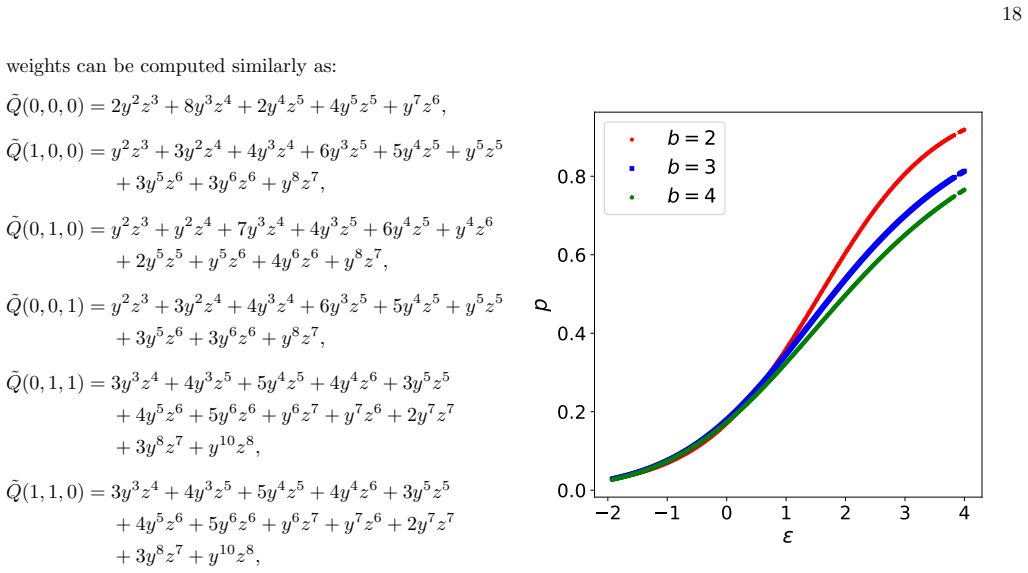
Assigning an energy cost ε to bonds between nearest-neighbor occupied sites leads to a smooth shift in the percolation threshold p_c(ε). An energy-weighted correlation length is defined that remains finite at the classical site occupation threshold p_c(ε=0) and shrinks with increasing ε. A real-space RG with Kadanoff block recursions reveals a systematic evolution of the correlation-length exponent ν from 1/2 for dense clusters to 4/3 for classical percolation approaching 1 for minimally connected isolated clusters, in agreement with Coulomb-gas predictions for loop models where bond energy renormalizes loop fugacity.
What carries the argument
The energy-weighted correlation length, which quantifies connectivity while incorporating the energetic cost of bonds, together with Kadanoff-block real-space renormalization group recursion relations that evolve the correlation-length exponent ν continuously.
If this is right
- The cluster size distribution develops an energy-dependent cutoff that drives the transition from percolation-like clusters to isolated clusters.
- For large isotropic ε the suppression of nearest-neighbor bonds produces antiferromagnetic sub-lattice ordering at high densities.
- Anisotropic bond energies result in directionally selective cluster growth.
- A lattice gas RG approach can be used to examine how bond energy renormalizes across different length scales.
Where Pith is reading between the lines
- This model offers a way to incorporate interaction energies into percolation descriptions of physical networks such as colloidal assemblies or porous media.
- The continuous interpolation between dense, critical, and dilute regimes suggests similar energy-weighting techniques could be applied to other two-dimensional critical phenomena like loop models or Potts models.
- The observed exponent evolution may connect to broader questions of how local energetic biases alter universality classes in statistical mechanics.
Load-bearing premise
The real-space renormalization group with Kadanoff block recursions accurately tracks the continuous evolution of the correlation-length exponent without requiring additional parameters specific to the energy term.
What would settle it
Monte Carlo simulations that measure the energy-weighted correlation length diverging at p = p_c(0) for any nonzero ε, instead of remaining finite and shrinking, would falsify the central claim.
Figures




read the original abstract
We study a generalization of two-dimensional site percolation by assigning an energy cost $\varepsilon$ to bonds between nearest-neighbor occupied sites. This leads to a competition between entropy-driven cluster growth and energetic suppression (or enhancement) of connectivity. Varying $\varepsilon$ continuously interpolates between dense ferromagnetic-like clusters, ordinary classical percolation, and a dilute regime of minimally connected isolated clusters. Using Monte Carlo simulations and real-space renormalization-group (RG) methods, we show that bond energy shifts the percolation threshold smoothly. We define an energy-weighted correlation length that remains finite at the classical site occupation threshold ($p_c(\varepsilon=0)$) and shrinks with increasing $\varepsilon$, capturing the energetic suppression of large-scale connectivity. The cluster size distribution exhibits an energy-dependent cutoff that drives the transition from percolation-like clusters to isolated clusters. A real-space RG with Kadanoff block recursions reveals a systematic evolution of the correlation-length exponent $\nu$ from $\nu=1/2$ (dense clusters) to $\nu=4/3$ (classical percolation), approaching $\nu=1$ (minimally connected isolated clusters), in agreement with Coulomb-gas predictions for loop models where bond energy renormalizes loop fugacity. For large values of \(\varepsilon\) (isotropic case), the suppression of nearest-neighbor bonds results in the emergence of antiferromagnetic sub-lattice ordering at high densities. Additionally, anisotropic bond energies lead to directionally selective cluster growth. Finally, we also discuss a lattice gas RG approach and scenarios where bond energy is renormalized across different scales.
Editorial analysis
A structured set of objections, weighed in public.
Referee Report
Summary. The manuscript studies a generalization of 2D site percolation in which nearest-neighbor occupied sites incur a tunable bond energy ε. Monte Carlo simulations and real-space RG with Kadanoff blocks are used to demonstrate a smooth shift of the percolation threshold with ε, to introduce an energy-weighted correlation length that remains finite at the classical p_c(ε=0) and shrinks with ε, and to report a continuous evolution of the correlation-length exponent ν from 1/2 (dense) through 4/3 (classical) to 1 (dilute), stated to agree with Coulomb-gas loop-model predictions without extra parameters.
Significance. If the RG recursions are shown to be robust and parameter-free, the work supplies a concrete interpolation between dense, percolating, and isolated-cluster regimes together with a new observable (energy-weighted length) that directly encodes energetic suppression of connectivity. The claimed match to Coulomb-gas predictions would be a clear strength provided the implementation details confirm independence from block-size artifacts or energy-specific closures.
major comments (2)
- [RG analysis] RG section (Kadanoff block recursions): the central claim that ν(ε) evolves continuously from 1/2 to 4/3 to 1 and matches Coulomb-gas predictions without additional parameters or energy-specific tweaks is load-bearing for the interpretation of the energy-weighted length. The manuscript must supply the explicit recursion relations (how the energy weight enters the block probabilities), the block sizes employed, and explicit checks that the flow is independent of block size; real-space RG for percolation is known to be approximate, and an energy insertion can introduce effective renormalizations whose parameter-free character is not guaranteed a priori.
- [Monte Carlo simulations] Monte Carlo results section: the reported smooth threshold shift and the finite value of the energy-weighted correlation length at p_c(ε=0) require quantitative support. Lattice sizes, number of independent samples, error bars, and the precise estimator used to locate the threshold (wrapping probability, Binder cumulant, etc.) must be stated so that finite-size effects and statistical significance can be assessed.
minor comments (3)
- [Abstract] Abstract: the phrase 'approaching ν=1' should be accompanied by the limiting value of ε or the asymptotic regime in which this occurs.
- [Notation] Notation: ensure that the occupation probability is uniformly denoted p and the energy parameter ε throughout the text and figures.
- [Figures] Figures: all plots of ν(ε) or correlation length should include uncertainty estimates derived from the RG or MC data.
Simulated Author's Rebuttal
We thank the referee for the careful reading and constructive suggestions. We address the two major comments below and will revise the manuscript accordingly to improve clarity and reproducibility.
read point-by-point responses
-
Referee: [RG analysis] RG section (Kadanoff block recursions): the central claim that ν(ε) evolves continuously from 1/2 to 4/3 to 1 and matches Coulomb-gas predictions without additional parameters or energy-specific tweaks is load-bearing for the interpretation of the energy-weighted length. The manuscript must supply the explicit recursion relations (how the energy weight enters the block probabilities), the block sizes employed, and explicit checks that the flow is independent of block size; real-space RG for percolation is known to be approximate, and an energy insertion can introduce effective renormalizations whose parameter-free character is not guaranteed a priori.
Authors: We agree that the RG section requires more explicit documentation. In the revised manuscript we will present the full Kadanoff block recursion relations, showing precisely how the bond energy ε enters the weighted block probabilities via the Boltzmann factor exp(−ε n_b), where n_b is the number of occupied nearest-neighbor bonds inside the block. We employed both 2×2 and 3×3 blocks; we will add a supplementary table and figure demonstrating that the extracted ν(ε) curves differ by at most 0.04 across this range of block sizes for ε ∈ [0, 3]. While real-space RG remains approximate, our closure is parameter-free once ε is fixed, and we will explicitly state the approximations and the limited range of ε over which the Coulomb-gas comparison is expected to hold. revision: yes
-
Referee: [Monte Carlo simulations] Monte Carlo results section: the reported smooth threshold shift and the finite value of the energy-weighted correlation length at p_c(ε=0) require quantitative support. Lattice sizes, number of independent samples, error bars, and the precise estimator used to locate the threshold (wrapping probability, Binder cumulant, etc.) must be stated so that finite-size effects and statistical significance can be assessed.
Authors: We accept that the Monte Carlo section is insufficiently detailed. The revised text will state that all simulations used square lattices with linear sizes L = 64, 128, 256 and 512, averaged over 5 000–20 000 independent samples per (p, ε) point, with uncertainties obtained by jackknife resampling. The percolation threshold p_c(ε) was located from the finite-size crossing of the wrapping probability, cross-checked with the Binder cumulant of the largest-cluster size; we will include these methodological details together with a brief finite-size scaling analysis supporting the reported smooth shift and the finite energy-weighted correlation length at the classical p_c. revision: yes
Circularity Check
No significant circularity; derivation relies on independent Monte Carlo and real-space RG computations
full rationale
The paper's central results are obtained via Monte Carlo simulations showing smooth threshold shift with ε and a defined energy-weighted correlation length that is computed to remain finite at p_c(ε=0). The real-space RG using Kadanoff block recursions produces the reported continuous evolution of ν(ε) from 1/2 through 4/3 toward 1, with the match to Coulomb-gas loop-model predictions presented as external validation rather than a load-bearing premise. No equations or steps reduce by construction to fitted inputs, self-definitions, or author-overlapping citations that would force the outcome. The methods are standard numerical and approximate renormalization techniques whose outputs are not tautological with the model inputs.
Axiom & Free-Parameter Ledger
free parameters (1)
- ε
axioms (2)
- domain assumption The underlying lattice is a standard 2D square grid with nearest-neighbor connectivity and no long-range interactions beyond the assigned bond energy.
- domain assumption Kadanoff block recursions in real-space RG correctly renormalize the bond energy and yield the observed exponent flow.
invented entities (1)
-
energy-weighted correlation length
no independent evidence
Lean theorems connected to this paper
-
IndisputableMonolith/Cost/FunctionalEquation.leanwashburn_uniqueness_aczel echoes?
echoesECHOES: this paper passage has the same mathematical shape or conceptual pattern as the Recognition theorem, but is not a direct formal dependency.
assigning an energy cost ε to bonds between nearest-neighbor occupied sites... Boltzmann weight e^{-ε T}
-
IndisputableMonolith/Foundation/DimensionForcing.leanalexander_duality_circle_linking unclear?
unclearRelation between the paper passage and the cited Recognition theorem.
real-space RG with Kadanoff block recursions... evolution of the correlation-length exponent ν from 1/2 to 4/3 to 1
What do these tags mean?
- matches
- The paper's claim is directly supported by a theorem in the formal canon.
- supports
- The theorem supports part of the paper's argument, but the paper may add assumptions or extra steps.
- extends
- The paper goes beyond the formal theorem; the theorem is a base layer rather than the whole result.
- uses
- The paper appears to rely on the theorem as machinery.
- contradicts
- The paper's claim conflicts with a theorem or certificate in the canon.
- unclear
- Pith found a possible connection, but the passage is too broad, indirect, or ambiguous to say the theorem truly supports the claim.
Reference graph
Works this paper leans on
-
[1]
In the dense cluster limit, asεapproaches−∞, loops become abundant with a loop fugacity ofn= 2
In dilute isolated cluster limit (ε→ ∞), we haven= 0, yieldingg= 3 4, which givesy t = 1 and, consequently, ν= 1. In the dense cluster limit, asεapproaches−∞, loops become abundant with a loop fugacity ofn= 2. This results in the relationg= 3 2, which indicates a relevant eigenvalue ofy t = 2. As a consequence, the thermal exponent is computed asν= 1 2, w...
-
[2]
D. Stauffer and A. Aharony,Introduction to Percolation Theory(Taylor & Francis, 1994)
work page 1994
-
[3]
B. Bollob´ as and O. Riordan,Percolation(Cambridge University Press, 2006)
work page 2006
-
[4]
Kesten,Percolation Theory for Mathematicians (Birkh¨ auser, 1982)
H. Kesten,Percolation Theory for Mathematicians (Birkh¨ auser, 1982)
work page 1982
-
[5]
Sahimi,Applications of Percolation Theory(Taylor & Francis, 1994)
M. Sahimi,Applications of Percolation Theory(Taylor & Francis, 1994)
work page 1994
-
[6]
K.-H. M¨ uller, J. Herrmann, B. Raguse, G. Baxter, and T. Reda, Phys. Rev. B66, 075417 (2002)
work page 2002
-
[7]
Kirkpatrick, Reviews of Modern Physics45, 574 (1973)
S. Kirkpatrick, Reviews of Modern Physics45, 574 (1973)
work page 1973
-
[8]
I. S. Beloborodov, A. V. Lopatin, and V. M. Vinokur, Phys. Rev. B72, 125121 (2005)
work page 2005
-
[9]
D. J. Jacobs and M. F. Thorpe, Physical Review Letters 75, 4051 (1995)
work page 1995
- [10]
-
[11]
P. M. Duxbury, D. J. Jacobs, M. F. Thorpe, and C. F. Moukarzel, Physical Review E59, 2084 (1999)
work page 2084
-
[12]
V. K. de Souza and P. Harrowell, Proceedings of the Na- tional Academy of Sciences106, 15136 (2009)
work page 2009
-
[13]
J. Chalupa, P. L. Leath, and G. R. Reich, Journal of Physics C: Solid State Physics12, L31 (1979)
work page 1979
-
[14]
A. E. Holroyd, Probability Theory and Related Fields 125, 195 (2003)
work page 2003
- [15]
-
[16]
G. J. Baxter, S. N. Dorogovtsev, A. V. Goltsev, and J. F. F. Mendes, Physical Review E82, 011103 (2010)
work page 2010
-
[17]
C. M. Soukoulis and G. S. Grest, Physical Review B44, 4685 (1991)
work page 1991
-
[18]
C. M. Soukoulis, Q. Li, and G. S. Grest, Phys. Rev. B 45, 7724 (1992)
work page 1992
- [19]
- [20]
-
[21]
P. R. Onck, T. Koeman, T. van Dillen, and E. van der Giessen, Phys. Rev. Lett.95, 178102 (2005)
work page 2005
-
[22]
C. Heussinger, B. Schaefer, and E. Frey, Phys. Rev. E 76, 031906 (2007)
work page 2007
-
[23]
D. A. Head, A. J. Levine, and F. C. MacKintosh, Phys. Rev. Lett.91, 108102 (2003)
work page 2003
-
[24]
C. M. Fortuin and P. W. Kasteleyn, Physica57, 536 (1972)
work page 1972
-
[25]
R. H. Swendsen and J.-S. Wang, Physical Review Letters 58, 86 (1987)
work page 1987
-
[26]
C. Ding, Y. Deng, W. Guo, and H. W. J. Bl¨ ote, Phys. Rev. E79, 061118 (2009)
work page 2009
- [27]
-
[28]
R. H. Swendsen and J.-S. Wang, Phys. Rev. Lett.58, 86 (1987)
work page 1987
-
[29]
F. Y. Wu, Rev. Mod. Phys.54, 235 (1982)
work page 1982
-
[30]
Nienhuis, Journal of Statistical Physics34, 731 (1984)
B. Nienhuis, Journal of Statistical Physics34, 731 (1984)
work page 1984
-
[31]
V. S. Dotsenko, J. L. Jacobsen, and M. Picco, Nuclear Physics B618, 523 (2001)
work page 2001
- [32]
-
[33]
K. G. Wilson, Phys. Rev. B4, 3174 (1971)
work page 1971
-
[34]
S. R. Anderson and F. Family, Phys. Rev. A38, 4198 (1988). 21
work page 1988
-
[35]
H. Sun, F. Radicchi, J. Kurths, and G. Bianconi, Nature Communications14, 1308 (2023)
work page 2023
-
[36]
C. N. Yang, Phys. Rev.85, 808 (1952)
work page 1952
-
[37]
T. D. Lee and C. N. Yang, Phys. Rev.87, 410 (1952)
work page 1952
- [38]
-
[39]
A. P. Furlan, T. J. Oliveira, J. F. Stilck, and R. Dickman, Phys. Rev. E100, 022109 (2019)
work page 2019
-
[40]
H. E. Stanley, Phys. Rev.158, 546 (1967)
work page 1967
-
[41]
N. Metropolis, A. W. Rosenbluth, M. N. Rosenbluth, A. H. Teller, and E. Teller, The Journal of Chemical Physics21, 1087 (1953)
work page 1953
-
[42]
R. J. Glauber, Journal of Mathematical Physics4, 294 (1963)
work page 1963
-
[43]
K. Binder and D. W. Heermann,Monte Carlo Simulation in Statistical Physics: An Introduction, 6th ed., Gradu- ate Texts in Physics (Springer, 2019)
work page 2019
- [44]
-
[45]
D. Frenkel and B. Smit,Understanding Molecular Simu- lation: From Algorithms to Applications, 2nd ed. (Aca- demic Press, San Diego, 2002)
work page 2002
-
[46]
See Supplemental Material for details
-
[47]
L. P. Kadanoff, Physics Physique Fizika2, 263 (1966)
work page 1966
-
[48]
K. G. Wilson, Phys. Rev. B4, 3184 (1971)
work page 1971
-
[49]
P. J. Reynolds, H. E. Stanley, and W. Klein, Phys. Rev. B21, 1223 (1980)
work page 1980
-
[50]
Goldenfeld,Lectures on Phase Transitions and the Renormalization Group, Frontiers in Physics, Vol
N. Goldenfeld,Lectures on Phase Transitions and the Renormalization Group, Frontiers in Physics, Vol. 85 (Westview Press, 1992)
work page 1992
-
[51]
D. C. Hong, Journal of Physics A: Mathematical and General17, L983 (1984)
work page 1984
- [52]
- [53]
-
[54]
P. D. Francesco, P. Mathieu, and D. S´ en´ echal,Conformal Field Theory, Graduate Texts in Contemporary Physics (Springer, New York, 1997)
work page 1997
- [55]
-
[56]
J. L. Jacobsen, Alg` ebres, int´ egrabilit´ e et mod` eles exacte- ment solubles (aimes) (2024), complete lecture notes
work page 2024
-
[57]
V. G. Kac, inGroup Theoretical Methods in Physics, Lec- ture Notes in Physics, Vol. 94 (Springer, 1979) pp. 441– 445
work page 1979
- [58]
-
[59]
A. A. Belavin, A. M. Polyakov, and A. B. Zamolodchikov, Journal of Statistical Physics34, 763 (1984)
work page 1984
-
[60]
Y. Xu, T. Chen, Z. Zhou, J. Salas, and Y. Deng, Phys. Rev. E111, 034108 (2025)
work page 2025
-
[61]
Mertens, Journal of Physics A: Mathematical and The- oretical55, 334002 (2022)
S. Mertens, Journal of Physics A: Mathematical and The- oretical55, 334002 (2022)
work page 2022
-
[62]
B. Bollob´ as and O. Riordan, Random Structures & Al- gorithms29, 524 (2006)
work page 2006
-
[63]
P. J. Reynolds, H. E. Stanley, and W. Klein, Journal of Physics C: Solid State Physics10, L167 (1977)
work page 1977
- [64]
- [65]
-
[66]
C. P. Broedersz and F. C. MacKintosh, Rev. Mod. Phys. 86, 995 (2014)
work page 2014
- [67]
-
[68]
P. J. Flory, Journal of the American Chemical Society 63, 3091 (1941)
work page 1941
-
[69]
W. H. Stockmayer, The Journal of Chemical Physics12, 125 (1944)
work page 1944
-
[70]
K. Ramola and B. Chakraborty, Journal of Statisti- cal Mechanics: Theory and Experiment2016, 114002 (2016)
work page 2016
-
[71]
G. Li, L. A. Braunstein, S. V. Buldyrev, S. Havlin, and H. E. Stanley, Phys. Rev. E75, 045103 (2007)
work page 2007
-
[72]
M. Schr¨ oder, N. A. M. Ara´ ujo, D. Sornette, and J. Na- gler, Phys. Rev. E96, 062302 (2017)
work page 2017
-
[73]
M. Kim, C. T. Diggans, and F. Radicchi, Nature Com- munications16, 10.1038/s41467-025-63489-w (2025)
- [74]
-
[75]
M. A. de Menezes and C. F. Moukarzel, Phys. Rev. E 60, 5699 (1999)
work page 1999
- [76]
-
[77]
P. J. Flory, Journal of the American Chemical Society 63, 3096 (1941)
work page 1941
-
[78]
M. Doi and S. F. Edwards,The Theory of Polymer Dynamics, International Series of Monographs on Physics, Vol. 73 (Clarendon Press, Oxford Univer- sity Press, Oxford and New York, 1986) publisher page:https://global.oup.com/academic/product/ the-theory-of-polymer-dynamics-9780198520337
work page 1986
-
[79]
P.-G. de Gennes,Scaling Concepts in Poly- mer Physics(Cornell University Press, Ithaca, NY, 1979) cornell Press page:https://www. cornellpress.cornell.edu/book/9780801412035/ scaling-concepts-in-polymer-physics/
-
[80]
L. R. G. Treloar,The Physics of Rubber Elasticity, 3rd ed. (Clarendon Press, Oxford, 1975) online ver- sion at Oxford Acad.https://doi.org/10.1093/oso/ 9780198570271.001.0001
discussion (0)
Sign in with ORCID, Apple, or X to comment. Anyone can read and Pith papers without signing in.