Physics Informed Neural Network-based Computational Method for Accelerating Time-Periodic Unsteady CFD Simulations
Pith reviewed 2026-05-19 23:49 UTC · model grok-4.3
The pith
Physics-informed neural network computes time-periodic flows by training over one period instead of simulating transients.
A machine-rendered reading of the paper's core claim, the machinery that carries it, and where it could break.
Core claim
By training the neural network parameters to satisfy the unsteady governing equations only inside one time period, the PINN converges to the correct periodic solution without ever computing the initial transient evolution from arbitrary starting conditions.
What carries the argument
Physics-informed neural network whose loss is evaluated solely over one time period using collocation points and automatic differentiation to enforce the governing equations.
If this is right
- Computational time to reach a periodic flow state drops substantially relative to the transient-to-periodic CFD workflow.
- Accuracy remains comparable to the traditional solver on the 2D heat diffusion and fluid flow verification cases.
- Hyperparameter choices such as collocation point density, network size, and point spacing directly control the tradeoff between speed and error.
- The meshless periodic formulation applies to both pure heat diffusion and incompressible flow problems.
Where Pith is reading between the lines
- The same single-period training strategy could be tested on three-dimensional or turbulent periodic flows to check scalability.
- A hybrid workflow that uses the PINN only for the periodic state and a conventional solver for any initial transients might combine the strengths of both approaches.
- Problems with known analytical periodic solutions would allow direct quantitative checks on whether the network converges to the exact periodic limit.
Load-bearing premise
Optimizing a neural network with physics loss over only one time period is sufficient to recover the true periodic state even though no transient data from initial conditions is provided.
What would settle it
Compare the PINN periodic solution against a reference obtained by running a conventional unsteady simulation for many periods; a clear mismatch in the established periodic regime would falsify the claim.
Figures




read the original abstract
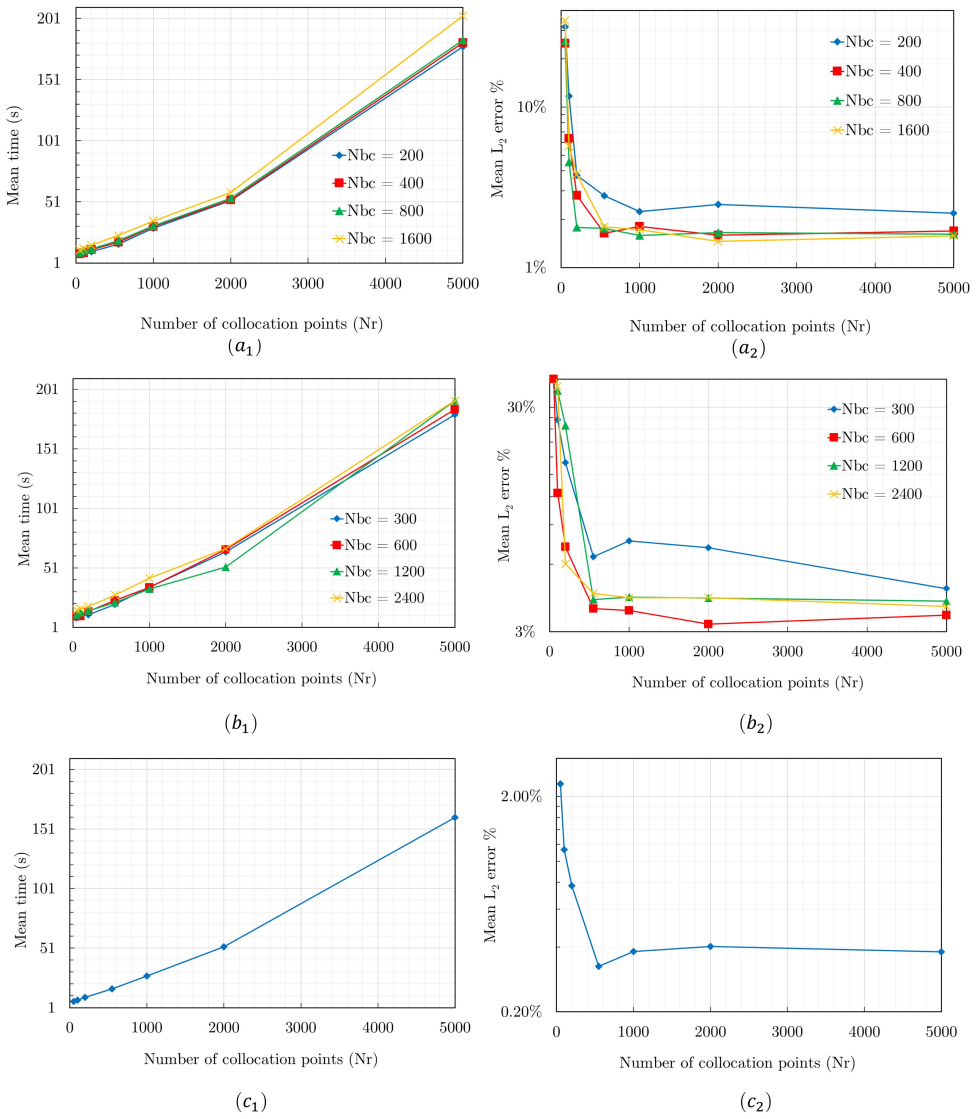
Presently, there is a steady state approach in Computational fluid dynamics (CFD) to obtain a steady solution directly from the steady state governing equations. Whereas, for obtaining a time-periodic flow solution, the present unsteady governing equations-based CFD approach starts from an initial condition and requires a large computational time during the initial non-periodic transient phase before reaching the periodic state. For obtaining the periodic flow directly, without transient simulations that may not be of interest, our objective is to propose a Physics Informed Neural Network (PINN)-based periodic CFD approach. The motivation is a substantial reduction in computational time by a meshless PINN-based periodic CFD solver as compared to the present mesh-based transient-to-periodic solver. Proof-of-concept, for the periodic CFD approach, is demonstrated here for 2D periodic heat diffusion and fluid flow problems. The proposed PINN-based periodic solver primarily focuses on the time-periodic state, optimizing the neural network model's trainable parameters to precisely fit a smaller time window (one time-period) rather than the temporal domain starting from the initial condition. After presenting a verification study, effect of the PINN-related various hyperparameters such as the number of collocation points, neural network architecture, and point spacing for numerical differentiation, on computational time and accuracy are presented. Our results demonstrate that the PINN-based periodic solver takes substantially less computational time to achieve almost same accuracy as that obtained by the traditional transient-to-periodic solver.
Editorial analysis
A structured set of objections, weighed in public.
Referee Report
Summary. The manuscript proposes a Physics-Informed Neural Network (PINN) approach for directly computing time-periodic solutions in unsteady CFD by optimizing the network parameters over a single time period rather than simulating the full transient evolution from initial conditions. Proof-of-concept demonstrations are given for 2D periodic heat diffusion and fluid flow problems, together with studies on the effects of hyperparameters (collocation points, network architecture, differentiation spacing) on runtime and accuracy; the central claim is that the PINN solver achieves substantial computational-time savings while attaining nearly the same accuracy as conventional transient-to-periodic mesh-based solvers.
Significance. If the single-period optimization reliably recovers the physically realized limit-cycle solution, the method could provide a useful meshless route to accelerate periodic-flow computations. The hyperparameter sensitivity analysis supplies practical implementation guidance. However, the absence of quantitative error metrics and uniqueness checks substantially reduces the assessed significance of the reported time-accuracy trade-off.
major comments (3)
- [Abstract] Abstract: the assertion that the PINN solver achieves 'almost same accuracy' as the traditional transient-to-periodic solver is unsupported by any reported quantitative error measures (L2 norms, maximum pointwise errors, or convergence data) or side-by-side comparisons; this quantitative gap is load-bearing for the central time-reduction claim.
- [Fluid flow example] Fluid-flow demonstration: no test is presented showing that the obtained periodic field is independent of neural-network initialization or collocation-point distribution, leaving open the possibility that the optimizer converges to a PDE-satisfying but non-physical periodic state rather than the attractor reached from given initial data.
- [Method] Method section: the physics-informed loss is minimized strictly inside one period [0,T] with no transient history; the manuscript provides neither an analysis of solution uniqueness for the chosen governing equations nor a numerical check that the converged state matches the long-time periodic solution obtained by conventional time-marching.
minor comments (2)
- The abstract would be strengthened by stating the concrete time-reduction factors and the specific 2D test cases employed.
- Notation for the period T, the neural-network parameters, and the collocation-point sets should be introduced consistently before the results are discussed.
Simulated Author's Rebuttal
We thank the referee for the thoughtful and constructive comments on our manuscript. We address each of the major comments below and will make the necessary revisions to improve the clarity and rigor of the presentation.
read point-by-point responses
-
Referee: [Abstract] Abstract: the assertion that the PINN solver achieves 'almost same accuracy' as the traditional transient-to-periodic solver is unsupported by any reported quantitative error measures (L2 norms, maximum pointwise errors, or convergence data) or side-by-side comparisons; this quantitative gap is load-bearing for the central time-reduction claim.
Authors: We agree with the referee that quantitative error metrics are essential to substantiate the accuracy claim. Although the manuscript includes verification studies and hyperparameter analyses, explicit L2 norms and pointwise error comparisons were not tabulated. In the revised manuscript, we will add a dedicated section or table presenting these quantitative measures for both the 2D heat diffusion and fluid flow cases, directly comparing the PINN results to the conventional solver outputs. This will provide concrete support for the 'almost same accuracy' statement. revision: yes
-
Referee: [Fluid flow example] Fluid-flow demonstration: no test is presented showing that the obtained periodic field is independent of neural-network initialization or collocation-point distribution, leaving open the possibility that the optimizer converges to a PDE-satisfying but non-physical periodic state rather than the attractor reached from given initial data.
Authors: This is a valid concern regarding the reliability of the optimization process. To address it, we will perform and report additional numerical experiments in the revision, using multiple random initializations of the network weights and different distributions of collocation points. We will demonstrate that the resulting periodic solutions converge to the same field (within numerical tolerance), consistent with the physical solution obtained via time-marching. This will help confirm that the method recovers the physically realized limit-cycle solution. revision: yes
-
Referee: [Method] Method section: the physics-informed loss is minimized strictly inside one period [0,T] with no transient history; the manuscript provides neither an analysis of solution uniqueness for the chosen governing equations nor a numerical check that the converged state matches the long-time periodic solution obtained by conventional time-marching.
Authors: We acknowledge that a formal uniqueness analysis is not provided in the current version. For the linear heat equation, uniqueness of the periodic solution can be established analytically, while for the nonlinear fluid flow equations, we rely on the physical expectation that the long-time behavior is unique. In the revised manuscript, we will include a direct numerical verification by comparing the PINN solution to the periodic state reached by the traditional transient simulation after many periods. Additionally, we will add a brief discussion on solution uniqueness for these specific problems based on existing literature for periodic flows. revision: partial
Circularity Check
No significant circularity; derivation self-contained via direct PDE residual minimization
full rationale
The paper defines a PINN loss over a single period [0,T] that enforces the unsteady governing equations, boundary conditions, and time-periodicity directly on the network outputs. This construction solves the periodic boundary-value problem rather than fitting to precomputed data or renaming a prior result. Verification against independent transient-to-periodic CFD runs supplies an external benchmark, and no load-bearing step reduces to a self-citation chain, fitted parameter renamed as prediction, or ansatz smuggled from prior author work. The speedup claim rests on measured wall-clock comparisons, not on any definitional equivalence.
Axiom & Free-Parameter Ledger
free parameters (3)
- Number of collocation points
- Neural network architecture
- Point spacing for numerical differentiation
axioms (1)
- domain assumption A neural network can be trained to satisfy the time-periodic governing equations when the loss is evaluated only over one period.
Reference graph
Works this paper leans on
-
[1]
T. Colonius, D. R. Williams, Control of vortex shedding on two- and three-dimensional aerofoils, Philosophical transactions. Series A, Mathematical, physical, and engineering sciences 369 (2011) 1525–1539.doi:10.1098/RSTA.2010.0355. URLhttps://pubmed.ncbi.nlm.nih.gov/21382829/
-
[2]
S. R. Morab, J. S. Murallidharan, A. Sharma, Computational hemodynamics and hemoacoustic study on carotid bifurcation: Effect of stenosis and branch angle, Physics of Fluids 36 (4 2024). doi:10.1063/5.0203193/3281081. URL/aip/pof/article/36/4/041906/3281081/Computational-hemodynamics-and-hemoacoustic-study
-
[3]
M. Mehrabi, S. Setayeshi, Computational fluid dynamics analysis of pulsatile blood flow behavior in modelled stenosed vessels with different severities, Mathematical Problems in Engineering 2012 (2012) 804765.doi:10.1155/2012/804765. URLhttps://onlinelibrary.wiley.com/doi/full/10.1155/2012/804765https: //onlinelibrary.wiley.com/doi/abs/10.1155/2012/804765...
-
[4]
M. McMullen, A. Jameson, J. J. Alonso, Acceleration of convergence to a periodic steady state in turbomachinery flows, 39th Aerospace Sciences Meeting and Exhibit (2001).doi:10.2514/6. 2001-152. URLhttps://arc.aiaa.org/doi/10.2514/6.2001-152
work page doi:10.2514/6 2001
-
[5]
Y. Cao, L. Zhou, C. Ou, H. Fang, D. Liu, 3d cfd simulation and analysis of transient flow in a water pipeline, Aqua Water Infrastructure, Ecosystems and Society 71 (2022) 751–767. doi:10.2166/AQUA.2022.023
-
[6]
D. Xue, Y. Liu, L. Li, Heat transfer performance of wet porous solar collectors under periodic conditions, Heat Transfer 50 (2021) 7440–7453.doi:10.1002/HTJ.22237. URLhttps://onlinelibrary.wiley.com/doi/full/10.1002/htj.22237https:// onlinelibrary.wiley.com/doi/abs/10.1002/htj.22237https://onlinelibrary.wiley. com/doi/10.1002/htj.22237
-
[7]
J. D. Anderson, Computational Fluid Dynamics: The Basic with Application, Vol. 1, McGraw- Hill, 1995. URLhttps://books.google.com/books/about/Computational_Fluid_Dynamics.html?id= dJceAQAAIAAJ
work page 1995
-
[8]
A. Sharma, Introduction to Computational Fluid Dynamics: Development, Application and Anal- ysis, Springer International Publishing, 2021.doi:10.1007/978-3-030-72884-7/COVER
-
[9]
M. R. Pfaller, J. Pham, N. M. Wilson, D. W. Parker, A. L. Marsden, On the periodicity of cardiovascular fluid dynamics simulations, Annals of biomedical engineering 49 (2021) 3574–3592. doi:10.1007/S10439-021-02796-X. URLhttps://pubmed.ncbi.nlm.nih.gov/34169398/
-
[10]
A. A. Johnson, T. E. Tezduyar, J. Liou, Numerical simulation of flows past periodic arrays of cylinders, Computational Mechanics 11 (1993) 371–383.doi:10.1007/BF00350094/METRICS. URLhttps://link.springer.com/article/10.1007/BF00350094
-
[11]
G. Carte, J. Dušek, P. Fraunié, A spectral time discretization for flows with dominant periodicity, Journal of Computational Physics 120 (1995) 171–183.doi:10.1006/JCPH.1995.1157
-
[12]
K. C. Hall, J. P. Thomas, W. S. Clark, Computation of unsteady nonlinear flows in cascades using a harmonic balance technique, https://doi.org/10.2514/2.1754 40 (2012) 879–886.doi: 10.2514/2.1754. URLhttps://arc.aiaa.org/doi/10.2514/2.1754 42
-
[13]
K. Ekici, K. C. Hall, Nonlinear analysis of unsteady flows in multistage turbomachines using harmonic balance, https://doi.org/10.2514/1.22888 45 (2012) 1047–1057.doi:10.2514/1.22888. URLhttps://arc.aiaa.org/doi/10.2514/1.22888
-
[14]
R. Lübke, A. Seidel-Morgenstern, L. Tobiska, Numerical method for accelerated calculation of cyclic steady state of modicon–smb-processes, Computers & Chemical Engineering 31 (2007) 258–267.doi:10.1016/J.COMPCHEMENG.2006.06.013
-
[15]
W. Zhang, G. Xi, C. Zhang, Z. Huang, A high-accuracy temporal–spatial pseudospectral method for time-periodic unsteady fluid flow and heat transfer problems, International Journal of Com- putational Fluid Dynamics 25 (2011) 191–206.doi:10.1080/10618562.2011.575369. URLhttps://www.tandfonline.com/doi/abs/10.1080/10618562.2011.575369
-
[16]
T. Richter, An averaging scheme for the efficient approximation of time-periodic flow problems, Computers & Fluids 214 (2021) 104769.doi:10.1016/J.COMPFLUID.2020.104769
-
[17]
Journal of Computational Physics 378, 686–707
M. Raissi, P. Perdikaris, G. E. Karniadakis, Physics-informed neural networks: A deep learning framework for solving forward and inverse problems involving nonlinear partial differential equa- tions, Journal of Computational Physics 378 (2019) 686–707.doi:10.1016/J.JCP.2018.10.045
-
[18]
M. W. Dissanayake, N. Phan-Thien, Neural-network-based approximations for solving partial differential equations, Communications in Numerical Methods in Engineering 10 (1994) 195–201. doi:10.1002/CNM.1640100303. URLhttps://onlinelibrary.wiley.com/doi/full/10.1002/cnm.1640100303https: //onlinelibrary.wiley.com/doi/abs/10.1002/cnm.1640100303https://onlineli...
-
[19]
S. Shah, N. K. Anand, Physics-informed neural networks for periodic flows, Physics of Fluids 36 (7 2024).doi:10.1063/5.0216266/3303820. URL/aip/pof/article/36/7/073620/3303820/Physics-informed-neural-networks-for-periodic
-
[20]
L. D. McClenny, U. M. Braga-Neto, Self-adaptive physics-informed neural networks, Journal of Computational Physics 474 (2023) 111722.doi:10.1016/J.JCP.2022.111722
-
[21]
S. Wang, X. Yu, P. Perdikaris, When and why pinns fail to train: A neural tangent kernel perspective, Journal of Computational Physics 449 (2022) 110768.doi:10.1016/J.JCP.2021. 110768
-
[22]
S. Wang, H. Wang, P. Perdikaris, On the eigenvector bias of fourier feature networks: From regression to solving multi-scale pdes with physics-informed neural networks, Computer Methods in Applied Mechanics and Engineering 384 (2021) 113938.doi:10.1016/J.CMA.2021.113938
-
[23]
M. A. Nabian, R. J. Gladstone, H. Meidani, Efficient training of physics-informed neural networks via importance sampling, Computer-Aided Civil and Infrastructure Engineering 36 (2021) 962– 977.doi:10.1111/MICE.12685
-
[24]
A. D. Jagtap, Y. Shin, K. Kawaguchi, G. E. Karniadakis, Deep kronecker neural networks: A general framework for neural networks with adaptive activation functions, Neurocomputing 468 (2022) 165–180.doi:10.1016/J.NEUCOM.2021.10.036
-
[25]
A. D. Jagtap, K. Kawaguchi, G. E. Karniadakis, Adaptive activation functions accelerate con- vergence in deep and physics-informed neural networks, Journal of Computational Physics 404 (2020) 109136.doi:10.1016/J.JCP.2019.109136
-
[26]
R. Mattey, S. Ghosh, A novel sequential method to train physics informed neural networks for allen cahn and cahn hilliard equations, Computer Methods in Applied Mechanics and Engineering 390 (2022) 114474.doi:10.1016/J.CMA.2021.114474. 43
-
[27]
C. Wu, M. Zhu, Q. Tan, Y. Kartha, L. Lu, A comprehensive study of non-adaptive and residual- based adaptive sampling for physics-informed neural networks, Computer Methods in Applied Mechanics and Engineering 403 (2023) 115671.doi:10.1016/J.CMA.2022.115671
- [28]
-
[29]
P. H. Chiu, J. C. Wong, C. Ooi, M. H. Dao, Y. S. Ong, Can-pinn: A fast physics-informed neural network based on coupled-automatic–numerical differentiation method, Computer Methods in Applied Mechanics and Engineering 395 (2022) 114909.doi:10.1016/J.CMA.2022.114909
- [30]
-
[31]
X. Chen, R. Chen, Q. Wan, R. Xu, J. Liu, An improved data-free surrogate model for solving partial differential equations using deep neural networks, Scientific Reports 2021 11:1 11 (2021) 1–17.doi:10.1038/s41598-021-99037-x. URLhttps://www.nature.com/articles/s41598-021-99037-x
-
[32]
S. Li, X. Feng, Dynamic weight strategy of physics-informed neural networks for the 2d navier–stokes equations, Entropy 2022, Vol. 24, Page 1254 24 (2022) 1254.doi:10.3390/ E24091254. URLhttps://www.mdpi.com/1099-4300/24/9/1254/htmhttps://www.mdpi.com/1099-4300/ 24/9/1254
work page 2022
-
[33]
L. Lu, R. Pestourie, W. Yao, Z. Wang, F. Verdugo, S. G. Johnson, Physics-informed neural networks with hard constraints for inverse design, SIAM Journal on Scientific Computing 43 (2021) B1105–B1132.doi:10.1137/21M1397908. URLhttps://arxiv.org/abs/2102.04626v1
-
[34]
D. P. Kingma, J. L. Ba, Adam: A method for stochastic optimization, 3rd International Confer- ence on Learning Representations, ICLR 2015 - Conference Track Proceedings (12 2014). URLhttps://arxiv.org/abs/1412.6980v9
work page internal anchor Pith review Pith/arXiv arXiv 2015
-
[35]
URLhttps://www.tensorflow.org/api_docs/python/tf/keras/optimizers/Adam
tf.keras.optimizers.adam | tensorflow v2.16.1. URLhttps://www.tensorflow.org/api_docs/python/tf/keras/optimizers/Adam
- [36]
-
[37]
N. Sukumar, A. Srivastava, Exact imposition of boundary conditions with distance functions in physics-informed deep neural networks, Computer Methods in Applied Mechanics and Engineer- ing 389 (2022) 114333.doi:10.1016/J.CMA.2021.114333. URLhttps://www.sciencedirect.com/science/article/pii/S0045782521006186
-
[38]
U. Ghia, K. N. Ghia, C. T. Shin, High-re solutions for incompressible flow using the navier- stokes equations and a multigrid method, Journal of Computational Physics 48 (1982) 387–411. doi:10.1016/0021-9991(82)90058-4. URLhttps://doi.org/10.2514/3.61116
- [39]
-
[40]
R. Shepherd, R. J. Wiltshire, A periodic solution to a nonlinear diffusion equation, Transport in Porous Media 15 (1994) 175–182.doi:10.1007/BF00625515/METRICS. URLhttps://link.springer.com/article/10.1007/BF00625515 44
-
[41]
J. A. Diez, J. Gratton, F. Minotti, Self-similar solutions of the second kind of nonlinear diffusion- type equations, Quarterly of Applied Mathematics 50 (1992) 401–414.doi:10.1090/QAM/ 1178424
-
[42]
C. A. Putra, P. S. Palar, R. Stevenson, L. R. Zuhal, On physics-informed deep learning for solving navier-stokes equations, AIAA Science and Technology Forum and Exposition, AIAA SciTech Forum 2022 (2022).doi:10.2514/6.2022-1436
-
[43]
S. Cai, Z. Wang, S. Wang, P. Perdikaris, G. E. Karniadakis, Physics-informed neural networks for heat transfer problems, Journal of Heat Transfer 143 (6 2021).doi:10.1115/1.4050542/ 1104439. URLhttps://dx.doi.org/10.1115/1.4050542
-
[44]
S. Goraya, N. Sobh, A. Masud, Error estimates and physics informed augmentation of neural networks for thermally coupled incompressible navier stokes equations, Computational Mechanics 72 (2023) 267–289.doi:10.1007/S00466-023-02334-7/FIGURES/29. URLhttps://link.springer.com/article/10.1007/s00466-023-02334-7
-
[45]
Z. Xing, H. Cheng, J. Cheng, Deep learning method based on physics-informed neural network for 3d anisotropic steady-state heat conduction problems, Mathematics 2023, Vol. 11, Page 4049 11 (2023) 4049.doi:10.3390/MATH11194049. URLhttps://www.mdpi.com/2227-7390/11/19/4049/htmhttps://www.mdpi.com/ 2227-7390/11/19/4049
-
[46]
H. S. Carslaw, J. J. C. Jaeger, Conduction of heat in solids. 2nde edition, edition anglaise (1986) 510. URLhttps://books.google.com/books/about/Conduction_of_Heat_in_Solids.html?id= y20sAAAAYAAJ 45
work page 1986
discussion (0)
Sign in with ORCID, Apple, or X to comment. Anyone can read and Pith papers without signing in.