Reduced-State Stabilizer R\'enyi Entropy as a Probe of Quantum Criticality in the Transverse ANNNI Model and the Quantum Compass Model
Pith reviewed 2026-05-20 11:14 UTC · model grok-4.3
The pith
The purity-corrected stabilizer Rényi entropy of reduced density matrices detects quantum phase transitions in the transverse ANNNI and quantum compass models.
A machine-rendered reading of the paper's core claim, the machinery that carries it, and where it could break.
Core claim
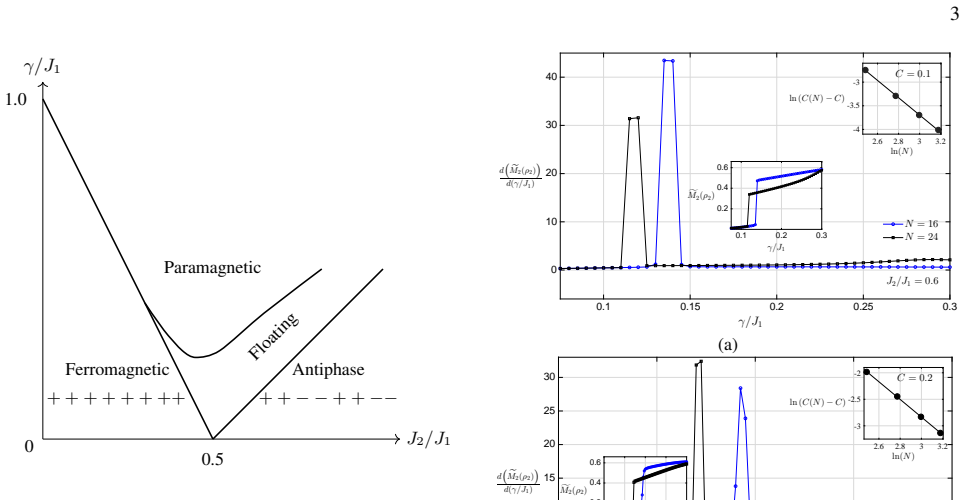
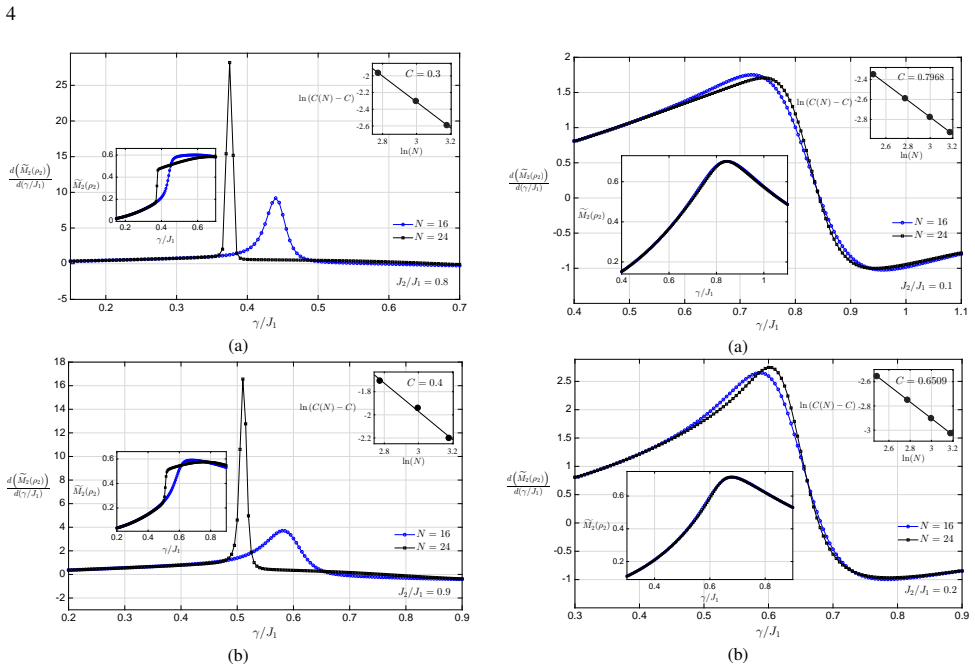
We investigate the effectiveness of the stabilizer Rényi entropy as an indicator of quantum phase transitions by examining the purity-corrected version applied to reduced density matrices of the ground states. In the transverse axial next-nearest-neighbor Ising model this quantity detects the antiphase-floating transition in the high-frustration regime, while the raw version reproduces the ferromagnetic-paramagnetic boundaries more accurately in the low-frustration regime. In the quantum compass model the purity-corrected entropy exhibits a clear signature near the isotropic point where the system undergoes a first-order transition. These results establish the stabilizer Rényi entropy of the
What carries the argument
the purity-corrected stabilizer Rényi entropy of reduced density matrices, which measures non-stabilizer resources within a subsystem and tracks how that quantity varies with model parameters to locate critical points
If this is right
- The purity-corrected SRE locates the antiphase-floating transition in the high-frustration regime of the TANNNI model.
- The raw SRE reproduces the ferromagnetic-paramagnetic phase boundaries in the low-frustration regime of the TANNNI model.
- The purity-corrected SRE produces a distinct signature at the isotropic point of the quantum compass model.
- The SRE of reduced states supplies a complementary indicator of quantum criticality and highlights the participation of non-stabilizer resources in many-body phase transitions.
Where Pith is reading between the lines
- The same reduced-state construction could be applied to other frustrated or compass-type Hamiltonians to test whether the detection of transitions remains reliable.
- If the SRE signature persists under time evolution, it might link non-stabilizer resources to dynamical critical phenomena as well.
- Direct comparison of the SRE behavior with other quantifiers of magic could clarify whether the reduced-state version captures a unique aspect of the transition.
Load-bearing premise
The assumption that changes in the purity-corrected SRE are caused by the underlying quantum phase transition rather than by finite-size effects or by the specific choice of subsystem size and purity correction procedure.
What would settle it
If the purity-corrected SRE remains smooth and featureless across the known critical values of the coupling parameters when the system size is increased well beyond current exact-diagonalization limits, the claim that it serves as a probe would be falsified.
Figures




read the original abstract
We investigate the effectiveness of the stabilizer R\'enyi entropy (SRE), a quantifier associated with non-stabilizer resources (quantum magic), as an indicator of quantum phase transitions. Specifically, we analyze the behavior of the purity-corrected SRE of reduced density matrices in the ground states of two one-dimensional spin models: the transverse axial next-nearest-neighbor Ising (TANNNI) model and the quantum compass model (QCM). The ground state of the TANNNI model is obtained using exact diagonalization techniques, while the QCM is analyzed using the Jordan--Wigner (JW) transformation followed by Bogoliubov diagonalization of the resulting quadratic fermionic Hamiltonian. For the TANNNI model, the purity-corrected SRE successfully detects the antiphase--floating phase transition in the high-frustration regime, while in the low-frustration regime the raw (purity-uncorrected) SRE reproduces the known ferromagnetic--paramagnetic phase boundaries more accurately. For the QCM, the purity-corrected SRE exhibits a clear signature near the isotropic point \(J_x/J_z=1\), where the system undergoes a first-order quantum phase transition. Our results establish SRE of reduced states as a complementary probe of quantum criticality and provide further insight into the role of non-stabilizer resources in many-body quantum phase transitions.
Editorial analysis
A structured set of objections, weighed in public.
Referee Report
Summary. The paper examines the stabilizer Rényi entropy (SRE) of reduced density matrices, with and without purity correction, as a diagnostic for quantum phase transitions in the transverse axial next-nearest-neighbor Ising (TANNNI) model and the quantum compass model (QCM). Ground states of the TANNNI model are obtained via exact diagonalization; the QCM is solved exactly via Jordan-Wigner transformation followed by Bogoliubov diagonalization. The authors report that purity-corrected SRE detects the antiphase-floating transition in the high-frustration regime of TANNNI, while raw SRE better reproduces the ferromagnetic-paramagnetic boundary at low frustration; in the QCM a clear signature appears at the isotropic point Jx/Jz = 1 marking the first-order transition.
Significance. If the reported SRE signatures prove robust under finite-size scaling and independent of subsystem partition, the work would supply a concrete numerical example linking non-stabilizer resources to quantum criticality and could motivate further analytic or tensor-network studies of magic as an order parameter. The exact solvability of the QCM provides a useful benchmark, while the TANNNI results illustrate regime-dependent utility of the purity correction.
major comments (2)
- [TANNNI results] TANNNI results (exact-diagonalization section): the manuscript presents SRE data only for small finite L without any finite-size scaling, data collapse, or extrapolation to the thermodynamic limit. Because the claimed detection of the antiphase-floating transition rests on these finite-L signatures, the absence of scaling analysis leaves open the possibility that the observed features are finite-size artifacts rather than universal indicators of the transition.
- [QCM results] QCM results (exact-solution section): the reduced-state SRE is computed for a specific subsystem partition whose size and location are not varied. No demonstration is given that the signature at Jx/Jz = 1 survives changes in subsystem size or is independent of the chosen cut, which is required to establish that the feature is a property of the phase transition rather than of the particular reduced-state choice.
minor comments (2)
- [Notation] Notation for the purity-corrected SRE should be defined once in the methods section and used consistently; the abstract and main text occasionally switch between “purity-corrected SRE” and “corrected SRE” without cross-reference.
- [Figures] Figure captions for the TANNNI SRE plots should explicitly state the system sizes L employed and whether open or periodic boundaries were used.
Simulated Author's Rebuttal
We thank the referee for the careful reading of our manuscript and the constructive comments. We address each major point below, indicating where revisions will be made to improve the presentation and robustness of our results.
read point-by-point responses
-
Referee: [TANNNI results] TANNNI results (exact-diagonalization section): the manuscript presents SRE data only for small finite L without any finite-size scaling, data collapse, or extrapolation to the thermodynamic limit. Because the claimed detection of the antiphase-floating transition rests on these finite-L signatures, the absence of scaling analysis leaves open the possibility that the observed features are finite-size artifacts rather than universal indicators of the transition.
Authors: We agree that finite-size scaling analysis would strengthen the claim that the SRE signatures reflect the antiphase-floating transition rather than finite-size effects. Our TANNNI results rely on exact diagonalization, which limits us to modest system sizes (L up to 12–16). In the revised manuscript we will add data for several values of L, track the location and height of the SRE features as functions of L, and include a brief extrapolation or convergence discussion toward the thermodynamic limit. Full data collapse may remain limited by the accessible sizes, but the added analysis will clarify the robustness of the reported detection. revision: yes
-
Referee: [QCM results] QCM results (exact-solution section): the reduced-state SRE is computed for a specific subsystem partition whose size and location are not varied. No demonstration is given that the signature at Jx/Jz = 1 survives changes in subsystem size or is independent of the chosen cut, which is required to establish that the feature is a property of the phase transition rather than of the particular reduced-state choice.
Authors: We thank the referee for highlighting this point. Because the QCM is solved exactly via the Jordan–Wigner transformation, the reduced SRE can be recomputed for arbitrary subsystem sizes and locations without additional numerical cost. In the revised manuscript we will present results for several contiguous and non-contiguous partitions (varying both the number of sites and their position along the chain) and show that the discontinuity or peak at Jx/Jz = 1 remains stable, thereby confirming that the signature is tied to the first-order transition rather than to the specific cut chosen. revision: yes
Circularity Check
No significant circularity; numerical probe compares SRE to external phase boundaries
full rationale
The paper computes the purity-corrected stabilizer Rényi entropy of reduced density matrices for ground states obtained via exact diagonalization (TANNNI) and Jordan-Wigner plus Bogoliubov diagonalization (QCM). These are direct numerical evaluations of a defined quantity on model Hamiltonians whose phase boundaries are taken from prior independent literature. No equation reduces a claimed prediction to a fitted parameter inside the paper, no self-citation supplies a load-bearing uniqueness theorem, and no ansatz is smuggled via prior work by the same authors. The study is therefore self-contained against external benchmarks and receives the default low-circularity finding.
Axiom & Free-Parameter Ledger
axioms (1)
- domain assumption Ground states of the TANNNI and QCM Hamiltonians are accurately obtained by exact diagonalization and Jordan-Wigner plus Bogoliubov diagonalization respectively.
Lean theorems connected to this paper
-
IndisputableMonolith/Foundation/RealityFromDistinction.leanreality_from_one_distinction unclear?
unclearRelation between the paper passage and the cited Recognition theorem.
For the TANNNI model... purity-corrected SRE successfully detects the antiphase–floating phase transition
What do these tags mean?
- matches
- The paper's claim is directly supported by a theorem in the formal canon.
- supports
- The theorem supports part of the paper's argument, but the paper may add assumptions or extra steps.
- extends
- The paper goes beyond the formal theorem; the theorem is a base layer rather than the whole result.
- uses
- The paper appears to rely on the theorem as machinery.
- contradicts
- The paper's claim conflicts with a theorem or certificate in the canon.
- unclear
- Pith found a possible connection, but the passage is too broad, indirect, or ambiguous to say the theorem truly supports the claim.
Reference graph
Works this paper leans on
-
[1]
and Eq. (3) runs over all 4n elements of the n-qubit Pauli group, which leads to exponential computational complexity as the system size increases. This exponential scaling makes the direct eval- uation of SRE for large many-body systems numerically challenging. Recently, an exact algorithm capable of com- puting SRE for systems up to approximately 20 qub...
-
[2]
We plot purity corrected SRE ( ˜M2) varying the transverse field γ/J 1 keeping J2/J 1 = 0
5 and γ/J 1 = 0 . We plot purity corrected SRE ( ˜M2) varying the transverse field γ/J 1 keeping J2/J 1 = 0 . 5 in Fig. 2. We observe that the variation of ˜M2 is mirror sym- metric about the critical point γ/J 1 = 0 and displays a dip at the same critical point. Therefore, the variation of ˜M2 signals the underlying phase transition. In the higher frustra...
-
[3]
From this comparison, we observe that in the region 0. 4 < J 2/J 1 < 0. 5, the critical transition points extracted from ˜M2 lie very close to the established quantum phase transition points. In the intermediate regime 0. 1 < J 2/J 1 < 0. 4, the ˜M2 tran- sition points show noticeable deviations from the known phase boundary, while in the very low-frustra...
-
[4]
5 it aligns well with the antiphase–floating phase boundary. In contrast, the transition points obtained from the raw M2 are found to agree with the known quantum phase boundaries in bot h the low- and high-frustration regimes. γ/J1 0.7 0.8 0.9 1 1.1 1.2 d ( ˜M2(ρ2) ) d(γ/J1) -1 -0.5 0 0.5 1 1.5 N = 12, exact diagonalization. N = 400, JW and Fourier transf...
-
[5]
5, however, the transition points obtained from the purity-corrected SRE do not coincide with the known ferromagnetic–paramagnetic phase boundary. Interest- ingly, the transitions obtained from the raw (purity- uncorrected) SRE agree well with the known quantum crit- ical points in this regime. Since the mixedness of the re- duced density matrices origina...
work page 2021
-
[6]
Sachdev, Quantum Phase Transitions, 2nd ed
S. Sachdev, Quantum Phase Transitions, 2nd ed. (Cam- bridge University Press, 2011)
work page 2011
-
[7]
V ojta, Quantum phase transitions, Reports on Progress in Physics 66, 2069 (2003)
M. V ojta, Quantum phase transitions, Reports on Progress in Physics 66, 2069 (2003)
work page 2069
-
[9]
T. J. Osborne and M. A. Nielsen, Entanglement in a simple quantum phase transition, Phys. Rev. A 66, 032110 (2002)
work page 2002
-
[10]
A. Osterloh, L. Amico, G. Falci, and R. Fazio, Scal- ing of entanglement close to a quantum phase transition, Nature 416, 608 (2002)
work page 2002
- [11]
- [12]
- [13]
-
[14]
L.-A. Wu, M. S. Sarandy, and D. A. Lidar, Quan- tum phase transitions and bipartite entanglement, Phys. Rev. Lett. 93, 250404 (2004)
work page 2004
- [15]
- [16]
-
[17]
G. Biswas and A. Biswas, Entanglement in first excited states of some many-body quantum spin systems: indi- cation of quantum phase transition in finite size systems, Physica Scripta 96, 025003 (2020)
work page 2020
- [18]
-
[19]
Dillenschneider, Quantum discord and quantum phase transition in spin chains, Phys
R. Dillenschneider, Quantum discord and quantum phase transition in spin chains, Phys. Rev. B 78, 224413 (2008)
work page 2008
-
[20]
M. S. Sarandy, Classical correlation and quantum discord in critical systems, Phys. Rev. A 80, 022108 (2009)
work page 2009
-
[21]
Y .-C. Li and H.-Q. Lin, Quantum coherence and quantum phase transitions, Scientific Reports 6, 26365 (2016)
work page 2016
-
[22]
Y . C. Li, J. Zhang, and H.-Q. Lin, Quantum co- herence spectrum and quantum phase transitions, Phys. Rev. B 101, 115142 (2020)
work page 2020
-
[23]
M.-M. Du, A. S. Khan, Z.-Y . Zhou, and D.- J. Zhang, Correlation-induced coherence and its use in detecting quantum phase transitions, Science China Physics, Mechanics & Astronomy 65, 100311 (2022)
work page 2022
- [24]
-
[25]
H.-L. Huang, Z.-Y . Sun, and B. Wang, Bell-chsh function approach to quantum phase transitions in matrix product systems, The European Physical Journal B 86, 279 (2013)
work page 2013
- [26]
-
[27]
Z.-Y . Sun, S. Liu, H.-L. Huang, D. Zhang, Y .-Y . Wu, J. Xu, B.-F. Zhan, H.-G. Cheng, C.-B. Duan, and B. Wang, Multipartite quantum nonlocality and bell- type inequalities in an infinite-order quantum phase transition of the one-dimensional spin-1/2 xxz chain, Phys. Rev. A 90, 062129 (2014)
work page 2014
- [28]
-
[29]
B.-L. Ye, B. Li, X.-B. Liang, and S.-M. Fei, Local quan- tum fisher information and one-way quantum deficit in spin-1/2 xx heisenberg chain with three-spin interaction, International Journal of Quantum Information 18, 2050016 (2020) , https://doi.org/10.1142/S0219749920500161
-
[30]
X.-D. Tan, Y . Shi, and R. Hou, Local quantum fisher in- formation and quantum phase transitions in the xy spin-1/2 chain, Quantum Information Processing 24, 108 (2025)
work page 2025
-
[31]
V . V eitch, S. A. Hamed Mousavian, D. Gottesman, and J. Emerson, The resource theory of stabilizer quantum com- putation, New Journal of Physics 16, 013009 (2014)
work page 2014
-
[32]
M. Howard and E. Campbell, Application of a resource the- ory for magic states to fault-tolerant quantum computing, Phys. Rev. Lett. 118, 090501 (2017)
work page 2017
-
[33]
Gottesman, Stabilizer codes and quantum error correc- tion, Ph.D
D. Gottesman, Stabilizer codes and quantum error correc- tion, Ph.D. thesis, Pasadena, California (1997)
work page 1997
-
[34]
D. Gottesman, The Heisenberg representation of quantum computers, in Group 22: Proceedings of the 12th In- ternational Colloquium on Group Theoretical Methods in Physics, edited by S. P . Corney, R. Delbourgo, and P . D. Jarvis (International Press of Boston, Cambridge, Mas- sachusetts, 1999) pp. 32–43
work page 1999
-
[35]
S. Aaronson and D. Gottesman, Improved simulation of sta- bilizer circuits, Physical Review A 70, 052328 (2004)
work page 2004
-
[36]
S. Bravyi and D. Gosset, Improved classical simula- tion of quantum circuits dominated by Clifford gates, Physical Review Letters 116, 250501 (2016)
work page 2016
-
[37]
J. A. Bergou, M. Hillery, and M. Saffman, Quantum Information Processing: Theory and Implementatio n (Springer, Cham, Switzerland, 2021)
work page 2021
-
[38]
G. Biswas, On classical simulation of quantum circuits composed of clifford gates, Quanta 13, 20–27 (2024)
work page 2024
- [39]
-
[40]
M. Heinrich and D. Gross, Robustness of Magic and Sym- metries of the Stabiliser Polytope, Quantum 3, 132 (2019)
work page 2019
-
[41]
J. R. Seddon and E. T. Campbell, Quan- tifying magic for multi-qubit operations, Proceedings of the Royal Society A: Mathematical, Physical and Engineering Sciences 475, 20190251 (2019) , https://royalsocietypublishing.org/rspa/article-pdf/doi/10.1098/rspa.2019.0251/1221292/rspa.2019.0251.pdf
work page doi:10.1098/rspa.2019.0251/1221292/rspa.2019.0251.pdf 2019
-
[42]
X. Wang, M. M. Wilde, and Y . Su, Efficiently computable bounds for magic state distillation, Phys. Rev. Lett. 124, 090505 (2020)
work page 2020
-
[43]
J. R. Seddon, B. Regula, H. Pashayan, Y . Ouyang, and E. T. Campbell, Quantifying quantum speedups: Im- proved classical simulation from tighter magic monotones, PRX Quantum 2, 010345 (2021)
work page 2021
- [44]
-
[45]
H. Dai, S. Fu, and S. Luo, Detecting magic states via characteristic functions, International Journal of Theoretical Physics 61, 35 (2022)
work page 2022
- [46]
-
[47]
T. Haug and L. Piroli, Stabilizer entropies and nonstabiliz - erness monotones, Quantum 7, 1092 (2023)
work page 2023
-
[48]
L. Leone and L. Bittel, Stabilizer entropies are monotones for magic-state resource theory, Phys. Rev. A 110, L040403 (2024)
work page 2024
-
[49]
Vidal, Efficient classical simulation of slightly entang led quantum computations, Phys
G. Vidal, Efficient classical simulation of slightly entang led quantum computations, Phys. Rev. Lett. 91, 147902 (2003)
work page 2003
-
[50]
Entanglement and tensor network states
J. Eisert, Entanglement and tensor network states (2013), arXiv:1308.3318 [quant-ph]
work page internal anchor Pith review Pith/arXiv arXiv 2013
- [51]
-
[52]
N. de Silva, M. Yin, and S. Strelchuk, Bases for optimising stabiliser decompositions of quantum states, Quantum Science and Technology 9, 045004 (2024)
work page 2024
-
[53]
V . Mittal and Y .-P . Huang, Quantum magic in discrete-time quantum walk, Phys. Rev. Res. 8, 013124 (2026)
work page 2026
-
[54]
P . S. Tarabunga and T. Haug, Efficient mutual magic and magic capacity with matrix product states, SciPost Phys. 19, 085 (2025)
work page 2025
-
[55]
X. Huang, H.-Z. Li, and J.-X. Zhong, A fast and exact approach for stabilizer r´ enyi entropy via the xor-fwht algorithm (2026), arXiv:2512.24685 [quant-ph]
-
[56]
G. Lami and M. Collura, Nonstabilizerness via perfect pauli sampling of matrix product states, Phys. Rev. Lett. 131, 180401 (2023)
work page 2023
-
[57]
S. Fu, X. Li, and S. Luo, Detecting quantum phase transition via magic resource in the xy spin model, Phys. Rev. A 106, 062405 (2022)
work page 2022
-
[58]
Y .-M. Ding, Z. Wang, and Z. Yan, Evaluating many- body stabilizer r´ enyi entropy by sampling reduced pauli strings: Singularities, volume law, and nonlocal magic, PRX Quantum 6, 030328 (2025)
work page 2025
- [59]
- [60]
-
[61]
C. M. Arizmendi, A. H. Rizzo, L. N. Epele, and C. A. Garc´ ıa Canal, Phase diagram of the annni model in the hamiltonian limit, Zeitschrift f¨ ur Physik B Condensed Matter83, 273 (1991)
work page 1991
-
[62]
P . Sen, Order disorder transitions in ising models in transverse fields with second neighbour interactions, Zeitschrift f¨ ur Physik B Condensed Matter98, 251 (1995)
work page 1995
-
[63]
H. Rieger and G. Uimin, The one-dimensional ANNNI model in a transverse field: analytic and numerical study of effective Hamiltonians, Zeitschrift fur Physik B Condensed Matter 101, 597 (1996) , arXiv:cond-mat/9604051 [cond-mat]
work page internal anchor Pith review Pith/arXiv arXiv 1996
-
[64]
H. Rieger and G. Uimin, The one-dimensional annni model in a transverse field: analytic and numerical study of effective hamiltonians, Zeitschrift f¨ ur Physik B Condensed Matter101, 597 (1996)
work page 1996
-
[65]
A. Dutta and D. Sen, Gapless line for the anisotropic heisenberg spin − 1 2 chain in a magnetic field and the quantum axial next-nearest-neighbor ising chain, Phys. Rev. B 67, 094435 (2003)
work page 2003
-
[66]
A. K. Chandra and S. Dasgupta, Floating phase in the one- dimensional transverse axial next-nearest-neighbor isin g model, Phys. Rev. E 75, 021105 (2007)
work page 2007
-
[67]
A. Nagy, Exploring phase transitions by finite- entanglement scaling of mps in the 1d annni model, 12 New Journal of Physics 13, 023015 (2011)
work page 2011
-
[68]
E. Lieb, T. Schultz, and D. Mattis, Two sol- uble models of an antiferromagnetic chain, in Condensed Matter Physics and Exactly Soluble Models: Selec ta of Elliott H. Lieb , edited by B. Nachtergaele, J. P . Solovej, and J. Yngvason (Springer Berlin Heidelberg, Berlin, Heidelberg, 2004) pp . 543–601
work page 2004
-
[69]
K. I. Kugel’ and D. I. Khomskii, The jahn-teller effect and magnetism: transition metal compounds, Phys. Usp. 25, 231 (1982)
work page 1982
-
[70]
Z. Nussinov and J. van den Brink, Compass models: Theory and physical motivations, Rev. Mod. Phys. 87, 1 (2015)
work page 2015
-
[71]
W. Brzezicki, J. Dziarmaga, and A. M. Ole´ s, Quantum phase transition in the one-dimensional compass model, Phys. Rev. B 75, 134415 (2007)
work page 2007
-
[72]
E. Eriksson and H. Johannesson, Multicriticality and entan - glement in the one-dimensional quantum compass model, Phys. Rev. B 79, 224424 (2009)
work page 2009
-
[73]
M. Heyl, Dynamical quantum phase transitions: a review, Reports on Progress in Physics 81, 054001 (2018)
work page 2018
-
[74]
I. Peschel and V . Eisler, Reduced density matri- ces and entanglement entropy in free lattice models, Journal of Physics A: Mathematical and Theoretical 42, 504003 (2009)
work page 2009
-
[75]
I. Peschel, Calculation of reduced den- sity matrices from correlation functions, Journal of Physics A: Mathematical and General 36, L205 (2003)
work page 2003
-
[76]
J. I. Latorre, E. Rico, and G. Vidal, Ground state entanglement in quantum spin chains, Quantum Info. Comput. 4, 48–92 (2004)
work page 2004
discussion (0)
Sign in with ORCID, Apple, or X to comment. Anyone can read and Pith papers without signing in.