Probing (sub-)solar-mass black holes and superspinars with current and next-generation gravitational-wave observatories
Pith reviewed 2026-05-20 09:00 UTC · model grok-4.3
The pith
Third-generation gravitational-wave detectors can measure the spins of sub-solar-mass compact objects to 10^{-4}--10^{-3} precision.
A machine-rendered reading of the paper's core claim, the machinery that carries it, and where it could break.
Core claim
The central claim is that third-generation observatories achieve spin-parameter uncertainties of order 10^{-4} to 10^{-3} for these low-mass systems at signal-to-noise ratios of 100--350, thereby enabling clear observational discrimination between near-extremal black holes and superspinars in the mass range 0.1--2 solar masses.
What carries the argument
The frequency-domain post-Newtonian inspiral waveform TaylorF2 truncated at the innermost stable circular orbit, which is used both to generate simulated signals and to perform Fisher-matrix or similar parameter estimation for mass and spin.
If this is right
- Third-generation detectors extend the observable mass range for these binaries and deliver substantially higher signal-to-noise ratios than current instruments.
- Spin precision at the level of 10^{-4}--10^{-3} would observationally separate objects with dimensionless spin at or below 1 from those with spin greater than 1.
- The longer inspiral phase captured by improved low-frequency sensitivity supplies many more gravitational-wave cycles and therefore tighter constraints on all binary parameters.
- Detection of such systems would directly constrain the existence and abundance of sub-solar-mass compact objects from primordial or exotic channels.
Where Pith is reading between the lines
- If superspinars are ruled out at the quoted precision, the result would tighten limits on the maximum rotation rate allowed by general relativity for horizonless objects.
- The same truncation-at-ISCO strategy could be applied to other waveform families or to full inspiral-merger-ringdown models once they become available for superspinars.
- Population studies that combine these spin measurements with mass distributions could distinguish primordial formation from high-energy production mechanisms.
Load-bearing premise
The gravitational-wave signals from superspinars can be adequately described by the standard TaylorF2 inspiral waveform truncated at the ISCO without extra modifications arising from their exotic properties.
What would settle it
An actual detection of a sub-solar-mass binary whose recovered primary spin exceeds 1 at more than a few standard deviations, or a failure to reach the quoted spin precision when real data from Einstein Telescope or Cosmic Explorer are analyzed with the same waveform model.
Figures


read the original abstract
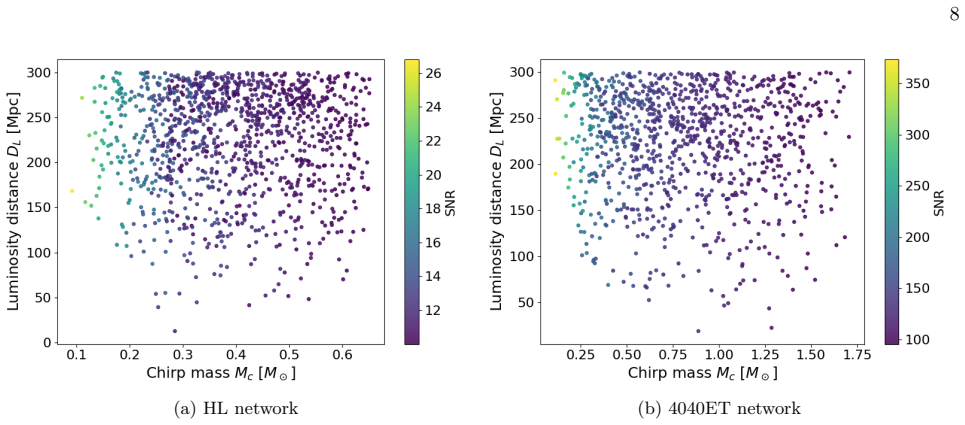
Gravitational-wave observations provide a powerful probe of compact objects and strong-field gravity. In this work, we investigate the detectability of binaries containing (sub-)solar-mass black holes and superspinars with current and next-generation gravitational-wave observatories. Such objects may arise from primordial formation channels or from more exotic high-energy scenarios, and their detection would provide important insights into the population of low-mass compact objects and the physics of extreme gravitational fields. We model the gravitational-wave signals using the frequency-domain post-Newtonian inspiral waveform model TaylorF2, and truncate the signal at the innermost stable circular orbit (ISCO) to avoid contamination from the post-inspiral regime. We assess the observability of these systems using the sensitivities of current detectors such as Advanced LIGO and upcoming third-generation observatories including the Einstein Telescope and Cosmic Explorer. Our results show that while current detectors have limited reach for very low-mass binaries, third-generation observatories can enhance both detection capability and parameter-estimation precision. Their improved strain sensitivity and extended low-frequency coverage allow these observatories to track the inspiral phase over a substantially larger number of gravitational-wave cycles. As a result, they achieve considerably higher signal-to-noise ratios and provide dramatically improved constraints on binary parameters. In particular, it is possible to measure the primary spin parameter with precision $\Delta \chi_{1z}~\sim~10^{-4}-10^{-3}$, potentially allowing clear observational discrimination between near-extremal black holes and superspinars in the mass range $0.1~M_\odot-2~M_\odot$ and with signal-to-noise ratio of $\sim 100-350$.
Editorial analysis
A structured set of objections, weighed in public.
Referee Report
Summary. The paper investigates the detectability of (sub-)solar-mass black holes and superspinars in binaries using current (Advanced LIGO) and next-generation (Einstein Telescope, Cosmic Explorer) gravitational-wave detectors. It models signals with the TaylorF2 post-Newtonian inspiral waveform truncated at the ISCO, computes SNRs and Fisher-matrix parameter uncertainties, and claims that third-generation detectors can achieve primary spin precisions Δχ_{1z} ∼ 10^{-4}–10^{-3} for masses 0.1–2 M_⊙ at SNR ∼100–350, enabling observational discrimination between near-extremal Kerr black holes and superspinars.
Significance. If the waveform truncation and modeling assumptions are valid, the results would be significant for extending GW probes to exotic low-mass compact objects and for showing how 3G detectors' extended low-frequency sensitivity yields high-precision spin measurements over many cycles. The forward-modeling approach using standard noise curves is a positive aspect, but the central discrimination claim depends on unverified applicability to superspinars.
major comments (1)
- [Abstract and waveform modeling] Abstract and waveform modeling: the TaylorF2 inspiral is truncated at the Kerr ISCO to obtain the reported Δχ_{1z} ∼ 10^{-4}–10^{-3} precision and discrimination power. For superspinars (|χ| > 1) the effective potential, ISCO radius, and geodesic structure differ from the Kerr case used to derive both the PN coefficients and the cutoff frequency; no additional error budget or modified termination condition is provided. This directly undermines the spin-uncertainty and discrimination claims for the superspinar hypothesis.
minor comments (2)
- [Parameter estimation section] Clarify whether the Fisher-matrix analysis includes the full covariance with mass and other parameters or reports marginal errors only.
- [Methods] Add explicit statements on the range of validity of TaylorF2 for the quoted mass and frequency bands.
Simulated Author's Rebuttal
We thank the referee for their careful reading and constructive feedback. We address the major comment on waveform modeling below and will revise the manuscript accordingly to strengthen the presentation of our assumptions and results.
read point-by-point responses
-
Referee: [Abstract and waveform modeling] Abstract and waveform modeling: the TaylorF2 inspiral is truncated at the Kerr ISCO to obtain the reported Δχ_{1z} ∼ 10^{-4}–10^{-3} precision and discrimination power. For superspinars (|χ| > 1) the effective potential, ISCO radius, and geodesic structure differ from the Kerr case used to derive both the PN coefficients and the cutoff frequency; no additional error budget or modified termination condition is provided. This directly undermines the spin-uncertainty and discrimination claims for the superspinar hypothesis.
Authors: We agree that the ISCO location for superspinars differs from the Kerr case. However, TaylorF2 is a post-Newtonian inspiral model whose coefficients are determined by the weak-field orbital dynamics at large separations; these coefficients do not depend on the strong-field geodesic structure near the compact object. The truncation at the Kerr ISCO is adopted uniformly to keep the waveform within the regime where the inspiral-only approximation remains valid and to exclude the unmodeled merger phase. For superspinars with |χ| > 1 the ISCO radius is typically smaller than the Kerr value, so the actual signal would contain additional cycles. Consequently, truncating at the Kerr ISCO yields conservative (lower) estimates of both SNR and spin precision; the true measurement uncertainties for superspinars would be at least as good as, and likely better than, the values we report. We will revise the manuscript to add an explicit discussion of this approximation in the waveform section, state that the quoted precisions are conservative lower bounds for superspinars, and note that the discrimination between near-extremal Kerr black holes and superspinars rests on whether the recovered spin lies above or below unity within the reported uncertainties. This clarification will be added without changing the numerical results or main conclusions. revision: yes
Circularity Check
No significant circularity; forward modeling with standard assumptions
full rationale
The paper performs a standard Fisher-matrix parameter-estimation study on the TaylorF2 waveform truncated at the Kerr ISCO. The reported spin precision Δχ_{1z} ∼ 10^{-4}–10^{-3} is a direct numerical output of that calculation under the stated modeling choices; it is not obtained by fitting to data and then relabeling the fit as a prediction, nor does any central equation reduce to a self-definition or self-citation chain. The applicability of the Kerr ISCO cutoff to superspinars is an explicit modeling assumption rather than a derived result that loops back on itself. No load-bearing step equates the claimed observable to its own input by construction.
Axiom & Free-Parameter Ledger
axioms (2)
- domain assumption General relativity holds for the spacetime around these objects
- standard math The post-Newtonian approximation is valid for the inspiral phase up to ISCO
invented entities (1)
-
superspinars
no independent evidence
Lean theorems connected to this paper
-
IndisputableMonolith/Foundation/AlexanderDuality.leanalexander_duality_circle_linking unclear?
unclearRelation between the paper passage and the cited Recognition theorem.
We model the gravitational-wave signals using the frequency-domain post-Newtonian inspiral waveform model TaylorF2, and truncate the signal at the innermost stable circular orbit (ISCO)
-
IndisputableMonolith/Cost/FunctionalEquation.leanwashburn_uniqueness_aczel unclear?
unclearRelation between the paper passage and the cited Recognition theorem.
the uncertainty in the primary spin is typically Δχ1z ∼10^{-4}−10^{-3}
What do these tags mean?
- matches
- The paper's claim is directly supported by a theorem in the formal canon.
- supports
- The theorem supports part of the paper's argument, but the paper may add assumptions or extra steps.
- extends
- The paper goes beyond the formal theorem; the theorem is a base layer rather than the whole result.
- uses
- The paper appears to rely on the theorem as machinery.
- contradicts
- The paper's claim conflicts with a theorem or certificate in the canon.
- unclear
- Pith found a possible connection, but the passage is too broad, indirect, or ambiguous to say the theorem truly supports the claim.
Reference graph
Works this paper leans on
-
[1]
The detectors are modeled using their design sensitivity power spectral densities
Second-Generation Detector Network We consider a two-detector network consisting of the Advanced LIGO observatories at Hanford (LHO) and Livingston (LLO), hereafter referred to as the HL network. The detectors are modeled using their design sensitivity power spectral densities. Within the GWBENCH framework [42], these are denoted as aLIGO H and aLIGO L
-
[2]
The CE detectors are assumed to be L- shaped interferometers with 40 km arm length (CE-
Third-Generation Detector Network For the third-generation configuration, we consider a three-detector network composed of two Cosmic Ex- plorer (CE) interferometers and one Einstein Tele- scope (ET). The CE detectors are assumed to be L- shaped interferometers with 40 km arm length (CE-
-
[3]
[29]. Since their final locations are not yet fixed, we place them at the current LIGO Hanford and Liv- ingston sites with the same orientations. These are denoted as CE-40 H and CE-40 L in GWBENCH [42]. Network Number of Detectors Name XG Observatories in Network HL 0 (2G only) aLIGO H, aLIGO L 4040ET 3 (XG) CE-40 H, CE-40 L, ET V TABLE I: Detector netwo...
-
[4]
Signal-to-Noise Ratio and Detection Criteria Having described the detector network configu- rations and the simulated binary population, we now outline the parameter-estimation framework employed in this work. The detectability of a gravitational-wave signal and the precision with which its parameters can be measured depend primarily on the signal-to-nois...
-
[5]
Fisher Matrix Formalism To estimate parameter uncertainties, we employ the Fisher information matrix formalism. For a given de- 6 tector, the Fisher information matrix Γ ab which is re- lated to the derivatives of the waveform with respect to the set of source parametersλis defined as: Γab = 2 Z fupper flow ˜hA,a˜h∗ A,b + ˜h∗ A,a˜hA,b SAn d f,(3) where∗co...
-
[6]
The third body carries away the excess energy, allowing the remaining pair to form a bound binary
Three-body Binary Formation In dense stellar systems, binaries can form dynami- cally through three-body encounters, in which two ini- tially unbound objects become gravitationally bound by transferring excess kinetic energy to a third pass- ing object. The third body carries away the excess energy, allowing the remaining pair to form a bound binary. This...
-
[7]
Binary Exchange Interactions Exchange interactions require the presence of a pre- existing binary population. However, binaries in the central parsec of the Galaxy are expected to be effi- ciently disrupted by dynamical encounters and tidal perturbations from the central supermassive black hole, Sgr A* [78, 79]. The dynamical evolution of binaries in such...
-
[8]
The capture cross section was derived in [64], which is given by Eq
Two-Body Gravitational-wave Capture Two initially unbound compact objects may form a binary if sufficient orbital energy is radiated during a close encounter. The capture cross section was derived in [64], which is given by Eq. (6). The corresponding binary formation timescale can be estimated as, t= 1 nσcapv ∼10 32 s∼1.3×10 24 s∼4.4×10 16 yr. This timesc...
-
[9]
B. P. Abbott et al. (LIGO Scientific Collaboration and Virgo Collaboration), Phys. Rev. Lett.116, 061102 (2016)
work page 2016
- [10]
-
[11]
A. G. Abac et al. (LIGO Scientific, VIRGO, KAGRA) (2025), 2508.18081
work page internal anchor Pith review Pith/arXiv arXiv 2025
-
[12]
A. G. Abac et al. (LIGO Scientific, VIRGO, KAGRA) (2025), 2508.18082
work page internal anchor Pith review Pith/arXiv arXiv 2025
-
[13]
A. G. Abac et al. (LIGO Scientific, VIRGO, KAGRA) (2026), 2603.19019
work page internal anchor Pith review Pith/arXiv arXiv 2026
-
[14]
A. G. Abac et al. (LIGO Scientific, VIRGO, KAGRA) (2026), 2603.19020
work page internal anchor Pith review Pith/arXiv arXiv 2026
-
[15]
A. G. Abac et al. (LIGO Scientific, VIRGO, KAGRA) (2026), 2603.19021
work page internal anchor Pith review Pith/arXiv arXiv 2026
-
[16]
A. G. Abac et al. (LIGO Scientific, Virgo, KAGRA), Phys. Rev. Lett.135, 111403 (2025), 2509.08054
work page internal anchor Pith review Pith/arXiv arXiv 2025
-
[17]
R. P. Kerr, Phys. Rev. Lett.11, 237 (1963)
work page 1963
-
[18]
C. Chakraborty, P. Kocherlakota, and P. S. Joshi, Phys. Rev. D95, 044006 (2017)
work page 2017
-
[19]
C. Chakraborty, P. Kocherlakota, M. Patil, S. Bhat- tacharyya, P. S. Joshi, and A. Kr´ olak, Phys. Rev. D 95, 084024 (2017)
work page 2017
-
[20]
E. G. Gimon and P. Hoˇ rava, Physics Letters B672, 299 (2009)
work page 2009
-
[21]
C. Chakraborty and S. Bhattacharyya, Journal of Cosmology and Astroparticle Physics2024, 007 (2024)
work page 2024
- [22]
- [23]
-
[24]
M. Wade, J. D. E. Creighton, E. Ochsner, and A. B. Nielsen, Phys. Rev. D88, 083002 (2013)
work page 2013
-
[25]
Prunier et al., Physics of the Dark Universe46, 14 101582 (2024)
M. Prunier et al., Physics of the Dark Universe46, 14 101582 (2024)
work page 2024
-
[26]
Morr´ as et al., Physics of the Dark Universe42, 101285 (2023)
G. Morr´ as et al., Physics of the Dark Universe42, 101285 (2023)
work page 2023
-
[27]
A. Magaraggia and N. Cappelluti (2026), 2602.21295
work page internal anchor Pith review Pith/arXiv arXiv 2026
-
[28]
B. P. Abbott et al., apjl892, L3 (2020)
work page 2020
- [29]
- [30]
-
[31]
Density Perturbations and Black Hole Formation in Hybrid Inflation
J. Garcia-Bellido, A. D. Linde, and D. Wands, Phys. Rev. D54, 6040 (1996), astro-ph/9605094
work page internal anchor Pith review Pith/arXiv arXiv 1996
-
[32]
S. W. Hawking, Physics Letters B231:3(1989)
work page 1989
-
[33]
S. W. Hawking, I. G. Moss, and J. M. Stewart, Phys. Rev. D26, 2681 (1982)
work page 1982
-
[34]
C. Chakraborty, S. Bhattacharyya, and P. S. Joshi, J. Cosmol. Astropart. Phys.2024, 053 (2024)
work page 2024
-
[35]
Punturo et al., Classical and Quantum Gravity 27, 194002 (2010)
M. Punturo et al., Classical and Quantum Gravity 27, 194002 (2010)
work page 2010
-
[36]
Hild et al., Classical and Quantum Gravity28, 094013 (2011)
S. Hild et al., Classical and Quantum Gravity28, 094013 (2011)
work page 2011
-
[37]
Cosmic Explorer: The U.S. Contribution to Gravitational-Wave Astronomy beyond LIGO
D. Reitze et al. (2019), 1907.04833
work page internal anchor Pith review Pith/arXiv arXiv 2019
-
[38]
N. E. Wolfe, S. Vitale, and C. Talbot, JCAP11, 039 (2023)
work page 2023
- [39]
-
[40]
D. N. Page, Phys. Rev. D13, 198 (1976)
work page 1976
-
[41]
C. Chakraborty and S. Bhattacharyya, Physical Re- view D106, 103028 (2022)
work page 2022
-
[42]
M. Mirbabayi, A. Gruzinov, and J. Nore˜ na, Journal of Cosmology and Astroparticle Physics2020, 017 (2020)
work page 2020
-
[43]
V. D. Luca et al., Journal of Cosmology and Astropar- ticle Physics2020, 044 (2020)
work page 2020
-
[44]
S. D. McDermott, H.-B. Yu, and K. M. Zurek, Phys. Rev. D85, 023519 (2012)
work page 2012
-
[45]
H. A. Adarsha, C. Chakraborty, and S. Bhat- tacharyya, Phys. Rev. D111, 103033 (2025)
work page 2025
-
[46]
H. A. Adarsha, C. Chakraborty, and S. Bhat- tacharyya, The European Physical Journal C86, 278 (2026)
work page 2026
-
[47]
W. E. East and L. Lehner, Phys. Rev. D100, 124026 (2019)
work page 2019
- [48]
-
[49]
Guptaet al., Classical and Quantum Gravity41, 245001 (2024), arXiv:2307.10421 [gr-qc]
I. Gupta et al. (2024), 2307.10421
-
[50]
Borhanian,GWBENCH: a novel Fisher information package for gravitational-wave benchmarking,Class
S. Borhanian (2020), 2010.15202
- [51]
-
[52]
Borhanian, Classical and Quantum Gravity38, 175014 (2021)
S. Borhanian, Classical and Quantum Gravity38, 175014 (2021)
work page 2021
-
[53]
LIGO Scientific Collaboration, Virgo Col- laboration, and KAGRA Collaboration, LVK Algorithm Library - LALSuite, Free software (GPL) (2018)
work page 2018
- [54]
-
[55]
B. S. Sathyaprakash and S. V. Dhurandhar, Phys. Rev. D44, 3819 (1991)
work page 1991
-
[56]
B. R. I. T. Damour and B. S. Sathyaprakash, Phys. Rev. D57, 885 (1998)
work page 1998
-
[57]
K. G. A. et al., Phys. Rev. D71, 084008 (2005)
work page 2005
-
[58]
B. P. Abbott et al. (LIGO Scientific and Virgo Col- laboration), Phys. Rev. Lett.118, 221101 (2017)
work page 2017
-
[59]
B. P. Abbott et al. (LIGO Scientific Collaboration and Virgo Collaboration), Phys. Rev. Lett.119, 141101 (2017)
work page 2017
-
[60]
B. P. Abbott et al., apjl851, L35 (2017), 1711.05578
work page internal anchor Pith review Pith/arXiv arXiv 2017
-
[61]
B. P. Abbott et al., Phys. Rev. X9, 031040 (2019)
work page 2019
- [62]
- [63]
-
[64]
Abbott et al., The Astrophysical Journal
R. Abbott et al., The Astrophysical Journal. Letters (Online)900(2020)
work page 2020
-
[65]
R. Abbott et al. (LIGO Scientific Collaboration and Virgo Collaboration), Phys. Rev. X11, 021053 (2021)
work page 2021
-
[66]
S. Biscoveanu, M. Isi, S. Vitale, and V. Varma, Phys. Rev. Lett.126, 171103 (2021)
work page 2021
-
[67]
C. V. D. Broeck and A. S. Sengupta, Classical and Quantum Gravity24, 1089 (2007)
work page 2007
- [68]
-
[69]
L. S. Finn, Phys. Rev. D46, 5236 (1992)
work page 1992
- [70]
- [71]
-
[72]
G. D. Quinlan and S. L. Shapiro, ApJ343, 725 (1989)
work page 1989
-
[73]
R. M. O’Leary, B. Kocsis, and A. Loeb, MNRAS395, 2127 (2009)
work page 2009
- [74]
-
[75]
LCDM-based models for the Milky Way and M31 I: Dynamical Models
A. Klypin, H. Zhao, and R. S. Somerville, Astrophys. J.573, 597 (2002), astro-ph/0110390
work page internal anchor Pith review Pith/arXiv arXiv 2002
-
[76]
X. X. Xue et al., apj684, 1143 (2008)
work page 2008
-
[77]
N. Sartore, E. Ripamonti, A. Treves, and R. Turolla, Astronomy and Astrophysics510, A23 (2010)
work page 2010
-
[78]
B. T. Reed, A. Deibel, and C. J. Horowitz, The As- trophysical Journal921, 89 (2021)
work page 2021
- [79]
- [80]
discussion (0)
Sign in with ORCID, Apple, or X to comment. Anyone can read and Pith papers without signing in.