Sense Smarter, Think Better: Edge Perception for Next-Generation Networks
Pith reviewed 2026-05-20 08:37 UTC · model grok-4.3
The pith
Consolidating research on sensing and edge AI yields design insights for edge perception systems in 6G networks.
A machine-rendered reading of the paper's core claim, the machinery that carries it, and where it could break.
Core claim
Edge perception serves as a foundational capability for sixth-generation networks by enabling the network edge to proactively sense, interpret, and interact with the physical environment in a task-oriented and resource-aware manner, built on the synergistic interactions between representative sensing modalities and edge AI techniques including in-band and out-of-band sensing, multi-modal fusion, integrated sensing-communication-computation, and active perception frameworks.
What carries the argument
Synergistic interactions between sensing modalities and edge AI, which allow AI to enhance sensing performance and sensing to facilitate downstream AI tasks through fusion and adaptive strategies.
If this is right
- Edge AI enhances both in-band and out-of-band sensing capabilities as well as multi-modal data fusion.
- Task-driven sensing and integrated sensing-communication-computation designs improve support for edge AI applications.
- Active perception frameworks enable dynamic adaptation of sensing strategies to downstream tasks.
- Key challenges and open issues identified can direct future research and implementation efforts.
Where Pith is reading between the lines
- System designers may prioritize certain modality combinations to reduce overhead in resource-constrained edge deployments.
- The surveyed interactions could inform sensing strategies in related domains such as autonomous systems or environmental monitoring.
- Prototype implementations testing the reviewed synergies in controlled wireless testbeds would provide direct validation of the insights.
Load-bearing premise
The selected representative sensing modalities and edge AI techniques are comprehensive and synergistic enough to guide practical 6G system design.
What would settle it
A deployed 6G edge system that achieves comparable or better task performance and resource efficiency without adopting the integrated sensing-AI approaches reviewed in the survey.
Figures




read the original abstract
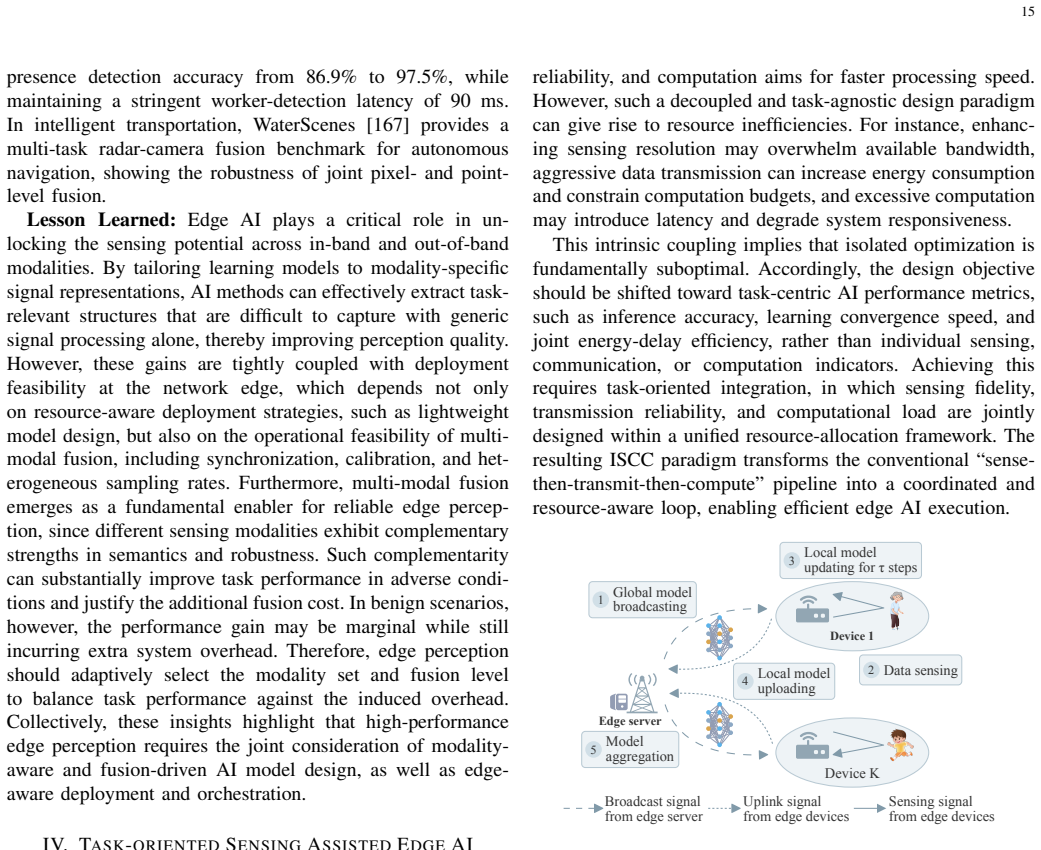
Edge perception has emerged as a foundational capability for future wireless networks, enabling the network edge to proactively sense, interpret, and interact with the physical environment in a task-oriented and resource-aware manner. This survey provides a comprehensive and structured overview of edge perception. We first review representative sensing modalities and edge artificial intelligence (AI) techniques as the fundamental building blocks. We then examine their synergistic interactions. We systematically analyze how edge AI enhances sensing capabilities, encompassing both in-band and out-of-band modalities, as well as multi-modal sensor data fusion. Moreover, we discuss the role of task-driven sensing in facilitating edge AI, including integrated sensing-communication-computation designs, and active perception frameworks that dynamically adapt sensing strategies for downstream applications. Finally, we identify key challenges and open issues. By consolidating fragmented research across sensing, communication, and edge AI, this survey provides forward-looking insights for the design and implementation of edge perception systems for sixth-generation (6G) networks.
Editorial analysis
A structured set of objections, weighed in public.
Referee Report
Summary. The manuscript is a survey on edge perception for 6G networks. It reviews representative sensing modalities and edge AI techniques as building blocks, examines their synergistic interactions (edge AI enhancing in-band/out-of-band sensing and multi-modal fusion; task-driven sensing and active perception frameworks supporting edge AI via integrated sensing-communication-computation designs), and identifies key challenges and open issues to consolidate research and provide forward-looking design insights.
Significance. If the reviewed literature is representative, the survey offers value by structuring fragmented work across sensing, communications, and edge AI, highlighting synergies that could inform practical 6G system architectures. The emphasis on task-oriented and resource-aware perception aligns with emerging 6G priorities and may help researchers navigate the intersection of these areas.
major comments (1)
- The abstract and introduction do not specify the selection criteria or search methodology used to identify 'representative' sensing modalities and edge AI techniques. Without this, it is difficult to evaluate whether the consolidation truly supports the claimed forward-looking insights for 6G design, as the central contribution rests on the representativeness of the reviewed works.
minor comments (2)
- Clarify the distinction between in-band and out-of-band modalities with concrete examples in the relevant review section to improve readability for readers outside the immediate subfield.
- Add a summary table or diagram in the synergy analysis section that maps specific sensing modalities to corresponding edge AI enhancements and task-driven benefits.
Simulated Author's Rebuttal
We thank the referee for the constructive feedback and the recommendation for minor revision. The point about clarifying the literature selection process is valid and will be addressed directly in the revised manuscript to improve transparency and support the survey's claims.
read point-by-point responses
-
Referee: The abstract and introduction do not specify the selection criteria or search methodology used to identify 'representative' sensing modalities and edge AI techniques. Without this, it is difficult to evaluate whether the consolidation truly supports the claimed forward-looking insights for 6G design, as the central contribution rests on the representativeness of the reviewed works.
Authors: We agree that explicitly documenting the selection criteria and search methodology would strengthen the manuscript. In the revised version, we will insert a dedicated subsection titled 'Survey Scope and Methodology' immediately following the Introduction. This subsection will describe the databases consulted (IEEE Xplore, ACM Digital Library, arXiv, and Web of Science), the primary search keywords and Boolean combinations employed (e.g., 'edge perception' AND '6G', 'task-oriented sensing' AND 'edge AI'), the publication time window (primarily 2018–2024 with selected foundational works), and the inclusion/exclusion criteria (relevance to integrated sensing-communication-computation, demonstrated task-driven performance gains, and citation impact). We believe this addition will allow readers to better evaluate the representativeness of the reviewed works while preserving the survey's forward-looking focus. revision: yes
Circularity Check
No significant circularity: standard literature survey with no derivations or fitted predictions
full rationale
This paper is a survey consolidating external literature on sensing modalities, edge AI techniques, their synergies, and challenges for 6G edge perception. No equations, parameters, or new derivations appear in the provided abstract or structure. The central claim rests on reviewing representative prior work rather than any internal reduction to self-defined inputs, fitted quantities, or self-citation chains. As a review, it has no load-bearing self-referential steps and is self-contained against external benchmarks.
Axiom & Free-Parameter Ledger
Lean theorems connected to this paper
-
IndisputableMonolith/Foundation/RealityFromDistinction.leanreality_from_one_distinction unclear?
unclearRelation between the paper passage and the cited Recognition theorem.
This survey provides a comprehensive and structured overview of edge perception... consolidating fragmented research across sensing, communication, and edge AI
-
IndisputableMonolith/Cost/FunctionalEquation.leanwashburn_uniqueness_aczel unclear?
unclearRelation between the paper passage and the cited Recognition theorem.
edge AI enhances sensing capabilities... task-driven sensing... active perception frameworks
What do these tags mean?
- matches
- The paper's claim is directly supported by a theorem in the formal canon.
- supports
- The theorem supports part of the paper's argument, but the paper may add assumptions or extra steps.
- extends
- The paper goes beyond the formal theorem; the theorem is a base layer rather than the whole result.
- uses
- The paper appears to rely on the theorem as machinery.
- contradicts
- The paper's claim conflicts with a theorem or certificate in the canon.
- unclear
- Pith found a possible connection, but the passage is too broad, indirect, or ambiguous to say the theorem truly supports the claim.
Reference graph
Works this paper leans on
-
[1]
Framework and overall objectives of the future development of IMT for 2030 and beyond,
ITU-R, “Framework and overall objectives of the future development of IMT for 2030 and beyond,” 2023. [Online]. Available: https: //www.itu.int/rec/R-RECM.2160-0-202311-I/en
work page 2030
-
[2]
Intelligent multi-modal sensing- communication integration: Synesthesia of machines,
X. Cheng, H. Zhang, J. Zhang, S. Gao, S. Li, Z. Huang, L. Bai, Z. Yang, X. Zheng, and L. Yang, “Intelligent multi-modal sensing- communication integration: Synesthesia of machines,”IEEE Commun. Surv. Tutor., vol. 26, no. 1, pp. 258–301, 2024
work page 2024
-
[3]
Collaborative sensing in internet of things: A comprehensive survey,
S. He, K. Shi, C. Liu, B. Guo, J. Chen, and Z. Shi, “Collaborative sensing in internet of things: A comprehensive survey,”IEEE Commun. Surv. Tutor., vol. 24, no. 3, pp. 1435–1474, 2022
work page 2022
-
[4]
Edge intelligence: The confluence of edge computing and artificial intelligence,
S. Deng, H. Zhao, W. Fang, J. Yin, S. Dustdar, and A. Y . Zomaya, “Edge intelligence: The confluence of edge computing and artificial intelligence,”IEEE Internet Things J., vol. 7, no. 8, pp. 7457–7469, 2020
work page 2020
-
[5]
G. Zhu, Z. Lyu, X. Jiao, P. Liu, M. Chen, J. Xu, S. Cui, and P. Zhang, “Pushing AI to wireless network edge: An overview on integrated sensing, communication, and computation towards 6g,”Science China Information Sciences, vol. 66, no. 3, p. 130301, 2023
work page 2023
-
[6]
Integrated sensing and edge AI: Realizing intelligent perception in 6g,
Z. Liu, X. Chen, H. Wu, Z. Wang, X. Chen, D. Niyato, and K. Huang, “Integrated sensing and edge AI: Realizing intelligent perception in 6g,”IEEE Commun. Surv. Tutor., pp. 1–1, 2025
work page 2025
-
[7]
Edge perception: Intelligent wireless sensing at network edge,
Y . Cui, X. Cao, G. Zhu, J. Nie, and J. Xu, “Edge perception: Intelligent wireless sensing at network edge,”IEEE Commun. Mag., vol. 63, no. 3, pp. 166–173, 2025
work page 2025
-
[8]
Y . Yang, Y . Chen, J. Wang, G. Sun, and D. Niyato, “Embodied AI- empowered low altitude economy: Integrated sensing, communications, computation, and control (ISC3),” 2024. [Online]. Available: https: //arxiv.org/abs/2412.19996
-
[9]
Deep AI enabled ubiquitous wireless sensing: A survey,
C. Li, Z. Cao, and Y . Liu, “Deep AI enabled ubiquitous wireless sensing: A survey,”ACM Comput. Surv., vol. 54, no. 2, Mar. 2021. [Online]. Available: https://doi.org/10.1145/3436729
-
[10]
Commodity WiFi sensing in ten years: Status, challenges, and opportunities,
S. Tan, Y . Ren, J. Yang, and Y . Chen, “Commodity WiFi sensing in ten years: Status, challenges, and opportunities,”IEEE Internet Things J., vol. 9, no. 18, pp. 17 832–17 843, 2022
work page 2022
-
[11]
WiFi-based human sensing with deep learning: Recent advances, challenges, and opportunities,
I. Ahmad, A. Ullah, and W. Choi, “WiFi-based human sensing with deep learning: Recent advances, challenges, and opportunities,”IEEE open j. Commun. Soc., vol. 5, pp. 3595–3623, 2024
work page 2024
-
[12]
An overview on IEEE 802.11bf: WLAN sensing,
R. Du, H. Hua, H. Xie, X. Song, Z. Lyu, M. Hu, Narengerile, Y . Xin, S. McCann, M. Montemurro, T. X. Han, and J. Xu, “An overview on IEEE 802.11bf: WLAN sensing,”IEEE Commun. Surv. Tutor., vol. 27, no. 1, pp. 184–217, 2025
work page 2025
-
[13]
WiFi sensing on the edge: Signal processing techniques and challenges for real-world systems,
S. M. Hernandez and E. Bulut, “WiFi sensing on the edge: Signal processing techniques and challenges for real-world systems,”IEEE Commun. Surv. Tutor., vol. 25, no. 1, pp. 46–76, 2023
work page 2023
-
[14]
Millimeter wave sensing: A review of application pipelines and building blocks,
B. van Berlo, A. Elkelany, T. Ozcelebi, and N. Meratnia, “Millimeter wave sensing: A review of application pipelines and building blocks,” IEEE Sens. J., vol. 21, no. 9, pp. 10 332–10 368, 2021
work page 2021
-
[15]
A survey of mmwave radar- based sensing in autonomous vehicles, smart homes and industry,
H. Kong, C. Huang, J. Yu, and X. Shen, “A survey of mmwave radar- based sensing in autonomous vehicles, smart homes and industry,” IEEE Commun. Surv. Tutor., vol. 27, no. 1, pp. 463–508, 2025
work page 2025
-
[16]
Automotive lidar technology: A survey,
R. Roriz, J. Cabral, and T. Gomes, “Automotive lidar technology: A survey,”IEEE Trans. Intell. Transp. Syst., vol. 23, no. 7, pp. 6282– 6297, 2022
work page 2022
-
[17]
Visual per- ception enabled industry intelligence: State of the art, challenges and prospects,
J. Yang, C. Wang, B. Jiang, H. Song, and Q. Meng, “Visual per- ception enabled industry intelligence: State of the art, challenges and prospects,”IEEE Trans. Industr. Inform., vol. 17, no. 3, pp. 2204–2219, 2021
work page 2021
-
[18]
Edge video analytics: A survey on applications, systems and enabling techniques,
R. Xu, S. Razavi, and R. Zheng, “Edge video analytics: A survey on applications, systems and enabling techniques,”IEEE Commun. Surv. Tutor., vol. 25, no. 4, pp. 2951–2982, 2023
work page 2023
-
[19]
F. J. Tovar-Lopez, “Recent progress in micro- and nanotechnology- enabled sensors for biomedical and environmental challenges,”Sensors, vol. 23, no. 12, 2023
work page 2023
-
[20]
Context-aware edge-based AI models for wireless sensor networks-an overview,
A. A. Al-Saedi, V . Boeva, E. Casalicchio, and P. Exner, “Context-aware edge-based AI models for wireless sensor networks-an overview,” Sensors, vol. 22, no. 15, 2022
work page 2022
-
[21]
Radar and camera fusion for object detection and tracking: A comprehensive survey,
K. Shi, S. He, Z. Shi, A. Chen, Z. Xiong, J. Chen, and J. Luo, “Radar and camera fusion for object detection and tracking: A comprehensive survey,”IEEE Commun. Surv. Tutor., pp. 1–1, 2025
work page 2025
-
[22]
A survey on mobile edge computing: The communication perspective,
Y . Mao, C. You, J. Zhang, K. Huang, and K. B. Letaief, “A survey on mobile edge computing: The communication perspective,”IEEE Commun. Surv. Tutor., vol. 19, no. 4, pp. 2322–2358, 2017
work page 2017
-
[23]
Machine and deep learning for resource allocation in multi-access edge computing: A survey,
H. Djigal, J. Xu, L. Liu, and Y . Zhang, “Machine and deep learning for resource allocation in multi-access edge computing: A survey,”IEEE Commun. Surv. Tutor., vol. 24, no. 4, pp. 2449–2494, 2022
work page 2022
-
[24]
Mobile edge intelligence for large language models: A contemporary survey,
G. Qu, Q. Chen, W. Wei, Z. Lin, X. Chen, and K. Huang, “Mobile edge intelligence for large language models: A contemporary survey,” IEEE Commun. Surv. Tutor., pp. 1–1, 2025
work page 2025
-
[25]
Distributed learning in wireless networks: Recent progress and future challenges,
M. Chen, D. G ¨und¨uz, K. Huang, W. Saad, M. Bennis, A. V . Feljan, and H. V . Poor, “Distributed learning in wireless networks: Recent progress and future challenges,”IEEE J. Sel. Areas Commun., vol. 39, no. 12, pp. 3579–3605, 2021
work page 2021
-
[26]
Green edge AI: A contemporary survey,
Y . Mao, X. Yu, K. Huang, Y .-J. Angela Zhang, and J. Zhang, “Green edge AI: A contemporary survey,”Proc. IEEE, vol. 112, no. 7, pp. 880–911, 2024
work page 2024
-
[27]
X. Wang, B. Wang, Y . Wu, Z. Ning, S. Guo, and F. R. Yu, “A survey on trustworthy edge intelligence: From security and reliability to transparency and sustainability,”IEEE Commun. Surv. Tutor., vol. 27, no. 3, pp. 1729–1757, 2025
work page 2025
-
[28]
K. Hoffpauir, J. Simmons, N. Schmidt, R. Pittala, I. Briggs, S. Makani, and Y . Jararweh, “A survey on edge intelligence and lightweight machine learning support for future applications and services,”J. Data Inf. Qual., vol. 15, no. 2, Jun. 2023
work page 2023
-
[29]
Edge intelligence in intelligent transportation systems: A survey,
T. Gong, L. Zhu, F. R. Yu, and T. Tang, “Edge intelligence in intelligent transportation systems: A survey,”IEEE Trans. Intell. Transp. Syst., vol. 24, no. 9, pp. 8919–8944, 2023
work page 2023
-
[30]
D. N. Molokomme, A. J. Onumanyi, and A. M. Abu-Mahfouz, “Edge intelligence in smart grids: A survey on architectures, offloading models, cyber security measures, and challenges,”J. Sens. Actuator Netw., vol. 11, no. 3, 2022
work page 2022
-
[31]
M. Al-Quraan, L. Mohjazi, L. Bariah, A. Centeno, A. Zoha, K. Arshad, K. Assaleh, S. Muhaidat, M. Debbah, and M. A. Imran, “Edge-native intelligence for 6G communications driven by federated learning: A survey of trends and challenges,”IEEE Trans. Emerg. Top. Comput. Intell., vol. 7, no. 3, pp. 957–979, 2023
work page 2023
-
[32]
A survey on collaborative DNN inference for edge intelligence,
W.-Q. Ren, Y .-B. Qu, C. Dong, Y .-Q. Jing, H. Sun, Q.-H. Wu, and S. Guo, “A survey on collaborative DNN inference for edge intelligence,”Machine Intelligence Research, vol. 20, no. 3, pp. 370– 395, 2023
work page 2023
-
[33]
Beyond transmitting bits: Context, semantics, and task-oriented communications,
D. G ¨und¨uz, Z. Qin, I. E. Aguerri, H. S. Dhillon, Z. Yang, A. Yener, K. K. Wong, and C.-B. Chae, “Beyond transmitting bits: Context, semantics, and task-oriented communications,”IEEE J. Sel. Areas Commun., vol. 41, no. 1, pp. 5–41, 2023
work page 2023
-
[34]
Integrated sensing and communications: Toward dual- functional wireless networks for 6G and beyond,
F. Liu, Y . Cui, C. Masouros, J. Xu, T. X. Han, Y . C. Eldar, and S. Buzzi, “Integrated sensing and communications: Toward dual- functional wireless networks for 6G and beyond,”IEEE J. Sel. Areas Commun., vol. 40, no. 6, pp. 1728–1767, 2022
work page 2022
-
[35]
Inte- grated sensing and communications: Recent advances and ten open challenges,
S. Lu, F. Liu, Y . Li, K. Zhang, H. Huang, J. Zou, X. Li, Y . Dong, F. Dong, J. Zhu, Y . Xiong, W. Yuan, Y . Cui, and L. Hanzo, “Inte- grated sensing and communications: Recent advances and ten open challenges,”IEEE Internet Things J., vol. 11, no. 11, pp. 19 094– 19 120, 2024
work page 2024
-
[36]
A survey on integrated sensing, communication, and computation,
D. Wen, Y . Zhou, X. Li, Y . Shi, K. Huang, and K. B. Letaief, “A survey on integrated sensing, communication, and computation,”IEEE Commun. Surv. Tutor., vol. 27, no. 5, pp. 3058–3098, 2025
work page 2025
-
[37]
S. M. Kay,Fundamentals of Statistical Signal Processing Volume II: Detection Theory. PTR Prentice-Hall, Englewood Cliffs, NJ, 1993
work page 1993
-
[38]
S. M. Kay,Fundamentals of Statistical Signal Processing Volume I: Estimation Theory. PTR Prentice-Hall, Englewood Cliffs, NJ, 1993
work page 1993
-
[39]
Multiple emitter location and signal parameter estima- tion,
R. Schmidt, “Multiple emitter location and signal parameter estima- tion,”IEEE Trans. Antennas Propag., vol. 34, no. 3, pp. 276–280, Mar. 1986. 21
work page 1986
-
[40]
ESPRIT-estimation of signal parameters via rotational invariance techniques,
R. Roy and T. Kailath, “ESPRIT-estimation of signal parameters via rotational invariance techniques,”IEEE Trans. Acoust., Speech, Signal Process., vol. 37, no. 7, pp. 984–995, Jul. 1989
work page 1989
-
[41]
Seventy years of radar and communications: The road from separation to integration,
F. Liu, L. Zheng, Y . Cui, C. Masouros, A. P. Petropulu, H. Griffiths, and Y . C. Eldar, “Seventy years of radar and communications: The road from separation to integration,”IEEE Signal Process. Mag., vol. 40, no. 5, pp. 106–121, Jul. 2023
work page 2023
-
[42]
Integrated sensing, communication, and powering: Toward multi-functional 6G wireless networks,
Y . Chen, Z. Ren, J. Xu, Y . Zeng, D. W. K. Ng, and S. Cui, “Integrated sensing, communication, and powering: Toward multi-functional 6G wireless networks,”IEEE Commun. Mag., vol. 63, no. 8, pp. 146–153, 2025
work page 2025
-
[43]
K. Zhi, C. Pan, H. Ren, K. K. Chai, C.-X. Wang, R. Schober, and X. You, “Performance analysis and low-complexity design for XL- MIMO with near-field spatial non-stationarities,”IEEE J. Sel. Areas Commun., vol. 42, no. 6, pp. 1656–1672, 2024
work page 2024
-
[44]
X. Song, Y . Fang, F. Wang, Z. Ren, X. Yu, Y . Zhang, F. Liu, J. Xu, D. W. K. Ng, R. Zhanget al., “An overview on IRS-enabled sensing and communications for 6G: architectures, fundamental limits, and joint beamforming designs,”Sci. China Inf. Sci., vol. 68, no. 5, p. 150301, Apr. 2025
work page 2025
-
[45]
Intelligent reflecting surface enabled sensing: Cram´er-Rao bound optimization,
X. Song, J. Xu, F. Liu, T. X. Han, and Y . C. Eldar, “Intelligent reflecting surface enabled sensing: Cram´er-Rao bound optimization,”IEEE Trans. on Signal Process., vol. 71, pp. 2011–2026, May 2023
work page 2011
-
[46]
X. Xu, H. Xu, D. Wei, W. Saad, M. Bennis, and M. Chen, “Transformer-based collaborative reinforcement learning for fluid an- tenna system (fas)-enabled 3d uav positioning,”IEEE J. Sel. Areas Commun., vol. 44, pp. 1128–1143, Oct. 2026
work page 2026
-
[47]
Near- field integrated imaging and communication in distributed MIMO networks,
K. Zhi, T. Yang, S. Li, Y . Song, A. Rezaei, and G. Caire, “Near- field integrated imaging and communication in distributed MIMO networks,” 2025. [Online]. Available: https://arxiv.org/pdf/2508.17526
-
[48]
G. Cheng, X. Song, Z. Lyu, and J. Xu, “Networked ISAC for low- altitude economy: Coordinated transmit beamforming and UA V trajec- tory design,”IEEE Trans. Commun., vol. 73, no. 8, pp. 5832–5847, 2025
work page 2025
-
[49]
Networking based ISAC hardware testbed and performance evaluation,
K. Ji, Q. Zhang, Z. Wei, Z. Feng, and P. Zhang, “Networking based ISAC hardware testbed and performance evaluation,”IEEE Commun. Mag., vol. 61, no. 5, pp. 76–82, May 2023
work page 2023
-
[50]
Robust indoor positioning provided by real-time RSSI values in unmodified WLAN networks,
S. Mazuelas, A. Bahillo, R. M. Lorenzo, P. Fernandez, F. A. Lago, E. Garcia, J. Blas, and E. J. Abril, “Robust indoor positioning provided by real-time RSSI values in unmodified WLAN networks,”IEEE J. Sel. Topics Signal Process., vol. 3, no. 5, pp. 821–831, Oct. 2009
work page 2009
-
[51]
An enhanced approach to imaging the indoor environment using WiFi RSSI measurements,
A. Dubey, P. Sood, J. Santos, D. Ma, C.-Y . Chiu, and R. Murch, “An enhanced approach to imaging the indoor environment using WiFi RSSI measurements,”IEEE Trans. Veh. Technol., vol. 70, no. 9, pp. 8415–8430, Sep. 2021
work page 2021
-
[52]
Wi-Fi CSI-based behavior recognition: From signals and actions to activities,
Z. Wang, B. Guo, Z. Yu, and X. Zhou, “Wi-Fi CSI-based behavior recognition: From signals and actions to activities,”IEEE Commun. Mag., vol. 56, no. 5, pp. 109–115, May 2018
work page 2018
-
[53]
WiFi CSI based passive human activity recognition using attention based BLSTM,
Z. Chen, L. Zhang, C. Jiang, Z. Cao, and W. Cui, “WiFi CSI based passive human activity recognition using attention based BLSTM,” Trans. Mobile Comput., vol. 18, no. 11, pp. 2714–2724, Nov 2019
work page 2019
-
[54]
M. A. Richardset al.,Fundamentals of Radar Signal Processing. McGraw-Hill New York, 2005, vol. 1
work page 2005
-
[55]
InFi: end-to-end learnable input filter for resource-efficient mobile-centric inference,
M. Yuan, L. Zhang, F. He, X. Tong, and X.-Y . Li, “InFi: end-to-end learnable input filter for resource-efficient mobile-centric inference,” in Proceedings of MobiCom ’22. New York, NY , USA: Association for Computing Machinery, 2022, p. 228–241
work page 2022
-
[56]
Split computing with scalable feature compression for visual analytics on the edge,
Z. Yuan, S. Rawlekar, S. Garg, E. Erkip, and Y . Wang, “Split computing with scalable feature compression for visual analytics on the edge,” IEEE Trans. Multimedia, vol. 26, pp. 10 121–10 133, 2024
work page 2024
-
[57]
VideoEdge: Processing camera streams using hierarchical clusters,
C.-C. Hung, G. Ananthanarayanan, P. Bodik, L. Golubchik, M. Yu, P. Bahl, and M. Philipose, “VideoEdge: Processing camera streams using hierarchical clusters,” in2018 IEEE/ACM Symposium on Edge Computing (SEC), 2018, pp. 115–131
work page 2018
-
[58]
F. Dong, H. Wang, D. Shen, Z. Huang, Q. He, J. Zhang, L. Wen, and T. Zhang, “Multi-exit DNN inference acceleration based on multi- dimensional optimization for edge intelligence,”IEEE Trans. Mob. Comput., vol. 22, no. 9, pp. 5389–5405, 2023
work page 2023
-
[59]
Towards edge-assisted real-time 3D segmentation of large scale LiDAR point clouds,
F. McLean, L. Xue, C. X. Lu, and M. Marina, “Towards edge-assisted real-time 3D segmentation of large scale LiDAR point clouds,” in Proceedings of EMDL ’22. New York, NY , USA: Association for Computing Machinery, 2022, p. 1–6
work page 2022
-
[60]
3D LiDAR map compression for efficient localization on resource constrained vehicles,
H. Yin, Y . Wang, L. Tang, X. Ding, S. Huang, and R. Xiong, “3D LiDAR map compression for efficient localization on resource constrained vehicles,”IEEE Trans. Intell. Transp. Syst., vol. 22, no. 2, pp. 837–852, 2021
work page 2021
-
[61]
W. Xiao, P. Li, M. Tang, C. Song, D. Yu, H. Liu, D. Chen, and N. Chen, “Real-time roadside 3D spatial perception with LiDAR AIoT: An edge- cloud–terminal collaborative sensing prototype,”IEEE Internet Things J., vol. 12, no. 9, pp. 12 624–12 639, 2025
work page 2025
-
[62]
EdgeCooper: Network-aware cooperative LiDAR perception for enhanced vehicular awareness,
G. Luo, C. Shao, N. Cheng, H. Zhou, H. Zhang, Q. Yuan, and J. Li, “EdgeCooper: Network-aware cooperative LiDAR perception for enhanced vehicular awareness,”IEEE J. Sel. Areas Commun., vol. 42, no. 1, pp. 207–222, 2024
work page 2024
-
[63]
AI-driven wearable bioelectronics in digital healthcare,
G. Huang, X. Chen, and C. Liao, “AI-driven wearable bioelectronics in digital healthcare,”Biosensors, vol. 15, no. 7, 2025
work page 2025
-
[64]
Z. Ren, Y . Peng, X. Song, Y . Fang, L. Qiu, L. Liu, D. W. K. Ng, and J. Xu, “Fundamental CRB-rate tradeoff in multi-antenna ISAC systems with information multicasting and multi-target sensing,”IEEE Trans. Wireless Commun., vol. 23, no. 4, pp. 3870–3885, Apr. 2024
work page 2024
-
[65]
Joint maneuver and beamforming design for UA V-enabled integrated sensing and communication,
Z. Lyu, G. Zhu, and J. Xu, “Joint maneuver and beamforming design for UA V-enabled integrated sensing and communication,”IEEE Trans. Wireless Commun., vol. 22, no. 4, pp. 2424–2440, Apr. 2023
work page 2023
-
[66]
On the fundamental tradeoff of integrated sensing and communications under Gaussian channels,
Y . Xiong, F. Liu, Y . Cui, W. Yuan, T. X. Han, and G. Caire, “On the fundamental tradeoff of integrated sensing and communications under Gaussian channels,”IEEE Trans. Inf. Theory, vol. 69, no. 9, pp. 5723– 5751, Sep. 2023
work page 2023
-
[67]
Random ISAC signals deserve dedicated precoding,
S. Lu, F. Liu, F. Dong, Y . Xiong, J. Xu, Y .-F. Liu, and S. Jin, “Random ISAC signals deserve dedicated precoding,”IEEE Trans. Signal Process., vol. 72, pp. 3453–3469, Jul. 2024
work page 2024
-
[68]
CP-OFDM achieves the lowest average ranging sidelobe under QAM/PSK constellations,
F. Liu, Y . Zhang, Y . Xiong, S. Li, W. Yuan, F. Gao, S. Jin, and G. Caire, “CP-OFDM achieves the lowest average ranging sidelobe under QAM/PSK constellations,”IEEE Trans. Inf. Theory, vol. 71, no. 9, pp. 6950–6967, Sep. 2025
work page 2025
-
[69]
Sensing mutual information with random signals in Gaussian channels,
L. Xie, F. Liu, J. Luo, and S. Song, “Sensing mutual information with random signals in Gaussian channels,”IEEE Trans. Commun., early access, Apr. 2025, doi:10.1109/TCOMM.2025.3564767
-
[70]
CRB-rate tradeoff for bistatic ISAC with Gaussian information and deterministic sensing signals,
X. Song, X. Yu, J. Xu, and D. W. K. Ng, “CRB-rate tradeoff for bistatic ISAC with Gaussian information and deterministic sensing signals,” Jul. 2025. [Online]. Available: https://arxiv.org/pdf/2507.21879
-
[71]
Detection in bistatic ISAC with deterministic sensing and Gaussian information signals,
——, “Detection in bistatic ISAC with deterministic sensing and Gaussian information signals,” Nov. 2025. [Online]. Available: https://arxiv.org/pdf/2511.10897
-
[72]
Wi-Fi sensing based on IEEE 802.11bf,
C. Chen, H. Song, Q. Li, F. Meneghello, F. Restuccia, and C. Cordeiro, “Wi-Fi sensing based on IEEE 802.11bf,”IEEE Commun. Mag., vol. 61, no. 1, pp. 121–127, Jan. 2023
work page 2023
-
[73]
Enhanced computer vision with microsoft kinect sensor: A review,
J. Han, L. Shao, D. Xu, and J. Shotton, “Enhanced computer vision with microsoft kinect sensor: A review,”IEEE Trans. Cybern., vol. 43, no. 5, pp. 1318–1334, 2013
work page 2013
-
[74]
Are we ready for real-time LiDAR semantic segmentation in autonomous driving?
S. A. Haidar, A. Chariot, M. Darouich, C. Joly, and J.- E. Deschaud, “Are we ready for real-time LiDAR semantic segmentation in autonomous driving?” 2024. [Online]. Available: https://arxiv.org/abs/2410.08365
-
[75]
A multi-modal IoT node for energy-efficient environmental monitoring with edge AI processing,
P. Wiese, V . Kartsch, M. Guermandi, and L. Benini, “A multi-modal IoT node for energy-efficient environmental monitoring with edge AI processing,” inProc. IEEE COINS, 2025, pp. 1–7
work page 2025
-
[76]
Z. Lyu, Y . Li, G. Zhu, J. Xu, H. Vincent Poor, and S. Cui, “Rethinking resource management in edge learning: A joint pre-training and fine- tuning design paradigm,”IEEE Trans. Wireless Commun., vol. 24, no. 2, pp. 1584–1601, Dec. 2025
work page 2025
-
[77]
Communication-efficient learning of deep networks from decentral- ized data,
B. McMahan, E. Moore, D. Ramage, S. Hampson, and B. Arcas, “Communication-efficient learning of deep networks from decentral- ized data,” inProc. International Conference on Artificial Intelligence and Statistics, vol. 54, Fort Lauderdale, FL, USA, 20–22 Apr. 2017, pp. 1273–1282
work page 2017
-
[78]
T. Guo, S. Guo, J. Wang, X. Tang, and W. Xu, “Promptfl: Let federated participants cooperatively learn prompts instead of models – federated learning in age of foundation model,”IEEE Trans. Mob. Comput., vol. 23, no. 5, pp. 5179–5194, Aug. 2024
work page 2024
-
[79]
Personal- ized edge intelligence via federated self-knowledge distillation,
H. Jin, D. Bai, D. Yao, Y . Dai, L. Gu, C. Yu, and L. Sun, “Personal- ized edge intelligence via federated self-knowledge distillation,”IEEE Trans. Parallel Distrib. Syst., vol. 34, no. 2, pp. 567–580, Nov. 2023
work page 2023
-
[80]
D. Wei, X. Xu, Y . Liu, H. Vincent Poor, and M. Chen, “Optimizing model splitting and device task assignment for deceptive signal-assisted private multi-hop split learning,”IEEE J. Sel. Areas Commun., vol. 44, pp. 1512–1528, Nov. 2026
work page 2026
discussion (0)
Sign in with ORCID, Apple, or X to comment. Anyone can read and Pith papers without signing in.