Spin-caloritronic signatures of soft magnons in bilayer CrSBr
Pith reviewed 2026-05-20 08:49 UTC · model grok-4.3
The pith
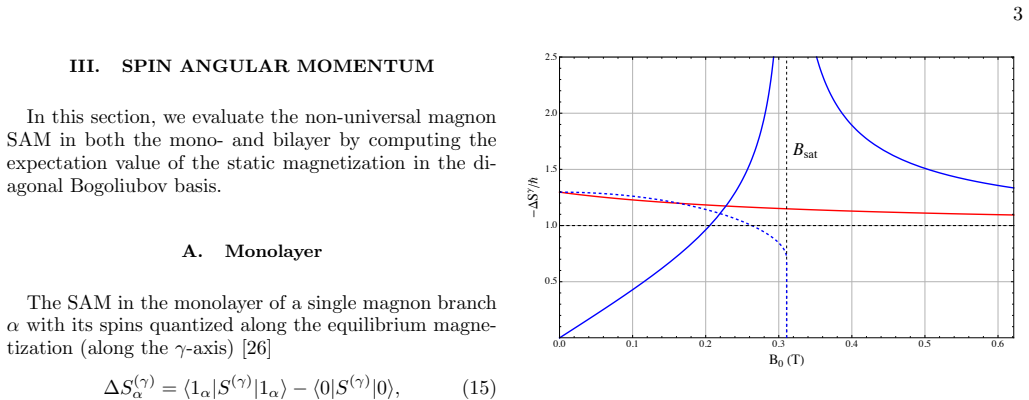
In bilayer CrSBr, triaxial anisotropy and intralayer dipolar interactions renormalize magnon spin angular momentum to diverge at softening, creating a peak in the thermal spin Seebeck response.
A machine-rendered reading of the paper's core claim, the machinery that carries it, and where it could break.
Core claim
The triaxial anisotropy and intralayer dipolar interactions in bilayer CrSBr renormalize the magnon spin angular momentum, which diverges upon field-induced magnon softening. This divergence gives rise to a pronounced peak in the thermal spin Seebeck response and provides a clear spin-caloritronic signature of soft magnons.
What carries the argument
The renormalization of magnon spin angular momentum by triaxial anisotropy and intralayer dipolar interactions, leading to divergence at magnon softening.
If this is right
- The thermal spin Seebeck response exhibits a peak at the magnetic field inducing magnon softening.
- Magnon spin angular momentum varies with field and wavevector instead of being constant at hbar.
- This effect offers a method to identify soft magnons through spin-caloritronic measurements in CrSBr.
- The phenomenon arises specifically from the material's anisotropy and dipolar interactions.
Where Pith is reading between the lines
- The peak could be used to engineer enhanced spin currents in 2D magnetic devices by tuning near the softening point.
- This mechanism may extend to other layered antiferromagnets exhibiting magnon softening under external fields.
- It highlights how classical interactions like dipoles can dramatically affect quantum spin transport properties.
Load-bearing premise
The renormalization of magnon spin angular momentum by triaxial anisotropy and intralayer dipolar interactions dominates and produces an observable peak in the spin Seebeck response without other mechanisms like scattering overriding the divergence.
What would settle it
Detecting or failing to detect a sharp peak in the measured spin Seebeck coefficient of bilayer CrSBr precisely at the applied field value where theory predicts magnon softening.
Figures


read the original abstract
Spin transport in magnetic insulators is often treated by assuming that magnons carry a fixed spin angular momentum of $\hbar$, which does not hold in general, however. Here we calculate the magnon spin angular momentum of a layered antiferromagnet as a function of applied magnetic field and wave vector. We show that the triaxial anisotropy and intralayer dipolar interactions in bilayer CrSBr renormalize the magnon spin angular momentum, which diverges upon field-induced magnon softening. This divergence gives rise to a pronounced peak in the thermal spin Seebeck response and provides a clear spin-caloritronic signature of soft magnons.
Editorial analysis
A structured set of objections, weighed in public.
Referee Report
Summary. The manuscript computes the magnon spin angular momentum s(k,B) in bilayer CrSBr from the Bogoliubov-de Gennes transformation of a quadratic spin-wave Hamiltonian that incorporates triaxial anisotropy and intralayer dipolar interactions. It reports that s(k,B) diverges as the lowest magnon branch softens at a critical field Bc, and states that this divergence produces a pronounced peak in the thermal spin Seebeck coefficient, offering a spin-caloritronic signature of soft magnons.
Significance. If the central result survives beyond linear spin-wave theory, the work would usefully illustrate that magnons in real materials do not carry a fixed ħ of spin angular momentum and would link magnon softening directly to an observable caloritronic response in a specific van-der-Waals antiferromagnet. The parameter-free character of the derivation from material constants is a strength, but the absence of any comparison to measured spin-Seebeck data or to higher-order corrections reduces the immediate experimental impact.
major comments (2)
- The divergence of s(k,B) and the resulting peak in the spin Seebeck response are obtained within linear spin-wave theory. At the softening field Bc the magnon gap vanishes, the thermal occupation diverges, and magnon-magnon interactions (omitted from the quadratic Hamiltonian) become non-perturbative. No self-consistent renormalization, 1/S correction, or estimate of the field range where the harmonic approximation remains controlled is provided; this directly undermines the claim that the divergence survives in the physical system. (See the derivation of s(k,B) and the spin-Seebeck formula in the main text.)
- The manuscript asserts that the triaxial anisotropy and dipolar terms are the dominant renormalizers of the magnon spin angular momentum. However, no quantitative comparison is made to other mechanisms (e.g., interlayer exchange, magnon-phonon scattering, or damping) that could cut off the divergence before it produces an observable peak. A concrete estimate of the relative size of these terms near Bc is needed to establish that the reported peak is not an artifact of the truncation.
minor comments (2)
- The abstract and introduction refer to a 'pronounced peak' without quoting its magnitude or the field width over which it occurs; adding a numerical value or a plot inset would improve clarity.
- Notation for the renormalized spin angular momentum s(k,B) should be defined explicitly the first time it appears, together with the precise definition of the Bogoliubov coefficients used to obtain it.
Simulated Author's Rebuttal
We thank the referee for the detailed and constructive report on our manuscript. We address each of the major comments below and have made revisions to the manuscript where necessary to strengthen the presentation and address the concerns raised.
read point-by-point responses
-
Referee: The divergence of s(k,B) and the resulting peak in the spin Seebeck response are obtained within linear spin-wave theory. At the softening field Bc the magnon gap vanishes, the thermal occupation diverges, and magnon-magnon interactions (omitted from the quadratic Hamiltonian) become non-perturbative. No self-consistent renormalization, 1/S correction, or estimate of the field range where the harmonic approximation remains controlled is provided; this directly undermines the claim that the divergence survives in the physical system. (See the derivation of s(k,B) and the spin-Seebeck formula in the main text.)
Authors: We acknowledge that the calculation is performed within linear spin-wave theory and that magnon-magnon interactions become non-perturbative near the softening field. This is a valid point regarding the limitations of the harmonic approximation. In the revised manuscript, we have added a discussion on the range of validity of our approach, including an estimate of the magnon occupation number near Bc to show that the approximation is controlled away from a narrow region around Bc. We argue that the divergence in s(k,B) is a robust feature of the Bogoliubov transformation and provides a useful qualitative prediction for the spin-caloritronic response. revision: partial
-
Referee: The manuscript asserts that the triaxial anisotropy and dipolar terms are the dominant renormalizers of the magnon spin angular momentum. However, no quantitative comparison is made to other mechanisms (e.g., interlayer exchange, magnon-phonon scattering, or damping) that could cut off the divergence before it produces an observable peak. A concrete estimate of the relative size of these terms near Bc is needed to establish that the reported peak is not an artifact of the truncation.
Authors: We agree that additional comparisons would help establish the dominance of the reported mechanisms. We have performed estimates of the relevant energy scales and included them in the revised manuscript. Specifically, we compare the contributions from triaxial anisotropy and intralayer dipolar interactions to interlayer exchange and magnon-phonon scattering near Bc. These estimates indicate that the anisotropy and dipolar terms remain the leading renormalizers in the parameter regime of interest, and that damping does not suppress the peak in the spin Seebeck coefficient. revision: yes
Circularity Check
Model calculation from microscopic Hamiltonian yields divergence and Seebeck peak without tautological reduction.
full rationale
The derivation computes the field- and wavevector-dependent magnon spin angular momentum s(k,B) from the quadratic spin Hamiltonian that incorporates the material-specific triaxial anisotropy and intralayer dipolar terms via the Bogoliubov-de Gennes transformation of linear spin-wave theory. The softening condition at Bc is an eigenvalue property of that same Hamiltonian; the divergence of s and the consequent peak in the thermal spin Seebeck coefficient are direct algebraic consequences of the transformation coefficients when the gap closes. No parameter is fitted to the Seebeck response itself, no self-citation supplies a uniqueness theorem or ansatz that encodes the target result, and the calculation remains self-contained against the stated microscopic inputs. The central claim is therefore a genuine prediction from the model rather than an identity by construction.
Axiom & Free-Parameter Ledger
axioms (2)
- domain assumption Magnon spin angular momentum can be calculated as a function of applied field and wave vector in a layered antiferromagnet
- domain assumption Triaxial anisotropy and intralayer dipolar interactions are the relevant interactions that renormalize the magnon spin
Lean theorems connected to this paper
-
IndisputableMonolith/Cost/FunctionalEquation.leanwashburn_uniqueness_aczel unclear?
unclearRelation between the paper passage and the cited Recognition theorem.
We show that the triaxial anisotropy and intralayer dipolar interactions in bilayer CrSBr renormalize the magnon spin angular momentum, which diverges upon field-induced magnon softening.
-
IndisputableMonolith/Foundation/AlphaCoordinateFixation.leanJ_uniquely_calibrated_via_higher_derivative unclear?
unclearRelation between the paper passage and the cited Recognition theorem.
the SAM ... diverges ... This divergence gives rise to a pronounced peak in the thermal spin Seebeck response
What do these tags mean?
- matches
- The paper's claim is directly supported by a theorem in the formal canon.
- supports
- The theorem supports part of the paper's argument, but the paper may add assumptions or extra steps.
- extends
- The paper goes beyond the formal theorem; the theorem is a base layer rather than the whole result.
- uses
- The paper appears to rely on the theorem as machinery.
- contradicts
- The paper's claim conflicts with a theorem or certificate in the canon.
- unclear
- Pith found a possible connection, but the passage is too broad, indirect, or ambiguous to say the theorem truly supports the claim.
Reference graph
Works this paper leans on
-
[1]
we find ∆S(γ,l) α =|u (l)|2 = 1 1− ω(l) α +A(l) k B(l) k 2 .(16) In the canted configuration (see Appendix B3) the SAM along thex- andz-axes are−|u (l)|2 sinθand −|u(l)|2 cosθ, respectively. An external field along the easy axis (b) of the mono- layer leads to the collinear configuration (γ=z, l= f) in which the magnetization direction is alongz. A field ...
-
[2]
Hamiltonian The Hamiltonian for a monolayer reads [19] HA =− X j γℏ ⃗B0 · ⃗Sj,A | {z } HExt − X j,σ Jσ⃗Sj,A · ⃗Sj+σ,A | {z } HEx − X j h Dx S2 x,j,A +D y S2 y,j,A +D z S2 z,j,A i | {z } HAn , (B1) to which we addH dip,A from Eq. (2)
-
[3]
Resonance frequencies The resonance frequencies for all phases in the mono- layer have been calculated in Ref. [19] and are shown in Fig. 8
-
[4]
Canted configuration Here we describe the coordinate transformations when the spin texture is non-collinear to an anisotropy axis. The canted phase in the monolayer is described in the basis of [ˆeA α ,ˆeA β ,ˆeA γ ] with transformations ˆx= cos(θ)ˆeA α + sin(θ)ˆeA γ , ˆy= ˆeA β , ˆz=−sin(θ)ˆeA α + cos(θ)ˆeA γ , (B2) 8 0.0 0.1 0.2 0.3 0.4 0.5 0.6 10 20 30...
-
[5]
(4) for all phases in the monolayer
Eigenvalue matrices Here we show the matrix elements ofH (l) from Eq. (4) for all phases in the monolayer. The elements for the external field along the easy axis (b) in the monolayer read A(f) k = 2Sγ(k) +S(D x +D y)−ℏγB 0 −2S(J+D z) − 1 2 µ0γℏMsf(k)− 1 2 µ0γℏMs k2 x k2 (1−f(k)), B(f) k =S(D x − Dy) + 1 2 µ0γℏMsf(k)− 1 2 µ0γℏMs k2 x k2 (1−f(k)). (B3) The...
-
[6]
Hamiltonian The Hamiltonian for a bilayer reads [19] HBi =H A +H B +H int.(C1) where Hint =− X j J⊥⃗Sj,A · ⃗Sj,B,(C2) to which we addH dip,A andH dip,B from Eq. (2)
-
[7]
(A)FMR The resonance frequencies for all phases in the bilayer have been calculated in Ref. [19] and are shown in Fig. 10. 9 0.0 0.1 0.2 0.3 0.4 10 20 30 40 50 B0 (T) ω(GHz) Bcrit flip 0.0 0.2 0.4 0.6 0.8 1.0 1.2 1.4 10 20 30 40 50 B0 (T) ω(GHz) Bsat cant FIG. 10. Resonance frequencies (k= 0) in the bilayer. (a) AFM ( ⃗B0 < B f lip crit ) and FM ( ⃗B0 ≥B ...
-
[8]
Canted configuration Here we describe the coordinate transformations when the spin texture is non-collinear to an anisotropy axis. The canted phase in the bilayer is described in the basis of [ˆeA α ,ˆeA β ,ˆeA γ ] and [ˆeB α ,ˆeB β ,ˆeB γ ] with transformations ˆx= cos(θ)ˆeA α + sin(θ)ˆeA γ , ˆy= ˆeA β , ˆz=−sin(θ)ˆeA α + cos(θ)ˆeA γ , (C3) and ˆx=−cos(θ...
-
[9]
Eigenvalue matrix Here we show the matrixH (l) for all phases in the bilayer. The matrix for the AFM phase in the bilayer reads HAF M = −AA,∥z k 0−B A,∥z k J⊥S 0−A B,∥−z k J⊥S−B A,∥z k −BA,∥z k J⊥S−A A,∥z k 0 J⊥S−B A,∥z k 0−A B,∥−z k , (C5) where AA,∥z k = 2Sγ(k) +S(D x +D y)−ℏγB 0 −2S(J+D z) +SJ ⊥ − 1 2 µ0γℏMsf(k)− 1 2 µ0γℏMs k2 x k2 (1−f(k...
-
[10]
Monolayer Fig. 12 shows the thermal SSC in the monolayer with temperatures ranging fromT= 1 K (most transparent curve) toT= 5 (opaque curve) K in steps of 1 K. 0.0 0.1 0.2 0.3 0.4 0.5 0.6-3.5 × 10¹⁷ -3.0 × 10¹⁷ -2.5 × 10¹⁷ -2.0 × 10¹⁷ -1.5 × 10¹⁷ -1.0 × 10¹⁷ -5.0 × 10¹⁶ 0 B0 (T) SS (∇T)/ℏ( K-1 s-1) Bsat FIG. 12. Thermal SSC for various temperatures in a m...
-
[11]
Bilayer Figs. 14(a) (AFM-FM) and 14(b) (canted-saturated) show the thermal SSC in the bilayer with temperatures ranging fromT= 1 K (most transparent curves) toT= 5 (opaque curves) K in steps of 1 K. Figs. 15(a) (AFM-FM) and 15(b) (canted-saturated) show the diffusive SSC in the bilayer with temperatures ranging fromT= 1 K (most transparent curves) toT= 5 ...
-
[12]
Monolayer Fig. 16 shows the magnon thermal conductivity in the monolayer with temperatures ranging fromT= 1 K (most transparent curve) toT= 5 (opaque curve) K in steps of 1 K. 0.0 0.1 0.2 0.3 0.4-1 × 10¹⁸ -8 × 10¹⁷ -6 × 10¹⁷ -4 × 10¹⁷ -2 × 10¹⁷ 0 B0 (T) SS (∇T)/ℏ( K-1 s-1) Bcrit flip 0.0 0.2 0.4 0.6 0.8 1.0 1.2 1.4 -5 × 10¹⁷ -4 × 10¹⁷ -3 × 10¹⁷ -2 × 10¹⁷ ...
-
[13]
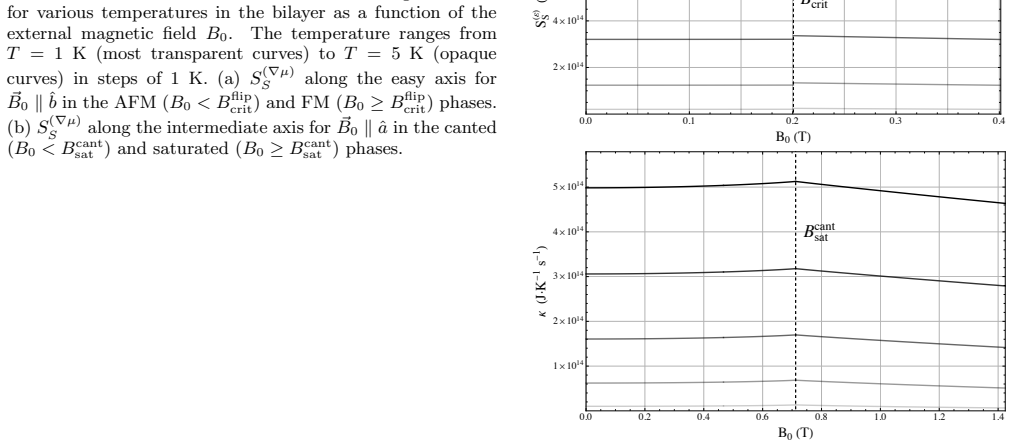
Bilayer Figs. 17(a) (AFM-FM) and 17(b) (canted-saturated) show the magnon thermal conductivity in the bilayer with temperatures ranging fromT= 1 K (most trans- parent curves) toT= 5 (opaque curves) K in steps of 1 K. 12 0.0 0.1 0.2 0.3 0.4 -7 × 10²¹ -6 × 10²¹ -5 × 10²¹ -4 × 10²¹ -3 × 10²¹ -2 × 10²¹ -1 × 10²¹ 0 B0 (T) SS (∇μ)/ℏ( J-1 s-1) Bcrit flip 0.0 0.2...
- [14]
- [15]
-
[16]
G. E. W. Bauer, E. Saitoh, and B. J. van Wees, Spin caloritronics, Nature Materials11, 391 (2012)
work page 2012
-
[17]
S. R. Boona, R. C. Myers, and J. P. Heremans, Spin caloritronics, Energy & Environmental Science7, 885 (2014)
work page 2014
- [18]
-
[19]
S. M. Rezende, R. L. Rodr´ ıguez-Su´ arez, and A. Azevedo, Diffusive magnonic spin transport in antiferromagnetic insulators, Physical Review B93, 054412 (2016)
work page 2016
-
[20]
H. Wu, L. Huang, C. Fang, B. S. Yang, C. H. Wan, G. Q. Yu, J. F. Feng, H. X. Wei, and X. F. Han, Magnon valve effect between two magnetic insulators, Physical Review Letters120, 097205 (2018)
work page 2018
-
[21]
J. Holanda, D. S. Maior, O. Alves Santos, L. H. Vilela- Le˜ ao, J. B. S. Mendes, A. Azevedo, R. L. Rodr´ ıguez- Su´ arez, and S. M. Rezende, Spin Seebeck effect in the antiferromagnet nickel oxide at room temperature, Ap- plied Physics Letters111, 172405 (2017)
work page 2017
-
[22]
C. Gong, L. Li, Z. Li, H. Ji, A. Stern, Y. Xia, T. Cao, W. Bao, C. Wang, Y. Wang, Z. Q. Qiu, R. J. Cava, S. G. Louie, J. Xia, and X. Zhang, Discovery of intrinsic fer- romagnetism in two-dimensional van der Waals crystals, Nature546, 265 (2017)
work page 2017
-
[23]
M. Gibertini, M. Koperski, A. F. Morpurgo, and K. S. Novoselov, Magnetic 2d materials and heterostructures, Nature Nanotechnology14, 408 (2019)
work page 2019
-
[24]
B. Huang, G. Clark, E. Navarro-Moratalla, D. R. Klein, R. Cheng, K. L. Seyler, D. Zhong, E. Schmidgall, M. A. McGuire, D. H. Cobden, W. Yao, D. Xiao, P. Jarillo- Herrero, and X. Xu, Layer-dependent ferromagnetism in a van der Waals crystal down to the monolayer limit, Nature546, 270 (2017)
work page 2017
-
[25]
D. MacNeill, J. T. Hou, D. R. Klein, P. Zhang, P. Jarillo- Herrero, and L. Liu, Gigahertz frequency antiferromag- netic resonance and strong magnon-magnon coupling in the layered crystal CrCl 3, Physical Review Letters123, 047204 (2019)
work page 2019
-
[26]
M. Bonilla, S. Kolekar, Y. Ma, H. C. Diaz, V. Kalappat- til, R. Das, T. Eggers, H. R. Gutierrez, M.-H. Phan, and M. Batzill, Strong room-temperature ferromagnetism in VSe2 monolayers on van der Waals substrates, Nature Nanotechnology13, 289 (2018)
work page 2018
- [27]
-
[28]
C. Gong and X. Zhang, Two-dimensional magnetic crys- tals and emergent heterostructure devices, Science363, 4450 (2019)
work page 2019
-
[29]
K. Yang, G. Wang, L. Liu, D. Lu, and H. Wu, Tri- axial magnetic anisotropy in the two-dimensional ferro- magnetic semiconductor CrSBr, Physical Review B104, 144416 (2021)
work page 2021
- [30]
- [31]
-
[32]
R. den Teuling, R. Das, A. V. Bondarenko, E. V. Tar- takovskaya, G. E. W. Bauer, and Y. M. Blanter, Spin waves in the bilayer van der waals magnet CrSBr, Phys. Rev. B112, 144442 (2025)
work page 2025
-
[33]
S. M. Rezende, B. Freelon, and R. L. Rodr´ ıguez-Su´ arez, Spin wave theory for the triaxial magnetic anisotropy two-dimensional van der Waals antiferromagnet CrSBr, AIP Advances16, 015119 (2026)
work page 2026
-
[34]
G. E. W. Bauer, P. Tang, M. Elyasi, Y. M. Blanter, and B. J. van Wees, Soft magnons in anisotropic ferromag- nets, Phys. Rev. B108, 064431 (2023)
work page 2023
-
[35]
S. A. Bender, R. A. Duine, and Y. Tserkovnyak, Electronic pumping of quasiequilibrium bose-einstein- condensed magnons, Phys. Rev. Lett.108, 246601 (2012)
work page 2012
-
[36]
S. M. Rezende, R. L. Rodr´ ıguez-Su´ arez, and A. Azevedo, Theory of the spin Seebeck effect in antiferromagnets, Phys. Rev. B93, 014425 (2016)
work page 2016
-
[37]
L. J. Cornelissen, K. J. H. Peters, G. E. W. Bauer, R. A. Duine, and B. J. van Wees, Magnon spin transport driven by the magnon chemical potential in a magnetic insula- tor, Phys. Rev. B94, 014412 (2016)
work page 2016
- [38]
-
[39]
N. Okuma, Magnon spin-momentum locking: Various spin vortices and dirac magnons in noncollinear antifer- romagnets, Phys. Rev. Lett.119, 107205 (2017)
work page 2017
-
[40]
R. den Teuling, R. Das, A. Bondarenko, E. Tar- takovskaya, G. Bauer, and Y. Blanter, Dipolar-exchange spin waves in thin bilayers, Low Temperature Physics51, 998 (2025)
work page 2025
-
[41]
T. Holstein and H. Primakoff, Field dependence of the intrinsic domain magnetization of a ferromagnet, Phys. Rev.58, 1098 (1940)
work page 1940
-
[42]
N. N. Bogoliubov, On the theory of superfluidity, J. Phys. (USSR)11, 23 (1947)
work page 1947
-
[43]
N. Okuma, Mathematical aspects of spin-momentum locking: generalization to magnonic systems and appli- cation of orbifold to topological material science, Ph.D. thesis, University of Tokyo, Tokyo, Japan (2018)
work page 2018
-
[44]
J. H. P. Colpa, Diagonalization of the quadratic boson hamiltonian, Physica A: Statistical Mechanics and its Applications93, 327 (1978)
work page 1978
-
[45]
A. Kamra and W. Belzig, Super-poissonian shot noise of squeezed-magnon mediated spin transport, Phys. Rev. Lett.116, 146601 (2016)
work page 2016
-
[46]
Hoogeboom, Spin transport and spin dynamics in an- tiferromagnets, Ph.D
G. Hoogeboom, Spin transport and spin dynamics in an- tiferromagnets, Ph.D. thesis, University of Groningen, 14 Groningen, The Netherlands (2021)
work page 2021
-
[47]
J. S. Jamison, Z. Yang, B. L. Giles, J. T. Brangham, G. Wu, P. C. Hammel, F. Yang, and R. C. Myers, Long lifetime of thermally excited magnons in bulk yttrium iron garnet, Physical Review B100, 134402 (2019)
work page 2019
-
[48]
Y. Gu, J. Barker, J. Li, T. Kikkawa, F. Camino, K. Kisslinger, J. Sinsheimer, L. Lienhard, J. J. Bauer, C. A. Ross, D. N. Basov, and E. Saitoh, Observing differ- ential spin currents by resonant inelastic x-ray scattering, Nature645, 900 (2025)
work page 2025
-
[49]
P. Tang and G. E. W. Bauer, Thermal and coherent spin pumping by noncollinear antiferromagnets, Phys. Rev. Lett.133, 036701 (2024)
work page 2024
-
[50]
B. Heinrich, C. Burrowes, E. Montoya, B. Kardasz, E. Girt, Y.-Y. Song, Y. Sun, and M. Wu, Spin pump- ing at the magnetic insulator (yig)/normal metal (au) interfaces, Phys. Rev. Lett.107, 066604 (2011)
work page 2011
-
[51]
S. S. Zhang and S.-C. Zhang, Spin convertance at mag- netic interfaces, Physical Review B86, 214424 (2012)
work page 2012
-
[52]
Q. Lu, Y. Li, B. Peng, H. Tang, Y. Zhang, Z. He, L. Wang, C. Li, W. Su, Q. Yang, Z. Zhou, and M. Liu, Enhancement of the spin-mixing conductance in Co-Fe- B/W bilayers by interface engineering, Phys. Rev. Appl. 12, 064035 (2019)
work page 2019
-
[53]
R. den Teuling, P. Tang, G. E. W. Bauer, and Y. M. Blanter, Dataset for ”spin-caloritronic signatures of soft magnons in bilayer crsbr”,https://doi.org/10.6084/ m9.figshare.31375255(2025)
work page 2025
-
[54]
D. Esteras, A. Rybakov, A. Ruiz, and J. J. Baldov´ ı, Magnon straintronics in the 2d van der waals ferromagnet crsbr from first-principles, Nano Lett.22, 8771 (2022)
work page 2022
discussion (0)
Sign in with ORCID, Apple, or X to comment. Anyone can read and Pith papers without signing in.