StampFormer: A Physics-Guided Material-Geometry-Coupled Multimodal Model for Rapid Prediction of Physical Fields in Sheet Metal Stamping
Pith reviewed 2026-05-20 20:42 UTC · model grok-4.3
The pith
StampFormer fuses geometry and material stress-strain data to predict stamping physical fields in under a second.
A machine-rendered reading of the paper's core claim, the machinery that carries it, and where it could break.
Core claim
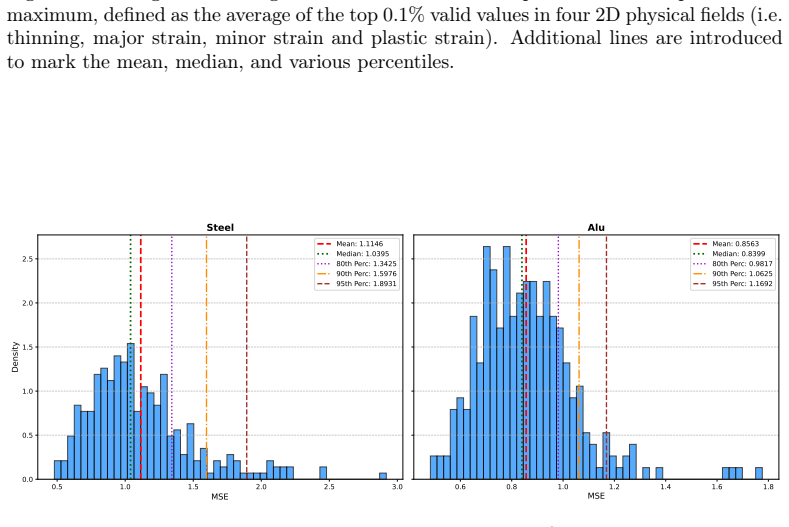
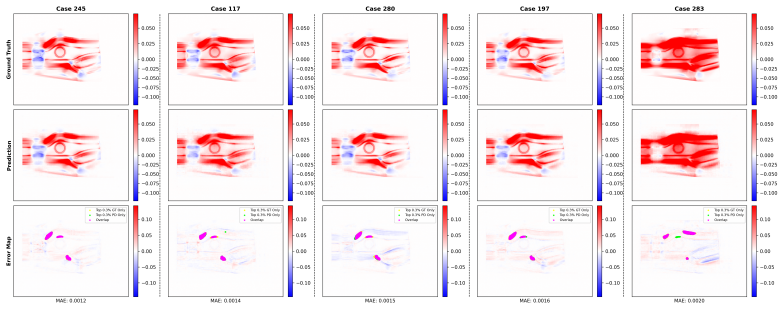
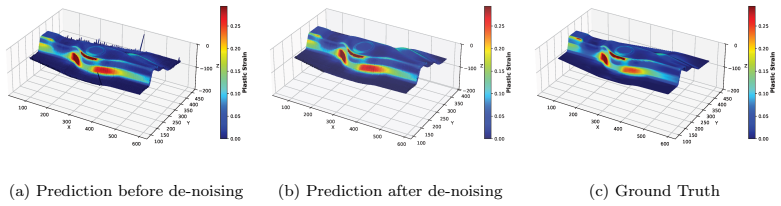
StampFormer is a physics-guided multimodal framework that takes component geometry and material stress-strain responses as inputs to predict FEA outcomes. It first fuses the two data types in a Material-Augmented Geometric Network, then injects the combined information at multiple scales through a Hierarchical Material Embedding Injection Unit before feeding it to an adapted Swin-UNet backbone. On two simulation datasets for a crossmember panel in steel and aluminium, the model produces thinning, major strain, minor strain, plastic strain, and displacement fields in under a second with average relative error below 8.5 percent on the 2D fields and mean squared error below 1.2 mm squared on 3D
What carries the argument
Material-Augmented Geometric Network that fuses geometry with material stress-strain curves before hierarchical injection into the network backbone
If this is right
- Designers can run many more geometry variants in the same time previously used for one full simulation.
- The model supplies complete field maps instead of single scalar quality metrics.
- The same architecture handles both steel and aluminium without separate models.
- Real-time manufacturability feedback becomes possible inside CAD tools.
Where Pith is reading between the lines
- If accuracy holds for new shapes, the approach could be retrained on a broader library of parts to cover entire vehicle programs.
- The same fusion pattern might apply to other manufacturing simulations such as forging or injection molding.
- Running the model inside an optimization loop could automatically suggest geometry changes that reduce forming problems.
Load-bearing premise
Data from simulations of one crossmember panel shape in steel and aluminium is enough for the model to work accurately on other part shapes and materials.
What would settle it
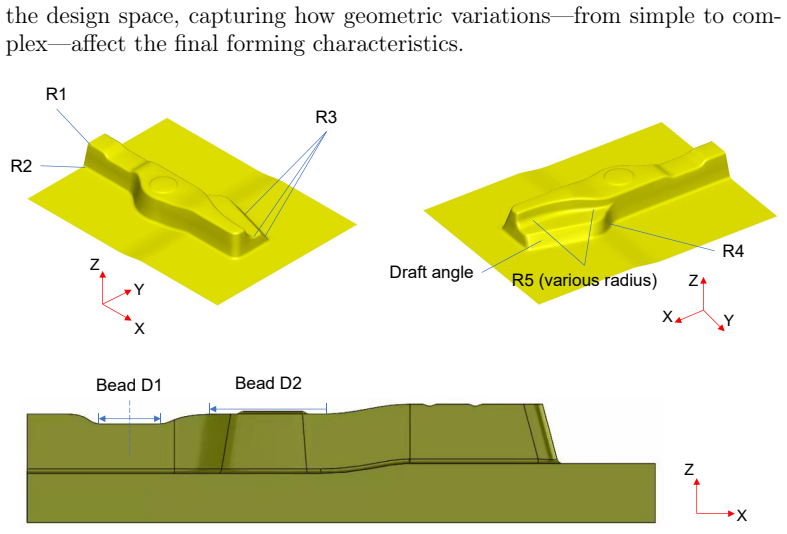
Test the trained model on finite element results for a different part geometry such as an automotive door or hood and check whether the relative errors on the physical fields remain below 8.5 percent.
Figures






read the original abstract
Traditional sheet metal forming relies on time-consuming and expensive Finite Element Analysis (FEA) for design validation, a process that significantly prolongs design cycles. While surrogate models offer faster iteration, current approaches have limitations: scalar-based methods cannot capture comprehensive field-based FEA results, while existing image-based models often ignore the critical role of material properties by focusing solely on geometry. To address this gap, we develop a physics-guided deep learning framework, namely StampFormer, which simultaneously uses component geometry and material stress-strain responses to predict FEA outcomes. The StampFormer framework uses three core components to process data. A Material-Augmented Geometric Network (MAGN) first fuses geometric and material data. This information is then integrated at various levels by a Hierarchical Material Embedding Injection Unit (HMEIU) before being processed by the primary network backbone, an adapted Swin-UNet. We evaluated our model on the stamping of a crossmember panel with two simulation datasets for steel and aluminium panels, and results demonstrate that StampFormer provides high-fidelity predictions of critical physical fields - including thinning, major strain, minor strain, plastic strain, and displacement - in under a second. Compared with ground truth FEA, our model achieved an average relative error of less than 8.5% on the four 2D fields and a mean squared error of less than 1.2 mm2 for the 3D displacement field. In summary, we introduce a practical and efficient framework that integrates multimodal information, namely geometry and material properties, to provide fast and accurate predictions, enabling designers to perform real-time manufacturability assessments.
Editorial analysis
A structured set of objections, weighed in public.
Referee Report
Summary. The manuscript introduces StampFormer, a multimodal deep learning model for rapid prediction of physical fields (thinning, major strain, minor strain, plastic strain, and 3D displacement) in sheet metal stamping. It fuses geometry and material stress-strain responses via a Material-Augmented Geometric Network (MAGN), Hierarchical Material Embedding Injection Unit (HMEIU), and adapted Swin-UNet backbone, reporting average relative error below 8.5% on 2D fields and MSE below 1.2 mm² on displacement for FEA simulations of a single crossmember panel using steel and aluminum, with inference under one second.
Significance. If the reported accuracy generalizes beyond the evaluated geometry and materials, the framework could meaningfully accelerate design validation cycles in manufacturing by replacing slow FEA with fast surrogate predictions, supporting real-time manufacturability checks.
major comments (3)
- [Evaluation / Results] Evaluation is confined to two simulation datasets for one crossmember panel geometry (steel and aluminum). This does not test the model's ability to maintain the claimed error bounds (<8.5% relative error, <1.2 mm² MSE) on unseen part shapes or boundary conditions, which is load-bearing for the central claim of enabling real-time assessment across sheet metal stamping.
- [Methods / Experiments] No baseline comparisons to existing scalar-based or image-based surrogate models, nor ablation studies isolating the contributions of MAGN and HMEIU, are provided. This makes it impossible to quantify the benefit of the proposed multimodal physics-guided fusion over standard supervised training on FEA labels.
- [Abstract / Methods] The abstract and methods describe the model as 'physics-guided' yet provide no explicit enforcement mechanism (e.g., physics-informed loss terms, constraints, or residual penalties) beyond end-to-end supervised training on FEA-generated labels; the approach appears purely data-driven.
minor comments (1)
- [Abstract] The abstract states 'average relative error of less than 8.5%' without specifying per-field breakdowns or confidence intervals; adding these would improve clarity.
Simulated Author's Rebuttal
We thank the referee for the detailed and constructive comments on our manuscript. We address each of the major comments below and outline the revisions we will make to improve the paper.
read point-by-point responses
-
Referee: [Evaluation / Results] Evaluation is confined to two simulation datasets for one crossmember panel geometry (steel and aluminum). This does not test the model's ability to maintain the claimed error bounds (<8.5% relative error, <1.2 mm² MSE) on unseen part shapes or boundary conditions, which is load-bearing for the central claim of enabling real-time assessment across sheet metal stamping.
Authors: We recognize the importance of evaluating generalization to unseen geometries and boundary conditions for the broader applicability of the model. The current study focuses on a representative industrial crossmember panel, which includes complex features such as varying thicknesses and curvatures encountered in automotive stamping. The multimodal architecture is designed to handle diverse inputs through the fusion of geometry and material properties. However, we agree that additional validation on different part shapes would strengthen the claims. In the revised manuscript, we will expand the discussion section to explicitly address the limitations regarding generalization and outline plans for future work on multi-geometry datasets. We will also attempt to include preliminary results on a simpler benchmark geometry if feasible with available simulation resources. revision: partial
-
Referee: [Methods / Experiments] No baseline comparisons to existing scalar-based or image-based surrogate models, nor ablation studies isolating the contributions of MAGN and HMEIU, are provided. This makes it impossible to quantify the benefit of the proposed multimodal physics-guided fusion over standard supervised training on FEA labels.
Authors: We appreciate this suggestion and agree that quantitative comparisons and ablations are essential to demonstrate the advantages of our approach. In the revised version, we will add baseline comparisons against a standard Swin-UNet trained solely on geometric inputs and against simpler convolutional models. Additionally, we will perform ablation studies by removing the MAGN and HMEIU components to isolate their impact on prediction accuracy. These additions will help quantify the benefits of the material-geometry coupling. revision: yes
-
Referee: [Abstract / Methods] The abstract and methods describe the model as 'physics-guided' yet provide no explicit enforcement mechanism (e.g., physics-informed loss terms, constraints, or residual penalties) beyond end-to-end supervised training on FEA-generated labels; the approach appears purely data-driven.
Authors: We thank the referee for pointing out this potential ambiguity in terminology. In our work, 'physics-guided' refers to the integration of physical material constitutive behavior (via stress-strain curves) as multimodal inputs to inform the geometric processing, thereby embedding domain-specific physical knowledge into the model. This is distinct from physics-informed neural networks that incorporate PDE residuals into the loss function. We will revise the abstract, introduction, and methods sections to clarify this usage and better distinguish our data-driven multimodal approach from explicit physics-constrained methods. revision: yes
Circularity Check
Supervised ML surrogate reports FEA-matched errors on single-geometry data without definitional reduction
full rationale
The paper describes an end-to-end trained neural architecture (MAGN + HMEIU + Swin-UNet) whose outputs are compared to FEA labels generated for one crossmember panel. Performance numbers (relative error <8.5 %, MSE <1.2 mm²) are standard test-set metrics from supervised fitting; no equation or claimed first-principles result is shown to equal its own inputs by construction, and no load-bearing self-citation chain is invoked. The work is therefore self-contained against its external FEA benchmark, yielding only minor circularity from the usual ML evaluation loop.
Axiom & Free-Parameter Ledger
free parameters (1)
- model weights and hyperparameters
axioms (1)
- domain assumption FEA simulations provide accurate ground-truth labels for training
Reference graph
Works this paper leans on
- [1]
-
[2]
W. Więckowski, M. Motyka, J. Adamus, P. Lacki, M. Dyner, Numer- ical and experimental analysis of titanium sheet forming for medical instrument parts, Materials 15 (5) (2022) 1735
work page 2022
-
[3]
H. R. Attar, H. Zhou, A. Foster, N. Li, Rapid feasibility assessment of components to be formed through hot stamping: A deep learning approach, J. Manuf. Process. 68 (2021) 1650–1671. 29
work page 2021
-
[4]
A. K. Perka, M. John, U. B. Kuruveri, P. L. Menezes, Advanced high- strength steels for automotive applications: Arc and laser welding pro- cess, properties, and challenges, Metals 12 (6) (2022) 1051
work page 2022
-
[5]
R. Chandel, N. Sharma, S. A. Bansal, A review on recent develop- ments of aluminum-based hybrid composites for automotive applica- tions, Emerg. Mater. 4 (5) (2021) 1243–1257
work page 2021
-
[6]
L. Hua, W. Zhang, H. Ma, Z. Hu, Investigation of formability, mi- crostructures and post-forming mechanical properties of heat-treatable aluminum alloys subjected to pre-aged hardening warm forming, Int. J. Mach. Tools Manuf. 169 (2021) 103799
work page 2021
-
[7]
H. R. Attar, N. Li, A. Foster, A new design guideline development strat- egy for aluminium alloy corners formed through cold and hot stamping processes, Mater. Des. 207 (2021) 109856
work page 2021
-
[8]
S.Li, D.Zhou, A.Pan, Integratedlightweightoptimizationdesignofwall thickness, material, and performance of automobile body side structure, Struct. Multidiscip. Optim. 67 (6) (2024) 95
work page 2024
-
[9]
I. Alawadhi, S. Ramnath, A. Bolar, Y. Fu, J. J. Shah, N. Zurbrugg, D. Detwiler, Structural Design Vs Manufacturability Costs of Complex Stamped Components, in: Proc. Int. Des. Eng. Tech. Conf. Comput. Inf. Eng. Conf. (IDETC/CIE), Vol. 88391, 2024, p. V005T05A008
work page 2024
-
[10]
H. Li, H. Zhou, N. Li, An integrated convolutional neural network- based surrogate model for crashworthiness performance prediction of hot-stamped vehicle panel components, in: MATEC Web Conf., Vol. 401, 2024, p. 03013
work page 2024
-
[11]
H. Zhou, Y. Zhao, H. Li, T. Pfaff, N. Li, A multi-level graph-based surrogate model for real-time high-fidelity sheet forming simulations, Adv. Eng. Inform. 66 (2025) 103458
work page 2025
-
[12]
M. Cantamessa, F. Montagna, G. D’Agnese, Data-driven innovation: challenges and insights of engineering design, Des. Sci. 10 (2024) e11
work page 2024
-
[13]
I.K.Nti, A.F.Adekoya, B.A.Weyori, O.Nyarko-Boateng, Applications of artificial intelligence in engineering and manufacturing: a systematic review, J. Intell. Manuf. 33 (6) (2022) 1581–1601. 30
work page 2022
-
[14]
A. T. G. Tapeh, M. Z. Naser, Artificial intelligence, machine learning, and deep learning in structural engineering: a scientometrics review of trends and best practices, Arch. Comput. Methods Eng. 30 (1) (2023) 115–159
work page 2023
- [15]
-
[16]
A. Ucar, M. Karakose, N. Kırımça, Artificial intelligence for predictive maintenance applications: key components, trustworthiness, and future trends, Appl. Sci. 14 (2) (2024) 898
work page 2024
-
[17]
Grover, AI-Enabled Supply Chain Optimization, Int
N. Grover, AI-Enabled Supply Chain Optimization, Int. J. Adv. Res. Sci. Commun. Technol. (2025) 28–44
work page 2025
-
[18]
Y. Kardovskyi, S. Moon, Artificial intelligence quality inspection of steel bars installation by integrating mask R-CNN and stereo vision, Autom. Constr. 130 (2021) 103850
work page 2021
-
[19]
J. Senoner, T. Netland, S. Feuerriegel, Using explainable artificial intel- ligence to improve process quality: evidence from semiconductor manu- facturing, Manage. Sci. 68 (8) (2022) 5704–5723
work page 2022
-
[20]
S. J. Plathottam, A. Rzonca, R. Lakhnori, C. O. Iloeje, A review of artificial intelligence applications in manufacturing operations, J. Adv. Manuf. Process. 5 (3) (2023) e10159
work page 2023
-
[21]
H. Zhou, Q. Xu, Z. Nie, N. Li, A study on using image-based machine learning methods to develop surrogate models of stamp forming simula- tions, J. Manuf. Sci. Eng. 144 (2) (2022) 021012
work page 2022
- [22]
-
[23]
M.Cheng, X.Zhao, M.Dhimish, W.Qiu, S.Niu, Areviewofdata-driven surrogate models for design optimization of electric motors, IEEE Trans. Transp. Electrific. 10 (4) (2024) 8413–8431. 31
work page 2024
-
[24]
R. Alizadeh, J. K. Allen, F. Mistree, Managing computational com- plexity using surrogate models: a critical review, Res. Eng. Des. 31 (3) (2020) 275–298
work page 2020
-
[25]
C. Ling, W. Kuo, M. Xie, An overview of adaptive-surrogate-model- assisted methods for reliability-based design optimization, IEEE Trans. Reliab. 72 (3) (2022) 1243–1264
work page 2022
-
[26]
A. Hashemi, J. Jang, J. Beheshti, A machine learning-based surrogate finite element model for estimating dynamic response of mechanical sys- tems, IEEE Access 11 (2023) 54509–54525
work page 2023
-
[27]
Y. Shi, Z. Lu, J. Zhou, E. Zio, A novel time-dependent system constraint boundary sampling technique for solving time-dependent reliability- based design optimization problems, Comput. Methods Appl. Mech. Eng. 372 (2020) 113342
work page 2020
-
[28]
T. Hart-Rawung, J. Buhl, M. Bambach, A fast approach for optimiza- tion of hot stamping based on machine learning of phase transformation kinetics, Procedia Manuf. 47 (2020) 707–712
work page 2020
-
[29]
D. Jankovič, M. Šimic, N. Herakovič, A data-driven simulation and Gaussian process regression model for hydraulic press condition diag- nosis, Adv. Eng. Inform. 59 (2024) 102276
work page 2024
-
[30]
J. Kim, C. Lee, Prediction of turbulent heat transfer using convolutional neural networks, J. Fluid Mech. 882 (2020) A18
work page 2020
-
[31]
K. Ren, Y. Chew, Y. F. Zhang, J. Y. H. Fuh, G. J. Bi, Thermal field prediction for laser scanning paths in laser aided additive manufacturing by physics-based machine learning, Comput. Methods Appl. Mech. Eng. 362 (2020) 112734
work page 2020
-
[32]
Q. Tian, S. Guo, E. Melder, L. Bian, W. G. Guo, Deep learning-based data fusion method for in situ porosity detection in laser-based additive manufacturing, J. Manuf. Sci. Eng. 143 (4) (2021) 041011
work page 2021
-
[33]
R. Azad, E. K. Aghdam, A. Rauland, Y. Jia, A. H. Avval, A. Bozorg- pour, S. Karimijafarbigloo, J. P. Cohen, E. Adeli, D. Merhof, Medical image segmentation review: The success of u-net, IEEE Trans. Pattern Anal. Mach. Intell. (2024). 32
work page 2024
-
[34]
Z. Luo, W. Yang, Y. Yuan, R. Gou, X. Li, Semantic segmentation of agriculturalimages: Asurvey, Inf.Process.Agric.11(2)(2024)172–186
work page 2024
-
[35]
J. W. Kim, A. U. Khan, I. Banerjee, Systematic review of hybrid vision transformer architectures for radiological image analysis, J. Imaging In- form. Med. (2025) 1–15
work page 2025
- [36]
- [37]
-
[38]
Z. Zhu, M. Sun, G. Qi, Y. Li, X. Gao, Y. Liu, Sparse dynamic volume TransUNet with multi-level edge fusion for brain tumor segmentation, Comput. Biol. Med. 172 (2024) 108284
work page 2024
-
[39]
D. Jain, R. Modzelewski, R. Hérault, C. Chatelain, E. Torfeh, S. Thureau, Differential-UMamba: Rethinking tumor segmentation un- der limited data scenarios, arXiv:2507.18177 (2025)
work page internal anchor Pith review Pith/arXiv arXiv 2025
-
[40]
H. Cao, Y. Wang, J. Chen, D. Jiang, X. Zhang, Q. Tian, M. Wang, Swin-unet: Unet-like pure transformer for medical image segmentation, in: Proc. Eur. Conf. Comput. Vis. (ECCV), 2022, pp. 205–218. 33
work page 2022
discussion (0)
Sign in with ORCID, Apple, or X to comment. Anyone can read and Pith papers without signing in.