Enhanced Ionization Charge Identification in the Short-Baseline Neutrino Program Neutrino Detectors with Deep Neural Networks
Pith reviewed 2026-05-20 19:49 UTC · model grok-4.3
The pith
A deep neural network identifies regions of interest more effectively than traditional thresholding in liquid argon neutrino detectors.
A machine-rendered reading of the paper's core claim, the machinery that carries it, and where it could break.
Core claim
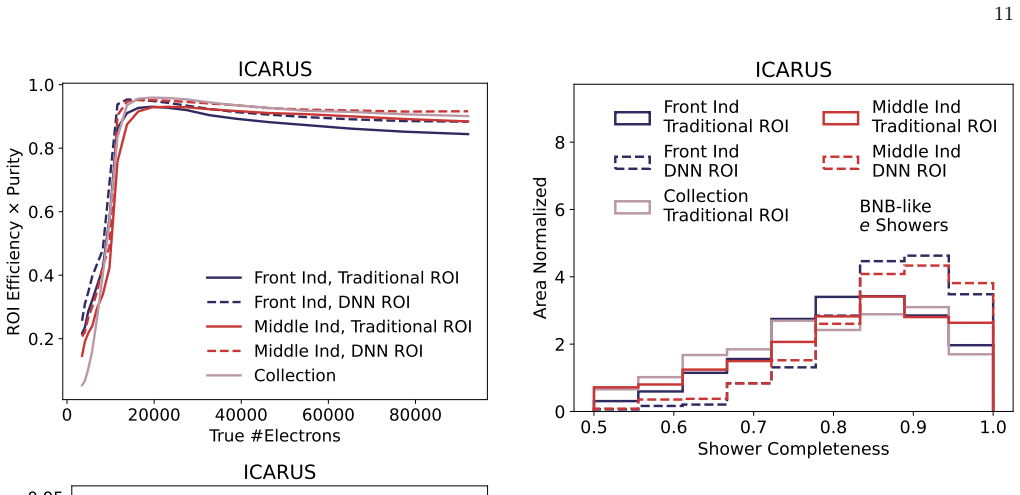
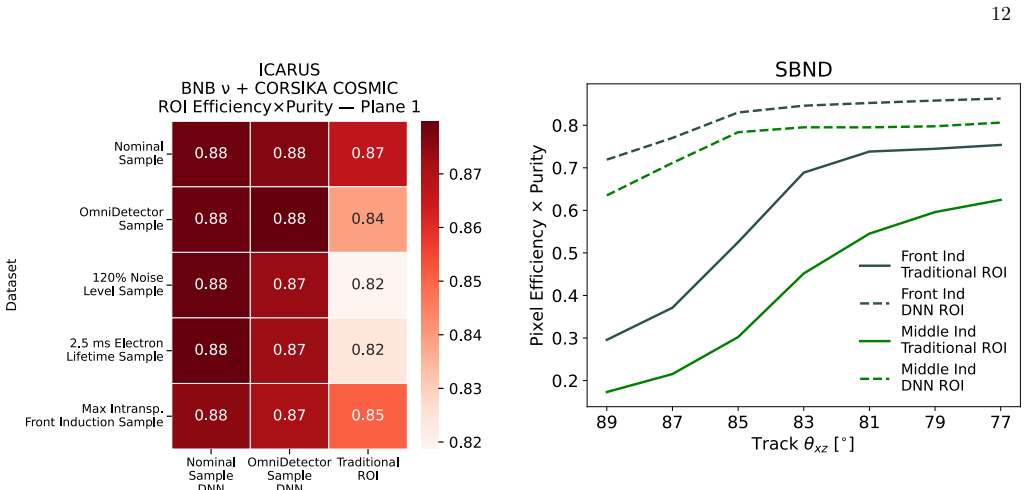
DNN ROI addresses limitations of the traditional wire-by-wire thresholding algorithm by leveraging the full two-dimensional detector readout and cross-plane matching information. It outperforms the traditional method in both low-level ROI identification performance and high-level reconstruction metrics for high-energy cosmic and accelerator neutrino interaction products, while also being more robust against detector variations, with or without sample augmentation.
What carries the argument
DNN ROI, a deep neural network that takes advantage of the complete two-dimensional detector readout and cross-plane matching to detect regions of interest in LArTPCs.
If this is right
- Enhanced identification of ionization charges from high-energy cosmic rays and neutrino interactions.
- Improved metrics in the overall event reconstruction for the SBND and ICARUS detectors.
- Increased robustness to changes in detector performance over time or between runs.
- More reliable results in analyses of accelerator neutrino beams and cosmic ray backgrounds.
Where Pith is reading between the lines
- Adapting this approach to other neutrino experiments using similar detector technology could yield comparable gains in data quality.
- Integration into online triggering systems might reduce the volume of data needing full processing.
- Further refinements could combine the neural network with traditional algorithms for hybrid performance.
Load-bearing premise
The samples used for training, including any augmentations, sufficiently represent the actual variations in detector response encountered during real operations of SBND and ICARUS.
What would settle it
Running the DNN ROI on real collected data from the SBND or ICARUS detectors and directly comparing its ROI identification accuracy and reconstruction quality against the traditional method on the same data set.
Figures






read the original abstract
We present a deep neural net-based region of interest detection method (DNN ROI) for signal processing in the liquid argon time projection chambers of the Short-Baseline Neutrino (SBN) Program, SBND and ICARUS. DNN ROI addresses limitations of the traditional wire-by-wire thresholding algorithm by leveraging the full two-dimensional detector readout and cross-plane matching information. To account for detector performance variations, we explore training with augmented samples. We find that DNN ROI outperforms the traditional method in both low-level ROI identification performance and high-level reconstruction metrics for high-energy cosmic and accelerator neutrino interaction products, while also being more robust against detector variations, with or without sample augmentation.
Editorial analysis
A structured set of objections, weighed in public.
Referee Report
Summary. The manuscript introduces a deep neural network method (DNN ROI) for region-of-interest detection in the signal processing chain of liquid argon time projection chambers in the SBN Program detectors (SBND and ICARUS). It claims that DNN ROI outperforms the conventional wire-by-wire thresholding algorithm on both low-level ROI identification metrics and downstream high-level reconstruction quantities for high-energy cosmic-ray and accelerator neutrino interactions, while also demonstrating greater robustness to detector variations whether or not the training set includes augmented samples that simulate performance fluctuations.
Significance. If the reported gains and robustness hold under realistic conditions, the approach could reduce systematic uncertainties in ionization charge identification and improve event reconstruction fidelity in LArTPC-based neutrino experiments, with direct relevance to the physics goals of the SBN program.
major comments (2)
- The central robustness claim—that DNN ROI remains superior “with or without sample augmentation” and is “more robust against detector variations”—rests on the assumption that the augmentation procedure faithfully reproduces the joint statistics of real effects (plane-to-plane correlated noise, gain drifts, wire response variations, time-dependent pedestal shifts). No quantitative closure test comparing augmented-sample distributions to real calibration-run statistics is presented; this is load-bearing for extrapolating the observed margin to live SBND/ICARUS operation.
- Comparative performance results for low-level ROI identification and high-level reconstruction metrics are reported without error bars, without explicit description of the validation-split protocol, and without quantitative thresholds defining “outperformance.” These omissions leave the strength of the headline claims only moderately supported.
minor comments (1)
- Figure captions and axis labels should explicitly state whether the plotted distributions are from augmented or unaugmented test sets.
Simulated Author's Rebuttal
We thank the referee for their detailed and constructive comments on our manuscript. We address each of the major comments below and indicate the revisions we plan to make.
read point-by-point responses
-
Referee: The central robustness claim—that DNN ROI remains superior “with or without sample augmentation” and is “more robust against detector variations”—rests on the assumption that the augmentation procedure faithfully reproduces the joint statistics of real effects (plane-to-plane correlated noise, gain drifts, wire response variations, time-dependent pedestal shifts). No quantitative closure test comparing augmented-sample distributions to real calibration-run statistics is presented; this is load-bearing for extrapolating the observed margin to live SBND/ICARUS operation.
Authors: We recognize the importance of validating the augmentation procedure against real data. While the augmentation is constructed from individually measured detector effects, a direct closure test on joint distributions was not included in the original submission. In the revised manuscript, we will add a quantitative comparison using calibration data from the SBND and ICARUS detectors to assess how well the augmented samples reproduce the observed statistics of noise, gain, and pedestal variations. revision: yes
-
Referee: Comparative performance results for low-level ROI identification and high-level reconstruction metrics are reported without error bars, without explicit description of the validation-split protocol, and without quantitative thresholds defining “outperformance.” These omissions leave the strength of the headline claims only moderately supported.
Authors: We agree that including error bars, detailing the validation protocol, and specifying quantitative outperformance criteria will better support our claims. We will revise the manuscript to include statistical uncertainties on all performance metrics, describe the train/validation/test split and any cross-validation procedure used, and provide explicit thresholds or significance levels for claiming outperformance. revision: yes
Circularity Check
No significant circularity: empirical performance comparison is self-contained
full rationale
The paper reports an empirical study comparing a DNN-based ROI detection method to a traditional wire-by-wire thresholding algorithm on liquid argon TPC data from the SBN program. Performance is quantified via standard metrics (e.g., identification efficiency, reconstruction quality) evaluated on held-out test sets and augmented samples that simulate detector variations. No equations, first-principles derivations, or predictions are presented that reduce by construction to fitted parameters or inputs defined from the same evaluation data. The robustness claims rest on the external assumption that the augmentation procedure adequately models real detector effects, but this is a methodological limitation rather than a logical circularity in which a claimed result is definitionally equivalent to its training inputs. No self-citation chains, uniqueness theorems, or ansatzes are invoked to force the central result. The derivation chain is therefore independent and externally falsifiable through direct comparison on real or simulated data.
Axiom & Free-Parameter Ledger
free parameters (1)
- DNN architecture and training hyperparameters
axioms (2)
- domain assumption Detector signals can be usefully represented as 2D images for convolutional processing.
- ad hoc to paper Augmented samples sufficiently span the space of detector variations.
Lean theorems connected to this paper
-
IndisputableMonolith/Foundation/RealityFromDistinction.leanreality_from_one_distinction unclear?
unclearRelation between the paper passage and the cited Recognition theorem.
DNN ROI addresses limitations of the traditional wire-by-wire thresholding algorithm by leveraging the full two-dimensional detector readout and cross-plane matching information... U-ResNet architecture
-
IndisputableMonolith/Cost/FunctionalEquation.leanwashburn_uniqueness_aczel unclear?
unclearRelation between the paper passage and the cited Recognition theorem.
We explore training with augmented samples... robustness against detector variations
What do these tags mean?
- matches
- The paper's claim is directly supported by a theorem in the formal canon.
- supports
- The theorem supports part of the paper's argument, but the paper may add assumptions or extra steps.
- extends
- The paper goes beyond the formal theorem; the theorem is a base layer rather than the whole result.
- uses
- The paper appears to rely on the theorem as machinery.
- contradicts
- The paper's claim conflicts with a theorem or certificate in the canon.
- unclear
- Pith found a possible connection, but the passage is too broad, indirect, or ambiguous to say the theorem truly supports the claim.
Reference graph
Works this paper leans on
-
[1]
ROI Filter Output: This frame consists of the de- convolved signal on the wire plane, using the ROI filter (Eq. 5)
-
[2]
Two-Plane (MP2) Coincidence: This frame en- codes geometric constraints across wire planes. It identifies channels where activity in one plane coin- cides with activity in at least one other plane within a common time window on an overlapping wire. This information helps the network disambiguate true physics signals from noise and artifacts that are unlik...
-
[3]
Three-Plane (MP3) Coincidence: Similar to MP2, this frame highlights channels where signals are simultaneously present (in time) across all three wire planes, providing the strongest geometric con- straint and a robust handle on true charge deposi- tions. Signals over five times the noise RMS on the plane of interest, and signals over three times the nois...
work page 2000
- [4]
- [5]
-
[6]
P. Abratenkoet al.(ICARUS), ICARUS at the Fermilab Short-Baseline Neutrino program: initial operation, Eur. Phys. J. C83, 467 (2023), arXiv:2301.08634 [hep-ex]
-
[7]
R. Acciarriet al.(MicroBooNE), Design and Construc- tion of the MicroBooNE Detector, JINST12(02), P02017, arXiv:1612.05824 [physics.ins-det]
-
[8]
A. A. Aguilar-Arevaloet al.(MiniBooNE), The Neutrino Flux Prediction at MiniBooNE, Phys. Rev. D79, 072002 (2009), arXiv:0806.1449 [hep-ex]
work page internal anchor Pith review Pith/arXiv arXiv 2009
-
[9]
P. Adamsonet al., The NuMI Neutrino Beam, Nucl. Instrum. Meth. A806, 279 (2016), arXiv:1507.06690 [physics.acc-ph]
work page internal anchor Pith review Pith/arXiv arXiv 2016
-
[10]
Adamset al.(MicroBooNE), Ionization electron signal processing in single phase LArTPCs
C. Adamset al.(MicroBooNE), Ionization electron signal processing in single phase LArTPCs. Part I. Algorithm Description and quantitative evaluation with MicroBooNE simulation, JINST13(07), P07006, arXiv:1802.08709 [physics.ins-det]
-
[11]
H. Yuet al., Augmented signal processing in Liquid Argon Time Projection Chambers with a deep neu- ral network, JINST16(01), P01036, arXiv:2007.12743 [physics.ins-det]
-
[12]
U-Net: Convolutional Networks for Biomedical Image Segmentation
O. Ronneberger, P. Fischer, and T. Brox, U-net: Con- volutional networks for biomedical image segmentation, CoRRabs/1505.04597(2015), 1505.04597
work page internal anchor Pith review Pith/arXiv arXiv 2015
- [14]
-
[15]
G. Kasieczka and D. Shih, Robust Jet Classifiers through Distance Correlation, Phys. Rev. Lett.125, 122001 (2020), arXiv:2001.05310 [hep-ph]
- [16]
-
[17]
A. Wilkinson, R. Radev, and S. Alonso-Monsalve, Con- trastive learning for robust representations of neutrino data, Phys. Rev. D111, 092011 (2025), arXiv:2502.07724 [hep-ex]
-
[18]
A Convolutional Neural Network Neutrino Event Classifier
A. Aurisano, A. Radovic, D. Rocco, A. Himmel, M. D. Messier, E. Niner, G. Pawloski, F. Psihas, A. Sousa, and P. Vahle, A Convolutional Neural Net- work Neutrino Event Classifier, JINST11(09), P09001, arXiv:1604.01444 [hep-ex]
work page internal anchor Pith review Pith/arXiv arXiv
-
[19]
A. M. Sirunyanet al.(CMS), Identification of heavy- flavour jets with the CMS detector in pp collisions at 13 TeV, JINST13(05), P05011, arXiv:1712.07158 [physics.ins-det]
work page internal anchor Pith review Pith/arXiv arXiv
-
[20]
Efficient Antihydrogen Detection in Antimatter Physics by Deep Learning
P. Sadowski, B. Radics, Ananya, Y. Yamazaki, and P. Baldi, Efficient antihydrogen detection in antimat- ter physics by deep learning, J. Phys. Comm.1, 025001 (2017), arXiv:1706.01826 [physics.ins-det]
work page internal anchor Pith review Pith/arXiv arXiv 2017
-
[21]
C. Adamset al.(MicroBooNE), Deep neural network for pixel-level electromagnetic particle identification in the MicroBooNE liquid argon time projection chamber, Phys. Rev. D99, 092001 (2019), arXiv:1808.07269 [hep- ex]
-
[22]
Decorrelated Jet Substructure Tagging using Adversarial Neural Networks
C. Shimmin, P. Sadowski, P. Baldi, E. Weik, D. White- son, E. Goul, and A. Søgaard, Decorrelated Jet Substruc- ture Tagging using Adversarial Neural Networks, Phys. Rev. D96, 074034 (2017), arXiv:1703.03507 [hep-ex]
work page internal anchor Pith review Pith/arXiv arXiv 2017
-
[23]
Improved Energy Reconstruction in NOvA with Regression Convolutional Neural Networks
P. Baldi, J. Bian, L. Hertel, and L. Li, Improved En- ergy Reconstruction in NOvA with Regression Convolu- tional Neural Networks, Phys. Rev. D99, 012011 (2019), arXiv:1811.04557 [physics.ins-det]
work page internal anchor Pith review Pith/arXiv arXiv 2019
-
[25]
A. Radovic, M. Williams, D. Rousseau, M. Kagan, D. Bonacorsi, A. Himmel, A. Aurisano, K. Terao, and T. Wongjirad, Machine learning at the energy and inten- sity frontiers of particle physics, Nature560, 41 (2018)
work page 2018
- [26]
-
[27]
L. Uboldi, D. Ruth, M. Andrews, M. H. L. S. Wang, H. J. Wenzel, W. Wu, and T. Yang, Extracting low energy signals from raw LArTPC waveforms using deep learning techniques — A proof of concept, Nucl. Instrum. Meth. A 1028, 166371 (2022), arXiv:2106.09911 [physics.ins-det]
-
[28]
B. Abiet al.(DUNE), Deep Underground Neutrino Experiment (DUNE), Far Detector Technical Design Report, Volume II: DUNE Physics, arxiv (2020), arXiv:2002.03005 [hep-ex]
-
[29]
SBND (SBND), Performance and Description of the Short-Baseline Near Detector (SBND), (2025)
work page 2025
- [30]
-
[31]
Wiener,Extrapolation, Interpolation and Smoothing of Stationary Time Series(M.I.T
N. Wiener,Extrapolation, Interpolation and Smoothing of Stationary Time Series(M.I.T. Press, Cambridge, Mass., 1949)
work page 1949
-
[32]
E. L. Snider and G. Petrillo, LArSoft: Toolkit for Sim- ulation, Reconstruction and Analysis of Liquid Argon TPC Neutrino Detectors, J. Phys. Conf. Ser.898, 042057 (2017)
work page 2017
-
[33]
The GENIE Neutrino Monte Carlo Generator
C. Andreopouloset al., The GENIE Neutrino Monte Carlo Generator, Nucl. Instrum. Meth.A614, 87 (2010), arXiv:0905.2517 [hep-ph]
work page internal anchor Pith review Pith/arXiv arXiv 2010
-
[34]
Alvarez-Rusoet al.(GENIE), Recent highlights from GENIE v3, Eur
L. Alvarez-Rusoet al.(GENIE), Recent highlights from GENIE v3, Eur. Phys. J. ST230, 4449 (2021), arXiv:2106.09381 [hep-ph]
-
[35]
D. Heck, J. Knapp, J. N. Capdevielle, G. Schatz, and T. Thouw, CORSIKA: A Monte Carlo code to simulate extensive air showers (1998)
work page 1998
-
[36]
S. Agostinelliet al., Geant4—a simulation toolkit, Nu- clear Instruments and Methods in Physics Research Sec- tion A: Accelerators, Spectrometers, Detectors and As- sociated Equipment506, 250 (2003)
work page 2003
- [37]
-
[38]
O. Bunemann, T. Cranshaw, and J. Harvey, Design of grid ionization chambers, Canadian Journal of Research 27, 191 (2011)
work page 2011
-
[39]
A. G¨ opfert, F. josef Hambsch, and H. Bax, A twin ioniza- tion chamber setup as detector for light charged particles with energies around 1mev applied to the reaction, Nu- clear Instruments & Methods in Physics Research Section A-accelerators Spectrometers Detectors and Associated Equipment441, 438 (2000)
work page 2000
-
[40]
R. Bevilacqua, A. G¨ o¨ ok, F. J. Hambsch, N. Jovanˇ cevi´ c, and M. Vidali, A procedure for the characterization of electron transmission through Frisch grids, Nucl. In- strum. Meth. A770, 64 (2015)
work page 2015
-
[41]
3D Semantic Segmentation with Submanifold Sparse Convolutional Networks
B. Graham, M. Engelcke, and L. van der Maaten, 3d semantic segmentation with submanifold sparse con- volutional networks, CoRRabs/1711.10275(2017), 1711.10275
work page internal anchor Pith review Pith/arXiv arXiv 2017
-
[42]
F. Drielsma, K. Terao, L. Domin´ e, and D. H. Koh, Scalable, end-to-end, deep-learning-based data recon- struction chain for particle imaging detectors (2021), arXiv:2102.01033 [hep-ex]
-
[43]
Z. Zhou, M. M. R. Siddiquee, N. Tajbakhsh, and J. Liang, Unet++: A nested u-net architecture for medi- cal image segmentation, CoRRabs/1807.10165(2018), 1807.10165
work page internal anchor Pith review Pith/arXiv arXiv 2018
-
[44]
L. R. Dice, Measures of the amount of ecologic associa- tion between species, Ecology26, 297 (1945)
work page 1945
-
[45]
T. Sørensen, A method of establishing groups of equal amplitude in plant sociology based on similarity of species content and its application to analyses of the veg- etation on Danish commons, Kongelige Danske Vidensk- abernes Selskab, Biologiske Skrifter5, 1 (1948)
work page 1948
-
[46]
A. P. Zijdenbos, B. M. Dawant, R. A. Margolin, and A. C. 17 Palmer, Morphometric analysis of white matter lesions in MR images: Method and validation, IEEE Transactions on Medical Imaging13, 716 (1994)
work page 1994
-
[47]
K. He, X. Zhang, S. Ren, and J. Sun, Deep residual learning for image recognition (2015), arXiv:1512.03385 [cs.CV]
work page internal anchor Pith review Pith/arXiv arXiv 2015
-
[48]
D. P. Kingma and J. Ba, Adam: A method for stochastic optimization (2017), arXiv:1412.6980 [cs.LG]
work page internal anchor Pith review Pith/arXiv arXiv 2017
- [49]
discussion (0)
Sign in with ORCID, Apple, or X to comment. Anyone can read and Pith papers without signing in.