Deconfined Boundary Phase Transition of a Quantum Critical Heisenberg Model
Pith reviewed 2026-05-20 08:00 UTC · model grok-4.3
The pith
A multispin boundary term drives a continuous transition from antiferromagnetic to valence-bond solid order at the edge of a quantum critical Heisenberg model.
A machine-rendered reading of the paper's core claim, the machinery that carries it, and where it could break.
Core claim
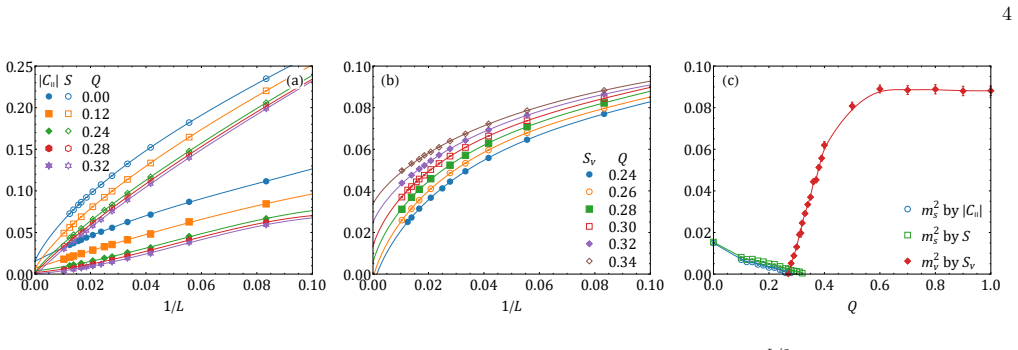
Introducing a multispin Q-term along the boundary of the (2+1)D quantum critical Heisenberg model with dangling chain drives a continuous boundary phase transition from antiferromagnetic order to valence-bond solid order at Q_c = 0.310(11). The weak long-range antiferromagnetic order for Q below Q_c is stabilized by quasi-long-range effective interactions mediated by the critical bulk state, while the valence-bond solid phase restores ordinary critical behavior.
What carries the argument
The multispin Q-term placed along the boundary, which favors valence-bond solid formation while competing with antiferromagnetic order and receives mediating interactions from the critical bulk.
If this is right
- The boundary transition stays continuous and distinct from bulk criticality because of the added Q-term.
- Quasi-long-range interactions transmitted through the critical bulk stabilize weak long-range antiferromagnetic order below Q_c.
- The extracted exponents y_s = 0.81(4), Delta_s = 0.660(15) and Delta_v = 0.204(14) characterize the boundary criticality.
- Once Q exceeds Q_c the valence-bond solid order at the boundary follows standard critical scaling without the mediating long-range effects.
- Topological or multispin boundary terms combined with bulk-mediated interactions can generate new deconfined phases in low-dimensional quantum systems.
Where Pith is reading between the lines
- The same boundary-engineering approach could be tested in other quantum critical models with different symmetries to produce analogous deconfined edge transitions.
- Quantum simulators that realize spin chains attached to critical planes could directly measure the predicted order-parameter scaling and the crossover at Q_c.
- The bulk-mediated interaction mechanism suggests that similar long-range boundary effects may appear whenever a critical bulk couples to a tunable edge.
Load-bearing premise
The large-scale quantum Monte Carlo simulations have fully controlled finite-size effects and boundary artifacts from the dangling-chain geometry so that the reported critical point, continuous character, and exponents accurately represent the thermodynamic limit.
What would settle it
Simulations on significantly larger systems that instead find a first-order jump, a vanishing of the long-range antiferromagnetic order, or exponents incompatible with the quoted values would falsify the claim of a continuous deconfined boundary transition.
Figures



read the original abstract
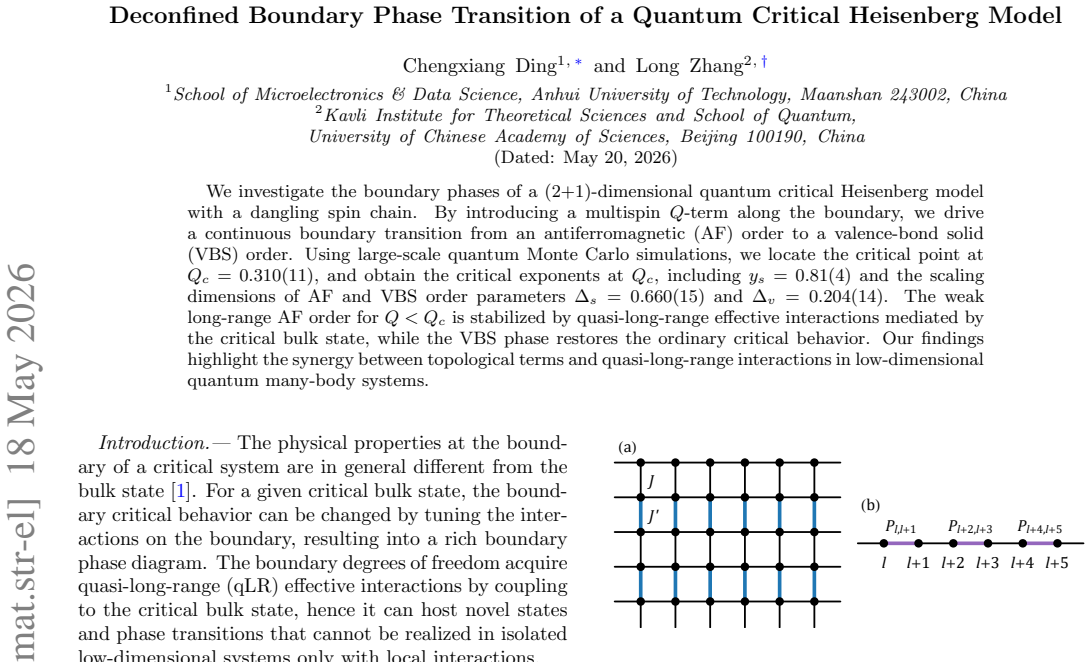
We investigate the boundary phases of a (2+1)-dimensional quantum critical Heisenberg model with a dangling spin chain. By introducing a multispin $Q$-term along the boundary, we drive a continuous boundary transition from an antiferromagnetic (AF) order to a valence-bond solid (VBS) order. Using large-scale quantum Monte Carlo simulations, we locate the critical point at $Q_{c}=0.310(11)$, and obtain the critical exponents at $Q_{c}$, including $y_{s}=0.81(4)$ and the scaling dimensions of AF and VBS order parameters $\Delta_{s}=0.660(15)$ and $\Delta_{v}=0.204(14)$. The weak long-range AF order for $Q<Q_{c}$ is stabilized by quasi-long-range effective interactions mediated by the critical bulk state, while the VBS phase restores the ordinary critical behavior. Our findings highlight the synergy between topological terms and quasi-long-range interactions in low-dimensional quantum many-body systems.
Editorial analysis
A structured set of objections, weighed in public.
Referee Report
Summary. The paper investigates the boundary phases of a (2+1)-dimensional quantum critical Heisenberg model with a dangling spin chain. By introducing a multispin Q-term along the boundary, the authors drive a continuous boundary transition from antiferromagnetic (AF) order to valence-bond solid (VBS) order. Large-scale quantum Monte Carlo simulations locate the critical point at Q_c=0.310(11) and yield exponents y_s=0.81(4), Δ_s=0.660(15), and Δ_v=0.204(14). The weak long-range AF order for Q<Q_c is interpreted as stabilized by quasi-long-range effective interactions mediated by the critical bulk state, while the VBS phase restores ordinary critical behavior.
Significance. If the results hold, the work provides concrete numerical evidence for a deconfined boundary phase transition, illustrating the interplay between boundary topological terms and bulk-mediated quasi-long-range interactions in quantum critical systems. The reported values with error bars from large-scale QMC constitute a strength, offering specific, falsifiable predictions for boundary criticality.
major comments (1)
- [Numerical results and methods] The central claim of a continuous transition at Q_c=0.310(11) with the quoted exponents depends on the QMC data reflecting the thermodynamic limit without significant rounding from finite-size or boundary effects. The dangling-chain geometry introduces open boundaries whose slow modes or effective fields are not guaranteed to be sub-dominant; the manuscript must supply explicit details on simulated system sizes, extrapolation methods, and dedicated checks for boundary artifacts to confirm that these do not shift the apparent location of Q_c or alter the continuity assessment.
minor comments (1)
- [Abstract] The abstract reports concrete numerical values with error bars but does not specify the lattice sizes or Monte Carlo update algorithms employed; adding this information would improve reproducibility without altering the central claims.
Simulated Author's Rebuttal
We thank the referee for the positive assessment of our work and for the constructive major comment. We address it point by point below and agree that additional details will strengthen the manuscript.
read point-by-point responses
-
Referee: [Numerical results and methods] The central claim of a continuous transition at Q_c=0.310(11) with the quoted exponents depends on the QMC data reflecting the thermodynamic limit without significant rounding from finite-size or boundary effects. The dangling-chain geometry introduces open boundaries whose slow modes or effective fields are not guaranteed to be sub-dominant; the manuscript must supply explicit details on simulated system sizes, extrapolation methods, and dedicated checks for boundary artifacts to confirm that these do not shift the apparent location of Q_c or alter the continuity assessment.
Authors: We agree that explicit documentation of system sizes, extrapolation procedures, and boundary-effect checks is essential to substantiate the thermodynamic-limit claims. In the revised manuscript we will add a dedicated subsection (or appendix) that tabulates all simulated linear sizes, describes the finite-size scaling and data-collapse protocols used to extract Q_c and the exponents, and presents dedicated diagnostics (including comparisons across different boundary terminations and monitoring of order-parameter convergence with increasing system size) confirming that open-boundary slow modes remain sub-dominant and do not shift the reported critical point or alter the continuity assessment. revision: yes
Circularity Check
No circularity: results are direct outputs of QMC simulation
full rationale
The paper reports the critical point Q_c and exponents as outputs of large-scale quantum Monte Carlo simulations applied to a defined Hamiltonian with boundary Q-term. No analytical derivation chain exists that reduces any claimed result to fitted inputs or self-citations by construction. The abstract and context show direct numerical determination of quantities like Q_c=0.310(11), y_s=0.81(4), and scaling dimensions, with interpretations following from the data rather than tautological redefinitions or imported uniqueness theorems. This is a standard non-circular numerical study.
Axiom & Free-Parameter Ledger
free parameters (1)
- Q
axioms (1)
- domain assumption The bulk (2+1)D Heisenberg model sits at its quantum critical point.
Lean theorems connected to this paper
-
IndisputableMonolith/Foundation/RealityFromDistinction.leanreality_from_one_distinction unclear?
unclearRelation between the paper passage and the cited Recognition theorem.
We locate the critical point at Qc=0.310(11), and obtain the critical exponents at Qc, including ys=0.81(4) and the scaling dimensions ... Δs=0.660(15) and Δv=0.204(14).
What do these tags mean?
- matches
- The paper's claim is directly supported by a theorem in the formal canon.
- supports
- The theorem supports part of the paper's argument, but the paper may add assumptions or extra steps.
- extends
- The paper goes beyond the formal theorem; the theorem is a base layer rather than the whole result.
- uses
- The paper appears to rely on the theorem as machinery.
- contradicts
- The paper's claim conflicts with a theorem or certificate in the canon.
- unclear
- Pith found a possible connection, but the passage is too broad, indirect, or ambiguous to say the theorem truly supports the claim.
Reference graph
Works this paper leans on
-
[1]
Binder, Critical behaviour at surfaces, inPhase Tran- sitions Crit
K. Binder, Critical behaviour at surfaces, inPhase Tran- sitions Crit. Phenom., Vol. 8, edited by C. Domb and J. L. Lebowitz (Academic Press, London, England, 1983)
work page 1983
-
[2]
L. Zhang and F. Wang, Unconventional surface critical behavior induced by a quantum phase transition from the two-dimensional Affleck-Kennedy-Lieb-Tasaki phase to a N´ eel-ordered phase, Phys. Rev. Lett.118, 087201 (2017)
work page 2017
-
[3]
C. Ding, L. Zhang, and W. Guo, Engineering surface crit- ical behavior of (2+1)-dimensional O(3) quantum critical points, Phys. Rev. Lett.120, 235701 (2018)
work page 2018
- [4]
-
[5]
L. Weber and S. Wessel, Nonordinary criticality at the edges of planar spin-1 Heisenberg antiferromagnets, Phys. Rev. B100, 054437 (2019)
work page 2019
-
[6]
W. Zhu, C. Ding, L. Zhang, and W. Guo, Surface critical behavior of coupled Haldane chains, Phys. Rev. B103, 024412 (2021)
work page 2021
-
[7]
L. Weber and S. Wessel, Spin versus bond correlations along dangling edges of quantum critical magnets, Phys. Rev. B103, L020406 (2021)
work page 2021
- [8]
-
[9]
Z. Wang, F. Zhang, and W. Guo, Bulk and surface critical behavior of a quantum Heisenberg antiferromagnet on two-dimensional coupled diagonal ladders, Phys. Rev. B 106, 134407 (2022)
work page 2022
-
[10]
Z. Wang, F. Zhang, and W. Guo, Extraordinary sur- face critical behavior induced by the symmetry-protected topological states of a two-dimensional quantum magnet, Phys. Rev. B108, 014409 (2023)
work page 2023
-
[11]
C. Ding, W. Zhu, W. Guo, and L. Zhang, Special tran- sition and extraordinary phase on the surface of a two- dimensional quantum Heisenberg antiferromagnet, Sci- Post Phys.15, 012 (2023)
work page 2023
-
[12]
Parisen Toldin, The ordinary surface universality class of the three-dimensional O(N) model, Phys
F. Parisen Toldin, The ordinary surface universality class of the three-dimensional O(N) model, Phys. Rev. B108, L020404 (2023)
work page 2023
-
[13]
F. Parisen Toldin, Boundary critical behavior of the three-dimensional Heisenberg universality class, Phys. Rev. Lett.126, 135701 (2021)
work page 2021
-
[14]
M. Hu, Y. Deng, and J.-P. Lv, Extraordinary-log sur- face phase transition in the three-dimensional XY model, Phys. Rev. Lett.127, 120603 (2021)
work page 2021
-
[15]
F. Parisen Toldin and M. A. Metlitski, Boundary critical- ity of the 3d O(N) model: from normal to extraordinary, Phys. Rev. Lett.128, 215701 (2022)
work page 2022
-
[16]
L.-R. L. Zhang, C. Ding, Y. Deng, and L.-R. L. Zhang, Surface criticality of the antiferromagnetic Potts model, Phys. Rev. B105, 224415 (2022)
work page 2022
- [17]
-
[18]
X. Zou, S. Liu, and W. Guo, Surface critical properties of the three-dimensional clock model, Phys. Rev. B106, 064420 (2022)
work page 2022
-
[19]
Y. Sun and J.-P. Lv, Quantum extraordinary-log univer- sality of boundary critical behavior, Phys. Rev. B106, 224502 (2022)
work page 2022
-
[20]
Y. Sun, J. Lyu, and J.-P. Lv, Classical-quantum cor- respondence of special and extraordinary-log criticality: Villain’s bridge, Phys. Rev. B106, 174516 (2022)
work page 2022
-
[21]
C.-M. Jian, Y. Xu, X.-C. Wu, and C. Xu, Continuous N´ eel-VBS quantum phase transition in non-local one- dimensional systems with SO(3) symmetry, SciPost Phys. 10, 033 (2021)
work page 2021
-
[22]
M. Metlitski, Boundary criticality of the O(N) model in 6 d=3 critically revisited, SciPost Phys.12, 131 (2022)
work page 2022
-
[23]
J. Padayasi, A. Krishnan, M. Metlitski, I. Gruzberg, and M. Meineri, The extraordinary boundary transition in the 3d O(N) model via conformal bootstrap, SciPost Phys.12, 190 (2022)
work page 2022
-
[24]
H.-H. Song and L. Zhang, Boundary phase transitions of two-dimensional quantum critical XXZ model, Phys. Rev. B111, 165139 (2025)
work page 2025
-
[25]
T. Grover and A. Vishwanath, Quantum criticality in topological insulators and superconductors: emergence of strongly coupled Majoranas and supersymmetry, arXiv:1206.1332
work page internal anchor Pith review Pith/arXiv arXiv
-
[26]
T. Suzuki and M. Sato, Gapless edge states and their sta- bility in two-dimensional quantum magnets, Phys. Rev. B86, 224411 (2012)
work page 2012
-
[27]
F. D. M. Haldane, Θ physics and quantum spin chains, J. Appl. Phys.57, 3359 (1985)
work page 1985
-
[28]
F. D. M. Haldane, O(3) nonlinearσmodel and the topo- logical distinction between integer- and half-integer-spin antiferromagnets in two dimensions, Phys. Rev. Lett.61, 1029 (1988)
work page 1988
-
[29]
Y. Tang and A. W. Sandvik, Method to characterize spinons as emergent elementary particles, Phys. Rev. Lett.107, 157201 (2011)
work page 2011
-
[30]
Y. Tang and A. W. Sandvik, Quantum Monte Carlo stud- ies of spinons in one-dimensional spin systems, Phys. Rev. B92, 184425 (2015)
work page 2015
-
[31]
M. Matsumoto, C. Yasuda, S. Todo, and H. Takayama, Ground-state phase diagram of quantum Heisenberg an- tiferromagnets on the anisotropic dimerized square lat- tice, Phys. Rev. B65, 014407 (2001)
work page 2001
-
[32]
N. Ma, P. Weinberg, H. Shao, W. Guo, D.-X. Yao, and A. W. Sandvik, Anomalous quantum-critical scaling cor- rections in two-dimensional antiferromagnets, Phys. Rev. Lett.121, 117202 (2018)
work page 2018
-
[33]
A. W. Sandvik, Evidence for deconfined quantum criti- cality in a two-dimensional Heisenberg model with four- spin interactions, Phys. Rev. Lett.98, 227202 (2007)
work page 2007
-
[34]
J. Lou, A. W. Sandvik, and N. Kawashima, Anti- ferromagnetic to valence-bond-solid transitions in two- dimensional SU(N) Heisenberg models with multispin in- teractions, Phys. Rev. B80, 180414(R) (2009)
work page 2009
-
[35]
T. Senthil, L. Balents, S. Sachdev, A. Vishwanath, and M. P. A. Fisher, Quantum criticality beyond the Landau- Ginzburg-Wilson paradigm, Phys. Rev. B70, 144407 (2004)
work page 2004
-
[36]
T. Senthil, A. Vishwanath, L. Balents, S. Sachdev, and M. P. A. Fisher, Deconfined quantum critical points, Sci- ence303, 1490 (2004)
work page 2004
-
[37]
A. W. Sandvik, Ground state projection of quantum spin systems in the valence-bond basis, Phys. Rev. Lett.95, 207203 (2005)
work page 2005
-
[38]
A. W. Sandvik and H. G. Evertz, Loop updates for varia- tional and projector quantum Monte Carlo simulations in the valence-bond basis, Phys. Rev. B82, 024407 (2010)
work page 2010
-
[39]
Y. Deng, H. W. J. Bl¨ ote, and M. P. Nightingale, Surface and bulk transitions in three-dimensional O(n) models, Phys. Rev. E72, 016128 (2005)
work page 2005
-
[40]
N. D. Mermin and H. Wagner, Absence of ferromag- netism or antiferromagnetism in one- or two-dimensional isotropic Heisenberg models, Phys. Rev. Lett.17, 1133 (1966)
work page 1966
-
[41]
Witten, Non-abelian bosonization in two dimensions, Commun
E. Witten, Non-abelian bosonization in two dimensions, Commun. Math. Phys.92, 455 (1984). TABLE AI. Fitting parameters of (−1) L/2C∥(L/2) atQ= 0 according to Eq. (A1). The fitting quality is very poor. In addition, the parameters vary significantly with the minimum lattice sizeL min, indicating that the fitting is unstable. Lmin a q ∥ c χ/d.o.f. 12 1.2(9)...
work page 1984
-
[42]
Affleck, Critical behavior of two-dimensional systems with continuous symmetries, Phys
I. Affleck, Critical behavior of two-dimensional systems with continuous symmetries, Phys. Rev. Lett.55, 1355 (1985)
work page 1985
-
[43]
Affleck, The quantum Hall effects,σ-models at Θ =π and quantum spin chains, Nucl
I. Affleck, The quantum Hall effects,σ-models at Θ =π and quantum spin chains, Nucl. Phys. B257, 397 (1985). Extraordinary-log trial fitting in theQ < Q c phase We attempt to fit the boundary spin correlation func- tion in theQ < Q c phase with the extraordinary-log scaling form [13, 22], (−1)L/2C∥(L/2) =a(lnr+c) −q∥ ,(A1) and the corresponding static AF ...
work page 1985
discussion (0)
Sign in with ORCID, Apple, or X to comment. Anyone can read and Pith papers without signing in.