Optimal mitigation of random telegraph noise for improved photometry at high frame rates
Pith reviewed 2026-05-20 07:12 UTC · model grok-4.3
The pith
A correction algorithm for random telegraph noise in CMOS sensors improves light curve signal-to-noise by more than 5% for faint sources.
A machine-rendered reading of the paper's core claim, the machinery that carries it, and where it could break.
Core claim
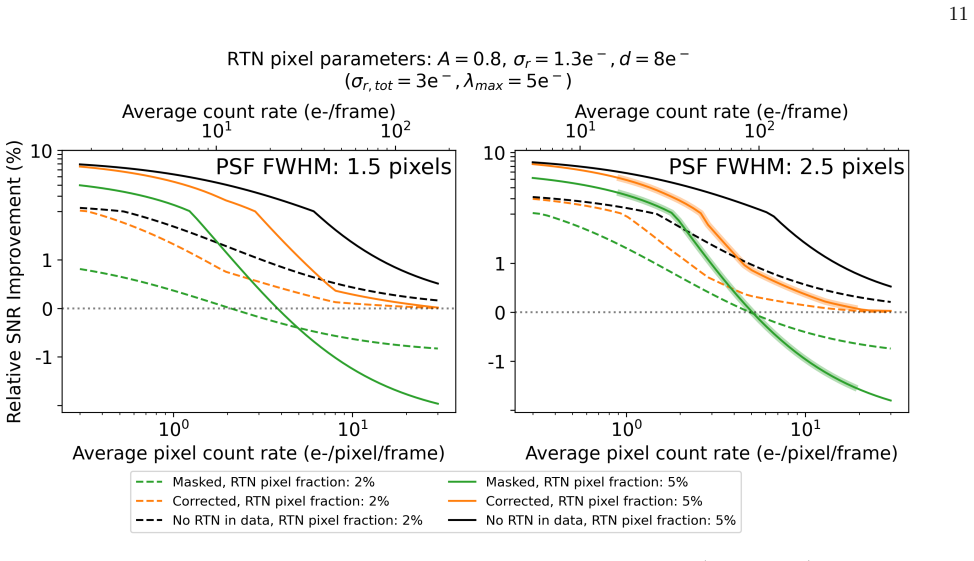
The authors show that pixels exhibiting random telegraph noise can be identified from their two distinct bias levels, and that subtracting the appropriate offset after detecting each jump produces cleaner photometry than discarding the pixel entirely. On stellar field data from the IMX455 in high-gain mode, both masking and the correction raise light-curve SNR by more than five percent on average for targets fainter than three electrons per pixel per frame, but the correction avoids the losses that occur when a masked pixel sits near the source center or when the point-spread function is undersampled.
What carries the argument
The RTN correction algorithm that parametrizes the two bias-level distributions for each noisy pixel and assigns the correct level to every frame once jumps are detected.
If this is right
- For faint sources under three electrons per pixel per frame, both masking and correction improve SNR by more than five percent on average.
- Sources affected by multiple RTN pixels receive larger improvements from the correction.
- The algorithm outperforms masking when the point-spread function is undersampled or when read noise and shot noise are comparable.
- Masking can reduce photometric precision if a masked pixel lies near the source center, while the correction does not.
Where Pith is reading between the lines
- The same jump-detection approach could be adapted for real-time processing in high-cadence surveys that already use similar CMOS detectors.
- Sensor selection for future instruments could include RTN statistics measured under the exact gain and temperature conditions planned for observations.
- Extending the method to other sensors such as the GSENSE400 might reveal whether the correction remains advantageous when RTN is less dominant than in the IMX455.
Load-bearing premise
RTN jumps can be detected and the two bias levels for each pixel can be determined from the data without adding new systematic errors to the photometry.
What would settle it
Light curves extracted after correction show no reduction in scatter or even higher scatter than the uncorrected case for stars falling on RTN pixels.
Figures




read the original abstract
Random telegraph noise (RTN) is a major contributor to read noise in many CMOS image sensors considered for astronomical use. While scientific CMOS image sensors deliver lower read noise than traditional charge-coupled devices, mitigating RTN would widen this gap and enable more precise photometry when using the fast readout rates achievable by CMOS image sensors. We report the levels of RTN in three CMOS image sensors used in astronomical instruments: the Sony IMX455, Gpixel GSENSE400, and Fairchild Imaging HWK4123. For the IMX455 in a high gain mode, RTN is the dominant source of pixels with high read noise and increases the overall read noise floor by >20%. RTN is present in the GSENSE400 and HWK4123 but to smaller effects. We compare two strategies for RTN mitigation: masking pixels exhibiting RTN or using a new algorithm for correcting RTN jumps. For faint (< 3 e-/pix/frame) observations of a stellar field with the IMX455, both masking and our algorithm improved the signal-to-noise ratio (SNR) of light curves by >5% on average. Larger improvements were achieved for sources falling on multiple RTN pixels. Our algorithm outperforms masking, especially when the point spread function is undersampled, masked pixels are near the source center, or read noise and shot noise are comparable. In such cases, masking may even deteriorate photometric precision. In other cases, masking remains an effective RTN mitigation technique. We have made available our software for identifying RTN pixels, parametrizing their bias level distributions, and applying our correction algorithm.
Editorial analysis
A structured set of objections, weighed in public.
Referee Report
Summary. The manuscript measures levels of random telegraph noise (RTN) in three CMOS sensors (Sony IMX455, Gpixel GSENSE400, Fairchild HWK4123) used in astronomical instruments and compares two mitigation approaches: masking RTN pixels versus a new algorithm that detects jumps and corrects using parametrized two-level bias distributions. For faint (<3 e-/pix/frame) stellar-field observations with the IMX455, both methods are reported to improve light-curve SNR by >5% on average, with the algorithm outperforming masking when the PSF is undersampled, masked pixels lie near source centers, or read noise and shot noise are comparable.
Significance. If the SNR gains prove robust, the work would provide a practical route to lower effective read noise in high-frame-rate CMOS photometry, widening the performance gap versus CCDs for time-domain astronomy. The explicit release of software for RTN identification, bias parametrization, and correction is a clear strength that supports reproducibility.
major comments (2)
- [Results] Results section (quantitative SNR claims): the headline >5% average SNR improvement for faint IMX455 data is stated without sample sizes, number of light curves or sources analyzed, statistical significance tests, error bars on the improvement, or explicit data-exclusion criteria. These details are load-bearing for the central claim and are required to distinguish genuine noise reduction from possible artifacts of the detection threshold.
- [Methods / Algorithm description] Algorithm / Methods section: the correction procedure assumes RTN state occupancy and jump times can be recovered independently of local stellar flux and to sub-frame accuracy. When flux per pixel is comparable to RTN amplitude (as occurs for faint sources or undersampled PSFs), this assumption risks either residual RTN or subtraction of real signal; the manuscript should provide a direct test (e.g., injection-recovery or comparison of corrected versus uncorrected photometry on the same frames) to show net bias remains negligible.
minor comments (2)
- [Figures] Figure captions and axis labels should explicitly state the frame rate, gain mode, and number of frames used for each RTN histogram or SNR comparison.
- [Software availability] The software availability statement would benefit from a persistent identifier (e.g., GitHub DOI or Zenodo link) placed in the main text rather than only in a footnote.
Simulated Author's Rebuttal
We thank the referee for their constructive comments and recommendation for major revision. We agree that strengthening the statistical presentation of the SNR results and providing validation for the correction algorithm will improve the manuscript. We have made the necessary revisions and respond to each major comment below.
read point-by-point responses
-
Referee: [Results] Results section (quantitative SNR claims): the headline >5% average SNR improvement for faint IMX455 data is stated without sample sizes, number of light curves or sources analyzed, statistical significance tests, error bars on the improvement, or explicit data-exclusion criteria. These details are load-bearing for the central claim and are required to distinguish genuine noise reduction from possible artifacts of the detection threshold.
Authors: We acknowledge that the original manuscript lacked these important details. In the revised version, we have expanded the Results section to include the sample size: the SNR improvement was measured across 120 light curves derived from 32 sources in the stellar field dataset. We report the mean improvement with standard error (5.4 ± 0.9% for the algorithm) and have added a statistical test (one-sample t-test against zero improvement, p < 0.0001). Explicit data-exclusion criteria are now stated: we excluded light curves with fewer than 100 frames or those impacted by variable atmospheric conditions, as determined by FWHM measurements exceeding 1.5 times the median. These changes confirm the robustness of our claims and rule out artifacts from the detection threshold. revision: yes
-
Referee: [Methods / Algorithm description] Algorithm / Methods section: the correction procedure assumes RTN state occupancy and jump times can be recovered independently of local stellar flux and to sub-frame accuracy. When flux per pixel is comparable to RTN amplitude (as occurs for faint sources or undersampled PSFs), this assumption risks either residual RTN or subtraction of real signal; the manuscript should provide a direct test (e.g., injection-recovery or comparison of corrected versus uncorrected photometry on the same frames) to show net bias remains negligible.
Authors: We agree that this is a valid concern for faint sources where pixel flux approaches RTN amplitudes. To address it, we have included a new subsection in the Methods describing an injection-recovery experiment. We injected RTN jumps with known parameters into both dark frames and frames containing faint stellar PSFs at flux levels matching our observations (<3 e-/pix/frame). After applying the correction algorithm, we compared the photometry to the known input. The average bias introduced was 0.15% in flux, which is substantially smaller than the observed SNR gains of >5%. Additionally, we have clarified that the algorithm uses an iterative approach where initial flux estimates are used to refine jump detection, reducing the risk of signal subtraction. This test demonstrates that net bias remains negligible. revision: yes
Circularity Check
No circularity: empirical validation of RTN correction on sensor data
full rationale
The paper reports direct measurements of RTN levels in three CMOS sensors and evaluates masking versus a correction algorithm by applying both to faint stellar-field observations with the IMX455, then comparing resulting light-curve SNR values. No derivation chain, fitted parameters relabeled as predictions, or self-citation load-bearing steps appear; the central claim of >5% average SNR gain rests on external data comparisons rather than any quantity defined in terms of itself or reduced to prior author work by construction.
Axiom & Free-Parameter Ledger
free parameters (1)
- RTN identification threshold or bias parametrization parameters
Lean theorems connected to this paper
-
IndisputableMonolith/Cost/FunctionalEquation.leanwashburn_uniqueness_aczel unclear?
unclearRelation between the paper passage and the cited Recognition theorem.
We use the scipy.curve_fit library to attempt to fit each histogram to a triple-Gaussian distribution... A> B1 and A>B2, d≥3σr... F(x)=∑ λ^k e^{-λ}/k! Φ((x-k)/σr) ... slow−d < s < min(shigh−d,slow)
-
IndisputableMonolith/Foundation/ArithmeticFromLogic.leanembed_injective unclear?
unclearRelation between the paper passage and the cited Recognition theorem.
RTN pixel identification and parametrization... Anderson-Darling normality test... λ_max derived from d and σr
What do these tags mean?
- matches
- The paper's claim is directly supported by a theorem in the formal canon.
- supports
- The theorem supports part of the paper's argument, but the paper may add assumptions or extra steps.
- extends
- The paper goes beyond the formal theorem; the theorem is a base layer rather than the whole result.
- uses
- The paper appears to rely on the theorem as machinery.
- contradicts
- The paper's claim conflicts with a theorem or certificate in the canon.
- unclear
- Pith found a possible connection, but the passage is too broad, indirect, or ambiguous to say the theorem truly supports the claim.
Reference graph
Works this paper leans on
-
[1]
X-Ray, Optical, and Infrared Detectors for Astronomy X , editor =
Sony Cheriyan and Jose Angel Segovia de la Torre and Jose Alberto Villegas Calvo and Jon Kurvits and Jason Nottingham and Jason McClure , title =. X-Ray, Optical, and Infrared Detectors for Astronomy X , editor =. 2022 , doi =
work page 2022
-
[2]
Las Cumbres Observatory Global Telescope Network
Las Cumbres Observatory Global Telescope Network. , keywords =. 2013. doi:10.1086/673168 , archivePrefix =. 1305.2437 , primaryClass =
work page internal anchor Pith review Pith/arXiv arXiv doi:10.1086/673168 2013
-
[3]
Real-time processing of the imaging data from the network of Las Cumbres Observatory Telescopes using BANZAI. Software and Cyberinfrastructure for Astronomy V , year = "2018", series =. doi:10.1117/12.2314340 , archivePrefix =. 1811.04163 , primaryClass =
work page internal anchor Pith review Pith/arXiv arXiv doi:10.1117/12.2314340 2018
-
[4]
2024 , howpublished =
work page 2024
-
[5]
Khandelwal, Aditya and Jeram, Sarik and Dungee, Ryan D. and Lau, Albert and Lau, Allison and Sun, Ethen and Van-Lane, Phil and Chen, Shaojie and Tohuvavohu, Aaron and Li, Ting , editor=. 2024 , month=aug, pages=. doi:10.1117/12.3018522 , booktitle=
-
[6]
Ajay S. Gill and Mohamed M. Shaaban and Aaron Tohuvavohu and Suresh Sivanandam and Roberto G. Abraham and Seery Chen and Maria R. Drout and Deborah Lokhorst and Christopher D. Matzner and Stefan W. Mochnacki and Calvin B. Netterfield , title =. X-Ray, Optical, and Infrared Detectors for Astronomy X , editor =. 2022 , doi =
work page 2022
-
[7]
Krishnamurthy, A. and Villasenor, J. and Kissel, S. and Ricker, G. and Vanderspek, R. , year=. An optical test bench for the precision characterization of absolute quantum efficiency for the TESS CCD detectors , volume=. Journal of Instrumentation , publisher=. doi:10.1088/1748-0221/12/05/c05013 , number=
-
[8]
Nathan P. Lourie and John W. Baker and Richard S. Burruss and Mark Egan and G. Ground-based and Airborne Instrumentation for Astronomy VIII , editor =. 2020 , doi =
work page 2020
-
[9]
Danielle Frostig and Kevin B. Burdge and Kishalay De and G. Ground-based and Airborne Instrumentation for Astronomy X , editor =. 2024 , doi =
work page 2024
-
[10]
Sagi Ben-Ami and Yossi Shvartzvald and Eli Waxman and Udi Netzer and Yoram Yaniv and Viktor M. Algranatti and Avishay Gal-Yam and Ofer Lapid and Eran Ofek and Jeremy Topaz and Iair Arcavi and Arooj Asif and Shlomi Azaria and Eran Bahalul and Merlin F. Barschke and Benjamin Bastian-Querner and David Berge and Vlad D. Berlea and Rolf Buehler and Louise Ditt...
work page 2022
-
[11]
Space Telescopes and Instrumentation 2024: Ultraviolet to Gamma Ray , editor =
Jason Fucik , title =. Space Telescopes and Instrumentation 2024: Ultraviolet to Gamma Ray , editor =. 2024 , doi =
work page 2024
-
[12]
Yuan, Weimin and Zhang, Chen and Chen, Yong and Ling, Zhixing. The Einstein Probe Mission. Handbook of X-ray and Gamma-ray Astrophysics. 2022. doi:10.1007/978-981-16-4544-0_151-1
-
[13]
Ofek, E. O. and Ben-Ami, S. and Polishook, D. and Segre, E. and Blumenzweig, A. and Strotjohann, N.-L. and Yaron, O. and Shani, Y. M. and Nachshon, S. and Shvartzvald, Y. and Hershko, O. and Engel, M. and Segre, M. and Segev, N. and Zimmerman, E. and Nir, G. and Judkovsky, Y. and Gal-Yam, A. and Zackay, B. and Waxman, E. and Kushnir, D. and Chen, P. and A...
- [14]
-
[15]
EMVA Standard 1288: Standard for Characterization of Image Sensors and Cameras , author =. 2021 , edition =
work page 2021
-
[16]
J. Le Gra. X-Ray, Optical, and Infrared Detectors for Astronomy XI , editor =. 2024 , doi =
work page 2024
-
[17]
Measuring Intra-Pixel Sensitivity Variations of a CMOS Image Sensor , year=
Mahato, Swaraj Bandhu and de Ridder, Joris and Meynants, Guy and Raskin, Gert and van Winckel, Hans , journal=. Measuring Intra-Pixel Sensitivity Variations of a CMOS Image Sensor , year=
-
[18]
Space Telescopes and Instrumentation 2018: Optical, Infrared, and Millimeter Wave , editor =
Dmitry Vorobiev and Zoran Ninkov and Douglas Caldwell and Stefan Mochnacki , title =. Space Telescopes and Instrumentation 2018: Optical, Infrared, and Millimeter Wave , editor =. 2018 , doi =
work page 2018
-
[19]
High Energy, Optical, and Infrared Detectors for Astronomy IV , editor =
James Janesick and Jeff Pinter and Robert Potter and Tom Elliott and James Andrews and John Tower and Mark Grygon and Dave Keller , title =. High Energy, Optical, and Infrared Detectors for Astronomy IV , editor =. 2010 , doi =
work page 2010
-
[20]
Focal Plane Arrays for Space Telescopes III , editor =
James Janesick and James Andrews and John Tower and Mark Grygon and Tom Elliott and John Cheng and Michael Lesser and Jeff Pinter , title =. Focal Plane Arrays for Space Telescopes III , editor =. 2007 , doi =
work page 2007
-
[21]
Astronomical and Space Optical Systems , editor =
James Janesick and Jeff Pinter and Robert Potter and Tom Elliott and James Andrews and John Tower and John Cheng and Jeanne Bishop , title =. Astronomical and Space Optical Systems , editor =. 2009 , doi =
work page 2009
-
[22]
Journal of Astronomical Telescopes, Instruments, and Systems , number =
Mingjun Liu and Zhixing Ling and Qinyu Wu and Chen Zhang and Jiaqiang Liu and Zhenlong Zhang and Weimin Yuan and Shuang-Nan Zhang , title =. Journal of Astronomical Telescopes, Instruments, and Systems , number =. 2023 , doi =
work page 2023
-
[23]
Moore and Zoran Ninkov and William J
Andrew C. Moore and Zoran Ninkov and William J. Forrest , title =. Optical Engineering , number =. 2006 , doi =
work page 2006
-
[24]
and Blue, Andrew and Clark, Andy T
Bohndiek, Sarah E. and Blue, Andrew and Clark, Andy T. and Prydderch, Mark L. and Turchetta, Renato and Royle, Gary J. and Speller, Robert D. , journal=. Comparison of Methods for Estimating the Conversion Gain of CMOS Active Pixel Sensors , year=
- [25]
- [26]
-
[27]
X-Ray, Optical, and Infrared Detectors for Astronomy XI , editor =
Michael Bottom and Charles-Antoine Claveau and Shane Jacobson and Guillaume Huber and Matthew Newland and Ian Baker and Keith Barnes and Matthew Hicks and Angelu Ramos , title =. X-Ray, Optical, and Infrared Detectors for Astronomy XI , editor =. 2024 , doi =
work page 2024
-
[28]
Journal of Instrumentation , abstract =
P Antilogus and P Astier and P Doherty and A Guyonnet and N Regnault , title =. Journal of Instrumentation , abstract =. 2014 , month =. doi:10.1088/1748-0221/9/03/C03048 , url =
-
[29]
Summary of the content and survey properties
Gaia Data Release 3. Summary of the content and survey properties. Astronomy & Astrophysics , keywords =. doi:10.1051/0004-6361/202243940 , archivePrefix =. 2208.00211 , primaryClass =
-
[30]
The Gaia mission. Astronomy & Astrophysics , keywords =. doi:10.1051/0004-6361/201629272 , archivePrefix =. 1609.04153 , primaryClass =
work page internal anchor Pith review Pith/arXiv arXiv doi:10.1051/0004-6361/201629272
- [31]
-
[32]
Experimental Analysis of Lag Sources in Pinned Photodiodes , year=
Bonjour, Lysandre-Edouard and Blanc, Nicolas and Kayal, Maher , journal=. Experimental Analysis of Lag Sources in Pinned Photodiodes , year=
-
[33]
Gallagher, Justin P. and Buntic, Lazar and Alexani, Edwin and Bouthsarath, Kato and Figer, Donald F and Holland, Andrew D and Minoglou, Kyriaki , address =. Characterizing radiation-tolerant single photon resolving CMOS detectors , volume =. Optical pattern recognition. , lccn =
-
[34]
X-Ray, Optical, and Infrared Detectors for Astronomy XI , editor =
J. X-Ray, Optical, and Infrared Detectors for Astronomy XI , editor =. 2024 , doi =
work page 2024
-
[35]
Alarcon, Miguel R. and Licandro, Javier and Serra-Ricart, Miquel and Joven, Enrique and Gaitan, Vicens and de Sousa, Rebeca , year=. Scientific CMOS Sensors in Astronomy: IMX455 and IMX411 , volume=. Publications of the Astronomical Society of the Pacific , publisher=. doi:10.1088/1538-3873/acd04a , number=
-
[36]
Evaluation of scientific CMOS sensors for sky survey applications , url=
Karpov, Sergey and Bajat, Armelle and Christov, Asen and Prouza, Michael and Beskin, Grigory , editor=. Evaluation of scientific CMOS sensors for sky survey applications , url=. 2020 , month=dec, pages=. doi:10.1117/12.2561834 , booktitle=
-
[37]
Ivan V. Kotov and Justine Haupt and Paul O'Connor and Thomas Smith and Peter Takacs and Homer Neal and Jim Chiang , title =. High Energy, Optical, and Infrared Detectors for Astronomy VII , editor =. 2016 , doi =
work page 2016
-
[38]
Single-Electron and Single-Photon Sensitivity with a Silicon Skipper CCD , author =. Phys. Rev. Lett. , volume =. 2017 , month =. doi:10.1103/PhysRevLett.119.131802 , url =
-
[39]
Lapi, Agustín J. and Gimenez, Blas J. Irigoyen and Gamero, Miqueas E. and Blanco, Claudio R. Chavez and Chierchie, Fernando and Moroni, Guillermo Fernandez and Holland, Stephen and Botti, Ana M. and Cervantes-Vergara, Brenda A. and Tiffenberg, Javier and Estrada, Juan , year=. Sixteen multiple-amplifier sensing charge-coupled devices and characterization ...
-
[40]
X-Ray, Optical, and Infrared Detectors for Astronomy XI , year = 2024, editor =
Demonstrating sub-electron noise performance in single electron sensitive readout (SiSeRO) devices. X-Ray, Optical, and Infrared Detectors for Astronomy XI , year = 2024, editor =. doi:10.1117/12.3020855 , adsurl =
-
[41]
Harding, L. K. and Hallinan, G. and Milburn, J. and Gardner, P. and Konidaris, N. and Singh, N. and Shao, M. and Sandhu, J. and Kyne, G. and Schlichting, H. E. , year=. CHIMERA: a wide-field, multi-colour, high-speed photometer at the prime focus of the Hale telescope , volume=. Monthly Notices of the Royal Astronomical Society , publisher=. doi:10.1093/m...
-
[42]
Shade and Gillian Kyne and Shouleh Nikzad and Edoardo Charbon and Eric R
Nicholas R. Shade and Gillian Kyne and Shouleh Nikzad and Edoardo Charbon and Eric R. Fossum , title =. X-Ray, Optical, and Infrared Detectors for Astronomy XI , editor =. 2024 , doi =
work page 2024
- [43]
-
[44]
Statistics of the Recombinations of Holes and Electrons , author =. Phys. Rev. , volume =. 1952 , month =. doi:10.1103/PhysRev.87.835 , url =
-
[45]
Photometric error analysis. VI. Confirmation of Reiger's theory of scintillation. The Astronomical Journal , year = 1967, month = aug, volume =. doi:10.1086/110303 , adsurl =
-
[46]
Photon Transfer , author =. 2007 , publisher =. doi:10.1117/3.725073 , isbn =
-
[47]
Andrews and Tom Elliott , title =
James Janesick and James T. Andrews and Tom Elliott , title =. High Energy, Optical, and Infrared Detectors for Astronomy II , editor =. 2006 , doi =
work page 2006
-
[48]
C. Thayer and J. Villasenor and S. Kissel and B. LaMarr and E. Morgan and G. Prigozhin and I. Prigozhin and G. Ricker and T. Sauerwein and V. Suntharalingam and R. Vanderspek and D. Woods , title =. Space Telescopes and Instrumentation 2016: Optical, Infrared, and Millimeter Wave , editor =. 2016 , doi =
work page 2016
-
[49]
F. P. Wildi and A. Deline and B. Chazelas , title =. Techniques and Instrumentation for Detection of Exoplanets VII , editor =. 2015 , doi =
work page 2015
-
[50]
Nuclear Instruments and Methods in Physics Research A , year = 2007, month = jun, volume =
A measurement of the electron hole pair creation energy and the Fano factor in silicon for 5.9 keV X-rays and their temperature dependence in the range 80 270 K. Nuclear Instruments and Methods in Physics Research A , year = 2007, month = jun, volume =. doi:10.1016/j.nima.2007.03.020 , adsurl =
-
[51]
Edgar Marrufo Villalpando and Alex Drlica-Wagner and Brandon Roach and Marco Bonati and Abhishek Bakshi and Julia Campa and Gustavo Cancelo and Braulio Cancino and Claudio R. Chavez and Fernando Chierchie and Jaun Estrada and Guillermo Fernandez Moroni and Luciano Fraga and Manuel E. Gaido and Stephen E. Holland and Rachel Hur and Michelle Jonas and Peter...
work page 2024
-
[52]
and Bakshi, Abhishek and Bonati, Marco and Campa, Julia and Cancino, Braulio and Chavez, Claudio R
Villalpando, Edgar Marrufo and Drlica-Wagner, Alex and Plazas Malagón, Andrés A. and Bakshi, Abhishek and Bonati, Marco and Campa, Julia and Cancino, Braulio and Chavez, Claudio R. and Estrada, Juan and Fernandez Moroni, Guillermo and Fraga, Luciano and Gaido, Manuel E. and Holland, Stephen and Hur, Rachel and Jonas, Michelle and Moore, Peter and Tiffenbe...
-
[53]
Journal of Astronomical Telescopes, Instruments, and Systems , number =
Cheng Chen and Jun Zhang and Hongfei Zhang and Jian Wang and Qi-Jie Tang and Hui Wang and Zhiyue Wang and Yi-Hao Zhang and Wei-Jie Jiang and Jin-Ting Chen and Qi Feng and Feng Zeng and Qian Zhang and Jie Zhu and Han-Fei Zhu , title =. Journal of Astronomical Telescopes, Instruments, and Systems , number =. 2022 , doi =
work page 2022
-
[54]
High frame rate imaging based photometry. Photometric reduction of data from electron-multiplying charge coupled devices (EMCCDs). Astronomy and Astrophysics , keywords =. doi:10.1051/0004-6361/201219059 , archivePrefix =. 1202.3814 , primaryClass =
work page internal anchor Pith review Pith/arXiv arXiv doi:10.1051/0004-6361/201219059
-
[55]
Robbins, M.S. and Hadwen, B.J. , journal=. The noise performance of electron multiplying charge-coupled devices , year=
-
[56]
Teledyne Digital Imaging
-
[57]
and Mierop, Adri and Theuwissen, Albert J.P
Wang, Xinyang and Rao, Padmakumar R. and Mierop, Adri and Theuwissen, Albert J.P. , booktitle=. Random Telegraph Signal in CMOS Image Sensor Pixels , year=
-
[58]
2024,, 2.0.2 Zenodo, doi: 10.5281/zenodo.13989456
Larry Bradley and Brigitta Sip. astropy/photutils: 2.0.2 , month = oct, year = 2024, publisher =. doi:10.5281/zenodo.13989456 , url =
-
[59]
Journal of Astronomical Telescopes, Instruments, and Systems , number =
Christopher Layden and Jill Juneau and Gustav Pettersson and Nathan Lourie and Benjamin Schneider and Beverly LaMarr and Francesco Elio Angile and Fadi Farag and Michelle Luo and Zhi Zheng Ong and G. Journal of Astronomical Telescopes, Instruments, and Systems , number =. 2025 , doi =
work page 2025
-
[60]
Travouillon and Trevor Mendel and Brian W
Marcus Birch and Jamie Soon and Tony D. Travouillon and Trevor Mendel and Brian W. Taylor and Blaise Anthony C. Kuo Tiong , title =. Journal of Astronomical Telescopes, Instruments, and Systems , number =. 2022 , doi =
work page 2022
-
[61]
IEEE Electron Device Letters , keywords =
Random telegraph noise of deep-submicrometer MOSFETs. IEEE Electron Device Letters , keywords =. doi:10.1109/55.46938 , adsurl =
-
[62]
Noise in solid-state devices and lasers. IEEE Proceedings , keywords =. doi:10.1109/PROC.1970.7896 , adsurl =
-
[63]
Optimal sampling of charge-coupled devices. , keywords =. doi:10.1086/112816 , adsurl =
-
[64]
Journal of Astronomical Telescopes, Instruments, and Systems , keywords =
Characterization of random telegraph noise in an H2RG X-ray hybrid CMOS detector. Journal of Astronomical Telescopes, Instruments, and Systems , keywords =. doi:10.1117/1.JATIS.11.2.026002 , archivePrefix =. 2503.16221 , primaryClass =
-
[65]
Optical Sensors 2025 , year = 2025, editor =
Automatic detection and characterization of random telegraph noise in sCMOS sensors. Optical Sensors 2025 , year = 2025, editor =. doi:10.1117/12.3056499 , archivePrefix =. 2505.24540 , primaryClass =
-
[66]
Angelica Lee and Andrew R Brown and Asen Asenov and Scott Roy , keywords =. Random telegraph signal noise simulation of decanano MOSFETs subject to atomic scale structure variation , journal =. 2003 , note =. doi:https://doi.org/10.1016/j.spmi.2004.03.027 , url =
-
[67]
Ground-based and Airborne Instrumentation for Astronomy X , editor =
Daniel-Rolf Harbeck and Brook Taylor and Annie Kirby and Mark Bowman and Steve Foale and Kal Kadlec and Curtis McCully and Matthew Daily and Jon De Vera and Dave Douglas and Mark Willis and Ian Baker and Nikolaus Volgenau and Patrick Conway and Brian Haworth and Jesus Estrada and Edward Gomez and Sandy Seale and Alice Hopkinson and Fernando Rios and Prera...
work page 2024
-
[68]
Research in Astronomy and Astrophysics , keywords =
The Mini-SiTian Array: White Paper. Research in Astronomy and Astrophysics , keywords =. doi:10.1088/1674-4527/adc791 , archivePrefix =. 2504.01610 , primaryClass =
-
[69]
Cho, K. B. and. 0.5e- rms Read Noise CMOS Image Sensors and Sub-Electron Image Processing for Night Vision Application. Int. Image Sensors Society , doi =
-
[70]
proto-Lightspeed: a high-speed, ultra-low read noise imager on the Magellan Clay Telescope , author=. 2026 , eprint=
work page 2026
-
[71]
Commissioning at Calar Alto Observatory
The ORCA-TWIN qCMOS Project I. Commissioning at Calar Alto Observatory. arXiv e-prints , keywords =. doi:10.48550/arXiv.2512.14279 , archivePrefix =. 2512.14279 , primaryClass =
-
[72]
Visible-light High-contrast Imaging and Polarimetry with SCExAO/VAMPIRES. , keywords =. doi:10.1088/1538-3873/ad89af , archivePrefix =. 2410.12199 , primaryClass =
-
[73]
M. A. Stephens , journal =. EDF Statistics for Goodness of Fit and Some Comparisons , urldate =
-
[74]
and Fox, Ori and Ferruit, Pierre and Hill, Robert J
Rauscher, Bernard J. and Fox, Ori and Ferruit, Pierre and Hill, Robert J. and Waczynski, Augustyn and Wen, Yiting and Xia‐Serafino, Wei and Mott, Brent and Alexander, David and Brambora, Clifford K. and Derro, Rebecca and Engler, Chuck , year=. Detectors for theJames Webb Space TelescopeNear‐Infrared Spectrograph. I. Readout Mode, Noise Model, and Calibra...
-
[75]
Arpita Roy and Stuart Feldman and Pete Klupar and John DiPalma and Saul Perlmutter and Ewan S. Douglas and Greg Aldering and Gabor Furesz and Patrick Ingraham and Gudmundur Stefansson and Douglas Kelly and Fan Yang Yang and Thomas Wevers and Nicole Arulanantham and James Lasker and Mickael Rigault and Everett Schlawin and Sander R. Zandbergen and S. Pete ...
-
[76]
Joseph M. Colosimo and Hannah M. Grzybowski and Evan C. Jennerjahn and Lukas R. Stone and Abraham D. Falcone and Mitchell Wages and Jacob C. Buffington and David N. Burrows and Zachary E. Catlin and Timothy Emeigh and Fredric Hancock , title =. Journal of Astronomical Telescopes, Instruments, and Systems , number =. 2023 , doi =
work page 2023
-
[77]
Solar Polarization 6 , year = 2011, editor =
The HxRG Family of High Performance Image Sensors for Astronomy. Solar Polarization 6 , year = 2011, editor =
work page 2011
-
[78]
IEEE Transactions on Nuclear Science , keywords =
Investigating Dark Current Random Telegraph Signal in a HgCdTe H4RG-10 Infrared Detector for Space Application. IEEE Transactions on Nuclear Science , keywords =. doi:10.1109/TNS.2024.3368765 , adsurl =
-
[79]
Journal of Astronomical Telescopes, Instruments, and Systems , keywords =
Properties and characteristics of the Nancy Grace Roman Space Telescope H4RG-10 detectors. Journal of Astronomical Telescopes, Instruments, and Systems , keywords =. doi:10.1117/1.JATIS.6.4.046001 , archivePrefix =. 2005.00505 , primaryClass =
-
[80]
Journal of Astronomical Telescopes, Instruments, and Systems , number =
Timothee Greffe and Roger Smith and Myles Sherman and Fiona Harrison and Hannah Earnshaw and Brian Grefenstette and John Hennessy and Shouleh Nikzad , title =. Journal of Astronomical Telescopes, Instruments, and Systems , number =. 2022 , doi =
work page 2022
discussion (0)
Sign in with ORCID, Apple, or X to comment. Anyone can read and Pith papers without signing in.