First-passage processes in a deterministic one-dimensional cellular automaton model of traffic flow
Pith reviewed 2026-05-20 07:42 UTC · model grok-4.3
The pith
Exact distributions for the first and last stopping times of cars are derived in a deterministic one-dimensional traffic flow model.
A machine-rendered reading of the paper's core claim, the machinery that carries it, and where it could break.
Core claim
Using first-passage process methods, the authors obtain closed-form expressions for the distribution of first-stopping times P(T_FS=t), the stopping probability P_S(t), and, in the low-density phase, for the last-stopping time distribution P(T_LS=t) together with the joint distribution P(T_LS=t, N_S=n) of last-stopping time and the number of stopping events. These formulas are derived for the deterministic cellular automaton in which each car advances if and only if the site ahead is vacant, starting from a product-measure initial configuration of density p. The results quantify the time scales of congestion formation and relaxation for individual cars in this interacting particle system.
What carries the argument
First-passage time analysis of individual car trajectories under the deterministic rightward motion rule of the cellular automaton.
If this is right
- If the central expressions hold, the average duration of congestion experienced by a car can be computed directly from the density without simulation.
- The joint distribution allows exact computation of how the number of stops correlates with the time of final stopping.
- Above the critical density the stopping probability remains positive at long times, indicating persistent congestion.
- The marginal distribution of the number of stops provides the probability that a car stops exactly n times before clearing.
Where Pith is reading between the lines
- These exact results could serve as a benchmark for testing approximate methods in more complex traffic models that include driver reaction times.
- Connections to surface growth models suggest that similar first-passage techniques might apply to other deterministic many-particle systems with local interactions.
- The phase transition at half density may have counterparts in related lattice gas models where exact solvability is possible.
Load-bearing premise
The derivations assume a completely random initial configuration in which each site is occupied independently with probability p and that the dynamics obey exactly the deterministic rule with no additional stochasticity or boundary effects.
What would settle it
A direct numerical simulation of the cellular automaton starting from many independent random initial configurations at a chosen density p, followed by counting the fraction of cars that experience their first stop at each time t, and comparing this empirical distribution to the closed-form formula.
Figures


read the original abstract
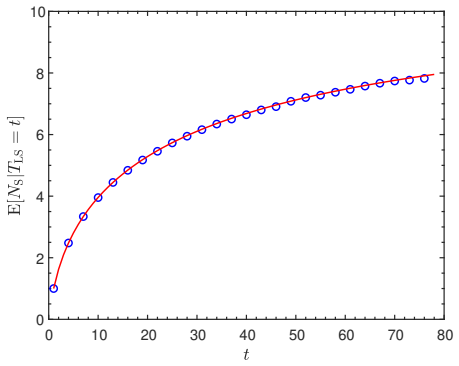
We present analytical results for first-passage processes in a deterministic one-dimensional cellular automaton (CA) model of traffic flow. Starting at time $t=0$ from a random initial state with car density p, at every time step $t\ge 1$ each car moves one step to the right if the cell on its right is empty, and is stopped if it is occupied by another car. The model, which coincides with CA rule 184 in Wolfram's numbering scheme, exhibits a continuous dynamical phase transition at $p=1/2$, between a low-density free-flowing phase and a high-density congested phase. Using the framework of first-passage processes, we derive a closed-form expression for the distribution $P(T_{FS}=t)$ of first-stopping (FS) times, which is the probability that a randomly selected car will be stopped for the first time at time $t$. We also obtain a closed-form expression for the stopping probability $P_S(t)$, which is the probability that a randomly selected car will be stopped at time $t$. In the low-density phase of $0<p<1/2$, the probability $P_S(t)$ yields a closed-form expression for the distribution $P(T_{LS}=t)$ of last-stopping (LS) times, which is the probability that a randomly selected car will be stopped for the last time at time $t$, beyond which it will move freely indefinitely. In this regime, we analyze the relation between the LS time and the number of stopping events $N_S$ which take place up to that time. We present closed-form expressions for the joint distribution $P(T_{LS}=t,N_S=n)$, for the two conditional distributions that emanate from it and for the marginal distribution $P(N_S=n)$. These results provide insight on the time scales of congestion and relaxation in deterministic traffic flow from the point of view of individual cars. In a broader context, they provide insight on complex relaxation processes that involve many interacting particles, such as deterministic surface growth.
Editorial analysis
A structured set of objections, weighed in public.
Referee Report
Summary. The manuscript derives closed-form expressions for first-passage processes in the deterministic rule-184 cellular automaton traffic model on the infinite line. Starting from a random initial configuration with independent site occupation probability p, it obtains exact expressions for the first-stopping time distribution P(T_FS=t), the time-dependent stopping probability P_S(t), and, in the low-density phase p<1/2, for the last-stopping time distribution P(T_LS=t), the joint distribution P(T_LS=t,N_S=n), the associated conditional distributions, and the marginal P(N_S=n). These characterize congestion and relaxation timescales for individual cars and are obtained directly from the deterministic update rule without additional stochasticity or boundary effects.
Significance. If the derivations hold, the work supplies exact, parameter-free analytical results for relaxation dynamics in a deterministic many-particle system. The combinatorial mapping to independent geometric gaps under the random-initial-measure ensemble is a clear strength, yielding falsifiable predictions that distinguish low- and high-density phases and may inform related models of surface growth or interacting particles.
minor comments (2)
- The abstract and introduction would benefit from a short explicit statement of the infinite-line, periodic-boundary-free setting to avoid any ambiguity about finite-size effects.
- Notation for the two conditional distributions derived from the joint P(T_LS=t,N_S=n) should be introduced with a single consistent symbol set when first defined.
Simulated Author's Rebuttal
We thank the referee for the positive and accurate summary of our manuscript, as well as for the favorable assessment of its significance. We appreciate the recommendation for minor revision.
Circularity Check
Derivations follow directly from deterministic rule and random initial measure with no reduction to inputs
full rationale
The paper derives closed-form distributions for first-stopping times, stopping probabilities, last-stopping times, and joint statistics by applying the deterministic CA rule 184 (move right iff right neighbor empty) to an infinite line with independent random initial occupations of probability p. These steps rely on combinatorial counting of gap propagations and first-passage mappings that are direct consequences of the stated assumptions; no fitted parameters, self-referential equations, or load-bearing self-citations appear in the central claims. The results remain self-contained against the explicit initial ensemble and update rule.
Axiom & Free-Parameter Ledger
free parameters (1)
- car density p
axioms (1)
- domain assumption Each car moves one step right if and only if the cell immediately to its right is empty; otherwise it remains stopped.
Lean theorems connected to this paper
-
IndisputableMonolith/Cost/FunctionalEquation.leanwashburn_uniqueness_aczel unclear?
unclearRelation between the paper passage and the cited Recognition theorem.
P(T_FS=t)=C_{t-1} p^t (1-p)^{t-1}... Catalan number C_n=1/(n+1) binom(2n,n)
What do these tags mean?
- matches
- The paper's claim is directly supported by a theorem in the formal canon.
- supports
- The theorem supports part of the paper's argument, but the paper may add assumptions or extra steps.
- extends
- The paper goes beyond the formal theorem; the theorem is a base layer rather than the whole result.
- uses
- The paper appears to rely on the theorem as machinery.
- contradicts
- The paper's claim conflicts with a theorem or certificate in the canon.
- unclear
- Pith found a possible connection, but the passage is too broad, indirect, or ambiguous to say the theorem truly supports the claim.
Reference graph
Works this paper leans on
-
[1]
This segment of 32 cells is a part of a larger system. Thus, t he boundaries of this subsystem are open and no cars enter from the left within the time window that is presented. The stopping time steps of the leftmost car, that starts from i = 0 at time t = 0 are t = 5 ,6,10 and 14. These times coincide with the ascending records of the correspond ing mou...
-
[2]
This implies that 2t− 2∑ t′=1 x0(t′) = t − 1
There is an equal number of occupied and unoccupied cells in the fir st 2 t − 2 cells in front of cell i = 0, namely t − 1 cars and t − 1 empty cells. This implies that 2t− 2∑ t′=1 x0(t′) = t − 1
-
[3]
Th is implies that j∑ t′=1 x0(t′) ≤ ⌊ j/ 2⌋, where ⌊y⌋ is the integer part of y
For any value of 1 ≤ j ≤ 2t − 2 the number of empty cells among the first j cells in front of cell i = 0 is larger than or equal to the number of cells occupied by cars. Th is implies that j∑ t′=1 x0(t′) ≤ ⌊ j/ 2⌋, where ⌊y⌋ is the integer part of y
-
[4]
Cell 2 t − 1 is occupied, namely x0(2t − 1) = 1. In the language of mountain ranges, the first condition means that the mountain land- scape returns to the reference height at i = 2t − 2. This implies that not only h(0) = 0 but also h(2t − 2) = 0. The second condition means that at any point within 1 ≤ j ≤ 2t − 2, the height of the mountain landscape is no...
-
[5]
The number of empty cells in the interval that includes the first t cars in front of cell i = 0 is in the range of 0 ≤ ℓ ≤ t − 1. This implies that in the interval that includes the first t cars in front of cell i = 0 there are more cars than empty cells
-
[6]
For any value of 1 ≤ j ≤ t + ℓ − 1 the number of occupied cells in the interval t + ℓ − j, t + ℓ − j + 1, . . . , t + ℓ − 1 is larger than or equal to the number of empty cells, namely j∑ j′=1 x0(t + ℓ − j′) ≥ ⌊ (j + 1)/ 2⌋
-
[7]
Cell t + ℓ is occupied, namely x0(t + ℓ) = 1. The number of initial configurations that satisfy these three cond itions is given by the Lobb number L t− 1+ℓ 2 , t− 1− ℓ 2 , which is defined by [47, 48] Ln,m = 2m + 1 n + m + 1 ( 2n m + n ) . (31) Using these results, it is found that the probability that a randomly s elected car will be stopped at time t is ...
-
[8]
Wolfram, Statistical mechanics of cellular automata , Rev
S. Wolfram, Statistical mechanics of cellular automata , Rev. Mod. Phys. 55, 601 (1983)
work page 1983
-
[9]
Wolfram, Universality and complexity in cellular aut omata, Physica D 10, 1 (1984)
S. Wolfram, Universality and complexity in cellular aut omata, Physica D 10, 1 (1984)
work page 1984
-
[10]
O. Biham, A.A. Middleton and D. Levine, Self organizatio n and a dynamical transition in traffic flow models, Phys. Rev. A 46, R6124 (1992)
work page 1992
-
[11]
S. Maerivoet and B. De Moor, Cellular automata models of r oad traffic, Physics Reports 419, 1 (2005)
work page 2005
-
[12]
D. Chowdhury, L. Santen and A. Schadschneider, Statisti cal physics of vehicular traffic and some related systems, Physics Reports 329, 199 (2000)
work page 2000
-
[13]
Helbing, Traffic and related self-driven many-particl e systems, Rev
D. Helbing, Traffic and related self-driven many-particl e systems, Rev. Mod. Phys. 73, 1067 (2001)
work page 2001
-
[14]
Schadschneider, Traffic flow: a statistical physics poi nt of view, Physica A 313, 153 (2002)
A. Schadschneider, Traffic flow: a statistical physics poi nt of view, Physica A 313, 153 (2002)
work page 2002
-
[15]
Nagatani, The physics of traffic jams, Rep
T. Nagatani, The physics of traffic jams, Rep. Prog. Phys. 65, 1331 (2002)
work page 2002
-
[16]
K. Nagel and M. Schreckenberg, A cellular automaton mode l for freeway traffic, J. de Physique I 2, 2221 (1992)
work page 1992
-
[17]
K. Nagel and H. J. Herrmann, Deterministic models for tr affic jams, Physica A 199, 254 (1993)
work page 1993
-
[18]
A. Schadschneider and M. Schreckenberg, Cellular auto maton models and traffic flow, J. Phys. A 26, L679 (1993)
work page 1993
-
[19]
M. Schreckenberg, A. Schadschneider, K. Nagel and N. It o, Discrete stochastic models for traffic flow, Phys. Rev. E 51, 2939 (1995)
work page 1995
-
[20]
B.S. Kerner and H. Rehborn, Experimental properties of complexity in traffic flow, Phys. Rev. E 53, 4275 (1996)
work page 1996
-
[21]
B.S. Kerner, S.L. Klenov and D.E. Wolf, Cellular automa ta approach to three-phase traffic theory, J. Phys. A 35, 9971 (2002)
work page 2002
-
[22]
J. Krug and H. Spohn, Universality classes for determin istic surface growth, Phys. Rev. A 38, 4271 (1988)
work page 1988
-
[23]
M. Sasv´ ari, and J. Kert´ esz, Cellular automata models of single-lane traffic, Phys. Rev. E 56, 4104 (1997)
work page 1997
-
[24]
V. Belitsky and P. A. Ferrari, Invariant measures and co nvergence properties for cellular 48 automaton 184 and related processes, J. Stat. Phys. 118, 589 (2005)
work page 2005
-
[25]
N. Boccara and H. Fuk´ s, Cellular automaton rules conse rving the number of active sites, J. Phys. A 31, 6007 (1998)
work page 1998
-
[26]
N. Boccara and H. Fuk´ s, Number-conserving cellular au tomaton rules, Fundam. Inf. 52, 1 (2002)
work page 2002
-
[27]
Fuk´ s, Solution of the density classification proble m with two cellular automata rules, Phys
H. Fuk´ s, Solution of the density classification proble m with two cellular automata rules, Phys. Rev. E 55, R2081 (1997)
work page 1997
-
[28]
Fuk´ s, Exact results for deterministic cellular aut omata traffic models, Phys
H. Fuk´ s, Exact results for deterministic cellular aut omata traffic models, Phys. Rev. E 60, 197 (1999)
work page 1999
-
[29]
Fuk´ s,Solvable Cellular Automata: Methods and Applications (Springer, Cham, 2023)
H. Fuk´ s,Solvable Cellular Automata: Methods and Applications (Springer, Cham, 2023)
work page 2023
-
[30]
A. Jha, K. Wiesenfeld, G. Lee and J. Laval, Simple traffic m odel as a space-time clustering phenomenon, Phys. Rev. E 112, 054104 (2025)
work page 2025
-
[31]
Redner, A Guide to First Passage Processes (Cambridge University Press, Cambridge, 2001)
S. Redner, A Guide to First Passage Processes (Cambridge University Press, Cambridge, 2001)
work page 2001
-
[32]
Spitzer, Interaction of Markov processes, Advances in Mathematics 5, 246 (1970)
F. Spitzer, Interaction of Markov processes, Advances in Mathematics 5, 246 (1970)
work page 1970
-
[33]
B. Derrida, E. Domany and D. Mukamel, An exact solution o f a one-dimensional asymmetric exclusion model with open boundaries, J. Stat. Phys. 69, 667 (1992)
work page 1992
-
[34]
Derrida, An exactly soluble non-equilibrium system : The asymmetric simple exclusion process, Phys
B. Derrida, An exactly soluble non-equilibrium system : The asymmetric simple exclusion process, Phys. Rep. 301, 65 (1998)
work page 1998
- [35]
-
[36]
Sch¨ utz, Time-dependent correlation functions in a one-dimensional asymmetric exclusion process, J
G.M. Sch¨ utz, Time-dependent correlation functions in a one-dimensional asymmetric exclusion process, J. Stat. Phys. 71, 471 (1993)
work page 1993
-
[37]
N. Rajewsky, L. Santen, A. Schadschneider and M. Schrec kenberg, The asymmetric exclusion process: comparison of update procedures, J. Stat. Phys. 92, 151 (1998)
work page 1998
-
[38]
V. Belitsky and G.M. Sch¨ utz, Cellular automaton model for molecular traffic jams, J. Stat. Mech. P07007 (2011)
work page 2011
-
[39]
V. Belitsky and G.M. Sch¨ utz, Microscopic position and structure of a shock in CA 184, J. Phys. A 44, 445003 (2011)
work page 2011
-
[40]
P. Mounaix, S. N. Majumdar and G. Schehr, Statistics of t he number of records for random walks and L´ evy flights on a 1D lattice, J. Phys. A 53, 415003 (2020). 49
work page 2020
-
[41]
S.N. Majumdar and G. Schehr, Statistics of Extremes and Records in Random Sequences (Oxford University Press, Oxford, 2024)
work page 2024
-
[42]
P. Flajolet and R. Sedgewick, Analytic Combinatorics (Cambridge University Press, Cam- bridge, 2009)
work page 2009
-
[43]
Audibert, Mathematics for Informatics and Computer Science (ISTE and Hoboken, Lon- don, 2010)
P. Audibert, Mathematics for Informatics and Computer Science (ISTE and Hoboken, Lon- don, 2010)
work page 2010
-
[44]
Stanley, Catalan Numbers (Cambridge University Press, Cambridge, 2015)
R.P. Stanley, Catalan Numbers (Cambridge University Press, Cambridge, 2015)
work page 2015
-
[45]
Koshy, Catalan Numbers with Applications (Oxford University Press, Oxford, 2009)
T. Koshy, Catalan Numbers with Applications (Oxford University Press, Oxford, 2009)
work page 2009
-
[46]
Deutsch, Dyck path enumeration, Discrete Mathematics 204, 167 (1999)
E. Deutsch, Dyck path enumeration, Discrete Mathematics 204, 167 (1999)
work page 1999
- [47]
-
[48]
J. Klinger, A. Barbier-Chebbah, R. Voituriez and O. B´ e nichou, Joint statistics of space and time exploration of one-dimensional random walks, Phys. Rev. E 105, 034116 (2022)
work page 2022
-
[49]
G. P´ olya, ¨Uber eine aufgabe der wahrscheinlichkeitsrechnung betreffe nd die irrfahrt im strassennetz Mathematische Annalen 84, 149 (1921)
work page 1921
-
[50]
F.W.J. Olver, D.M. Lozier, R.R. Boisvert and C.W. Clark , NIST Handbook of Mathematical Functions (Cambridge University Press, Cambridge, 2010)
work page 2010
-
[51]
Feller, An Introduction to Probability Theory and its Applications: V ol
W. Feller, An Introduction to Probability Theory and its Applications: V ol. I (Wiley, New York, 1971)
work page 1971
-
[52]
Feller, An Introduction to Probability Theory and its Applications: V ol
W. Feller, An Introduction to Probability Theory and its Applications: V ol. II (Wiley, New York, 1971)
work page 1971
-
[53]
S.N. Majumdar, G. Schehr and G. Wergen, Record statisti cs and persistence for a random walk with a drift, J. Phys. A 45, 355002 (2012)
work page 2012
-
[54]
Lobb, Deriving the nth Catalan number, The Mathematical Gazette 83, 109 (1999)
A. Lobb, Deriving the nth Catalan number, The Mathematical Gazette 83, 109 (1999)
work page 1999
-
[55]
T. Koshy, Lobb’s generalisation of Catalan’s parenthe sisation problem revisited, The Mathe- matical Gazette 96, 56 (2012)
work page 2012
-
[56]
D. Toussaint and F. Wilczek, Particle-antiparticle an nihilation in diffusive motion, J. Chem. Phys. 78, 2642 (1983)
work page 1983
-
[57]
K. Kang and S. Redner, Scaling approach for the kinetics of recombination processes, Phys. Rev. Lett. 52, 955 (1984). 50
work page 1984
-
[58]
M. Bramson and J.L. Lebowitz, Asymptotic behavior of de nsities in diffusion-dominated an- nihilation reactions, Phys. Rev. Lett. 61, 2397 (1988); Erratum: Phys. Rev. Lett. 62, 694 (1989)
work page 1988
-
[59]
P. Krapivsky, E. Ben-Naim and S. Redner, A Kinetic View of Statistical Physics (Cambridge University Press, Cambridge, 2010)
work page 2010
-
[60]
Y. Elskens and H.L. Frisch, Annihilation kinetics in th e one-dimensional ideal gas, Phys. Rev. A 31, 3812 (1985)
work page 1985
-
[61]
R.B. Paris, Asymptotics of the gauss hypergeometric fu nction with large parameters I, Journal of Classical Analysis 2, 183 (2013)
work page 2013
-
[62]
G. Hertzberg Rabinovich, O. Biham and E. Katzav, Struct ure and dynamics in the low-density phase of a two-dimensional cellular automaton model of traffi c flow, Phys. Rev. E 113, 014127 (2026)
work page 2026
-
[63]
E. Katzav and M. Schwartz, What is the connection betwee n ballistic deposition and the Kardar-Parisi-Zhang equation?, Phys. Rev. E 70, 061608 (2004)
work page 2004
-
[64]
M. Fukui and Y. Ishibashi, Traffic flow in 1D cellular autom aton model including cars moving with high speed, J. Phys. Soc. Jpn. 65, 1868 (1996)
work page 1996
-
[65]
Ross, A First Course in Probability, 10th Edition (Pearson, Upper Saddle River, NJ, 2020), page 399
S.M. Ross, A First Course in Probability, 10th Edition (Pearson, Upper Saddle River, NJ, 2020), page 399
work page 2020
-
[66]
W.-S. Chou, T.-X. He and P. J.-S. Shiue, On the primality of the generalized Fuss-Catalan numbers, Journal of Integer Sequences 21, 18.2.1 (2018). 51
work page 2018
discussion (0)
Sign in with ORCID, Apple, or X to comment. Anyone can read and Pith papers without signing in.