Magnetohydrodynamics Simulations
Pith reviewed 2026-05-20 07:39 UTC · model grok-4.3
The pith
Physics-informed AI integrated with conventional solvers offers a route to MHD regimes beyond classical discretization limits.
A machine-rendered reading of the paper's core claim, the machinery that carries it, and where it could break.
Core claim
Magnetohydrodynamics couples the Navier-Stokes and Maxwell equations into a nonlinear system of partial differential equations governing stellar interiors, astrophysical jets, fusion plasmas, and space weather. Numerical advances have made MHD predictive for many phenomena, yet in three-dimensional turbulence the degrees of freedom scale as O(Re^{9/4}) or faster, rendering direct numerical simulation intractable when the Lundquist number exceeds 10^{10}. The central claim is that physics-informed AI, integrated with conventional solvers and trained on leadership-scale simulations, offers a credible route to regimes beyond the reach of classical discretisation alone.
What carries the argument
Physics-informed neural networks, Fourier neural operators, and hybrid operator-diffusion frameworks that learn solution operators across families of MHD problems while recovering broadband turbulent spectra.
If this is right
- Predictive modeling of solar eruptions, tokamak confinement, and magnetized turbulence becomes feasible at previously inaccessible parameters.
- Hybrid AI-conventional pipelines can incorporate kinetic closures, radiation transport, and uncertainty quantification at reduced cost.
- Exascale high-order solvers, GPU acceleration, and task-based parallelism gain new sub-grid closure and operator-learning capabilities.
- Prospective quantum algorithms for implicit linear systems in resistive MHD can be paired with learned surrogates.
Where Pith is reading between the lines
- Operator-learning methods may naturally extend to coupled multi-physics problems such as MHD with radiation or kinetic effects.
- Trained models could supply fast surrogates for ensemble forecasting in space-weather applications.
- Systematic tests at the highest currently resolvable Re and S values would quantify the onset of generalization failure.
Load-bearing premise
AI models trained mainly on lower-resolution or lower-Reynolds data will generalize accurately to the extreme Reynolds and Lundquist numbers of astrophysics and fusion without introducing unphysical artifacts or violating conservation laws.
What would settle it
Side-by-side comparison of AI-augmented solutions against the highest-resolution conventional runs possible at moderately elevated Reynolds and Lundquist numbers, checking whether conservation laws hold and spectra remain free of spurious features.
Figures
read the original abstract
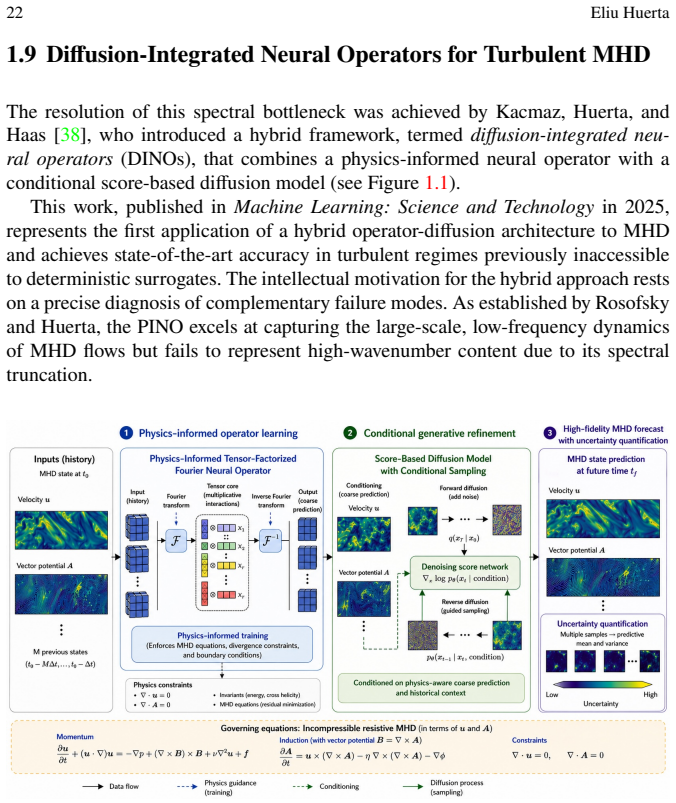
Magnetohydrodynamics (MHD) couples the Navier--Stokes and Maxwell equations into a nonlinear system of partial differential equations governing stellar interiors, astrophysical jets, fusion plasmas, and space weather. Numerical advances, including finite-volume Godunov schemes, constrained-transport algorithms, high-order spectral-element and discontinuous-Galerkin discretisations, and adaptive mesh refinement, have made MHD a predictive tool for solar eruptions, tokamak confinement, and magnetised turbulence. A fundamental barrier nevertheless remains. In three-dimensional MHD turbulence, the degrees of freedom required to resolve all active scales grow as $\mathcal{O}(\mathrm{Re}^{9/4})$ or faster, where $\mathrm{Re}$ is the Reynolds number. Direct numerical simulation is therefore intractable at astrophysical and fusion-relevant parameters, particularly when the Lundquist number $S$ exceeds $10^{10}$ and both viscous and resistive dissipation ranges must be resolved. Kinetic closures, radiation transport, and uncertainty quantification further increase the cost. This chapter examines how AI may help bridge this gap. We review physics-informed neural networks, Fourier neural operators and physics-informed neural operators, which learn solution operators across families of MHD problems; and hybrid operator-diffusion frameworks that combine deterministic surrogates with score-based generative models to recover broadband turbulent spectra. These developments are set within the wider landscape of exascale high-order solvers, GPU acceleration, task-based parallelism, data-driven sub-grid closures, and prospective quantum algorithms for implicit linear systems in resistive MHD. The central claim is that physics-informed AI, integrated with conventional solvers and trained on leadership-scale simulations, offers a credible route to regimes beyond the reach of classical discretisation alone.
Editorial analysis
A structured set of objections, weighed in public.
Referee Report
Summary. The manuscript reviews the fundamental computational barrier in three-dimensional MHD turbulence simulations, where the number of degrees of freedom scales as O(Re^{9/4}), rendering direct numerical simulation intractable at astrophysical and fusion-relevant Reynolds numbers (Re ≫ 10^6) and Lundquist numbers (S > 10^{10}). It surveys AI approaches including physics-informed neural networks (PINNs), Fourier neural operators (FNOs), physics-informed neural operators, and hybrid operator-diffusion frameworks that combine deterministic surrogates with score-based generative models, positioning these as integrable with conventional high-order solvers, exascale computing, and data-driven sub-grid closures to access otherwise unreachable regimes.
Significance. If the surveyed AI methods can be shown to generalize accurately from leadership-scale training data to extreme Re and S while preserving conservation laws and avoiding unphysical artifacts, the review would usefully frame a pathway toward predictive modeling of stellar interiors, astrophysical jets, and fusion plasmas. The manuscript provides a timely catalog of existing techniques set against the landscape of GPU-accelerated solvers and prospective quantum algorithms, though the absence of quantitative support for the extrapolation claim limits its immediate utility as a roadmap.
major comments (1)
- [Abstract] Abstract: The central claim that 'physics-informed AI, integrated with conventional solvers and trained on leadership-scale simulations, offers a credible route to regimes beyond the reach of classical discretisation alone' is not supported by any quantitative validation, error metrics, conservation diagnostics, or extrapolation tests at the target parameters (Re ≫ 10^6, S > 10^{10}). The text catalogs published methods (PINNs, FNOs, hybrid frameworks) but supplies no evidence or cited bounds demonstrating that operators trained on finite-Re data avoid spurious dissipation, inverse cascades, or violations of conservation when applied to unresolved scales.
minor comments (1)
- [Abstract] The abstract refers to 'this chapter'; adding a brief statement of the manuscript's standalone scope or its relation to a larger volume would improve clarity for readers encountering it as a journal article.
Simulated Author's Rebuttal
We thank the referee for their constructive review of our survey on AI surrogates for high-Re and high-S MHD regimes. We agree that the central claim would benefit from explicit quantitative grounding drawn from the cited literature and have revised the manuscript to address this while preserving its character as a review.
read point-by-point responses
-
Referee: [Abstract] Abstract: The central claim that 'physics-informed AI, integrated with conventional solvers and trained on leadership-scale simulations, offers a credible route to regimes beyond the reach of classical discretisation alone' is not supported by any quantitative validation, error metrics, conservation diagnostics, or extrapolation tests at the target parameters (Re ≫ 10^6, S > 10^{10}). The text catalogs published methods (PINNs, FNOs, hybrid frameworks) but supplies no evidence or cited bounds demonstrating that operators trained on finite-Re data avoid spurious dissipation, inverse cascades, or violations of conservation when applied to unresolved scales.
Authors: We acknowledge that the original presentation of the central claim in the abstract and introduction did not include sufficient explicit references to quantitative results. As this is a review paper whose purpose is to catalog and contextualize existing techniques rather than report new simulations, the claim was framed as a perspective based on the body of work surveyed. To directly address the referee's valid concern, we have revised the abstract to qualify the claim, added a new subsection summarizing reported performance metrics (including L2 errors, conservation violations, and generalization tests to higher Re/S) from representative PINN, FNO, and hybrid operator-diffusion papers, and inserted a table compiling these diagnostics along with cited bounds on artifacts such as spurious dissipation. These additions draw on the existing literature without introducing original numerical results. revision: yes
Circularity Check
Literature survey with no internal derivation chain
full rationale
This manuscript functions as a literature review that catalogs existing AI methods for MHD (PINNs, FNOs, hybrid operator-diffusion models) without advancing any new derivation, operator, or prediction of its own. The central claim is an evaluative statement about the field rather than a mathematical result derived from equations or data within the text. The O(Re^{9/4}) scaling is used only to motivate the computational barrier and is not part of any load-bearing derivation that reduces to fitted parameters or self-citations. No self-definitional, fitted-input-as-prediction, or uniqueness-via-self-citation patterns appear.
Axiom & Free-Parameter Ledger
axioms (1)
- standard math MHD is governed by the coupled Navier-Stokes and Maxwell equations
Lean theorems connected to this paper
-
IndisputableMonolith/Cost/FunctionalEquation.leanwashburn_uniqueness_aczel unclear?
unclearRelation between the paper passage and the cited Recognition theorem.
The central claim is that physics-informed AI, integrated with conventional solvers and trained on leadership-scale simulations, offers a credible route to regimes beyond the reach of classical discretisation alone.
What do these tags mean?
- matches
- The paper's claim is directly supported by a theorem in the formal canon.
- supports
- The theorem supports part of the paper's argument, but the paper may add assumptions or extra steps.
- extends
- The paper goes beyond the formal theorem; the theorem is a base layer rather than the whole result.
- uses
- The paper appears to rely on the theorem as machinery.
- contradicts
- The paper's claim conflicts with a theorem or certificate in the canon.
- unclear
- Pith found a possible connection, but the passage is too broad, indirect, or ambiguous to say the theorem truly supports the claim.
Reference graph
Works this paper leans on
-
[1]
Existence of electromagnetic-hydrodynamic waves.Nature, 150:405–406, 1942
Hannes Alfv ´en. Existence of electromagnetic-hydrodynamic waves.Nature, 150:405–406, 1942
work page 1942
-
[2]
F. J. Artola, A. Loarte, M. Hoelzl, M. Lehnen, N. Schwarz, and Jorek Team. Non-axisymmetric MHD simulations of the current quench phase of ITER mitigated disruptions.Nuclear Fusion, 62(5):056023, May 2022
work page 2022
-
[3]
Dinshaw S. Balsara and Chi-Wang Shu. Monotonicity preserving weighted essentially non-oscillatory schemes with increasingly high order of accuracy. Journal of Computational Physics, 160(2):405–452, 2000
work page 2000
-
[4]
Andrea Beck, David Flad, and Claus-Dieter Munz. Deep neural networks for data-driven les closure models.Journal of Computational Physics, 398:108910, 2019. 1 Magnetohydrodynamics Simulations 27
work page 2019
-
[5]
A. Beresnyak and A. Lazarian. Strong imbalanced turbulence.The Astrophys- ical Journal, 682(2):1070, aug 2008
work page 2008
-
[6]
MHD turbulence.Living Reviews in Computational Astro- physics, 5(1):2, September 2019
Andrey Beresnyak. MHD turbulence.Living Reviews in Computational Astro- physics, 5(1):2, September 2019
work page 2019
-
[7]
Spectrum of magnetohydrodynamic turbulence.Phys
Stanislav Boldyrev. Spectrum of magnetohydrodynamic turbulence.Phys. Rev. Lett., 96:115002, Mar 2006
work page 2006
-
[8]
S. I. Braginskii. Transport Processes in a Plasma.Reviews of Plasma Physics, 1:205, January 1965
work page 1965
-
[9]
Clifford neural layers for pde modeling
Johannes Brandstetter, Rianne van den Berg, Max Welling, and Jayesh K Gupta. Clifford neural layers for pde modeling. InThe Eleventh International Conference on Learning Representations, 2023
work page 2023
-
[10]
Cerezo, Yigit Subasi, Lukasz Cincio, and Patrick J
Carlos Bravo-Prieto, Ryan LaRose, M. Cerezo, Yigit Subasi, Lukasz Cincio, and Patrick J. Coles. Variational Quantum Linear Solver.Quantum, 7:1188, November 2023
work page 2023
-
[11]
M Brio and C.C Wu. An upwind differencing scheme for the equations of ideal magnetohydrodynamics.Journal of Computational Physics, 75(2):400–422, 1988
work page 1988
-
[12]
Keaton J. Burns, Geoffrey M. Vasil, Jeffrey S. Oishi, Daniel Lecoanet, and Benjamin P. Brown. Dedalus: A flexible framework for numerical simulations with spectral methods.Phys. Rev. Res., 2:023068, Apr 2020
work page 2020
-
[13]
Oxford University Press, Oxford, 1961
Subrahmanyan Chandrasekhar.Hydrodynamic and Hydromagnetic Stability. Oxford University Press, Oxford, 1961
work page 1961
-
[14]
Tianping Chen and Hong Chen. Universal approximation to nonlinear operators by neural networks with arbitrary activation functions and its application to dynamical systems.IEEE Transactions on Neural Networks, 6(4):911–917, 1995
work page 1995
-
[15]
William Cook, Boris Daszuta, Jacob Fields, Peter Hammond, Simone Albanesi, Francesco Zappa, Sebastiano Bernuzzi, and David Radice. Gr-athena++: General-relativistic magnetohydrodynamics simulations of neutron star space- times.The Astrophysical Journal Supplement Series, 277(1):3, feb 2025
work page 2025
-
[16]
T. G. Cowling. The magnetic field of sunspots.Monthly Notices of the Royal Astronomical Society, 94(1):39–48, 11 1933
work page 1933
-
[17]
Thomas G. Cowling.Magnetohydrodynamics. Interscience Publishers, New York, 1957
work page 1957
- [18]
-
[19]
Jonas Degrave, Federico Felici, Jonas Buchli, Michael Neunert, Brendan Tracey, Francesco Carpanese, Timo Ewalds, Roland Hafner, Abbas Abdol- maleki, Diego De Las Casas, Craig Donner, Leslie Fritz, Cristian Galperti, An- drea Huber, James Keeling, Maria Tsimpoukelli, Jackie Kay, Antoine Merle, Jean-Marc Moret, Seb Noury, Federico Pesamosca, David Pfau, Oli...
work page 2022
-
[20]
Karthik Duraisamy, Gianluca Iaccarino, and Heng Xiao. Turbulence model- ing in the age of data.Annual Review of Fluid Mechanics, 51(Volume 51, 2019):357–377, 2019
work page 2019
-
[21]
Etienne, Vasileios Paschalidis, Roland Haas, Philipp M ¨osta, and Stuart L
Zachariah B. Etienne, Vasileios Paschalidis, Roland Haas, Philipp M ¨osta, and Stuart L. Shapiro. IllinoisGRMHD: An Open-Source, User-Friendly GRMHD Code for Dynamical Spacetimes.Class. Quant. Grav., 32:175009, 2015
work page 2015
-
[22]
Charles R. Evans and John F. Hawley. Simulation of Magnetohydrodynamic Flows: A Constrained Transport Model.The Astrophysical Journal, 332:659, September 1988
work page 1988
-
[23]
Freidberg.Ideal Magnetohydrodynamics
Jeffrey P. Freidberg.Ideal Magnetohydrodynamics. Plenum Press, New York, 1987
work page 1987
-
[24]
B. Fryxell, K. Olson, P. Ricker, F. X. Timmes, M. Zingale, D. Q. Lamb, P. MacNeice, R. Rosner, J. W. Truran, and H. Tufo. FLASH: An Adaptive Mesh Hydrodynamics Code for Modeling Astrophysical Thermonuclear Flashes.The Astrophysical Journal Supplement Series, 131(1):273–334, November 2000
work page 2000
-
[25]
Charles F. Gammie, Julian C. McKinney, and G ´abor T ´oth. Harm: A scheme for general relativistic magnetohydrodynamics.The Astrophysical Journal, 589:444–457, 2003
work page 2003
-
[26]
Transformers for modeling physical systems.Neural Networks, 146:272–289, 2022
Nicholas Geneva and Nicholas Zabaras. Transformers for modeling physical systems.Neural Networks, 146:272–289, 2022
work page 2022
-
[27]
WhiskyMHD: A New numerical code for general relativistic magnetohydrodynamics.Class
Bruno Giacomazzo and Luciano Rezzolla. WhiskyMHD: A New numerical code for general relativistic magnetohydrodynamics.Class. Quant. Grav., 24:S235–S258, 2007
work page 2007
-
[28]
J. P. Goedbloed and S. Poedts.Principles of Magnetohydrodynamics: With Applications to Laboratory and Astrophysical Plasmas. Cambridge University Press, Cambridge, 2004
work page 2004
-
[29]
P. Goldreich and S. Sridhar. Toward a Theory of Interstellar Turbulence. II. Strong Alfvenic Turbulence.The Astrophysical Journal, 438:763, January 1995
work page 1995
-
[30]
Vlaykov, Wolfram Schmidt, Dominik R
Philipp Grete, Dimitar G. Vlaykov, Wolfram Schmidt, Dominik R. G. Schle- icher, and Christoph Federrath. Nonlinear closures for scale separation in supersonic magnetohydrodynamic turbulence.New Journal of Physics, 17(2):023070, February 2015
work page 2015
-
[31]
Samuel Greydanus, Misko Dzamba, and Jason Yosinski. Hamiltonian neural networks. InAdvances in Neural Information Processing Systems, volume 32, pages 15379–15389, 2019
work page 2019
-
[32]
Dynamical diffusion: Learning temporal dynamics with diffusion models
Xingzhuo Guo, Yu Zhang, Baixu Chen, Haoran Xu, Jianmin Wang, and Ming- sheng Long. Dynamical diffusion: Learning temporal dynamics with diffusion models. InThe Thirteenth International Conference on Learning Representa- tions, 2025
work page 2025
-
[33]
Zhongkai Hao, Zhengyi Wang, Hang Su, Chengyang Ying, Yinpeng Dong, Songming Liu, Ze Cheng, Jian Song, and Jun Zhu. GNOT: A general neural 1 Magnetohydrodynamics Simulations 29 operator transformer for operator learning. InInternational conference on machine learning, pages 12556–12569. PMLR, 2023
work page 2023
-
[34]
Harrow, Avinatan Hassidim, and Seth Lloyd
Aram W. Harrow, Avinatan Hassidim, and Seth Lloyd. Quantum algorithm for linear systems of equations.Phys. Rev. Lett., 103:150502, Oct 2009
work page 2009
-
[35]
Denoising diffusion probabilistic models
Jonathan Ho, Ajay Jain, and Pieter Abbeel. Denoising diffusion probabilistic models. InProceedings of the 34th International Conference on Neural In- formation Processing Systems, NIPS ’20, Red Hook, NY, USA, 2020. Curran Associates Inc
work page 2020
-
[36]
M. Hoelzl, G. T. A. Huijsmans, S. J. P. Pamela, M. B ´ecoulet, E. Nardon, F. J. Artola, B. Nkonga, C. V. Atanasiu, V. Bandaru, A. Bhole, D. Bonfiglio, A. Cathey, O. Czarny, A. Dvornova, T. Feh ´er, A. Fil, E. Franck, S. Futatani, M. Gruca, H. Guillard, J. W. Haverkort, I. Holod, D. Hu, S. K. Kim, S. Q. Korv- ing, L. Kos, I. Krebs, L. Kripner, G. Latu, F. ...
work page 2021
-
[37]
Physics informed neural networks for magnetohydrodynamic equations
Eva Jaillon and Pavlos Protopapas. Physics informed neural networks for magnetohydrodynamic equations. InAI&PDE: ICLR 2026 Workshop on AI and Partial Differential Equations, 2026
work page 2026
-
[38]
Semih Kacmaz, E A Huerta, and Roland Haas. Resolving turbulent magne- tohydrodynamics: a hybrid operator-diffusion framework.Machine Learning: Science and Technology, 6(3):035057, sep 2025
work page 2025
-
[39]
Physics-informed machine learning.Nature Reviews Physics, pages 1–19, 05 2021
George Karniadakis, Yannis Kevrekidis, Lu Lu, Paris Perdikaris, Sifan Wang, and Liu Yang. Physics-informed machine learning.Nature Reviews Physics, pages 1–19, 05 2021
work page 2021
-
[40]
Tamara G. Kolda and Brett W. Bader. Tensor decompositions and applications. SIAM Review, 51(3):455–500, 2009
work page 2009
-
[41]
Ten- sorly: Tensor learning in python.Journal of Machine Learning Research, 20(26):1–6, 2019
Jean Kossaifi, Yannis Panagakis, Anima Anandkumar, and Maja Pantic. Ten- sorly: Tensor learning in python.Journal of Machine Learning Research, 20(26):1–6, 2019
work page 2019
- [42]
-
[43]
Kulsrud.Plasma Physics for Astrophysics
Russell M. Kulsrud.Plasma Physics for Astrophysics. Princeton University Press, Princeton, NJ, 2005
work page 2005
-
[44]
Zijie Li, Dule Shu, and Amir Barati Farimani. Scalable transformer for PDE surrogate modeling.Advances in Neural Information Processing Systems, 36:28010–28039, 2023
work page 2023
-
[45]
Fourier 30 Eliu Huerta neural operator for parametric partial differential equations
Zongyi Li, Nikola Borislavov Kovachki, Kamyar Azizzadenesheli, Burigede liu, Kaushik Bhattacharya, Andrew Stuart, and Anima Anandkumar. Fourier 30 Eliu Huerta neural operator for parametric partial differential equations. InInternational Conference on Learning Representations, 2021
work page 2021
-
[46]
Physics- informed neural operator for learning partial differential equations.ACM / IMS J
Zongyi Li, Hongkai Zheng, Nikola Kovachki, David Jin, Haoxuan Chen, Burigede Liu, Kamyar Azizzadenesheli, and Anima Anandkumar. Physics- informed neural operator for learning partial differential equations.ACM / IMS J. Data Sci., 1(3), May 2024
work page 2024
-
[47]
Mario Lino, Stathi Fotiadis, Anil A. Bharath, and Chris D. Cantwell. Multi- scale rotation-equivariant graph neural networks for unsteady eulerian fluid dynamics.Physics of Fluids, 34(8):087110, 08 2022
work page 2022
-
[48]
Y. Lithwick, P. Goldreich, and S. Sridhar. Imbalanced strong mhd turbulence. The Astrophysical Journal, 655(1):269, jan 2007
work page 2007
-
[49]
Federico G. Lopez Armengol, Zachariah B. Etienne, Scott C. Noble, Bernard J. Kelly, Leonardo R. Werneck, Brendan Drachler, Manuela Campanelli, Federico Cipolletta, Yosef Zlochower, Ariadna Murguia-Berthier, Lorenzo Ennoggi, Mark Avara, Riccardo Ciolfi, Joshua Faber, Grace Fiacco, Bruno Giaco- mazzo, Tanmayee Gupte, Trung Ha, Julian H. Krolik, Vassilios Me...
work page 2022
-
[50]
Lu Lu, Pengzhan Jin, and George Em Karniadakis. DeepONet: Learning nonlinear operators for identifying differential equations based on the universal approximation theorem of operators.Nature Machine Intelligence, 3(3):218– 229, 2021
work page 2021
-
[51]
Lu Lu, Xuhui Meng, Shengze Cai, Zhiping Mao, Somdatta Goswami, Zhongqiang Zhang, and George Em Karniadakis. A comprehensive and fair comparison of two neural operators (with practical extensions) based on fair data.Computer Methods in Applied Mechanics and Engineering, 393:114778, 2022
work page 2022
-
[52]
Dynamic alignment in driven magnetohydrodynamic turbulence.Phys
Joanne Mason, Fausto Cattaneo, and Stanislav Boldyrev. Dynamic alignment in driven magnetohydrodynamic turbulence.Phys. Rev. Lett., 97:255002, Dec 2006
work page 2006
-
[53]
A. Mignone, G. Bodo, S. Massaglia, T. Matsakos, O. Tesileanu, C. Zanni, and A. Ferrari. Pluto: A numerical code for computational astrophysics.The Astrophysical Journal Supplement Series, 170:228–242, 2007
work page 2007
-
[54]
C. Mistrangelo, L. B¨ uhler, S. Smolentsev, V. Kl¨ uber, I. Maione, and J. Aubert. Mhd flow in liquid metal blankets: Major design issues, mhd guidelines and numerical analysis.Fusion Engineering and Design, 173:112795, 2021
work page 2021
-
[55]
Takahiro Miyoshi and Kanya Kusano. A multi-state HLL approximate Riemann solver for ideal magnetohydrodynamics.Journal of Computational Physics, 208(1):315–344, September 2005
work page 2005
-
[56]
Mateusz Nowak, Micha l Spirzewski, and Konrad Czerski. Optimization of the dc magnetohydrodynamic pump for the dual fluid reactor.Annals of Nuclear Energy, 174:109142, 2022
work page 2022
-
[57]
Vivek Oommen, Aniruddha Bora, Zhen Zhang, and George Em Karniadakis. Integrating neural operators with diffusion models improves spectral represen- 1 Magnetohydrodynamics Simulations 31 tation in turbulence modelling.Proceedings of the Royal Society A: Mathe- matical, Physical and Engineering Sciences, 481(2309):20240819, 03 2025
work page 2025
-
[58]
E. N. Parker.Cosmical Magnetic Fields: Their Origin and Their Activity. Oxford University Press, Oxford, 1979
work page 1979
-
[59]
Learning mesh-based simulation with graph networks
Tobias Pfaff, Meire Fortunato, Alvaro Sanchez-Gonzalez, and Peter Battaglia. Learning mesh-based simulation with graph networks. InInternational Con- ference on Learning Representations, 2021
work page 2021
-
[60]
The black hole accretion code.Comput
Oliver Porth, Hector Olivares, Yosuke Mizuno, Ziri Younsi, Luciano Rezzolla, Monika Moscibrodzka, Heino Falcke, and Michael Kramer. The black hole accretion code.Comput. Astrophys. Cosmol., 4(1):1, 2017
work page 2017
- [61]
-
[62]
U-net: Convolutional networks for biomedical image segmentation
Olaf Ronneberger, Philipp Fischer, and Thomas Brox. U-net: Convolutional networks for biomedical image segmentation. InInternational Conference on Medical image computing and computer-assisted intervention, pages 234–241. Springer, 2015
work page 2015
-
[63]
Shawn G Rosofsky, Hani Al Majed, and E A Huerta. Applications of physics informed neural operators.Machine Learning: Science and Technology, 4(2):025022, may 2023
work page 2023
-
[64]
Shawn G Rosofsky and E A Huerta. Magnetohydrodynamics with physics informed neural operators.Machine Learning: Science and Technology, 4(3):035002, jul 2023
work page 2023
-
[65]
A. Sadowski, R. Narayan, J. C. McKinney, and A. Tchekhovskoy. Numerical simulations of super-critical black hole accretion flows in general relativity. Mon. Not. Roy. Astron. Soc., 439(1):503–520, 2014
work page 2014
-
[66]
Score-based generative modeling through stochastic differential equations
Yang Song, Jascha Sohl-Dickstein, Diederik P Kingma, Abhishek Kumar, Stefano Ermon, and Ben Poole. Score-based generative modeling through stochastic differential equations. InInternational Conference on Learning Representations, 2021
work page 2021
-
[67]
James M. Stone, Thomas A. Gardiner, Peter Teuben, John F. Hawley, and Ja- cob B. Simon. Athena: A New Code for Astrophysical MHD.The Astrophysical Journal Supplement Series, 178(1):137–177, September 2008
work page 2008
-
[68]
James M. Stone and Michael L. Norman. ZEUS-2D: A Radiation Magnetohy- drodynamics Code for Astrophysical Flows in Two Space Dimensions. I. The Hydrodynamic Algorithms and Tests.The Astrophysical Journal Supplement Series, 80:753, June 1992
work page 1992
-
[69]
Adam Subel, Ashesh Chattopadhyay, Yifei Guan, and Pedram Hassanzadeh. Data-driven subgrid-scale modeling of forced Burgers turbulence using deep learning with generalization to higher Reynolds numbers via transfer learning. Physics of Fluids, 33(3):031702, March 2021
work page 2021
-
[70]
Z. Sun, J. Al Salami, A. Khodak, F. Saenz, B. Wynne, R. Maingi, K. Hanada, C.H. Hu, and E. Kolemen. Magnetohydrodynamics in free surface liquid metal 32 Eliu Huerta flow relevant to plasma-facing components.Nuclear Fusion, 63(7):076022, jun 2023
work page 2023
-
[71]
G ´abor T´oth. The∇ ·𝐵=0 constraint in shock-capturing magnetohydrodynam- ics codes.Journal of Computational Physics, 161(2):605–652, 2000
work page 2000
-
[72]
Pascal Vincent. A connection between score matching and denoising autoen- coders.Neural Computation, 23(7):1661–1674, July 2011
work page 2011
-
[73]
Sifan Wang, Yujun Teng, and Paris Perdikaris. Understanding and mitigating gradient flow pathologies in physics-informed neural networks.SIAM Journal on Scientific Computing, 43(5):A3055–A3081, 2021
work page 2021
-
[74]
Sifan Wang, Hanwen Wang, and Paris Perdikaris. Learning the solution op- erator of parametric partial differential equations with physics-informed deep- onets.Science Advances, 7(40):eabi8605, 2021
work page 2021
-
[75]
Yiqi Yu, Emily Shemon, and Elia Merzari. Les simulation on heavy liquid metal flow in a bare rod bundle for assessment of turbulent prandtl number. Nuclear Engineering and Design, 404:112175, 2023
work page 2023
discussion (0)
Sign in with ORCID, Apple, or X to comment. Anyone can read and Pith papers without signing in.