Dependence on the Equation of State in SPH Simulations of Proto-Uranian Disk Formation from a Giant Impact
Pith reviewed 2026-05-22 09:02 UTC · model grok-4.3
The pith
For giant impacts matching Uranus's spin, disk mass and size are set by angular momentum while rock fraction varies with the equation of state.
A machine-rendered reading of the paper's core claim, the machinery that carries it, and where it could break.
Core claim
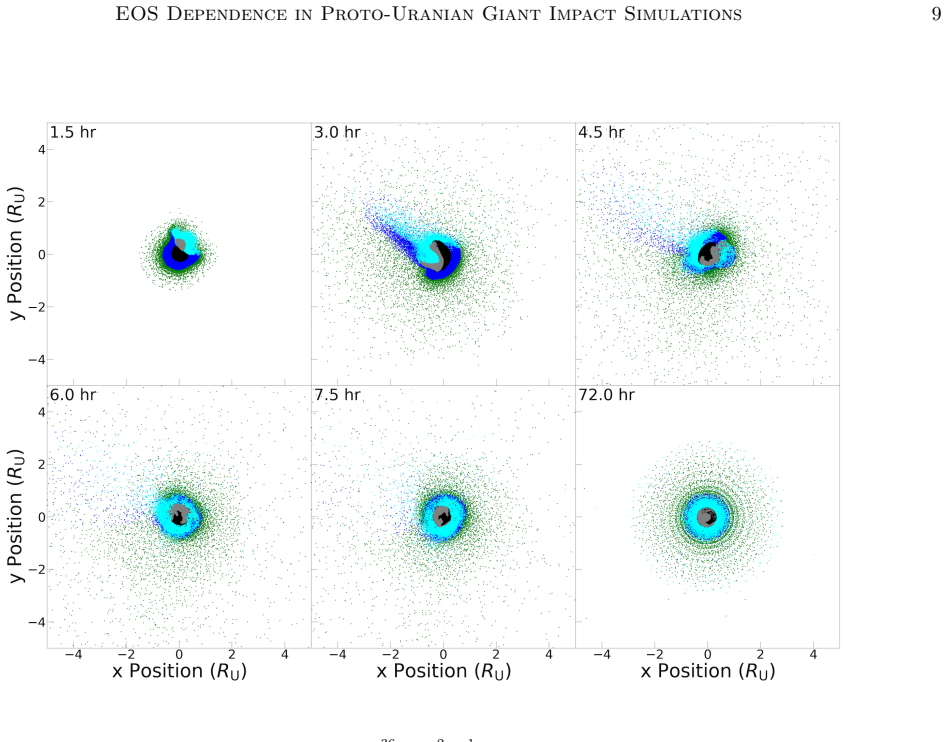
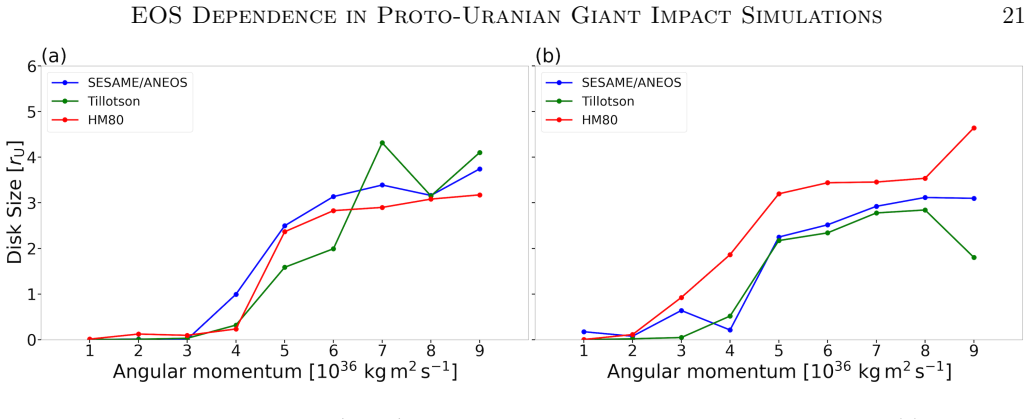
In simulations of a 3 Earth-mass impactor striking proto-Uranus at parameters that reproduce the observed spin state, the post-impact rotation period, the mass of the ejected disk, and the radial extent of that disk remain nearly the same across three different equations of state and two SPH formulations. These outcomes are controlled primarily by the angular momentum of the impact. By contrast, the rock-to-ice ratio in the disk material shows strong dependence on which EOS is adopted.
What carries the argument
Systematic comparison of three distinct EOS models and two SPH schemes (standard and density-independent) in giant-impact simulations tuned to match Uranus's current rotation.
If this is right
- Disk mass and radial size can be predicted reliably from impact angular momentum alone.
- Disk rock fraction requires careful EOS selection to constrain possible satellite compositions.
- Earlier inconsistencies in reported disk compositions are attributable to differences in EOS rather than SPH scheme.
- The giant-impact scenario for Uranus remains testable once disk-evolution models incorporate the range of rock fractions found here.
Where Pith is reading between the lines
- Disk-evolution calculations run across the full range of rock fractions reported here could produce bounded predictions for the ice-to-rock ratios of Uranus's regular satellites.
- The robustness of mass and size to microphysical details suggests that analogous impacts on other ice giants would yield structurally similar disks even if their EOS differs.
- If multi-phase or temperature-dependent EOS refinements alter the rock fraction by more than the spread seen across the three models tested, satellite-accretion outcomes could shift measurably.
Load-bearing premise
The assumption that a 3-Earth-mass impactor and the explored range of impact parameters are representative of the actual formation event, and that the tested EOS models and SPH schemes capture the dominant physical uncertainties.
What would settle it
Running identical impact simulations with an additional independent EOS model or with a non-SPH hydrodynamics code and checking whether the rock fraction remains strongly EOS-dependent while mass and size stay unchanged.
Figures






read the original abstract
The $98^\circ$ obliquity of Uranus is widely attributed to a giant impact that ejected material and formed a debris disk, which subsequently coalesced into its regular satellites. Previous Smoothed Particle Hydrodynamics (SPH) studies have yielded inconsistent disk compositions, a discrepancy often linked to the variety of numerical and physical modeling assumptions. We address this by presenting SPH simulations that systematically test three distinct EOS models alongside two SPH schemes (standard SPH, and the enhanced density-independent SPH). We utilized a $3M_{\oplus}$ impactor and explored a range of impact parameters which are capable of reproducing Uranus's current spin state. Our primary finding is that for impacts capable of reproducing Uranus's current rotation, the choice of EOS or SPH scheme barely affects macroscopic features such as the post-impact rotation period, disk mass, or disk size; these properties are primarily controlled by the impact's angular momentum. In contrast, the disk's rock fraction is highly EOS-dependent. Our results clarify that while disk mass and size are robust outcomes, the final disk composition is highly model-dependent. Therefore, accurate EOS modeling, integrated with detailed disk evolution studies, is essential to definitively validate the giant impact scenario for Uranus.
Editorial analysis
A structured set of objections, weighed in public.
Referee Report
Summary. The manuscript presents SPH simulations of a giant impact on proto-Uranus using a fixed 3 Earth-mass impactor and a range of impact parameters selected to reproduce the planet's observed spin state. It systematically compares three distinct equations of state and two SPH schemes (standard and density-independent), concluding that for spin-matching impacts the choice of EOS or SPH variant has negligible effect on macroscopic disk properties such as post-impact rotation period, disk mass, and disk size, which are instead controlled primarily by the impact angular momentum; in contrast, the disk rock fraction is strongly EOS-dependent. The authors argue that this clarifies prior inconsistencies in the literature and underscores the need for accurate EOS modeling in disk evolution studies.
Significance. If the central result holds, the work provides a useful clarification of why previous SPH studies of Uranian satellite formation have disagreed on disk composition while showing more consistency on bulk properties. By isolating the spin-matching subset of impacts, it demonstrates robustness of mass and size outcomes and isolates composition as the key model-dependent quantity. This has direct implications for subsequent N-body or disk-evolution calculations that rely on the initial disk state. The systematic multi-EOS, multi-scheme comparison is a methodological strength.
major comments (2)
- [§2 and abstract] §2 (Simulation Setup) and abstract: the impactor mass is fixed at 3 M_⊕ and impact parameters are chosen specifically to reproduce Uranus's spin. This restricted slice of parameter space may mask EOS sensitivity in disk mass and size; different impactor masses would alter shock heating, vaporization thresholds, and angular-momentum partitioning, potentially producing larger spreads in macroscopic outcomes under the same EOS variations. The manuscript provides no tests at other masses and no explicit argument that 3 M_⊕ is representative, rendering the robustness claim conditional on an untested assumption.
- [Results section] Results section (disk property comparisons): while the paper reports that macroscopic features are insensitive to EOS within the explored runs, the quantitative spreads in disk mass and size across EOS models are not tabulated or plotted with error bars that would allow assessment of whether the observed insensitivity is statistically meaningful or merely a consequence of the narrow parameter choice.
minor comments (2)
- [Abstract] Abstract: the specific three EOS models and the two SPH schemes should be named explicitly rather than described generically.
- [Figures and text] Figure captions and text: ensure consistent notation for rock fraction (e.g., always specify whether it is mass fraction or number fraction) and clarify how particles are classified as belonging to the disk versus the planet.
Simulated Author's Rebuttal
We thank the referee for their constructive and detailed review. The comments highlight important aspects of the scope and presentation of our results, which we address point by point below.
read point-by-point responses
-
Referee: [§2 and abstract] §2 (Simulation Setup) and abstract: the impactor mass is fixed at 3 M_⊕ and impact parameters are chosen specifically to reproduce Uranus's spin. This restricted slice of parameter space may mask EOS sensitivity in disk mass and size; different impactor masses would alter shock heating, vaporization thresholds, and angular-momentum partitioning, potentially producing larger spreads in macroscopic outcomes under the same EOS variations. The manuscript provides no tests at other masses and no explicit argument that 3 M_⊕ is representative, rendering the robustness claim conditional on an untested assumption.
Authors: We agree that the study is restricted to a 3 M_⊕ impactor and to the subset of impact parameters that reproduce Uranus's observed spin. This choice follows from the scientific goal of examining the giant-impact scenario capable of explaining the planet's obliquity and rotation; prior literature on Uranian satellite formation has commonly adopted similar impactor masses. Within this spin-matching regime our results show that disk mass and size are controlled primarily by angular momentum rather than EOS. We will revise the manuscript to include an explicit statement of this scope, a brief justification for the 3 M_⊕ choice based on existing models, and a clear caveat that sensitivity at other masses remains untested. No new simulations at different masses will be added in this revision. revision: partial
-
Referee: [Results section] Results section (disk property comparisons): while the paper reports that macroscopic features are insensitive to EOS within the explored runs, the quantitative spreads in disk mass and size across EOS models are not tabulated or plotted with error bars that would allow assessment of whether the observed insensitivity is statistically meaningful or merely a consequence of the narrow parameter choice.
Authors: We accept this criticism of the presentation. In the revised manuscript we will insert a new table that reports the numerical values of post-impact rotation period, disk mass, disk size, and rock fraction for every EOS–SPH combination, together with the range or standard deviation across the spin-matching impact parameters. We will also add error bars (or shaded ranges) to the relevant comparison figures. These additions will allow readers to judge the magnitude of the spreads directly. revision: yes
Circularity Check
No circularity: results from independent numerical variation against external spin target
full rationale
The paper reports direct SPH simulation outcomes for a fixed 3M⊕ impactor across EOS variants and schemes, selecting impact parameters only to match Uranus's observed rotation period as an external benchmark. Macroscopic disk properties are stated to be controlled by angular momentum while rock fraction varies with EOS; these emerge from explicit numerical comparisons rather than any equation reducing a reported quantity to a fitted parameter or self-citation by construction. No self-definitional steps, fitted-input predictions, or load-bearing self-citations appear in the provided text, so the central claims remain independent of the inputs.
Axiom & Free-Parameter Ledger
free parameters (2)
- Impactor mass
- Impact parameter range
axioms (2)
- domain assumption SPH and its density-independent variant accurately capture the hydrodynamics and mixing in giant impacts between icy bodies.
- domain assumption The three chosen EOS models adequately sample the range of plausible rock-ice behavior under impact conditions.
Lean theorems connected to this paper
-
IndisputableMonolith/Cost/FunctionalEquation.leanwashburn_uniqueness_aczel unclear?
unclearRelation between the paper passage and the cited Recognition theorem.
Our primary finding is that for impacts capable of reproducing Uranus's current rotation, the choice of EOS or SPH scheme barely affects macroscopic features such as the post-impact rotation period, disk mass, or disk size; these properties are primarily controlled by the impact's angular momentum. In contrast, the disk's rock fraction is highly EOS-dependent.
-
IndisputableMonolith/Foundation/RealityFromDistinction.leanreality_from_one_distinction unclear?
unclearRelation between the paper passage and the cited Recognition theorem.
We employed two Smoothed-Particle Hydrodynamics (SPH) schemes... three distinct EOS models (ANEOS/SESAME, Tillotson EOS, and HM80 EOS)
What do these tags mean?
- matches
- The paper's claim is directly supported by a theorem in the formal canon.
- supports
- The theorem supports part of the paper's argument, but the paper may add assumptions or extra steps.
- extends
- The paper goes beyond the formal theorem; the theorem is a base layer rather than the whole result.
- uses
- The paper appears to rely on the theorem as machinery.
- contradicts
- The paper's claim conflicts with a theorem or certificate in the canon.
- unclear
- Pith found a possible connection, but the passage is too broad, indirect, or ambiguous to say the theorem truly supports the claim.
discussion (0)
Sign in with ORCID, Apple, or X to comment. Anyone can read and Pith papers without signing in.