Ancilla Assisted Quantum Process Tomography using Bound entangled states
Pith reviewed 2026-05-20 10:06 UTC · model grok-4.3
The pith
Certain bound entangled states can be used for ancilla-assisted quantum process tomography.
A machine-rendered reading of the paper's core claim, the machinery that carries it, and where it could break.
Core claim
Certain bound entangled states can be used for ancilla-assisted quantum process tomography. Explicit demonstrations establish that these states support faithful process reconstruction from measurement outcomes. Local filtering operations improve the trace norm of the realignment criterion but render the resulting states unfaithful and unsuitable for reliable reconstruction. Quantitative efficiency bounds are established through comparisons with Werner and isotropic states.
What carries the argument
Bound entangled states as ancilla resources whose entanglement structure permits a unique mapping from joint measurement outcomes to the unknown quantum process.
If this is right
- Bound entangled states expand the set of usable ancilla resources beyond those with distillable entanglement for performing process tomography.
- Local filtering operations, despite improving certain entanglement witnesses, make bound entangled states unsuitable for faithful AAQPT.
- Performance comparisons yield quantitative efficiency bounds relative to Werner states and isotropic states.
Where Pith is reading between the lines
- These states could prove more resilient to specific decoherence mechanisms in laboratory implementations of process tomography.
- Higher-dimensional variants of bound entangled states might yield protocols that require fewer measurement settings.
- The same bound entangled resources could potentially support combined tasks such as tomography followed by error mitigation.
Load-bearing premise
The chosen bound entangled states permit a unique and reliable mapping from measurement outcomes to the elements of the quantum process.
What would settle it
Observing a quantum process for which the measurement statistics obtained with one of the proposed bound entangled ancilla states yield either ambiguous or incorrect reconstruction would falsify the claim.
Figures
read the original abstract
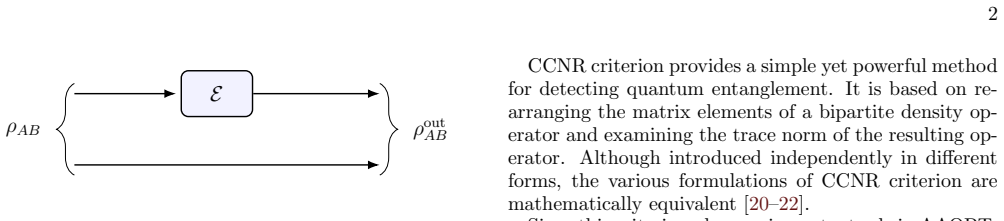
Lu \textit{et al.} [Ann. Phys. (Berlin) \textbf{534}, 2100550 (2022)] posed the question of whether bound entangled states can be used for ancilla-assisted quantum process tomography (AAQPT). In this work, we answer this question in the affirmative by explicitly demonstrating that certain bound entangled states can be used for AAQPT. We further show that, although local filtering operations may improve the trace norm of the realignment criterion, they are essentially ineffective for AAQPT, as they render the resulting states \emph{unfaithful} and therefore unsuitable for reliable process reconstruction. Further, we investigate the efficiency of bound entangled states for AAQPT and establish quantitative bounds by comparing their performance with Werner and isotropic states. Our results therefore provide a new application of bound entangled states in the context of ancilla-assisted quantum process tomography.
Editorial analysis
A structured set of objections, weighed in public.
Referee Report
Summary. The manuscript answers affirmatively the question posed by Lu et al. on whether bound entangled states can be used for ancilla-assisted quantum process tomography (AAQPT). It provides an explicit demonstration that certain bound entangled states enable faithful process reconstruction, shows that local filtering operations improve the realignment criterion but render the states unfaithful for AAQPT, and compares the efficiency of these states against Werner and isotropic states via quantitative bounds.
Significance. If the explicit demonstration and invertibility hold, the work supplies a concrete new application of bound entangled states in quantum tomography, extending their utility beyond their usual characterization as non-distillable resources. This is noteworthy because bound entanglement is typically difficult to harness for information-processing tasks, and the efficiency comparisons provide quantitative context relative to standard entangled resources.
major comments (1)
- [Section on explicit demonstration of AAQPT with bound entangled states] The central claim of faithful AAQPT requires that the linear map from the unknown process (Choi operator) to the measurement outcome probabilities is bijective for arbitrary CPTP maps. The demonstration in the section presenting the bound entangled ancilla states must explicitly verify that the chosen states span the full space of processes (e.g., by computing the rank of the reconstruction matrix or providing an explicit inversion formula); without this, reconstruction may fail for process directions orthogonal to the support of the ancilla state, as noted in the stress-test concern.
minor comments (2)
- [Methods/Results] Clarify the precise form of the bound entangled states used (e.g., their explicit density-matrix representation or the parameters in the family) in the methods or results section to allow reproducibility.
- [Efficiency comparison section] The efficiency comparison with Werner and isotropic states would benefit from a table summarizing the quantitative bounds (e.g., number of measurements or reconstruction error) for direct side-by-side evaluation.
Simulated Author's Rebuttal
We thank the referee for their careful reading of the manuscript and for recognizing the potential significance of using bound entangled states for ancilla-assisted quantum process tomography. We address the major comment below.
read point-by-point responses
-
Referee: The central claim of faithful AAQPT requires that the linear map from the unknown process (Choi operator) to the measurement outcome probabilities is bijective for arbitrary CPTP maps. The demonstration in the section presenting the bound entangled ancilla states must explicitly verify that the chosen states span the full space of processes (e.g., by computing the rank of the reconstruction matrix or providing an explicit inversion formula); without this, reconstruction may fail for process directions orthogonal to the support of the ancilla state, as noted in the stress-test concern.
Authors: We agree that explicit verification of bijectivity is required to substantiate faithful reconstruction for arbitrary CPTP maps. Our demonstration shows that the selected bound entangled states permit process reconstruction via the measurement probabilities, but to directly address the concern about possible orthogonal directions and the stress-test, we will revise the relevant section to include an explicit computation of the rank of the reconstruction matrix (confirming it is full rank) together with the corresponding inversion formula. revision: yes
Circularity Check
No circularity: explicit demonstration of bound entangled states for AAQPT is self-contained
full rationale
The paper addresses a question posed by Lu et al. by providing an explicit demonstration that specific bound entangled states enable faithful ancilla-assisted quantum process tomography. It further analyzes local filtering operations and compares efficiency against Werner and isotropic states through direct performance bounds. No load-bearing step reduces by construction to a fitted input, self-citation chain, or ansatz smuggled from prior work by the same authors. The central claim rests on construction and comparison rather than re-deriving the invertibility map from its own outputs. This qualifies as a normal non-circular finding for a demonstration-style result.
Axiom & Free-Parameter Ledger
axioms (1)
- standard math Standard framework of quantum mechanics, density operators, and linear maps for quantum processes and states.
Lean theorems connected to this paper
-
IndisputableMonolith/Foundation/RealityFromDistinction.leanreality_from_one_distinction unclear?
unclearRelation between the paper passage and the cited Recognition theorem.
We now show that γ is indeed a counterexample, namely, that its realigned operator R(γ) is invertible... for sufficiently small ε>0, the perturbed operator R(γ) remains invertible.
What do these tags mean?
- matches
- The paper's claim is directly supported by a theorem in the formal canon.
- supports
- The theorem supports part of the paper's argument, but the paper may add assumptions or extra steps.
- extends
- The paper goes beyond the formal theorem; the theorem is a base layer rather than the whole result.
- uses
- The paper appears to rely on the theorem as machinery.
- contradicts
- The paper's claim conflicts with a theorem or certificate in the canon.
- unclear
- Pith found a possible connection, but the passage is too broad, indirect, or ambiguous to say the theorem truly supports the claim.
Reference graph
Works this paper leans on
-
[1]
M. A. Nielsen and I. L. Chuang,Quantum computation and quantum information(Cambridge university press, 2010)
work page 2010
-
[2]
I. L. Chuang and M. A. Nielsen, Prescription for ex- perimental determination of the dynamics of a quan- tum black box, Journal of Modern Optics44, 2455–2467 (1997)
work page 1997
-
[3]
J. F. Poyatos, J. I. Cirac, and P. Zoller, Complete char- acterization of a quantum process: The two-bit quantum gate, Phys. Rev. Lett.78, 390 (1997)
work page 1997
-
[5]
J. B. Altepeter, D. Branning, E. Jeffrey, T. C. Wei, P. G. Kwiat, R. T. Thew, J. L. O’Brien, M. A. Nielsen, and A. G. White, Ancilla-assisted quantum process to- mography, Physical Review Letters90, 10.1103/phys- revlett.90.193601 (2003)
-
[6]
M. Mohseni and D. A. Lidar, Direct characterization of quantum dynamics, Phys. Rev. Lett.97, 170501 (2006)
work page 2006
-
[7]
M. Mohseni, A. T. Rezakhani, and D. A. Lidar, Quantum-process tomography: Resource analysis of dif- ferent strategies, Phys. Rev. A77, 032322 (2008)
work page 2008
-
[8]
Z. Bao and D. F. V. James, Quantum properties of bi- partite separable mixed state for ancilla-assisted pro- 7 cess tomography, Quantum Information Processing25, 10.1007/s11128-025-05036-6 (2026)
-
[9]
P. W. Shor, J. A. Smolin, and A. V. Thapliyal, Super- activation of bound entanglement, Phys. Rev. Lett.90, 107901 (2003)
work page 2003
-
[10]
D. P. Chi, J. W. Choi, J. S. Kim, T. Kim, and S. Lee, Bound entangled states with a nonzero distillable key rate, Phys. Rev. A75, 032306 (2007)
work page 2007
- [11]
-
[12]
G. T´ oth and T. V´ ertesi, Quantum states with a posi- tive partial transpose are useful for metrology, Phys. Rev. Lett.120, 020506 (2018)
work page 2018
-
[13]
K. F. P´ al, G. T´ oth, E. Bene, and T. V´ ertesi, Bound en- tangled singlet-like states for quantum metrology, Phys. Rev. Res.3, 023101 (2021)
work page 2021
-
[14]
C. Roch i Carceller and A. Tavakoli, Bound entangled states are useful in prepare-and-measure scenarios, Phys. Rev. Lett.134, 120203 (2025)
work page 2025
-
[15]
G. Lu, Z. Zhang, Y. Dai, Y. Dong, and C. Zhang, Not all entangled states are useful for ancilla-assisted quantum process tomography, Annalen der Physik534, 10.1002/andp.202100550 (2022)
- [16]
-
[17]
A. Jamio lkowski, Linear transformations which preserve trace and positive semidefiniteness of operators, Reports on mathematical physics3, 275 (1972)
work page 1972
-
[18]
M.-D. Choi, Completely positive linear maps on com- plex matrices, Linear algebra and its applications10, 285 (1975)
work page 1975
-
[19]
P. Arrighi and C. Patricot, On quantum operations as quantum states, Annals of Physics311, 26–52 (2004)
work page 2004
-
[20]
K. Chen and L.-A. Wu, A matrix realignment method for recognizing entanglement, Quantum Info. Comput. 3, 193–202 (2003)
work page 2003
-
[21]
O. Rudolph, Some properties of the computable cross- norm criterion for separability, Physical Review A67, 10.1103/physreva.67.032312 (2003)
-
[22]
O. Rudolph, Further results on the cross norm crite- rion for separability, Quantum Information Processing4, 219–239 (2005)
work page 2005
-
[23]
D. Cariello, Inequalities for the schmidt number of bipar- tite states, Letters in Mathematical Physics110, 827–833 (2019)
work page 2019
-
[24]
´A. Luk´ acs, R. Tr´ enyi, T. V´ ertesi, and G. T´ oth, Itera- tive optimization in quantum metrology and entangle- ment theory using semidefinite programming, Quantum Science and Technology11, 015042 (2026)
work page 2026
-
[25]
I. M´ arton, E. Bene, and T. V´ ertesi, Bound entanglement- assisted prepare-and-measure scenarios based on four- dimensional quantum messages, Quantum Science and Technology10, 04LT02 (2025)
work page 2025
-
[26]
Gisin, Hidden quantum nonlocality revealed by local filters, Physics Letters A210, 151 (1996)
N. Gisin, Hidden quantum nonlocality revealed by local filters, Physics Letters A210, 151 (1996)
work page 1996
-
[27]
M. Horodecki, P. Horodecki, and R. Horodecki, Insepa- rable two spin- 1 2 density matrices can be distilled to a singlet form, Phys. Rev. Lett.78, 574 (1997)
work page 1997
-
[28]
P. G. Kwiat, S. Barraza-Lopez, A. Stefanov, and N. Gisin, Experimental entanglement distillation and ‘hidden’non-locality, Nature409, 1014 (2001)
work page 2001
-
[29]
Z.-W. Wang, X.-F. Zhou, Y.-F. Huang, Y.-S. Zhang, X.- F. Ren, and G.-C. Guo, Experimental entanglement dis- tillation of two-qubit mixed states under local operations, Phys. Rev. Lett.96, 220505 (2006)
work page 2006
-
[30]
L. Masanes, Y.-C. Liang, and A. C. Doherty, All bipartite entangled states display some hidden nonlocality, Phys. Rev. Lett.100, 090403 (2008)
work page 2008
-
[31]
D. E. Jones, B. T. Kirby, G. Riccardi, C. Antonelli, and M. Brodsky, Exploring classical correlations in noise to recover quantum information using local filtering, New Journal of Physics22, 073037 (2020)
work page 2020
- [32]
-
[33]
T. Pramanik, Y.-W. Cho, S.-W. Han, S.-Y. Lee, Y.-S. Kim, and S. Moon, Revealing hidden quantum steer- ability using local filtering operations, Phys. Rev. A99, 030101 (2019)
work page 2019
- [34]
-
[35]
M. J. Donald, M. Horodecki, and O. Rudolph, The uniqueness theorem for entanglement measures, Journal of Mathematical Physics43, 4252–4272 (2002)
work page 2002
-
[36]
R. F. Werner, Quantum states with einstein-podolsky- rosen correlations admitting a hidden-variable model, Phys. Rev. A40, 4277 (1989)
work page 1989
-
[37]
M. Horodecki and P. Horodecki, Reduction criterion of separability and limits for a class of distillation protocols, Phys. Rev. A59, 4206 (1999)
work page 1999
-
[38]
G. M. D’Ariano and P. Lo Presti, Quantum tomography for measuring experimentally the matrix elements of an arbitrary quantum operation, Phys. Rev. Lett.86, 4195 (2001). Appendix A:3⊗3PPT entangled state with maximal CCNR violation We now provide the explicit form of the 3⊗3 PPT entangled state discussed in the main text, generated using the numerical opti...
work page 2001
discussion (0)
Sign in with ORCID, Apple, or X to comment. Anyone can read and Pith papers without signing in.