Faraday Complexity and Depolarization in LOFAR Two-metre Sky Survey (LoTSS-DR2) Polarized Radio Sources
Pith reviewed 2026-05-20 04:48 UTC · model grok-4.3
pith:LL5IQ4KS Add to your LaTeX paper
What is a Pith Number?\usepackage{pith}
\pithnumber{LL5IQ4KS}
Prints a linked pith:LL5IQ4KS badge after your title and writes the identifier into PDF metadata. Compiles on arXiv with no extra files. Learn more
The pith
Multi-component modeling of 1565 LoTSS-DR2 sources shows 43% have complex Faraday structure, external dispersion dominates in 54%, and rest-frame dispersion correlates positively with redshift in external and mixed populations.
A machine-rendered reading of the paper's core claim, the machinery that carries it, and where it could break.
Core claim
External Faraday dispersion dominates the depolarization behaviour, with 54.1% of sources classified as external-screen dominated and approximately 60% showing statistically significant evidence for turbulent external Faraday-active media, while only 10.3% are consistent with pure internal differential Faraday rotation. The rest-frame Faraday dispersion exhibits significant positive correlations with redshift for the external-screen dominated and mixed depolarization populations, even after controlling for radio luminosity.
Load-bearing premise
That the multi-component Faraday depolarization models applied to the 120-168 MHz Stokes Q and U spectra accurately distinguish physical external screens from internal effects and noise without significant post-hoc model selection bias or unaccounted calibration residuals (invoked in the broadband spectro-polarimetric analysis and model classification steps described in the abstract).
Figures



read the original abstract
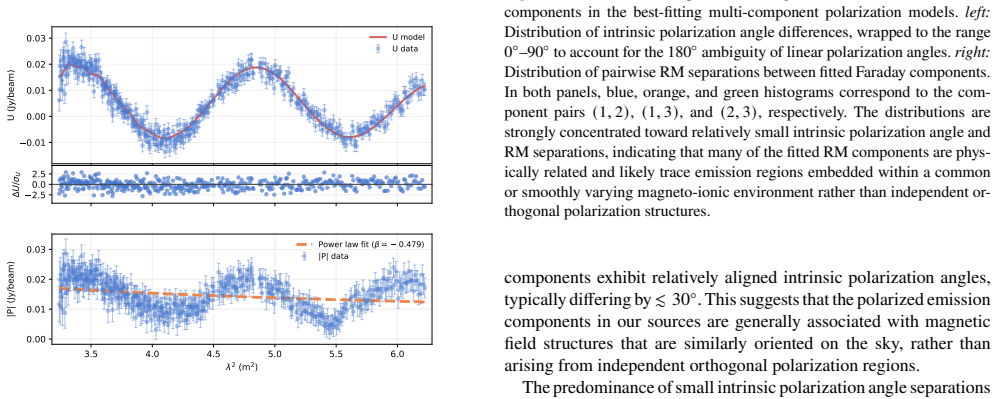
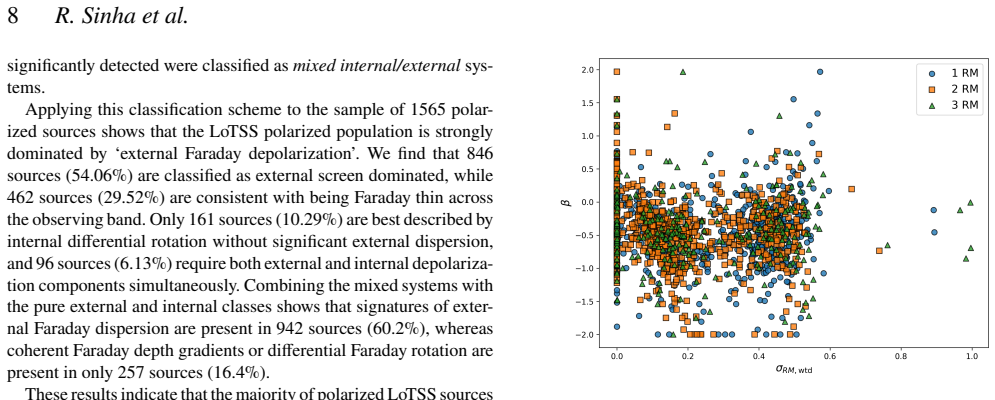
We present a broadband spectro-polarimetric analysis of 1,565 polarized radio sources from the LOFAR Two-Metre Sky Survey Data Release 2 (LoTSS-DR2) RM Grid catalogue. This study uses frequency-dependent Stokes Q and U spectra across the 120-168 MHz LOFAR HBA band to investigate their polarization properties. The polarization behaviour of each source is modelled with multi-component Faraday depolarization models to investigate the magneto-ionic environments responsible for low-frequency depolarization. Significant Faraday complexity is observed throughout the sample, with 43.2% of sources requiring two or three Faraday components. External Faraday dispersion dominates the depolarization behaviour, with 54.1% of sources classified as external-screen dominated and approximately 60% showing statistically significant evidence for turbulent external Faraday-active media, while only 10.3% are consistent with pure internal differential Faraday rotation. The intrinsic polarization angle and RM separations between fitted components are generally small, suggesting that many RM components trace physically related emission regions embedded within common magneto-ionic environments. A weak but statistically significant anti-correlation is detected between the polarization spectral index, $\beta$, and weighted Faraday dispersion, $\sigma_{\rm RM,wtd}$, for two-component systems, whereas one- and three-component populations show no significant trend. The rest-frame Faraday dispersion, $\sigma_{\rm RM,rest}$, exhibits significant positive correlations with redshift for the external-screen dominated and mixed depolarization populations, even after controlling for radio luminosity, indicating increasingly turbulent or strongly magnetized environments surrounding radio AGN at earlier cosmic epochs.
Editorial analysis
A structured set of objections, weighed in public.
Referee Report
Summary. The paper analyzes 1,565 polarized radio sources from the LoTSS-DR2 RM Grid catalogue using broadband Stokes Q and U spectra across 120-168 MHz. It fits multi-component Faraday depolarization models to classify depolarization mechanisms, reporting that 43.2% of sources require two or three components, external Faraday dispersion dominates in 54.1% of sources with ~60% showing turbulent external media, only 10.3% consistent with pure internal differential Faraday rotation, a weak anti-correlation between polarization spectral index β and weighted Faraday dispersion σ_RM,wtd in two-component systems, and positive correlations of rest-frame Faraday dispersion σ_RM,rest with redshift for external and mixed populations even after controlling for luminosity.
Significance. If the model-based classifications hold, the work provides a statistically large sample view of low-frequency depolarization mechanisms in radio AGN, highlighting the prevalence of external turbulent screens and a redshift trend suggesting evolving magneto-ionic environments. The broadband spectro-polarimetric approach and separation into one-, two-, and three-component populations are useful contributions to cosmic magnetism studies.
major comments (3)
- [Abstract] Abstract and methods: The headline classification fractions (54.1% external-screen dominated, 10.3% pure internal differential Faraday rotation, ~60% turbulent external) rest on assigning physical labels after fitting multi-component models to the 120-168 MHz Q/U spectra. No end-to-end injection or recovery tests are described to quantify false-positive rates for declaring external turbulent screens when the input is internal differential rotation or noise-only, which is load-bearing for the central claim given the compressed Faraday depth scale and potential calibration residuals at LOFAR frequencies.
- [Abstract] Abstract: The reported anti-correlation between β and σ_RM,wtd for two-component systems, and the positive σ_RM,rest-redshift correlations for external/mixed populations, are derived quantities obtained from the same model fits to the same spectra. This introduces potential circular dependence on the fitting procedure and model selection that should be quantified (e.g., via bootstrap or mock spectra) before interpreting them as physical trends.
- [Abstract] Abstract: The 43.2% multi-component fraction and the redshift trend are stated without details on how data quality cuts, S/N thresholds, or model selection criteria (AIC/BIC or equivalent) propagate into the uncertainties on these percentages and correlations; this affects the robustness of the controlled luminosity analysis.
minor comments (2)
- Clarify the exact definition and weighting scheme for σ_RM,wtd and how it differs from σ_RM,rest in the text and any equations.
- The intrinsic polarization angle and RM separations between components are described as 'generally small'; provide quantitative distributions or a table summarizing these values.
Simulated Author's Rebuttal
We thank the referee for the constructive and detailed report. The comments highlight important aspects of validation and robustness that we address below. We have revised the manuscript to incorporate additional tests, analyses, and clarifications as described in the point-by-point responses.
read point-by-point responses
-
Referee: [Abstract] Abstract and methods: The headline classification fractions (54.1% external-screen dominated, 10.3% pure internal differential Faraday rotation, ~60% turbulent external) rest on assigning physical labels after fitting multi-component models to the 120-168 MHz Q/U spectra. No end-to-end injection or recovery tests are described to quantify false-positive rates for declaring external turbulent screens when the input is internal differential rotation or noise-only, which is load-bearing for the central claim given the compressed Faraday depth scale and potential calibration residuals at LOFAR frequencies.
Authors: We agree that end-to-end injection and recovery tests provide valuable quantification of classification reliability. Our current classifications are based on statistical model selection via AIC/BIC combined with visual inspection of the fits to the observed spectra. In the revised manuscript we will add a new subsection to the Methods describing Monte Carlo simulations in which synthetic spectra with known internal differential rotation, external dispersion, and noise-only inputs are generated and passed through the identical fitting and classification pipeline. These tests will report recovery fractions and false-positive rates under the specific frequency coverage and noise properties of the LoTSS-DR2 data. revision: yes
-
Referee: [Abstract] Abstract: The reported anti-correlation between β and σ_RM,wtd for two-component systems, and the positive σ_RM,rest-redshift correlations for external/mixed populations, are derived quantities obtained from the same model fits to the same spectra. This introduces potential circular dependence on the fitting procedure and model selection that should be quantified (e.g., via bootstrap or mock spectra) before interpreting them as physical trends.
Authors: We appreciate the referee’s caution regarding possible circularity. The model selection and parameter estimation occur prior to the calculation of the reported correlations. To quantify any residual dependence on the fitting procedure, the revised manuscript will include a bootstrap resampling analysis: spectra will be resampled within their uncertainties, refitted, and the resulting distributions of β, σ_RM,wtd and σ_RM,rest will be used to assess the stability and significance of the quoted correlations. revision: yes
-
Referee: [Abstract] Abstract: The 43.2% multi-component fraction and the redshift trend are stated without details on how data quality cuts, S/N thresholds, or model selection criteria (AIC/BIC or equivalent) propagate into the uncertainties on these percentages and correlations; this affects the robustness of the controlled luminosity analysis.
Authors: We agree that explicit propagation of uncertainties arising from data-quality cuts and model-selection criteria is required for a complete assessment of robustness. The revised manuscript will expand the Methods section to document the precise S/N thresholds, polarisation fraction cuts, and AIC/BIC thresholds employed. We will also add a sensitivity analysis that varies these thresholds within reasonable ranges and reports the resulting variation in the multi-component fraction and in the significance of the σ_RM,rest–redshift relations after luminosity control. revision: yes
Circularity Check
No significant circularity; empirical results from model fits to observational spectra
full rationale
The paper applies multi-component Faraday depolarization models to 120-168 MHz Stokes Q/U spectra for 1565 sources, classifies depolarization types (e.g., 54.1% external-screen dominated), and reports correlations (e.g., anti-correlation between β and σ_RM,wtd for two-component systems, or σ_RM,rest with redshift). These are direct statistical outputs from fitting the models to the data rather than any derivation that reduces a claimed result to its inputs by construction. No self-definitional steps, fitted inputs renamed as predictions, or load-bearing self-citations appear in the analysis chain. The findings remain self-contained against the LoTSS-DR2 observations.
Axiom & Free-Parameter Ledger
free parameters (3)
- number of Faraday components per source
- Faraday dispersion σ_RM and RM values for each component
- polarization spectral index β
axioms (2)
- standard math Faraday rotation measure is proportional to the line-of-sight integral of electron density times parallel magnetic field
- domain assumption Depolarization can be described by a small number of discrete external or internal Faraday screens with Gaussian or uniform RM distributions
Lean theorems connected to this paper
-
IndisputableMonolith/Cost/FunctionalEquation.leanwashburn_uniqueness_aczel unclear?
unclearRelation between the paper passage and the cited Recognition theorem.
External Faraday dispersion dominates the depolarization behaviour, with 54.1% of sources classified as external-screen dominated... modelled with multi-component Faraday depolarization models
-
IndisputableMonolith/Foundation/ArithmeticFromLogic.leanLogicNat.induction unclear?
unclearRelation between the paper passage and the cited Recognition theorem.
The polarization behaviour of each source is modelled with multi-component Faraday depolarization models... BIC model selection
What do these tags mean?
- matches
- The paper's claim is directly supported by a theorem in the formal canon.
- supports
- The theorem supports part of the paper's argument, but the paper may add assumptions or extra steps.
- extends
- The paper goes beyond the formal theorem; the theorem is a base layer rather than the whole result.
- uses
- The paper appears to rely on the theorem as machinery.
- contradicts
- The paper's claim conflicts with a theorem or certificate in the canon.
- unclear
- Pith found a possible connection, but the passage is too broad, indirect, or ambiguous to say the theorem truly supports the claim.
Reference graph
Works this paper leans on
-
[1]
Broadband Radio Polarimetry and Faraday Rotation of 563 Extragalactic Radio Sources
Broadband Radio Polarimetry and Faraday Rotation of 563 Extragalactic Radio Sources. , keywords =. doi:10.1088/0004-637X/815/1/49 , archivePrefix =. 1511.04080 , primaryClass =
work page internal anchor Pith review Pith/arXiv arXiv doi:10.1088/0004-637x/815/1/49
-
[2]
Banfield, J. K. and George, S. J. and Taylor, A. R. and Stil, J. M. and Jarrett, T. H. and Rosenberg, J. L. and Edge, A. C. , year=. POLARIZED RADIO SOURCES: A STUDY OF LUMINOSITY, REDSHIFT, AND INFRARED COLORS , volume=. The Astrophysical Journal , publisher=. doi:10.1088/0004-637X/733/1/69 , number=
-
[3]
Space Science Reviews , year = 2012, volume = 166, pages =
Magnetic Fields in Galaxies. Space Science Reviews , year = 2012, volume = 166, pages =. doi:10.1007/s11214-011-9782-z , adsurl =
-
[4]
Planets, Stars and Stellar Systems , pages=
Magnetic Fields in Galaxies , author=. Planets, Stars and Stellar Systems , pages=. 2013 , publisher=. doi:10.1007/978-94-007-5612-0_17 , url=
-
[5]
Beck, R. and others , title =. Astronomy & Astrophysics , volume =. 2021 , doi =
work page 2021
-
[6]
Faraday Rotation Measure Synthesis
Faraday rotation measure synthesis. , keywords =. doi:10.1051/0004-6361:20052990 , archivePrefix =. astro-ph/0507349 , primaryClass =
work page internal anchor Pith review Pith/arXiv arXiv doi:10.1051/0004-6361:20052990
-
[7]
Monthly Notices of the Royal Astronomical Society , volume =
The Recognition of BL Lac Objects and Their Statistical Properties , author =. Monthly Notices of the Royal Astronomical Society , volume =. 1993 , month =. doi:10.1093/mnras/261.4.795 , url =
-
[8]
Burn, B. J. , title =. Monthly Notices of the Royal Astronomical Society , volume =. 1966 , month =. doi:10.1093/mnras/133.1.67 , url =
-
[9]
Polarization Performance and Challenges for ASKAP. Publications of the Astronomical Society of Australia , year = 2013, volume =. doi:10.1017/pasa.2012.001 , archivePrefix =. 1212.4433 , primaryClass =
work page internal anchor Pith review Pith/arXiv arXiv doi:10.1017/pasa.2012.001 2013
-
[10]
Allison H. Costa and Steven R. Spangler and Joseph R. Sink and Shea Brown and Sui Ann Mao , title =. 2016 , month =. doi:10.3847/0004-637X/821/2/92 , url =
-
[11]
A Broadband Polarization Catalog of Extragalactic Radio Sources
A Broadband Polarization Catalog of Extragalactic Radio Sources. , keywords =. doi:10.1088/0067-0049/212/1/15 , archivePrefix =. 1403.2391 , primaryClass =
work page internal anchor Pith review Pith/arXiv arXiv doi:10.1088/0067-0049/212/1/15
-
[12]
Integrated Polarization of Sources at lambda ~1m and New Rotation Measure Ambiguities
Integrated Polarization of Sources at -0.5ex 1 m and New Rotation Measure Ambiguities. , keywords =. doi:10.1088/0004-6256/141/6/191 , archivePrefix =. 1103.4149 , primaryClass =
work page internal anchor Pith review Pith/arXiv arXiv doi:10.1088/0004-6256/141/6/191
-
[13]
The correct sense of Faraday rotation. , keywords =. doi:10.1093/mnras/stab1641 , archivePrefix =. 2106.03074 , primaryClass =
-
[14]
Broadband Polarimetry with the Square Kilometre Array: A Unique Astrophysical Probe
Broadband Polarimetry with the Square Kilometre Array. Advancing Astrophysics with the Square Kilometre Array (AASKA14) , year = 2015, month = apr, eid =. doi:10.22323/1.215.0103 , archivePrefix =. 1501.00626 , primaryClass =
work page internal anchor Pith review Pith/arXiv arXiv doi:10.22323/1.215.0103 2015
-
[15]
Gaensler, B. M. and Heald, G. H. and McClure-Griffiths, N. M. and Anderson, C. S. and Van Eck, C. L. and West, J. L. and Thomson, A. J. M. and Leahy, J. P. and Rudnick, L. and Ma, Y. K. and et al. , year =. The Polarisation Sky Survey of the Universe’s Magnetism (. Publications of the Astronomical Society of Australia , publisher =. doi:10.1017/pasa.2025....
-
[16]
The depolarization properties of powerful radio sources: breaking the radio power versus redshift degeneracy. , keywords =. doi:10.1111/j.1365-2966.2004.07225.x , archivePrefix =. astro-ph/0309529 , primaryClass =
-
[17]
Govoni, F. and Feretti, L. , year=. MAGNETIC FIELDS IN CLUSTERS OF GALAXIES , volume=. International Journal of Modern Physics D , publisher=. doi:10.1142/S0218271804005080 , number=
-
[18]
Hales, C. A. and Murphy, T. and Curran, J. R. and Middelberg, E. and Gaensler, B. M. and Norris, R. P. , year=. BLOBCAT: software to catalogue flood-filled blobs in radio images of total intensity and linear polarization , volume=. Monthly Notices of the Royal Astronomical Society , publisher=. doi:10.1111/j.1365-2966.2012.21373.x , number=
-
[19]
Magnetic Fields in Diffuse Media , year = 2015, editor =
Synchrotron Radiation and Faraday Rotation. Magnetic Fields in Diffuse Media , year = 2015, editor =. doi:10.1007/978-3-662-44625-6_3 , adsurl =
-
[20]
Ishwara-Chandra, C. H. and Saikia, D. J. and Kapahi, V. K. and McCarthy, P. J. , title = ". Monthly Notices of the Royal Astronomical Society , volume =. 1998 , month =. doi:10.1046/j.1365-8711.1998.01906.x , adsurl =
-
[21]
Structures of the magnetoionic media around the Fanaroff-Riley Class I radio galaxies 3C31 and Hydra A. , keywords =. doi:10.1111/j.1365-2966.2008.13895.x , archivePrefix =. 0809.2411 , primaryClass =
-
[22]
Magnetic field disorder and Faraday effects on the polarization of extragalactic radio sources
Magnetic Field Disorder and Faraday Effects on the Polarization of Extragalactic Radio Sources. , keywords =. doi:10.3847/0004-637X/829/1/5 , archivePrefix =. 1607.04914 , primaryClass =
work page internal anchor Pith review Pith/arXiv arXiv doi:10.3847/0004-637x/829/1/5
-
[23]
The Faraday Rotation Measure Grid of the LOFAR Two-metre Sky Survey: Data Release 2 , volume=
O’Sullivan, S P and Shimwell, T W and Hardcastle, M J and Tasse, C and Heald, G and Carretti, E and Brüggen, M and Vacca, V and Sobey, C and VanEck, C L and Horellou, C and Beck, R and Bilicki, M and Bourke, S and Botteon, A and Croston, J H and Drabent, A and Duncan, K and Heesen, V and Ideguchi, S and Kirwan, M and Lawlor, L and Mingo, B and Nikiel-Wroc...
-
[24]
Ma, Y. K. and Mao, S. A. and Stil, J. M. and Basu, A. and West, J. L. and Heald, G. and Akahori, T. and Ott, J. and Marvil, J. , title = ". Monthly Notices of the Royal Astronomical Society , volume =. 2019 , month =. doi:10.1093/mnras/stz1313 , url =
-
[25]
Monthly Notices of the Royal Astronomical Society , volume =
Ma, Yik Ki and Mao, S A and Stil, Jeroen and Basu, Aritra and West, Jennifer and Heiles, Carl and Hill, Alex S and Betti, S K , title =. Monthly Notices of the Royal Astronomical Society , volume =. 2019 , month =. doi:10.1093/mnras/stz1328 , url =
-
[26]
MNRAS , archivePrefix = "arXiv", eprint =
Internal Faraday rotation and jet-core polarization in the nearby radio galaxy 3C 273. MNRAS , archivePrefix = "arXiv", eprint =
-
[27]
N. M. McClure-Griffiths and G. J. Madsen and B. M. Gaensler and D. McConnell and D. H. F. M. Schnitzeler , title =. 2010 , month =. doi:10.1088/0004-637X/725/1/275 , url =
-
[28]
RMextract: Ionospheric Faraday Rotation calculator
-
[29]
Magnetic field strength and spectral distribution of six parsec-scale active galactic nuclei jets. , keywords =. doi:10.1111/j.1365-2966.2009.15428.x , archivePrefix =. 0907.5211 , primaryClass =
-
[30]
O’Sullivan, S. P. and Brown, S. and Robishaw, T. and Schnitzeler, D. H. F. M. and McClure‐Griffiths, N. M. and Feain, I. J. and Taylor, A. R. and Gaensler, B. M. and Landecker, T. L. and Harvey‐Smith, L. and Carretti, E. , title =. Monthly Notices of the Royal Astronomical Society , volume =. 2012 , month =. doi:10.1111/j.1365-2966.2012.20554.x , url =
-
[31]
O'Sullivan, S. P. and Purcell, C. R. and Anderson, C. S. and Farnes, J. S. and Sun, X. H. and Gaensler, B. M. Broad-band, radio spectro-polarimetric study of 100 radiative-mode and jet-mode AGN. Mon. Not. Roy. Astron. Soc. 2017. doi:10.1093/mnras/stx1133. arXiv:1705.00102
work page internal anchor Pith review Pith/arXiv arXiv doi:10.1093/mnras/stx1133 2017
-
[32]
Broadband radio spectro-polarimetric observations of high Faraday rotation measure AGN
Broadband radio spectro-polarimetric observations of high-Faraday-rotation-measure AGN. , keywords =. doi:10.1051/0004-6361/201731804 , archivePrefix =. 1801.09731 , primaryClass =
work page internal anchor Pith review Pith/arXiv arXiv doi:10.1051/0004-6361/201731804
- [33]
-
[34]
The Open Journal of Astrophysics , keywords =
Faraday Depolarization Study of a Radio Galaxy Using LOFAR Two-metre Sky Survey: Data Release 2. The Open Journal of Astrophysics , keywords =. doi:10.33232/001c.157500 , archivePrefix =. 2510.00440 , primaryClass =
-
[35]
The Clumpy Medium around Distant Radio Galaxies. doi:10.1086/115011 , adsurl =
-
[36]
Andati, Lexy A. L. and Baidoo, Lerato M. and Ramaila, Athanaseus J. T. and Smirnov, Oleg M. and Makhathini, Sphesihle and Perley, Richard A. , title =. Monthly Notices of the Royal Astronomical Society , volume =. 2024 , doi =
work page 2024
- [37]
-
[38]
LOFAR Deep Fields: Probing the sub-mJy regime of polarized extragalactic sources in ELAIS-N1 - II. Analysis , DOI= "10.1051/0004-6361/202451039", url= "https://doi.org/10.1051/0004-6361/202451039", journal =
-
[39]
C. R. Purcell and B. M. Gaensler and X. H. Sun and E. Carretti and G. Bernardi and M. Haverkorn and M. J. Kesteven and S. Poppi and D. H. F. M. Schnitzeler and L. Staveley-Smith , title =. doi:10.1088/0004-637x/804/1/22 , url =
-
[40]
Sociological Methodology , year=
Bayesian Model Selection in Social Research , author=. Sociological Methodology , year=
-
[41]
, archivePrefix = "arXiv", eprint =
Cosmic evolution of the Faraday rotation measure in the intracluster medium. , archivePrefix = "arXiv", eprint =
-
[42]
Polarization signatures of unresolved radio sources
Polarization signatures of unresolved radio sources. , keywords =. doi:10.1093/mnras/stv708 , archivePrefix =. 1504.00017 , primaryClass =
work page internal anchor Pith review Pith/arXiv arXiv doi:10.1093/mnras/stv708
-
[43]
Finding a complex polarized signal in wide-band radio data. , keywords =. doi:10.1093/mnras/stx2754 , archivePrefix =. 1710.10274 , primaryClass =
-
[44]
The LOFAR Two-metre Sky Survey. V. Second data release. , keywords =. doi:10.1051/0004-6361/202142484 , archivePrefix =. 2202.11733 , primaryClass =
-
[45]
The LOFAR Two-metre Sky Survey: VII. Third Data Release. , keywords =. doi:10.1051/0004-6361/202557749 , archivePrefix =. 2602.15949 , primaryClass =
-
[46]
Depolarization and Faraday effects in galaxies. , keywords =. doi:10.1046/j.1365-8711.1998.01782.x , adsurl =
-
[47]
Monthly Notices of the Royal Astronomical Society , volume =
Yushkov, E and Pashchenko, I N and Sokoloff, D and Chumarin, G , title =. Monthly Notices of the Royal Astronomical Society , volume =. 2024 , month =. doi:10.1093/mnras/stae2480 , url =
-
[48]
Sun, X. H. and Rudnick, L. and Akahori, T. and Wolleben, M. and Bell, M. R. and Bray, J. D. and Scaife, A. M. M. and others , title =. The Astronomical Journal , volume =. 2015 , doi =
work page 2015
-
[49]
Stil, J. M. and Keller, B. W. and George, S. J. and Taylor, A. R. , year=. DEGREE OF POLARIZATION AND SOURCE COUNTS OF FAINT RADIO SOURCES , volume=. The Astrophysical Journal , publisher=. doi:10.1088/0004-637X/787/2/99 , number=
-
[50]
Astronomy and Astrophysics , year = 1973, month = may, volume =
On the Relationship between Supernova Remnant Parameters and their Spectra. Astronomy and Astrophysics , year = 1973, month = may, volume =
work page 1973
-
[51]
A Rotation Measure Image of the Sky. , keywords =. doi:10.1088/0004-637X/702/2/1230 , adsurl =
-
[52]
Taylor, A. R. and Legodi, L. S. , title =. The Astrophysical Journal , volume =. 2024 , doi =
work page 2024
-
[53]
Space Science Reviews , volume=
Diffuse Radio Emission from Galaxy Clusters , author=. Space Science Reviews , volume=. 2019 , publisher=. doi:10.1007/s11214-019-0584-z , url=
-
[54]
Observational Cosmology with New Radio Surveys , editor =
Selection Effects in Radio Surveys , author =. Observational Cosmology with New Radio Surveys , editor =. 1997 , publisher =. doi:10.1007/978-94-015-8951-2_2 , url =
-
[55]
Wang, Z. and others , title =. Publications of the Astronomical Society of Australia , volume =. 2022 , doi =
work page 2022
discussion (0)
Sign in with ORCID, Apple, or X to comment. Anyone can read and Pith papers without signing in.