HiLiftAeroML: High-Fidelity Computational Fluid Dynamics Dataset for High-Lift Aircraft Aerodynamics
Pith reviewed 2026-05-20 02:48 UTC · model grok-4.3
pith:HSHUH3LB Add to your LaTeX paper
What is a Pith Number?\usepackage{pith}
\pithnumber{HSHUH3LB}
Prints a linked pith:HSHUH3LB badge after your title and writes the identifier into PDF metadata. Compiles on arXiv with no extra files. Learn more
The pith
The first open-source high-fidelity CFD dataset for high-lift aircraft has been released to support AI surrogate model development.
A machine-rendered reading of the paper's core claim, the machinery that carries it, and where it could break.
Core claim
The paper establishes the first open-source high-fidelity CFD dataset for high-lift aircraft aerodynamics, consisting of 1800 samples from 180 geometry variants and 10 angles of attack of the NASA CRM high-lift configuration, each computed with GPU-accelerated explicit wall-modeled LES on 300M-500M cell grids, with all geometries, volume and surface data, and forces released under CC-BY-4.0.
What carries the argument
The dataset of 1800 wall-modeled LES simulations on large solution-adapted grids that supplies time-averaged flow fields and forces for AI surrogate training.
If this is right
- AI surrogate models trained on this data can predict high-lift forces and flow fields for new configurations without running full CFD each time.
- The open release removes the need for each research group to generate its own expensive high-fidelity data.
- Design studies can now explore more geometry variations and angles of attack than was previously practical with RANS alone.
- Time-averaged volume and surface variables in the dataset enable training of models that output full flow-field predictions rather than only integral quantities.
Where Pith is reading between the lines
- The dataset's geometry variants could be used to quantify sensitivity of high-lift performance to small changes in flap or slat settings.
- Similar high-fidelity datasets for other aircraft classes or flow regimes could be generated using the same workflow to expand the range of AI surrogates.
- Integration of this data with optimization loops might allow rapid exploration of high-lift configurations that minimize drag while meeting lift requirements.
Load-bearing premise
The wall-modeled large eddy simulation results on 300M-500M cell grids are accurate enough to serve as reliable ground truth for training AI models of high-lift flows.
What would settle it
A direct comparison of the dataset's predicted lift, drag, and pitching moment coefficients against experimental data from the AIAA High-Lift Prediction Workshop at the same conditions would show whether the simulations match physical measurements within acceptable error.
Figures




read the original abstract
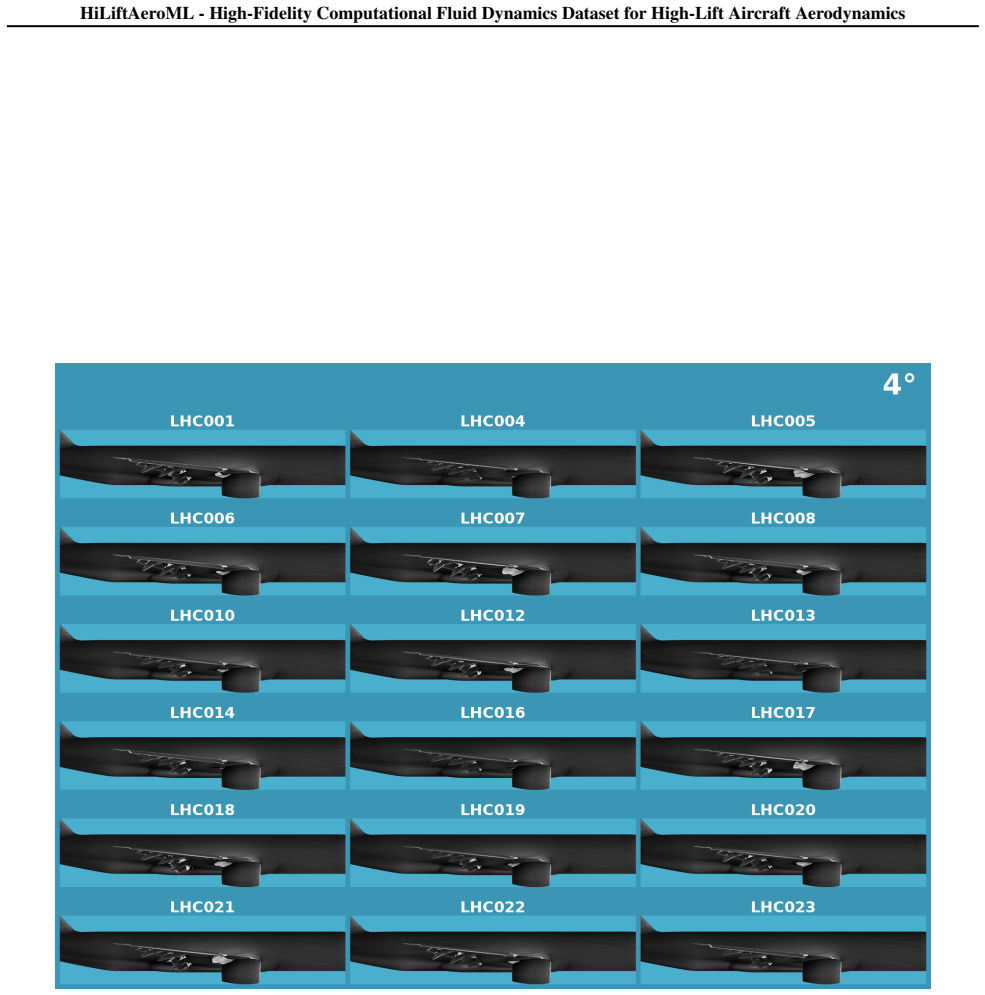
This paper describes the first-ever open-source high-fidelity CFD dataset of a high-lift aircraft for the purpose of AI surrogate model development. The dataset is composed of 1800 samples, arising from 180 geometry variants and 10 angles of attack for the high-lift NASA Common Research Model (CRM) geometry, used within the AIAA High-Lift Prediction Workshop series. One of the novelties of this dataset is the use of a GPU-accelerated high-fidelity explicit, wall-modeled LES approach for each simulation, using solution-adapted grids between 300M and 500M cells. This ensures the greatest possible accuracy given known challenges in steady-state RANS approaches for these portions of the flight envelope. The entire dataset (geometries, time-averaged volume and surface variables and integral forces) are available, free of charge with a permissive open-source license (CC-BY-4.0). By making this data publicly available, we aim to accelerate the research and development of AI surrogate modeling within the aerospace industry.
Editorial analysis
A structured set of objections, weighed in public.
Referee Report
Summary. The paper introduces HiLiftAeroML, the first open-source high-fidelity CFD dataset for high-lift aircraft aerodynamics. It consists of 1800 samples from 180 geometry variants of the NASA CRM high-lift configuration at 10 angles of attack. Simulations are performed using GPU-accelerated explicit wall-modeled LES on solution-adapted grids with 300M to 500M cells. The dataset includes geometries, time-averaged volume and surface variables, and integral forces, released under the CC-BY-4.0 license to support the development of AI surrogate models in the aerospace industry.
Significance. If the WMLES simulations provide the claimed high accuracy for the high-lift regime, this dataset represents a significant contribution by providing large-scale, open data that can accelerate machine learning applications in aerodynamics. It directly addresses the scarcity of high-fidelity data for complex configurations where RANS methods are known to have limitations. The open-source release with a permissive license enhances its potential impact on the community.
major comments (2)
- Abstract: The statement that the WMLES approach 'ensures the greatest possible accuracy given known challenges in steady-state RANS approaches' lacks supporting evidence in the manuscript, such as grid-convergence studies, comparisons to experimental data from the AIAA High-Lift Prediction Workshop, or quantified error metrics for lift, drag, or surface pressure in separated flow regions. This is load-bearing for the dataset's designation as 'high-fidelity' and its suitability for training reliable AI surrogates.
- Dataset description section: No details are provided on verification that the solution-adapted grids of 300M-500M cells achieve adequate resolution for capturing key high-lift phenomena such as leading-edge vortices, flap separation, or wake interactions under the explicit WMLES formulation.
minor comments (2)
- The manuscript would benefit from a summary table listing the number of cells, time-averaging intervals, and computational resources used across the 1800 simulations to aid reproducibility.
- Consider including a short section on known limitations of the wall model employed and how they may affect predictions in the high-lift regime for users developing AI surrogates.
Simulated Author's Rebuttal
We are grateful to the referee for their careful reading and valuable suggestions. We have carefully considered the major comments and provide our responses below, along with plans for revisions to the manuscript.
read point-by-point responses
-
Referee: Abstract: The statement that the WMLES approach 'ensures the greatest possible accuracy given known challenges in steady-state RANS approaches' lacks supporting evidence in the manuscript, such as grid-convergence studies, comparisons to experimental data from the AIAA High-Lift Prediction Workshop, or quantified error metrics for lift, drag, or surface pressure in separated flow regions. This is load-bearing for the dataset's designation as 'high-fidelity' and its suitability for training reliable AI surrogates.
Authors: We concur that the current wording in the abstract makes a strong claim without direct supporting evidence presented in the paper. This manuscript focuses on the generation and public release of the HiLiftAeroML dataset rather than on a detailed validation of the WMLES results against experiments. While the choice of explicit WMLES on large, adapted grids is motivated by the known deficiencies of RANS in predicting separated flows at high angles of attack, we will revise the abstract to avoid the phrase 'ensures the greatest possible accuracy' and instead describe the approach as providing high-fidelity data that mitigates some limitations of RANS. We will include citations to previous studies that have validated the WMLES methodology for high-lift configurations. We are unable to add new grid-convergence studies or error metrics at this stage without performing additional simulations and post-processing, which falls outside the intended scope of this work. revision: partial
-
Referee: Dataset description section: No details are provided on verification that the solution-adapted grids of 300M-500M cells achieve adequate resolution for capturing key high-lift phenomena such as leading-edge vortices, flap separation, or wake interactions under the explicit WMLES formulation.
Authors: We accept this observation and will enhance the dataset description section with additional information on the grid generation and adaptation process. Specifically, we will describe the criteria used for solution-based adaptation to ensure sufficient resolution in critical areas such as leading-edge regions, flap gaps, and wakes. This will include references to resolution requirements for WMLES in complex aerodynamic flows. However, we note that exhaustive verification for each of the 180 geometry variants was not conducted as part of this project; the grid sizes were selected based on established practices for achieving acceptable accuracy in WMLES for high-lift problems. revision: yes
- Conducting comprehensive grid-convergence studies and providing quantified error metrics compared to experimental data for the entire dataset
Circularity Check
Dataset release paper with no derivations, predictions, or self-referential steps
full rationale
This is a dataset release paper whose central contribution is the public distribution of 1800 WMLES simulations on the high-lift NASA CRM. No equations are derived, no parameters are fitted to data, and no predictions are made that could reduce to internal quantities by construction. The accuracy claim for WMLES versus RANS is an external assertion based on known literature limitations rather than any self-citation chain or definitional loop within the paper. The work is therefore self-contained with respect to the circularity criteria.
Axiom & Free-Parameter Ledger
Reference graph
Works this paper leans on
-
[1]
Adam M. Clark and Christopher L. Rumsey and Jeffrey P. Slotnick and Li Wang , title =. AIAA SciTech Forum , doi =. https://arc.aiaa.org/doi/pdf/10.2514/6.2025-0045 , year=
-
[2]
Eric J. Nielsen and Aaron Walden and Gabriel Nastac and Li Wang and William Jones and Mark Lohry and William K. Anderson and Boris Diskin and Yi Liu and Christopher L. Rumsey and Prahladh Iyer and Patrick Moran and Mohammad Zubair , title =. AIAA AVIATION FORUM AND ASCEND 2024 , chapter =. doi:10.2514/6.2024-3866 , URL =. https://arc.aiaa.org/doi/pdf/10.2...
-
[3]
AIAA SCITECH 2025 Forum , pages=
Rapidus: Performance-Portable Parallel Flow Solver for Aerospace Applications , author=. AIAA SCITECH 2025 Forum , pages=
work page 2025
-
[4]
GeoTransolver: Learning Physics on Irregular Domains Using Multi-scale Geometry Aware Physics Attention Transformer , author=. 2025 , eprint=
work page 2025
-
[5]
SuperWing: a comprehensive transonic wing dataset for data-driven aerodynamic design , author=. 2025 , eprint=
work page 2025
-
[6]
Development of the high lift common research model (
Lacy, Doug S and Sclafani, Anthony J , booktitle =. Development of the high lift common research model (. 2016 , doi=
work page 2016
-
[7]
Doug S. Lacy and Adam M. Clark , title =. AIAA Aviation Forum , doi =. https://arc.aiaa.org/doi/pdf/10.2514/6.2020-2771 , year=
-
[8]
Ashley N. Evans and Doug S. Lacy and Ian Smith and Melissa B. Rivers , title =. AIAA Aviation Forum , doi =
-
[9]
John Vassberg and Mark Dehaan and Melissa Rivers and Richard Wahls , title =. 2008 , booktitle =. doi:10.2514/6.2008-6919 , URL =
-
[10]
arXiv preprint arXiv:2502.04317 , year=
Factorized Implicit Global Convolution for Automotive Computational Fluid Dynamics Prediction , author=. arXiv preprint arXiv:2502.04317 , year=
-
[11]
Advances in neural information processing systems , volume=
Pointnet++: Deep hierarchical feature learning on point sets in a metric space , author=. Advances in neural information processing systems , volume=
-
[12]
Advances in neural information processing systems , volume=
Pointnext: Revisiting pointnet++ with improved training and scaling strategies , author=. Advances in neural information processing systems , volume=
-
[13]
Transolver: A Fast Transformer Solver for PDEs on General Geometries
Transolver: A fast transformer solver for pdes on general geometries , author=. arXiv preprint arXiv:2402.02366 , year=
work page internal anchor Pith review Pith/arXiv arXiv
-
[14]
Advances in Neural Information Processing Systems , volume=
Geometry-informed neural operator for large-scale 3d pdes , author=. Advances in Neural Information Processing Systems , volume=
-
[15]
arXiv preprint arXiv:2501.13350 , year=
DoMINO: A Decomposable Multi-scale Iterative Neural Operator for Modeling Large Scale Engineering Simulations , author=. arXiv preprint arXiv:2501.13350 , year=
-
[16]
arXiv preprint arXiv:2502.09692 , year=
NeuralCFD: Deep Learning on High-Fidelity Automotive Aerodynamics Simulations , author=. arXiv preprint arXiv:2502.09692 , year=
-
[17]
arXiv preprint arXiv:2411.17164 , year=
X-meshgraphnet: Scalable multi-scale graph neural networks for physics simulation , author=. arXiv preprint arXiv:2411.17164 , year=
-
[18]
Nature machine intelligence , volume=
Learning nonlinear operators via DeepONet based on the universal approximation theorem of operators , author=. Nature machine intelligence , volume=. 2021 , publisher=
work page 2021
-
[19]
arXiv preprint arXiv:2503.15766 , year=
Accelerating Transient CFD through Machine Learning-Based Flow Initialization , author=. arXiv preprint arXiv:2503.15766 , year=
-
[20]
Some salient features of the time-averaged ground vehicle wake , author=. SAE transactions , pages=. 1984 , publisher=
work page 1984
-
[21]
Angel and Aditya Ghate and Gaetan Kenway and Man Long Wong and Cetin C
Neil Ashton and Jordan B. Angel and Aditya Ghate and Gaetan Kenway and Man Long Wong and Cetin C. Kiris and Astrid Walle and Danielle C. Maddix and Gary Page , booktitle=. Windsor. 2024 , url=
work page 2024
-
[22]
Data-Efficient Operator Learning via Unsupervised Pretraining and In-Context Learning , author=. 2024 , journal=
work page 2024
-
[23]
A strategy for optimum surveys of passenger-car flow fields , author=. 1989 , institution=
work page 1989
-
[24]
Introduction of a new full-scale open cooling version of the
Hupertz, Burkhard and Kr. Introduction of a new full-scale open cooling version of the. Progress in Vehicle Aerodynamics and Thermal Management: 11th FKFS Conference, Stuttgart, September 26-27, 2017 11 , pages=. 2018 , organization=
work page 2017
-
[25]
arXiv preprint arXiv:2406.09624 , year=
DrivAerNet++: A Large-Scale Multimodal Car Dataset with Computational Fluid Dynamics Simulations and Deep Learning Benchmarks , author=. arXiv preprint arXiv:2406.09624 , year=
-
[26]
Fuchs, M. and Mockett, C. and Steger, M. and Thiele, F. , booktitle =. A novel
-
[27]
Using Uncertainty Quantification to Characterize and Improve Out-of-Domain Learning for PDEs , author=. 2024 , journal=
work page 2024
-
[28]
Incorporating physics into data-driven computer vision , author=. Nat Mach Intell , volume =
-
[29]
Learning skillful medium-range global weather forecasting , author=. 2023 , journal=
work page 2023
- [30]
-
[31]
Lino, Mario and Fotiadis, Stathi and Bharath, Anil A. and Cantwell, Chris D. , number =. 2023 , booktitle =. doi:10.1098/rspa.2023.0058 , issn =
-
[32]
Fuchs, M. and Mockett, C. and Sesterhenn, J. and Thiele, F. , publisher =. Assessment of novel. doi:10.2514/6.2015-3433 , year =
-
[33]
Fuchs, M. and Fischer D. and Mockett, C. and Kramer, F. and Knacke, T. and Sesterhenn, J. and Thiele, F. , booktitle =. Assessment of different meshing strategies for low. doi:https://doi.org/10.2514/6.2017-3020 , year =
-
[34]
Fuchs, M. and Mockett, C. and Sesterhenn, J. and Thiele, F. , title =. Progress in Hybrid RANS-LES Modelling, Notes on Numerical Fluid Mechanics and Multidisciplinary Design , editor =. 2018 , publisher =
work page 2018
-
[35]
Fuchs, M. and Fliessbach, L. and Mockett, C. and Kramer, F. and Knacke, T. and Thiele, F. , booktitle =. Aeroacoustic prediction of a three-element high-lift airfoil using a grey-area enhanced. doi:https://doi.org/10.2514/6.2019-2462 , year =
-
[36]
Fuchs, M. and Mockett, C. and Sesterhenn, J. and Thiele, F. , booktitle =. The grey-area improved -. 2020 , publisher =
work page 2020
-
[37]
Proceedings of the 28th AIAA/CEAS Aeroacoustics Conference, Southampton, UK, AIAA 2022-2860 , doi =
Two computational studies of a flatback airfoil using non-zonal and embedded scale-resolving turbulence modelling approaches , author =. Proceedings of the 28th AIAA/CEAS Aeroacoustics Conference, Southampton, UK, AIAA 2022-2860 , doi =
work page 2022
-
[38]
Hupertz, Burkhard and Chalupa, Karel and Krueger, Lothar and Howard, Kevin and Glueck, Hans-Dieter and Lewington, Neil and Chang, Jin-Hyuck and Shin, Yong-su , number =. 2021 , journal =
work page 2021
-
[39]
arXiv preprint arXiv:2504.06699 , year =
Benchmarking Convolutional Neural Network and Graph Neural Network based Surrogate Models on a Real-World Car External Aerodynamics Dataset , author =. arXiv preprint arXiv:2504.06699 , year =
- [40]
-
[41]
Proceedings of ETMM8, Marseille , year =
Detection of initial transient and estimation of statistical error in time-resolved turbulent flow data , author =. Proceedings of ETMM8, Marseille , year =
-
[42]
Mockett, C. and Fuchs, M. and Garbaruk, A. and Shur, M. and Spalart, P. and Strelets, M. and Thiele, F. and Travin, A. , title =. Progress in Hybrid RANS-LES Modelling, Notes on Numerical Fluid Mechanics and Multidisciplinary Design , editor =. 2015 , publisher =
work page 2015
-
[43]
Mockett, C. and Fuchs, M. and Knacke, T. and Kramer, F. and Michel, U. and Steger, M. and Thiele, F. , title =. Progress in Hybrid RANS-LES Modelling, Notes on Numerical Fluid Mechanics and Multidisciplinary Design , editor =. 2019 , publisher =
work page 2019
-
[44]
Mockett, C. and Knacke, T. and Sch\". A statistical approach for optimising. 3rd High-Fidelity Industrial LES/DNS Symposium , year =
-
[45]
Montecchia, M. and Brethouwer, G. and Wallin, S. and Johansson, A. and Knacke, T. , journal =. Improving. 2019 , publisher =
work page 2019
- [46]
-
[47]
Numerical study of the turbulent flow past an airfoil with trailing edge separation , author =. AIAA Journal , volume =
-
[48]
International Journal of Heat and Fluid Flow , volume=
Strategies for turbulence modelling and simulations , author=. International Journal of Heat and Fluid Flow , volume=. 2000 , publisher=
work page 2000
-
[49]
Spalart, P. R. and Deck, S. and Shur, M. L. and Squires, K. D. and Strelets, M. Kh. and Travin, A. , number =. 2006 , journal =. doi:10.1007/s00162-006-0015-0 , issn =
-
[50]
SAE International Journal of Advances and Current Practices in Mobility , volume =
Pad correction estimation around 5 belt wind tunnel wheel belts using pressure tap measurement and mathematical pressure distribution model , author =. SAE International Journal of Advances and Current Practices in Mobility , volume =
-
[51]
G. Br\`. Large-eddy simulations of co-annular turbulent jet using a
-
[52]
Clark and Konrad Goc and Neil Ashton and Utkarsh Ayachit and Lukas Mosimann , title =
Liam Heidt and Christopher Ivey and Sanjeeb Bose and Rahul Agrawal and Adam M. Clark and Konrad Goc and Neil Ashton and Utkarsh Ayachit and Lukas Mosimann , title =. Submitted to AIAA SciTech Forum , year=
-
[53]
BlendedNet++: A Large-Scale Blended Wing Body Aerodynamics Dataset and Benchmark , author=. 2025 , eprint=
work page 2025
-
[54]
Fluid Intelligence: A Forward Look on AI Foundation Models in Computational Fluid Dynamics , author=. 2025 , eprint=
work page 2025
-
[55]
ONERA's CRM WBPN database for machine learning activities, related regression challenge and first results , author=. 2025 , eprint=
work page 2025
-
[56]
Brodersen and Stefan Keye and Kelly R
Ed Tinoco and Olaf P. Brodersen and Stefan Keye and Kelly R. Laflin and John C. Vassberg and Ben Rider and Richard A. Wahls and Joseph H. Morrison and Brent. W. Pomeroy and David Hue and Mitsuhiro Murayama , title =. AIAA Aviation Forum , chapter =. 2023 , publisher =. doi:10.2514/6.2023-3492 , URL =
-
[57]
Geometry Aware Operator Transformer as an Efficient and Accurate Neural Surrogate for PDEs on Arbitrary Domains , author=. 2025 , eprint=
work page 2025
-
[58]
AB-UPT for Automotive and Aerospace Applications , author=. 2025 , eprint=
work page 2025
-
[59]
Wissink and Jason Cornelius , title =
Philipp Bekemeyer and Nathan Hariharan and Andrew M. Wissink and Jason Cornelius , title =. AIAA SciTech Forum , chapter =. 2025 , doi =. https://arc.aiaa.org/doi/pdf/10.2514/6.2025-0036 , abstract =
-
[60]
Aagren and Darrell Nieves Lugo , title =
Jason Cornelius and Nicholas Peters and Tove S. Aagren and Darrell Nieves Lugo , title =. AIAA SciTech Forum , chapter =. 2025 , doi =. https://arc.aiaa.org/doi/pdf/10.2514/6.2025-0038 , abstract =
-
[61]
Andrew L. Kaminsky and Alec M. House and Louis Jensen and Matthew Liu and William Chapman and Alessandro P. Brown and Andrew M. Wissink and Nathan S. Hariharan and David McDaniel , title =. AIAA SciTech Forum , chapter =. 2025 , doi =
work page 2025
-
[62]
Jude and Jay Sitaraman and Nathan S
Jennifer Abras and Shirzad Hosseinverdi and Dylan P. Jude and Jay Sitaraman and Nathan S. Hariharan , title =. AIAA SciTech Forum , chapter =. 2025 , doi =
work page 2025
-
[63]
AIAA SciTech Forum , chapter =
Rahul Agrawal and Sanjeeb Bose and Parviz Moin , title =. AIAA SciTech Forum , chapter =. 2025 , doi =
work page 2025
-
[64]
AIAA Aviation Forum and Ascend , pages=
Testing the Full-Span High-Lift Common Research Model at the ONERA F1 Pressurized Low-Speed Wind Tunnel , author=. AIAA Aviation Forum and Ascend , pages=
-
[65]
Journal of Fluid Mechanics , volume=
Weakly nonlinear behaviour of transonic buffet on airfoils , author=. Journal of Fluid Mechanics , volume=. 2024 , publisher=
work page 2024
-
[66]
Global structure of buffeting flow on transonic airfoils , author=. IUTAM Symposium on Unsteady Separated Flows and their Control: Proceedings of the IUTAM Symposium “Unsteady Separated Flows and their Control “, Corfu, Greece, 18--22 June 2007 , pages=. 2009 , organization=
work page 2007
-
[67]
Virtanen, Pauli and Gommers, Ralf and Oliphant, Travis E. and Haberland, Matt and Reddy, Tyler and Cournapeau, David and Burovski, Evgeni and Peterson, Pearu and Weckesser, Warren and Bright, Jonathan and. Nature Methods , year =
-
[68]
Jacques Peter and Quentin Bennehard and Sébastien Heib and Jean-Luc Hantrais-Gervois and Frédéric Moëns , keywords =. ONERA’s CRM WBPN database for machine learning activities, related regression challenge and first results , journal =. 2025 , issn =. doi:https://doi.org/10.1016/j.compfluid.2025.106838 , url =
-
[69]
Luminary Cloud. SHIFT-Wing: High-Fidelity Computational Fluid Dynamics Dataset for Transonic Aerospace External Aerodynamics , year =
-
[70]
Reverse Flow Radius in Vortex Chambers , author=. AIAA Journal , volume=. 1986 , publisher=
work page 1986
-
[71]
Aviation Week & Space Technology , volume=
Planetary Flight Surge Faces Budget Realities , author=. Aviation Week & Space Technology , volume=
- [72]
-
[73]
Computational Methods for Fluid Flow , edition=
Peyret, Roger and Taylor, Thomas D , year=. Computational Methods for Fluid Flow , edition=
-
[74]
Aerothermodynamics of Gas Turbine and Rocket Propulsion , series=. 1984 , publisher=
work page 1984
-
[75]
Teleoperation and Robotics in Space , series=
Techniques for Collision Prevention, Impact Stability, and Force Control by Space Manipulators , author=. Teleoperation and Robotics in Space , series=. 1994 , publisher=
work page 1994
-
[76]
AIAA Guidance, Navigation, and Control Conference , series=
Spacecraft Thermal Control, Design, and Operation , author=. AIAA Guidance, Navigation, and Control Conference , series=. 1989 , pages=
work page 1989
-
[77]
Fluid Mechanics Proceedings , editor=
-
[78]
Nonequilibrium Radiation for Earth Entry , author=. AIAA Paper 2016--3690 , year=
work page 2016
-
[79]
Improvements to the quadratic constitutive relation based on NASA juncture flow data , author=. AIAA Journal , volume=. 2020 , publisher=
work page 2020
-
[80]
Subgrid-scale stress modelling based on the square of the velocity gradient tensor , volume =
Nicoud, Franck and Ducros, Fr\'. Subgrid-scale stress modelling based on the square of the velocity gradient tensor , volume =. 1999 , journal =
work page 1999
discussion (0)
Sign in with ORCID, Apple, or X to comment. Anyone can read and Pith papers without signing in.