Detrimental Agnostic Entanglement: The Case Against Hardware-Efficient Ans\"atze for Combinatorial Optimization
Pith reviewed 2026-05-20 05:43 UTC · model grok-4.3
pith:DSKQZEAL Add to your LaTeX paper
What is a Pith Number?\usepackage{pith}
\pithnumber{DSKQZEAL}
Prints a linked pith:DSKQZEAL badge after your title and writes the identifier into PDF metadata. Compiles on arXiv with no extra files. Learn more
The pith
A fully separable ansatz outperforms all entangled hardware-efficient configurations for MaxCut.
A machine-rendered reading of the paper's core claim, the machinery that carries it, and where it could break.
Core claim
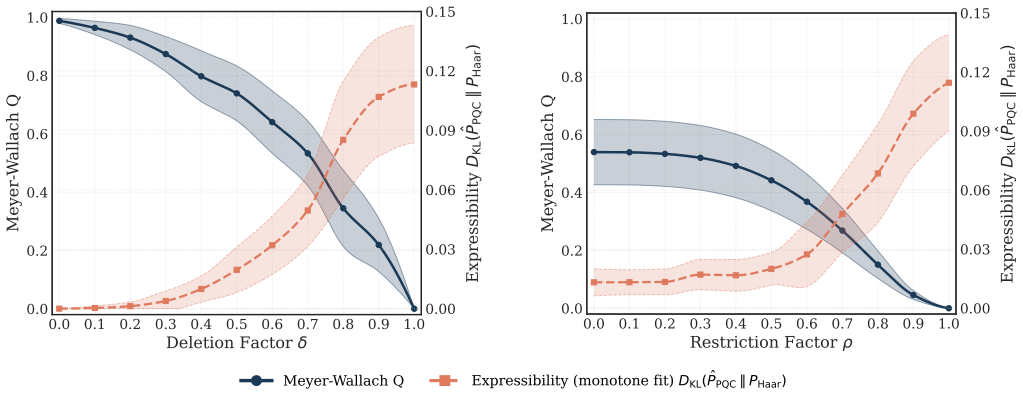
Tracking the entanglement trajectory Q(t) throughout VQA training reveals that when the ansatz grants the optimizer indirect control over entanglement through its parameters, it consistently drives entanglement down. In line with this tendency, a fully separable ansatz outperforms all entangled hardware-efficient configurations, establishing a monotonic relationship: less problem-agnostic entanglement yields better performance. In contrast, QAOA, whose entanglement is structurally derived from the problem Hamiltonian, maintains high entanglement yet achieves competitive solution quality, demonstrating that entanglement structure, not merely quantity, determines its utility.
What carries the argument
Two complementary control mechanisms that provide smooth, monotonic control over hardware-efficient ansatz entanglement as quantified by the Meyer-Wallach measure Q.
If this is right
- Hardware-efficient ansatze are inappropriate for combinatorial optimization on diagonal Hamiltonians.
- Variational approaches should prioritize problem-structured circuit designs.
- Entanglement structure determines its utility more than its quantity alone.
- The optimizer reduces entanglement during training whenever the ansatz permits indirect control.
Where Pith is reading between the lines
- Similar performance penalties from agnostic entanglement may occur for other diagonal Hamiltonian problems beyond MaxCut.
- Ansatz designs could benefit from built-in mechanisms that minimize unnecessary entanglement during optimization.
- These findings may encourage hardware implementations that reduce entangling gates for certain optimization tasks.
- Default entangling layers in variational algorithms warrant re-examination for diagonal problems.
Load-bearing premise
The two complementary control mechanisms provide smooth, monotonic control over hardware-efficient ansatz entanglement as quantified by the Meyer-Wallach measure.
What would settle it
Observing higher solution quality from a specific entangled hardware-efficient ansatz than from the fully separable ansatz on identical MaxCut instances would falsify the claimed monotonic performance relationship.
Figures



read the original abstract
Variational quantum algorithms (VQAs) for combinatorial optimization routinely employ entangling gates as a default design choice, yet the role of entanglement, in its amount and structure, remains poorly understood. This gap is particularly consequential for problems governed by diagonal Hamiltonians, whose ground states are classical product states and therefore require no entanglement in principle, raising the fundamental question of whether and how entangling gates help or hinder the variational search. We investigate this question for MaxCut by introducing two complementary control mechanisms that provide smooth, monotonic control over hardware-efficient ansatz (HEA) entanglement as quantified by the Meyer-Wallach measure $Q$, and by benchmarking against QAOA as a problem-structured reference. Tracking the entanglement trajectory $Q(t)$ throughout VQA training reveals that when the ansatz grants the optimizer indirect control over entanglement through its parameters, it consistently drives entanglement down. In line with this tendency, a fully separable ansatz outperforms all entangled hardware-efficient configurations, establishing a monotonic relationship: less problem-agnostic entanglement yields better performance. In contrast, QAOA, whose entanglement is structurally derived from the problem Hamiltonian, maintains high entanglement yet achieves competitive solution quality, demonstrating that entanglement structure, not merely quantity, determines its utility. These findings suggest that HEAs for diagonal Hamiltonians are inappropriate and that variational approaches to combinatorial optimization should prioritize problem-structured circuit designs.
Editorial analysis
A structured set of objections, weighed in public.
Referee Report
Summary. The manuscript examines the role of entanglement in variational quantum algorithms for MaxCut on diagonal Hamiltonians. It introduces two control mechanisms to modulate entanglement in hardware-efficient ansatze (HEA) as quantified by the Meyer-Wallach measure Q, tracks the entanglement trajectory Q(t) during training, and benchmarks against QAOA. The central findings are that optimizers drive entanglement downward when possible, a fully separable ansatz outperforms all entangled HEA variants establishing a monotonic relationship between reduced problem-agnostic entanglement and better performance, while QAOA maintains high but problem-structured entanglement and achieves competitive results. The work concludes that HEAs are inappropriate for such problems and that problem-structured circuit designs should be prioritized.
Significance. If the isolation of entanglement effects holds, the results would provide concrete empirical guidance against default use of entangling gates in VQAs for diagonal Hamiltonians whose ground states are product states, while highlighting that entanglement structure (as in QAOA) can be beneficial even at high quantities. The introduction of monotonic control mechanisms over Q and the explicit Q(t) tracking are useful methodological contributions that could be extended to other ansatz families.
major comments (2)
- [Abstract / control mechanisms section] Abstract and the section describing the control mechanisms: the claim that the two complementary mechanisms provide smooth, monotonic control over HEA entanglement (via Q) while holding circuit depth, gate set, and effective expressivity fixed is load-bearing for attributing performance gains to reduced Q rather than confounders. The skeptic note correctly identifies that without explicit fixed-parameter-count ablations or expressivity metrics (e.g., effective dimension of the reachable subspace), the outperformance of the separable ansatz and the observed Q(t) trajectories could arise from changes in the number of independent variational parameters or reachable subspace instead of entanglement per se.
- [Benchmarking / results on separable vs entangled HEAs] Results section on benchmarking: the monotonic relationship 'less problem-agnostic entanglement yields better performance' rests on the separable ansatz outperforming all entangled HEA configurations, but the manuscript must demonstrate that the control mechanisms do not inadvertently alter expressivity in a non-monotonic manner across the tested range; otherwise the central claim that entanglement itself is detrimental remains under-supported.
minor comments (2)
- [Abstract / experimental setup] The abstract and methods lack explicit details on the number of independent trials, error bars, or data exclusion criteria for the benchmarking results; these should be added for reproducibility even if the central trends are robust.
- [Methods] Clarify the precise definitions and implementation of the two complementary control mechanisms (e.g., which parameters or gates are varied) to allow readers to verify the claimed monotonicity in Q independently.
Simulated Author's Rebuttal
We thank the referee for the constructive and detailed report. The comments highlight important considerations for rigorously isolating the role of entanglement. We address each major comment below and indicate planned revisions to strengthen the manuscript.
read point-by-point responses
-
Referee: [Abstract / control mechanisms section] Abstract and the section describing the control mechanisms: the claim that the two complementary mechanisms provide smooth, monotonic control over HEA entanglement (via Q) while holding circuit depth, gate set, and effective expressivity fixed is load-bearing for attributing performance gains to reduced Q rather than confounders. The skeptic note correctly identifies that without explicit fixed-parameter-count ablations or expressivity metrics (e.g., effective dimension of the reachable subspace), the outperformance of the separable ansatz and the observed Q(t) trajectories could arise from changes in the number of independent variational parameters or reachable subspace instead of entanglement per se.
Authors: We agree that demonstrating fixed parameter count and comparable expressivity is essential to attribute performance differences to entanglement. Both control mechanisms were explicitly constructed to preserve circuit depth, the full gate set, and the exact number of variational parameters: the first modulates entanglement strength via a continuous scaling parameter applied to existing entangling gates without adding or removing parameters, while the second achieves complementary control by selectively nullifying entanglement contributions through fixed (non-variational) adjustments that leave the variational manifold dimension unchanged. Although we did not compute effective dimension or perform separate ablations in the original submission, the consistent monotonic improvement in solution quality as Q is reduced—culminating in the separable ansatz (identical parameter count, zero entanglement) being optimal—provides supporting evidence that expressivity changes are not the driver. We will add an explicit parameter-count table and a short discussion of why the reachable subspace remains comparable across the tested range in the revised manuscript. revision: partial
-
Referee: [Benchmarking / results on separable vs entangled HEAs] Results section on benchmarking: the monotonic relationship 'less problem-agnostic entanglement yields better performance' rests on the separable ansatz outperforming all entangled HEA configurations, but the manuscript must demonstrate that the control mechanisms do not inadvertently alter expressivity in a non-monotonic manner across the tested range; otherwise the central claim that entanglement itself is detrimental remains under-supported.
Authors: The reported benchmarking indeed shows a strictly monotonic performance gain with decreasing Q across the controlled HEA family. Because the mechanisms vary entanglement continuously while keeping the underlying hardware-efficient topology, gate types, and variational parameter count identical, non-monotonic expressivity shifts are unlikely; any such shift would have to occur in a manner precisely anti-correlated with Q, which is not observed in the Q(t) trajectories or final performance. Nevertheless, to directly address the concern we will include additional supporting material in the revision, such as a comparison of optimization convergence rates and a brief analysis of the variational landscape curvature at representative points, to confirm that expressivity does not vary non-monotonically with the control parameter. revision: partial
Circularity Check
No significant circularity; claims rest on direct empirical measurements
full rationale
The paper's core results derive from experimental tracking of the Meyer-Wallach measure Q(t) during VQA training on MaxCut instances, direct performance comparisons of a fully separable ansatz against entangled HEA variants, and benchmarking against QAOA as an independent problem-structured reference. These observations are obtained via introduced control mechanisms whose monotonicity is asserted from the experimental setup itself rather than from any self-referential definition, fitted parameter renamed as prediction, or load-bearing self-citation chain. No equation or claim reduces to its own inputs by construction; the monotonic relationship is presented as an observed outcome, not a tautology.
Axiom & Free-Parameter Ledger
axioms (1)
- domain assumption Ground states of diagonal Hamiltonians are classical product states requiring no entanglement
Lean theorems connected to this paper
-
IndisputableMonolith/Foundation/RealityFromDistinction.leanreality_from_one_distinction unclear?
unclearRelation between the paper passage and the cited Recognition theorem.
two complementary control mechanisms that provide smooth, monotonic control over hardware-efficient ansatz (HEA) entanglement as quantified by the Meyer-Wallach measure Q
-
IndisputableMonolith/Cost/FunctionalEquation.leanwashburn_uniqueness_aczel unclear?
unclearRelation between the paper passage and the cited Recognition theorem.
less problem-agnostic entanglement yields better performance
What do these tags mean?
- matches
- The paper's claim is directly supported by a theorem in the formal canon.
- supports
- The theorem supports part of the paper's argument, but the paper may add assumptions or extra steps.
- extends
- The paper goes beyond the formal theorem; the theorem is a base layer rather than the whole result.
- uses
- The paper appears to rely on the theorem as machinery.
- contradicts
- The paper's claim conflicts with a theorem or certificate in the canon.
- unclear
- Pith found a possible connection, but the passage is too broad, indirect, or ambiguous to say the theorem truly supports the claim.
Reference graph
Works this paper leans on
-
[1]
A variational eigenvalue solver on a photonic quantum processor,
A. Peruzzo, J. McClean, P. Shadbolt, M.-H. Yung, X.-Q. Zhou, P. J. Love, A. Aspuru-Guzik, and J. L. O’brien, “A variational eigenvalue solver on a photonic quantum processor,”Nature communications, vol. 5, no. 1, p. 4213, 2014
work page 2014
-
[2]
A Quantum Approximate Optimization Algorithm
E. Farhi, J. Goldstone, and S. Gutmann, “A quantum approximate optimization algorithm,”arXiv preprint arXiv:1411.4028, 2014
work page internal anchor Pith review Pith/arXiv arXiv 2014
-
[3]
Hardware-efficient variational quantum eigensolver for small molecules and quantum magnets,
A. Kandala, A. Mezzacapo, K. Temme, M. Takita, M. Brink, J. M. Chow, and J. M. Gambetta, “Hardware-efficient variational quantum eigensolver for small molecules and quantum magnets,”nature, vol. 549, no. 7671, pp. 242–246, 2017
work page 2017
-
[4]
Performance of hybrid quantum-classical variational heuristics for combinatorial optimization,
G. Nannicini, “Performance of hybrid quantum-classical variational heuristics for combinatorial optimization,”Physical Review E, vol. 99, no. 1, p. 013304, 2019
work page 2019
-
[5]
Improving variational quantum optimization using cvar,
P. K. Barkoutsos, G. Nannicini, A. Robert, I. Tavernelli, and S. Woerner, “Improving variational quantum optimization using cvar,”Quantum, vol. 4, p. 256, 2020
work page 2020
-
[6]
Filtering variational quantum algorithms for combinatorial optimization,
D. Amaro, C. Modica, M. Rosenkranz, M. Fiorentini, M. Benedetti, and M. Lubasch, “Filtering variational quantum algorithms for combinatorial optimization,”Quantum Science & Technology, vol. 7, no. 1, p. 015021, 2022
work page 2022
-
[7]
Layer vqe: A variational approach for combinatorial optimization on noisy quantum computers,
X. Liu, A. Angone, R. Shaydulin, I. Safro, Y . Alexeev, and L. Cincio, “Layer vqe: A variational approach for combinatorial optimization on noisy quantum computers,”IEEE Transactions on Quantum Engineer- ing, vol. 3, pp. 1–20, 2022
work page 2022
-
[8]
T. Miki, R. Okita, M. Shimada, D. Tsukayama, and J.-i. Shirakashi, “Variational ansatz preparation to avoid cnot-gates on noisy quantum devices for combinatorial optimizations,”AIP Advances, vol. 12, no. 3, 2022
work page 2022
-
[9]
Benchmarking adaptative variational quantum algorithms on qubo instances,
G. Turati, M. F. Dacrema, and P. Cremonesi, “Benchmarking adaptative variational quantum algorithms on qubo instances,” in2023 IEEE Inter- national Conference on Quantum Computing and Engineering (QCE), vol. 1. IEEE, 2023, pp. 407–413
work page 2023
-
[10]
Calibrating the role of entanglement in variational quantum circuits,
A. C. Nakhl, T. Quella, and M. Usman, “Calibrating the role of entanglement in variational quantum circuits,”Physical Review A, vol. 109, no. 3, p. 032413, 2024
work page 2024
-
[11]
Quantum variational optimization: The role of entanglement and problem hardness,
P. D ´ıez-Valle, D. Porras, and J. J. Garc ´ıa-Ripoll, “Quantum variational optimization: The role of entanglement and problem hardness,”Physical Review A, vol. 104, no. 6, p. 062426, 2021
work page 2021
-
[12]
The questionable influence of entanglement in quantum optimi- sation algorithms,
T. Rohe, D. Schuman, J. N ¨ublein, L. S ¨unkel, J. Stein, and C. Linnhoff- Popien, “The questionable influence of entanglement in quantum optimi- sation algorithms,” in2024 IEEE International Conference on Quantum Computing and Engineering (QCE), vol. 1. IEEE, 2024, pp. 1497– 1503
work page 2024
-
[13]
Quantum energy landscape and circuit optimization,
J. Kim and Y . Oz, “Quantum energy landscape and circuit optimization,” Physical Review A, vol. 106, no. 5, p. 052424, 2022
work page 2022
-
[14]
Reducibility among combinatorial problems,
R. M. Karp, “Reducibility among combinatorial problems,” inComplex- ity of Computer Computations, ser. The IBM Research Symposia Series, R. E. Miller, J. W. Thatcher, and J. D. Bohlinger, Eds. Boston, MA: Springer, 1972, pp. 85–103
work page 1972
-
[15]
M. X. Goemans and D. P. Williamson, “Improved approximation algo- rithms for maximum cut and satisfiability problems using semidefinite programming,”Journal of the ACM (JACM), vol. 42, no. 6, pp. 1115– 1145, 1995
work page 1995
-
[16]
Most quantum states are too entangled to be useful as computational resources,
D. Gross, S. T. Flammia, and J. Eisert, “Most quantum states are too entangled to be useful as computational resources,”Physical review letters, vol. 102, no. 19, p. 190501, 2009
work page 2009
-
[17]
Entanglement-variational hardware-efficient ansatz for eigensolvers,
X. Wang, B. Qi, Y . Wang, and D. Dong, “Entanglement-variational hardware-efficient ansatz for eigensolvers,”Physical Review Applied, vol. 21, no. 3, p. 034059, 2024
work page 2024
-
[18]
On the practical usefulness of the hardware efficient ansatz,
L. Leone, S. F. Oliviero, L. Cincio, and M. Cerezo, “On the practical usefulness of the hardware efficient ansatz,”Quantum, vol. 8, p. 1395, 2024
work page 2024
-
[19]
Global entanglement in multiparticle systems,
D. A. Meyer and N. R. Wallach, “Global entanglement in multiparticle systems,”Journal of Mathematical Physics, vol. 43, no. 9, pp. 4273– 4278, 2002
work page 2002
-
[20]
An observable measure of entanglement for pure states of multi-qubit systems,
G. K. Brennen, “An observable measure of entanglement for pure states of multi-qubit systems,”Quantum Information & Computation, vol. 3, no. 6, pp. 619–626, 2003
work page 2003
-
[21]
Entanglement perspective on the quantum approximate optimization algorithm,
M. Dupont, N. Didier, M. J. Hodson, J. E. Moore, and M. J. Reagor, “Entanglement perspective on the quantum approximate optimization algorithm,”Physical Review A, vol. 106, no. 2, p. 022423, 2022
work page 2022
-
[22]
The Heisenberg Representation of Quantum Computers
D. Gottesman, “The heisenberg representation of quantum computers,” arXiv preprint quant-ph/9807006, 1998
work page internal anchor Pith review Pith/arXiv arXiv 1998
-
[23]
On the role of entanglement in quantum- computational speed-up,
R. Jozsa and N. Linden, “On the role of entanglement in quantum- computational speed-up,”Proceedings of the Royal Society of London. Series A: Mathematical, Physical and Engineering Sciences, vol. 459, no. 2036, pp. 2011–2032, 2003
work page 2036
-
[24]
Barren plateaus in quantum neural network training landscapes,
J. R. McClean, S. Boixo, V . N. Smelyanskiy, R. Babbush, and H. Neven, “Barren plateaus in quantum neural network training landscapes,”Nature communications, vol. 9, no. 1, p. 4812, 2018
work page 2018
-
[25]
Entanglement-induced barren plateaus,
C. Ortiz Marrero, M. Kieferov ´a, and N. Wiebe, “Entanglement-induced barren plateaus,”PRX quantum, vol. 2, no. 4, p. 040316, 2021
work page 2021
discussion (0)
Sign in with ORCID, Apple, or X to comment. Anyone can read and Pith papers without signing in.