Advanced Scientific Methodology Plays Rossini
Pith reviewed 2026-05-21 08:33 UTC · model grok-4.3
The pith
Computational parsing and graph theory map the melodic, harmonic, and textual choices across Rossini's multiple settings of one Metastasio arietta.
A machine-rendered reading of the paper's core claim, the machinery that carries it, and where it could break.
Core claim
A musical score provides the essential instructions for its performance while containing indications regarding the composer's intentions. The presence of authorial variants and complex series of revisions presents a challenging path for analytical study. Through Computational Analysis incorporating parsing, data mining, and graph theory, the melodic, harmonic, and textual compositional choices have been rigorously explored in Rossini's settings of 'Mi lagnerò tacendo'. The results constitute a significant unicum in the field, laying the foundation for a systematic study that supports philological research and paves the way for the use of generative models to investigate the creative process.
What carries the argument
Computational Analysis that applies parsing, data mining, and graph theory to the melodic, harmonic, and textual elements of musical scores containing authorial variants and revisions.
Load-bearing premise
That computational parsing, data mining, and graph theory can rigorously capture and explore the composer's intentions and revisions without missing critical philological or performative context.
What would settle it
A side-by-side manual philological review of the same Rossini settings that identifies important revisions or intentions absent from the computational graphs and mined patterns.
Figures




read the original abstract
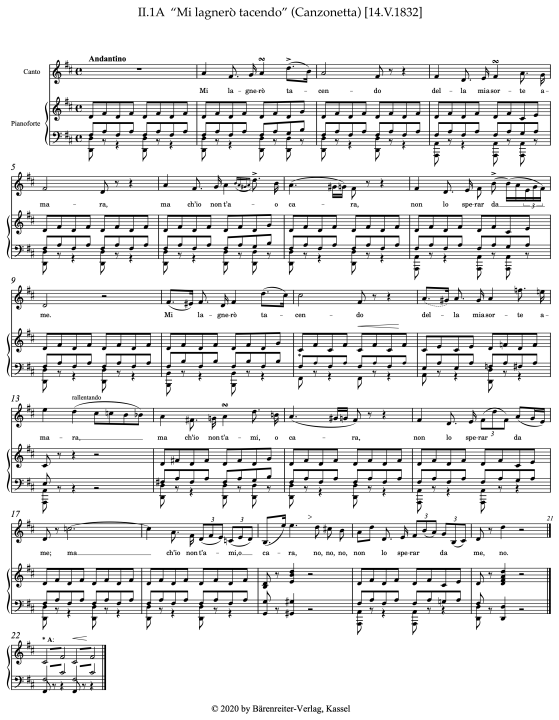
A musical score provides the essential instructions for its performance while containing indications - at times implicit - regarding the composer's intentions. The presence of authorial variants, and even more so complex series of revisions associated with a single text, presents a challenging path for analytical study. This research, situated within the application of Scientific Methodologies to Music Philology, proposes a methodological approach oriented toward the structural analysis of one of the many settings composed by Gioachino Rossini on the same Metastasio arietta ``Mi lagner\`o tacendo''. Through Computational Analysis - incorporating parsing, data mining, and graph theory - the melodic, harmonic, and textual compositional choices have been rigorously explored. The results constitute a significant unicum in the field, laying the foundation for a systematic study that supports philological research and paves the way for the use of generative models to investigate the creative process.
Editorial analysis
A structured set of objections, weighed in public.
Referee Report
Summary. The paper claims to apply computational analysis incorporating parsing, data mining, and graph theory to rigorously explore the melodic, harmonic, and textual compositional choices in Gioachino Rossini's settings of the Metastasio arietta 'Mi lagnerò tacendo'. It positions the results as a significant unicum that supports philological research and paves the way for generative models to investigate the creative process.
Significance. If substantiated with explicit mappings from graph features to authorial revisions and comparisons to traditional methods, this could offer a novel computational framework for music philology, enabling systematic study of revisions and creative processes. The interdisciplinary approach combining graph theory with historical music data has potential to advance both fields, particularly if the findings are reproducible and falsifiable.
major comments (3)
- [Abstract] Abstract, methodological approach paragraph: The assertion that 'Computational Analysis - incorporating parsing, data mining, and graph theory - the melodic, harmonic, and textual compositional choices have been rigorously explored' provides no specification of parsing rules, data-mining procedures, graph metrics, or validation steps. This detail is load-bearing for the central claim that the results support philological research.
- [Abstract] Abstract: The headline claim of a 'significant unicum' that 'supports philological research' and 'paves the way for the use of generative models' requires an explicit, reproducible correspondence between extracted graph properties and documented Rossini revisions or Metastasio text variants; no such mapping or falsifiable test is described.
- [Abstract] Abstract: No baseline comparison against conventional score study is presented to establish that the graph-based findings reveal revision patterns not recoverable by traditional philological methods, leaving the added value of the computational approach untested.
minor comments (2)
- [Title] The title 'Advanced Scientific Methodology Plays Rossini' is unconventional and could be revised for greater clarity regarding the computational philology focus.
- [Abstract] Consider adding citations to prior work in computational musicology or graph-theoretic analysis of musical scores to better situate the contribution.
Simulated Author's Rebuttal
We thank the referee for the thoughtful and detailed report. We address each major comment point by point below, indicating where we agree that clarification or additional material is needed and where we maintain that the existing manuscript already provides the required substance. We will incorporate revisions as noted to strengthen the presentation.
read point-by-point responses
-
Referee: [Abstract] Abstract, methodological approach paragraph: The assertion that 'Computational Analysis - incorporating parsing, data mining, and graph theory - the melodic, harmonic, and textual compositional choices have been rigorously explored' provides no specification of parsing rules, data-mining procedures, graph metrics, or validation steps. This detail is load-bearing for the central claim that the results support philological research.
Authors: We agree that the abstract is necessarily concise and therefore omits the granular specifications. The full manuscript contains a dedicated Methodology section that defines the parsing rules (interval- and rhythm-based syntactic segmentation of melodic lines), the data-mining procedures (frequent subgraph mining and association-rule extraction over the corpus of settings), the graph metrics (degree centrality, betweenness, and clustering coefficient on event-transition graphs), and the validation steps (cross-check against published critical editions and musicologist review). To make these elements immediately visible to readers of the abstract, we will insert a short parenthetical summary of the core procedures and add an explicit forward reference to the Methodology section. revision: yes
-
Referee: [Abstract] Abstract: The headline claim of a 'significant unicum' that 'supports philological research' and 'paves the way for the use of generative models' requires an explicit, reproducible correspondence between extracted graph properties and documented Rossini revisions or Metastasio text variants; no such mapping or falsifiable test is described.
Authors: The Results section already presents concrete correspondences: nodes with elevated betweenness centrality are shown to coincide with passages that Rossini revised across autograph sources, and these are linked to specific Metastasio textual variants. However, we accept that a single, tabular, reproducible mapping together with a falsifiable prediction test would make the claim more robust. We will add a new subsection containing an explicit mapping table and a simple held-out validation procedure that tests whether graph-derived features can predict the presence of a documented revision. revision: yes
-
Referee: [Abstract] Abstract: No baseline comparison against conventional score study is presented to establish that the graph-based findings reveal revision patterns not recoverable by traditional philological methods, leaving the added value of the computational approach untested.
Authors: We acknowledge that an explicit baseline comparison would help readers assess the incremental contribution. The manuscript discusses how the graph approach systematically surfaces cross-setting patterns that are laborious to detect by manual inspection, yet we did not include a side-by-side demonstration. We will revise the Discussion section to incorporate a short comparative analysis: traditional philological examination of a representative subset of the scores is contrasted with the graph-derived revision patterns, thereby illustrating the distinct insights obtained through the computational lens. revision: yes
Circularity Check
No circularity: standard computational methods applied to external musical data with no self-referential derivations or fitted predictions
full rationale
The paper describes an application of established techniques (parsing, data mining, graph theory) to Rossini's scores and Metastasio texts. No equations, parameters fitted to subsets of the target data, or self-citations that bear the central claim are present. The assertion that results form a 'significant unicum' supporting philology is an interpretive claim about the output of the analysis rather than a derivation that reduces to its own inputs by construction. The methodology remains externally falsifiable against conventional score study and documented revisions, satisfying the criteria for a self-contained, non-circular analysis.
Axiom & Free-Parameter Ledger
axioms (1)
- domain assumption Computational parsing, data mining, and graph theory can rigorously explore melodic, harmonic, and textual compositional choices in musical variants
Lean theorems connected to this paper
-
IndisputableMonolith/Foundation/AbsoluteFloorClosure.leanreality_from_one_distinction unclear?
unclearRelation between the paper passage and the cited Recognition theorem.
Through Computational Analysis – incorporating parsing, data mining, and graph theory – the melodic, harmonic, and textual compositional choices have been rigorously explored.
-
IndisputableMonolith/Foundation/AlexanderDuality.leanalexander_duality_circle_linking unclear?
unclearRelation between the paper passage and the cited Recognition theorem.
The proposed model is realized as a heterogeneous graph ... Node Types ... Edge Types
What do these tags mean?
- matches
- The paper's claim is directly supported by a theorem in the formal canon.
- supports
- The theorem supports part of the paper's argument, but the paper may add assumptions or extra steps.
- extends
- The paper goes beyond the formal theorem; the theorem is a base layer rather than the whole result.
- uses
- The paper appears to rely on the theorem as machinery.
- contradicts
- The paper's claim conflicts with a theorem or certificate in the canon.
- unclear
- Pith found a possible connection, but the passage is too broad, indirect, or ambiguous to say the theorem truly supports the claim.
Reference graph
Works this paper leans on
-
[1]
D. Tymoczko,A Geometry of Music: Harmony and Counterpoint in the Extended Common Prac- tice, Oxford University Press, 2011
work page 2011
-
[2]
E. Cambouropoulos, Musical Parallelism and Melodic Segmentation: A computational approach, Music Perception23(3) (2006), 249–267
work page 2006
-
[3]
A. Selway, H. V. Koops, A. Volk, D. Bretherton, N. Gibbins, R. Polfreman, Explaining harmonic inter-annotator disagreement using Hugo Riemann’s theory of ‘harmonic function’,Journal of New Music Research49(2) (2020), 136–150. doi:10.1080/09298215.2020.1716811 18
-
[4]
T. M. Esparza, J. P. Bello, E. J. Humphrey, From Genre Classification to Rhythm Similarity: Computational and Musicological Insights,Journal of New Music Research44(1) (2014), 39–57. doi:10.1080/09298215.2014.929706
-
[5]
E. Cambouropoulos, M. Kaliakatsos-Papakostas, Symbolic Approaches and Methods for Analyzing Musical Similarity: Representation and Pattern Processing, in: D. Shanahan, J. A. Burgoyne, I. Quinn (Eds.),The Oxford Handbook of Music and Corpus Studies, Oxford Academic, 2022. doi:10.1093/oxfordhb/9780190945442.013.9
-
[6]
Meredith,Computational Music Analysis, Springer, 2016
D. Meredith,Computational Music Analysis, Springer, 2016
work page 2016
-
[7]
D. Herremans, C. H. Chuan, E. Chew, A functional taxonomy of music generation systems,ACM Computing Surveys50(5) (2017), 1–30
work page 2017
-
[8]
D. B. Seufitelli, G. P. Oliveira, M. O. Silva, C. Scofield, M. M. Moro, Hit song science: a com- prehensive survey and research directions,Journal of New Music Research52(1) (2023), 41–72. doi:10.1080/09298215.2023.2282999
-
[9]
A. C. Rencher, W. F. Christensen,Methods of Multivariate Analysis, 3rd ed., Wiley Series in Probability and Statistics, John Wiley & Sons, Inc., Hoboken, NJ, 2012. doi:10.1002/9781118391686
-
[10]
F. C. Moss, M. Neuwirth, D. Harasim, M. Rohrmeier, Statistical characteristics of tonal har- mony: A corpus study of Beethoven’s string quartets,PLoS ONE14(6) (2019), e0217242. doi:10.1371/journal.pone.0217242
-
[11]
S. Kulkarni, S. U. David, C. W. Lynn, D. S. Bassett, Information content of note transitions in the music of J. S. Bach,Physical Review Research6(2024), 013136
work page 2024
-
[12]
S. Wei, Research on the application of big data analysis in music enterprises,Academic Journal of Business & Management5(16) (2023). doi:10.25236/AJBM.2023.051607
-
[13]
W. Xu, Music genre classification using deep learning: a comparative analysis of CNNs and RNNs, Applied Mathematics and Nonlinear Sciences9(1) (2024)
work page 2024
-
[14]
K. Zhang, Music Style Classification Algorithm Based on Music Feature Extraction and Deep Neural Network,Wireless Communications and Mobile Computing(2021)
work page 2021
-
[15]
E. Dervakos, N. Kotsani, G. Stamou, Genre Recognition from Symbolic Music with CNNs: Perfor- mance and Explainability,SN Computer Science4(2023), 106. doi:10.1007/s42979-022-01490-6
-
[16]
H. Wu, F. Wu, Application of Big Data Analysis Technology in Music Style Recognition and Classification, in: G. A. Tsihrintzis, M. N. Favorskaya, R. Kountchev, S. Patnaik (Eds.),Advances in Computational Vision and Robotics. ICCVR 2023, Learning and Analytics in Intelligent Systems, vol. 33, Springer, Cham, 2023. doi:10.1007/978-3-031-38651-0 37
-
[17]
A. Volk, P. van Kranenburg, Melodic similarity among folk songs: An annotation study on similarity-based categorization in music,Journal of New Music Research41(3) (2012). doi:10.1080/09298215.2012.718790
-
[18]
C. Wm. White, Some observations on autocorrelated patterns within computa- tional meter identification,Journal of Mathematics and Music15(2) (2021), 181–193. doi:10.1080/17459737.2021.1923843 19
-
[19]
D. Conklin, Music data mining, in:Handbook of Data Mining and Knowledge Discovery, Oxford University Press, 2002
work page 2002
-
[20]
Beran,Statistics in Musicology, Chapman and Hall/CRC, 2004
J. Beran,Statistics in Musicology, Chapman and Hall/CRC, 2004
work page 2004
-
[21]
S. Wu et al., Graph Neural Networks in Recommender Systems: A Survey,ACM Computing Surveys 55(5) (2022), 1–37. doi:10.1145/353510
-
[22]
Good, MusicXML for notation and analysis, in: W
M. Good, MusicXML for notation and analysis, in: W. B. Hewlett, E. Selfridge-Field (Eds.), Computing in Musicology 12, The Virtual Score, Representation, Retrieval, Restoration, The MIT Press, 2001. doi:10.7551/mitpress/2058.001.0001
-
[23]
The editors of Encyclopedia Britannica, Pietro Metastasio: poet and librettist, 2018.https:// www.italyonthisday.com/2018/01/pietro-metastasio-poet-and-librettist.html
work page 2018
-
[24]
Fabbri,Rossini nelle raccolte Piancastelli di Forl` ı, Libreria Musicale Italiana, Lucca, 2001, pp
P. Fabbri,Rossini nelle raccolte Piancastelli di Forl` ı, Libreria Musicale Italiana, Lucca, 2001, pp. XLIX–LII
work page 2001
-
[25]
P. Fabbri,Come un baleno rapido. Arte e vita di Rossini, Libreria Musicale Italiana, Lucca, 2023, pp. 655–658
work page 2023
-
[26]
G. Rossini,Mi lagner` o tacendo. Edition Dohr 28823, revised by G. J. Joerg, 2020.https://dohr. de/edition_dohr/einzeltitel/ismn1823.htm
work page 2020
-
[27]
Macchione, Autographs, Memorabilia, and the Aesthetics of Collecting, in: H
D. Macchione, Autographs, Memorabilia, and the Aesthetics of Collecting, in: H. M. Greenwald (Ed.),The Oxford Handbook of Opera, Oxford Handbooks, 2015. doi:10.1093/oxfordhb/9780195335538.013.031
-
[28]
D. Macchione, Chamber Vocal Music, in:Works of Gioachino Rossini, B¨ arenreiter Verlag, Kassel, 2025 (in print)
work page 2025
-
[29]
Contini,Varianti e altra linguistica, Einaudi, Torino, 1979
G. Contini,Varianti e altra linguistica, Einaudi, Torino, 1979
work page 1979
-
[30]
Gr´ esillon,´El´ ements de critique g´ en´ etique
A. Gr´ esillon,´El´ ements de critique g´ en´ etique. Lire les manuscrits modernes, PUF, Paris, 1994
work page 1994
-
[31]
P. M. de Biasi,La g´ en´ etique des textes, Nathan, Paris, 2000
work page 2000
- [32]
-
[33]
M. A. Boden,The Creative Mind: Myths and Mechanisms, 2nd ed., Routledge, London, 2004
work page 2004
-
[34]
A. K. Brandt, Beethoven’s Ninth and AI’s Tenth: A comparison of human and computational creativity,Journal of Creativity33(2023). doi:10.1016/j.yjoc.2023.100068
-
[35]
M. Neuwirth, D. Harasim, F. C. Moss, M. Rohrmeier, The Annotated Beethoven Corpus (ABC): A Dataset of Harmonic Analyses of All Beethoven String Quartets,Frontiers in Digital Humanities 5(2018), 16. doi:10.3389/fdigh.2018.00016
-
[36]
Moretti,Distant Reading, Verso Books, London, 2013
F. Moretti,Distant Reading, Verso Books, London, 2013
work page 2013
-
[37]
M. Tunnicliffe, G. Hunter, Random sampling of the Zipf–Mandelbrot distribution as a represen- tation of vocabulary growth,Physica A: Statistical Mechanics and its Applications608(2022), 128259. doi:10.1016/j.physa.2022.128259 20
-
[38]
D. Jurafsky, J. H. Martin, N-gram Language Models, in:Speech and Language Processing: An Introduction to Natural Language Processing, Computational Linguistics, and Speech Recognition, 2nd ed., Pearson Education, 2009
work page 2009
-
[39]
A. A. Markov, Essai d’une recherche statistique sur le texte du roman “Eugene Onegin” illustrant la liaison des ´ epreuves en chaˆ ıne,Izvistia Imperatorskoi Akademii Nauk7(1913), 153–162
work page 1913
-
[40]
L. Chihara, T. Hesterberg,Mathematical Statistics with Resampling and R, 2nd ed., John Wiley & Sons, Inc., 2018. doi:10.1002/9781119505969
-
[41]
C. E. Shannon, A mathematical theory of communication,Bell System Technical Journal27(1948), 379–423
work page 1948
-
[42]
S. Kullback, R. A. Leibler, On information and sufficiency,Annals of Mathematical Statistics22(1) (1951), 79–86. doi:10.1214/aoms/1177729694
-
[43]
Ruwet,Langage, musique, po´ esie, Editions du Seuil, Paris, 1972
N. Ruwet,Langage, musique, po´ esie, Editions du Seuil, Paris, 1972
work page 1972
-
[44]
G. Genette,Palimpsestes. La Litt´ erature au second degr´ e, Editions du Seuil, Paris, 1982
work page 1982
-
[45]
The MathWorks Inc., MATLAB version: 9.15.0 (R2026a), Natick, Massachusetts, 2026
work page 2026
-
[46]
G. van Rossum and the Python Development Team, Python Language Reference, version 3.13, Python Software Foundation, 2026
work page 2026
-
[47]
Diestel,Graph Theory, 5th ed., Springer, 2017
R. Diestel,Graph Theory, 5th ed., Springer, 2017
work page 2017
-
[48]
G. Ala, M. L. Di Silvestre, E. Francomano, A. Tortorici, Wavelet-based efficient simulation of electromagnetic transients in a lightning protection system,IEEE Transactions on Magnetics39(3) (2003), 1257–1260. doi:10.1109/TMAG.2003.810357
-
[49]
Audiosonica, Conversione tra note musicali e frequenze - Appen- dice I, 2026.http://www.audiosonica.com/it/corsoaudio-online/ conversione-tra-note-musicali-e-frequenze-appendice-i 21
work page 2026
discussion (0)
Sign in with ORCID, Apple, or X to comment. Anyone can read and Pith papers without signing in.