Resource generation and dynamical complexities in open random quantum circuits
Pith reviewed 2026-05-21 07:23 UTC · model grok-4.3
The pith
Environmental memory qualitatively alters resource generation in open random quantum circuits
A machine-rendered reading of the paper's core claim, the machinery that carries it, and where it could break.
Core claim
Realistic quantum devices are inherently open and often involve environments with memory. Unitary and memoryful open random circuits exhibit sustained growth and saturation of entanglement and non-stabilizerness, whereas memoryless dynamics produces entanglement that decays to zero after transient growth while non-stabilizerness remains non-zero. Krylov complexity shows suppressed spreading in memoryless circuits but strong growth that saturates at the maximum value in the unitary and memoryful cases. Memoryful circuits approach low-order quantum-state k-designs more effectively than the other two. Closed dynamics are therefore usually the most resource-generating but are ideal; realistic dy
What carries the argument
Comparison of memoryless versus memoryful ensembles of open random quantum circuits, which isolates how environmental memory affects the time evolution of entanglement, non-stabilizerness, and Krylov complexity relative to the closed unitary case.
If this is right
- Closed dynamics generate the most quantum resources but remain an idealization.
- Realistic open dynamics generate less, yet memoryful versions can sometimes outdo closed dynamics in approaching k-designs.
- Non-stabilizerness persists as a nonclassical resource after entanglement has decayed in memoryless cases.
- Krylov complexity grows strongly and saturates in unitary and memoryful circuits but is suppressed without memory.
- Memoryful open circuits provide a route to low-order state designs that is more effective than memoryless or purely unitary evolution.
Where Pith is reading between the lines
- Device engineers might deliberately engineer controlled memory in the environment to prolong certain quantum resources.
- The observed separation between entanglement decay and persistent non-stabilizerness could appear in other open-system models beyond random circuits.
- Numerical or experimental checks on higher-order k-designs would test whether the memory advantage extends beyond low orders.
Load-bearing premise
The specific constructions chosen for the memoryless and memoryful open random circuit ensembles accurately capture the essential features of realistic open quantum systems with memory.
What would settle it
A laboratory implementation of a memoryless open random circuit in which entanglement entropy is observed to return to zero after initial growth while a measure of non-stabilizerness remains strictly positive.
Figures



read the original abstract
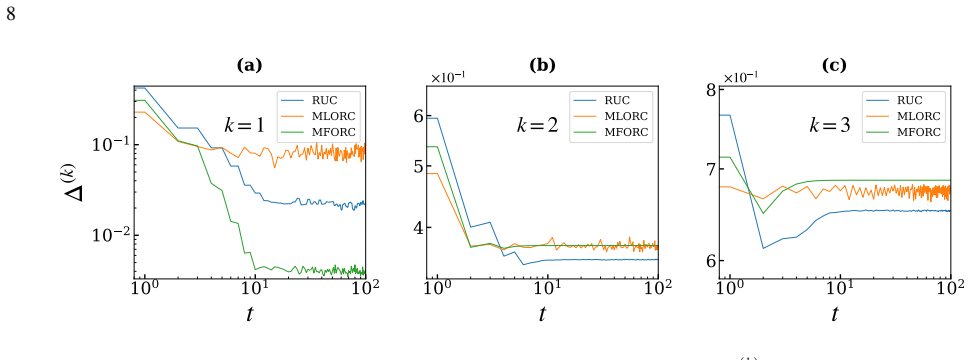
Realistic quantum devices are inherently open and often involve environments with memory. Here, we investigate quantum resource generation in two classes of random circuits, namely, memoryless open and memoryful open random circuits, and compare their behavior with the well-explored random unitary circuit model. We show that environmental memory qualitatively alters the dynamics: while unitary and memoryful circuits exhibit sustained growth and saturation of entanglement and non-stabilizerness (magic); memoryless dynamics leads to a distinct behavior where entanglement decays to zero after transient growth, even though non-stabilizerness remains non-zero, indicating the persistence of nonclassical features beyond entanglement. Consistently, Krylov complexity reveals suppressed spreading of quantum states in memoryless circuits, in contrast to strong growth in unitary and memoryful dynamics, which saturates at the maximum value. Finally, we show that memoryful circuits more effectively approach low-order quantum-state k-designs than the other two circuits. Closed dynamics are therefore usually the most resource-generating, but are ideal; realistic dynamics are open and seem to generate less, but if they possess memory, they can sometimes even outdo closed dynamics.
Editorial analysis
A structured set of objections, weighed in public.
Referee Report
Summary. The manuscript investigates quantum resource generation and dynamical complexities in open random quantum circuits, distinguishing between memoryless and memoryful environmental interactions and comparing both to the standard unitary random circuit model. It claims that environmental memory qualitatively alters the dynamics: unitary and memoryful circuits exhibit sustained growth and saturation of entanglement and non-stabilizerness (magic), while memoryless circuits show only transient entanglement growth followed by decay to zero, with persistent non-zero magic indicating nonclassical features beyond entanglement. Krylov complexity is reported as suppressed in memoryless cases but strongly growing and saturating in the other two; memoryful circuits are said to approach low-order quantum state k-designs more effectively than the alternatives. The overall conclusion is that closed dynamics are typically most resource-generating but idealized, whereas realistic open dynamics generate less unless they possess memory.
Significance. If the reported distinctions prove robust and general, the work would usefully highlight the role of environmental memory in realistic open quantum systems, showing that memoryful open dynamics can sometimes match or exceed closed-system resource generation in entanglement, magic, and design properties. The separation between decaying entanglement and persisting magic in the memoryless case offers a concrete illustration of nonclassicality surviving beyond entanglement, which could inform studies of open-system resource theories and complexity measures.
major comments (2)
- [Circuit model definitions] The section introducing the memoryless and memoryful open random circuit ensembles: the central qualitative claims rest on these specific constructions. The manuscript should supply an explicit mapping or justification relating the chosen Kraus-operator or gate ensembles to standard open-system frameworks (Markovian Lindblad evolution or collision-model non-Markovian channels) so that the observed entanglement decay, Krylov-complexity suppression, and k-design behavior can be assessed as general rather than potentially model-specific artifacts.
- [Numerical results] Numerical results sections reporting entanglement, magic, Krylov complexity, and k-design distances: the abstract and claims assert clear qualitative differences, yet the provided text supplies no details on circuit depth, ensemble size, numerical precision, or error bars. Without these, the statistical support for statements such as “entanglement decays to zero” or “saturation at the maximum value” cannot be evaluated; the full manuscript must include convergence checks and error analysis to substantiate the load-bearing distinctions.
minor comments (1)
- [Abstract] Abstract: a single sentence indicating the typical system sizes or circuit depths employed would help readers gauge the scale at which the reported behaviors are observed.
Simulated Author's Rebuttal
We thank the referee for their thorough review and constructive feedback on our manuscript. We address each of the major comments below, indicating the changes we will implement in the revised version.
read point-by-point responses
-
Referee: [Circuit model definitions] The section introducing the memoryless and memoryful open random circuit ensembles: the central qualitative claims rest on these specific constructions. The manuscript should supply an explicit mapping or justification relating the chosen Kraus-operator or gate ensembles to standard open-system frameworks (Markovian Lindblad evolution or collision-model non-Markovian channels) so that the observed entanglement decay, Krylov-complexity suppression, and k-design behavior can be assessed as general rather than potentially model-specific artifacts.
Authors: We thank the referee for highlighting this important point. To address it, we will revise the manuscript by adding an explicit discussion in Section II that maps our memoryless open random circuit model to the Markovian Lindblad equation in the appropriate limit, and our memoryful model to a non-Markovian collision model with environmental memory. This will include the derivation of the effective master equation from the Kraus operators and a justification for why these ensembles capture the essential features of standard open-system frameworks, thereby supporting the generality of our qualitative results. revision: yes
-
Referee: [Numerical results] Numerical results sections reporting entanglement, magic, Krylov complexity, and k-design distances: the abstract and claims assert clear qualitative differences, yet the provided text supplies no details on circuit depth, ensemble size, numerical precision, or error bars. Without these, the statistical support for statements such as “entanglement decays to zero” or “saturation at the maximum value” cannot be evaluated; the full manuscript must include convergence checks and error analysis to substantiate the load-bearing distinctions.
Authors: We agree that the numerical details are essential for validating the claims. In the revised manuscript, we will expand the numerical results section to include specific information on the circuit depths employed (ranging from 10 to several hundred layers depending on the quantity), the ensemble sizes used for averaging (typically 500-2000 realizations), the numerical methods and precision (e.g., exact diagonalization for small systems or tensor network approximations), and error bars representing the standard error of the mean. Additionally, we will include supplementary figures demonstrating convergence with respect to circuit depth and ensemble size to confirm that the observed behaviors, such as entanglement decay to zero and saturation of other measures, are robust. revision: yes
Circularity Check
No circularity: behaviors follow directly from explicit circuit definitions
full rationale
The paper defines three explicit random circuit ensembles (unitary, memoryless open, memoryful open) via their gate/Kraus constructions and then directly computes entanglement, magic, Krylov complexity, and k-design metrics on them. These quantities are obtained from the definitions without any fitted parameters being relabeled as predictions, without self-citations carrying the central claims, and without any ansatz or uniqueness theorem imported from prior author work. The observed distinctions (e.g., entanglement decay in memoryless case) are therefore straightforward consequences of the chosen dynamics rather than reductions to the inputs by construction. The modeling assumptions about realism are stated explicitly and remain open to external validation.
Axiom & Free-Parameter Ledger
axioms (1)
- domain assumption Random circuit ensembles provide representative samples of typical quantum dynamical behavior
Reference graph
Works this paper leans on
-
[1]
M. P. A. Fisher, V . Khemani, A. Nahum, and S. Vijay, “Random quantum circuits,” Annu. Rev. Condens. Matter Phys.14, 335 (2023)
work page 2023
-
[2]
Dynamic scaling of growing interfaces,
M. Kardar, G. Parisi, and Y . C. Zhang, “Dynamic scaling of growing interfaces,” Phys. Rev. Lett.56, 889 (1986)
work page 1986
-
[3]
Quantum entan- glement growth under random unitary dynamics,
A. Nahum, J. Ruhman, S. Vijay, and J. Haah, “Quantum entan- glement growth under random unitary dynamics,” Phys. Rev. X 7, 031016 (2017)
work page 2017
-
[4]
Growth of genuine multipartite entan- glement in random unitary circuits,
A. Bera and S. S. Roy, “Growth of genuine multipartite entan- glement in random unitary circuits,” Phys. Rev. A102, 062431 (2020)
work page 2020
-
[5]
Magic spreading in random quantum circuits,
X. Turkeshi, E. Tirrito, and P. Sierant, “Magic spreading in random quantum circuits,” Nat. Commun.16, 2575 (2025)
work page 2025
-
[6]
Growth and spreading of quantum resources under random circuit dynamics,
S. Aditya, X. Turkeshi, and P. Sierant, “Growth and spreading of quantum resources under random circuit dynamics,” (2025), arXiv:2512.14827 [quant-ph]
-
[7]
J.-Z. Zhuang, Y .-K. Wu, and L.-M. Duan, “Phase-transition- like behavior in information retrieval of a quantum scrambled random circuit system,” Phys. Rev. B106, 144308 (2022)
work page 2022
-
[8]
Scrambling dynamics and out-of- time-ordered correlators in quantum many-body systems,
S. Xu and B. Swingle, “Scrambling dynamics and out-of- time-ordered correlators in quantum many-body systems,” PRX Quantum5, 010201 (2024)
work page 2024
-
[9]
Quantum complex- ity and localization in random and time-periodic unitary cir- cuits,
H. Sahu, A. Bhattacharya, and P. P. Nath, “Quantum complex- ity and localization in random and time-periodic unitary cir- cuits,” (2024), arXiv:2409.03656 [quant-ph]
-
[10]
Krylov com- plexity and trotter transitions in unitary circuit dynamics,
P. Suchsland, R. Moessner, and P. W. Claeys, “Krylov com- plexity and trotter transitions in unitary circuit dynamics,” Phys. Rev. B111, 014309 (2025)
work page 2025
-
[11]
Fast computational deep thermalization,
S. Chakraborty, S. Choi, S. Ghosh, and T. Giurgic ˘a Tiron, “Fast computational deep thermalization,” Phys. Rev. Lett.135, 210603 (2025)
work page 2025
-
[12]
Measurement-induced phase transitions in the dynamics of entanglement,
B. Skinner, J. Ruhman, and A. Nahum, “Measurement-induced phase transitions in the dynamics of entanglement,” Phys. Rev. X9, 031009 (2019)
work page 2019
-
[13]
Quantum mpemba effect in random circuits,
X. Turkeshi, P. Calabrese, and A. De Luca, “Quantum mpemba effect in random circuits,” Phys. Rev. Lett.135, 040403 (2025)
work page 2025
-
[14]
Symmetry restoration and quantum mpemba effect in symmetric random circuits,
S. Liu, H. K. Zhang, S. Yin, and S. X. Zhang, “Symmetry restoration and quantum mpemba effect in symmetric random circuits,” Phys. Rev. Lett.133, 140405 (2024)
work page 2024
-
[15]
Mpemba effects in quantum complexity,
S. Aditya, A. Summer, P. Sierant, and X. Turkeshi, “Mpemba effects in quantum complexity,” (2025), arXiv:2509.22176 [quant-ph]
-
[16]
Quantum mpemba effect in long-ranged u(1)-symmetric ran- dom circuits,
H. Z. Li, C. H. Lee, S. Liu, S. X. Zhang, and J. X. Zhong, “Quantum mpemba effect in long-ranged u(1)-symmetric ran- dom circuits,” (2025), arXiv:2512.06775 [quant-ph]
-
[17]
Operator spreading in ran- dom unitary circuits,
A. Nahum, S. Vijay, and J. Haah, “Operator spreading in ran- dom unitary circuits,” Phys. Rev. X8, 021014 (2018)
work page 2018
-
[18]
V . Khemani, A. Vishwanath, and D. A. Huse, “Operator spreading and the emergence of dissipative hydrodynamics un- der unitary evolution with conservation laws,” Phys. Rev. X8, 031057 (2018)
work page 2018
-
[19]
Operator hydrodynamics, otocs, and entanglement growth in systems without conservation laws,
C. W. V . Keyserlingk, T. Rakovszky, F. Pollmann, and S. L. 11 Sondhi, “Operator hydrodynamics, otocs, and entanglement growth in systems without conservation laws,” Phys. Rev. X8, 021013 (2018)
work page 2018
-
[20]
Solution of a minimal model for many-body quantum chaos,
A. Chan, A. De Luca, and J. T. Chalker, “Solution of a minimal model for many-body quantum chaos,” Phys. Rev. X8, 041019 (2018)
work page 2018
-
[21]
Emergent statistical mechanics of entanglement in random unitary circuits,
T. Zhou and A. Nahum, “Emergent statistical mechanics of entanglement in random unitary circuits,” Phys. Rev. B99, 174205 (2019)
work page 2019
-
[22]
Exact convergence times for generation of ran- dom bipartite entanglement,
M. ˇZnidariˇc, “Exact convergence times for generation of ran- dom bipartite entanglement,” Phys. Rev. A78, 032324 (2008)
work page 2008
-
[23]
Logarithmic negativity: A full entanglement monotone that is not convex,
M. B. Plenio, “Logarithmic negativity: A full entanglement monotone that is not convex,” Phys. Rev. Lett.95, 090503 (2005)
work page 2005
-
[25]
The separability versus entanglement problem
S. Das, T. Chanda, M. Lewenstein, A. Sanpera, A. Sen De, and U. Sen, “The separability versus entanglement problem,” (2017), arXiv:1701.02187 [quant-ph]
work page internal anchor Pith review Pith/arXiv arXiv 2017
-
[26]
L. Leone, S. F. E. Oliviero, and A. Hamma, “Stabilizer r ´enyi entropy,” Phys. Rev. Lett.128, 050402 (2022)
work page 2022
-
[27]
A universal operator growth hypothesis,
D. E. Parker, X. Cao, A. Avdoshkin, T. Scaffidi, and E. Alt- man, “A universal operator growth hypothesis,” Phys. Rev. X9, 041017 (2019)
work page 2019
-
[28]
Geometry of krylov complexity,
P. Caputa, J. M. Magan, and D. Patramanis, “Geometry of krylov complexity,” Phys. Rev. Res.4, 013041 (2022)
work page 2022
-
[29]
Operator growth and Krylov construction in dissipative open quantum systems,
A. Bhattacharya, P. Nandy, P. P. Nath, and H. Sahu, “Operator growth and Krylov construction in dissipative open quantum systems,” JHEP12, 081 (2022)
work page 2022
-
[30]
On Krylov complexity in open systems: an approach via bi-Lanczos algo- rithm,
A. Bhattacharya, P. Nandy, P. P. Nath, and H. Sahu, “On Krylov complexity in open systems: an approach via bi-Lanczos algo- rithm,” JHEP12, 066 (2023)
work page 2023
-
[31]
Krylov complexity in open quantum systems,
C. Liu, H. Tang, and H. Zhai, “Krylov complexity in open quantum systems,” Phys. Rev. Res.5, 033085 (2023)
work page 2023
-
[32]
Krylov complexity of density matrix operators,
P. Caputa, H. S. Jeong, S. Liu, J. F. Pedraza, and L. C. Qu, “Krylov complexity of density matrix operators,” JHEP05, 337 (2024)
work page 2024
-
[33]
S´ anchez-Garrido,On Krylov Complexity , Ph.D
A. S ´anchez, G.,On Krylov Complexity, Ph.D. thesis, Southamp- ton U., U. Geneva (main) (2024), arXiv:2407.03866 [hep-th]
-
[34]
Krylov fractality and complex- ity in generic random matrix ensembles,
B. Bhattacharjee and P. Nandy, “Krylov fractality and complex- ity in generic random matrix ensembles,” Phys. Rev. B111, L060202 (2025)
work page 2025
-
[35]
Quantum dynamics in Krylov space: Methods and applications,
P. Nandy, A. S. Matsoukas-Roubeas, P. Mart ´ınez-Azcona, A. Dymarsky, and A. del Campo, “Quantum dynamics in Krylov space: Methods and applications,” Phys. Rept.1125- 1128, 1 (2025)
work page 2025
-
[36]
E. Rabinovici, A. S ´anchez-Garrido, R. Shir, and J. Sonner, “Krylov Complexity,” (2025), arXiv:2507.06286 [hep-th]
work page internal anchor Pith review Pith/arXiv arXiv 2025
-
[37]
Quantum chaos and the complexity of spread of states,
V . Balasubramanian, P. Caputa, J. M. Magan, and Q. Wu, “Quantum chaos and the complexity of spread of states,” Phys. Rev. D106, 046007 (2022)
work page 2022
-
[38]
Krylov complexity from integrability to chaos,
E. Rabinovici, A. S ´anchez-Garrido, R. Shir, and J. Sonner, “Krylov complexity from integrability to chaos,” JHEP07, 151 (2022)
work page 2022
-
[39]
Krylov complexity and chaos in quantum mechanics,
K. Hashimoto, K. Murata, N. Tanahashi, and R. Watanabe, “Krylov complexity and chaos in quantum mechanics,” JHEP 11, 040 (2023)
work page 2023
-
[40]
Integrability-to-chaos transition through the krylov approach for state evolution,
G. F. Scialchi, A. J. Roncaglia, and D. A. Wisniacki, “Integrability-to-chaos transition through the krylov approach for state evolution,” Phys. Rev. E109, 054209 (2024)
work page 2024
-
[41]
Quantum chaos, integrability, and late times in the krylov basis,
V . Balasubramanian, J. M. Magan, and Q. Wu, “Quantum chaos, integrability, and late times in the krylov basis,” Phys. Rev. E111, 014218 (2025)
work page 2025
-
[42]
Krylov complex- ity as a probe for chaos,
M. Alishahiha, S. Banerjee, and M. J. Vasli, “Krylov complex- ity as a probe for chaos,” Eur. Phys. J. C85, 749 (2025)
work page 2025
-
[43]
Krylov complexity as an order parameter for quan- tum chaotic-integrable transitions,
M. Baggioli, K. B. Huh, H. S. Jeong, K. Y . Kim, and J. F. Pedraza, “Krylov complexity as an order parameter for quan- tum chaotic-integrable transitions,” Phys. Rev. Res.7, 023028 (2025)
work page 2025
-
[44]
Random quantum circuits are approximate 2-designs,
A. W. Harrow and R. A. Low, “Random quantum circuits are approximate 2-designs,” Commun. Math. Phys.291, 257 (2009)
work page 2009
-
[45]
Local random quantum circuits are approximate polynomial-designs,
F. G. S. L. Brand ˜ao, A. W. Harrow, and M. Horodecki, “Local random quantum circuits are approximate polynomial-designs,” Commun. Math. Phys.346, 397 (2016)
work page 2016
-
[46]
Y . Nakata, D. Zhao, T. Okuda, E. Bannai, Y . Suzuki, S. Tamiya, K. Heya, Z. Yan, K. Zuo, S. Tamate, Y . Tabuchi, and Y . Naka- mura, “Quantum circuits for exact unitaryt-designs and ap- plications to higher-order randomized benchmarking,” PRX Quantum2, 030339 (2021)
work page 2021
-
[47]
Random quantum circuits are approximate uni- tary t-designs in depthO(nt 5+o(1)),
J. Haferkamp, “Random quantum circuits are approximate uni- tary t-designs in depthO(nt 5+o(1)),” Quantum 6, 795 (2022) 6, 795 (2022)
work page 2022
-
[48]
Exact emergent quantum state designs from quantum chaotic dynamics,
W. W. Ho and S. Choi, “Exact emergent quantum state designs from quantum chaotic dynamics,” Phys. Rev. Lett.128, 060601 (2022)
work page 2022
-
[49]
Emergent quantum state designs from individual many-body wave functions,
J. S. Cotler, D. K. Mark, H. Y . Huang, F. Hern ´andez, J. Choi, A. L. Shaw, M. Endres, and S. Choi, “Emergent quantum state designs from individual many-body wave functions,” PRX Quantum4, 010311 (2023)
work page 2023
-
[50]
A. W. Harrow and S. Mehraban, “Approximate unitary t- designs by short random quantum circuits using nearest- neighbor and long-range gates,” Commun. Math. Phys.401, 1531 (2023)
work page 2023
-
[51]
Approximatet-designs in generic circuit architectures,
D. Belkin, J. Allen, S. Ghosh, C. Kang, S. Lin, J. Sud, F. T. Chong, B. Fefferman, and B. K. Clark, “Approximatet-designs in generic circuit architectures,” PRX Quantum5, 040344 (2024)
work page 2024
-
[52]
Designs via free prob- ability,
M. Fava, J. Kurchan, and S. Pappalardi, “Designs via free prob- ability,” Phys. Rev. X15, 011031 (2025)
work page 2025
-
[53]
Uni- tary designs of symmetric local random circuits,
Y . Mitsuhashi, R. Suzuki, T. Soejima, and N. Yoshioka, “Uni- tary designs of symmetric local random circuits,” Phys. Rev. Lett.134, 180404 (2025)
work page 2025
-
[54]
Unitaryk-designs from random number-conserving quantum circuits,
S. N. Hearth, M. O. Flynn, A. Chandran, and C. R. Laumann, “Unitaryk-designs from random number-conserving quantum circuits,” Phys. Rev. X15, 021022 (2025)
work page 2025
-
[55]
R. Horodecki, P. Horodecki, M. Horodecki, and K. Horodecki, “Quantum entanglement,” Rev. Mod. Phys.81, 865 (2009)
work page 2009
-
[56]
Teleporting an unknown quantum state via dual classical and einstein-podolsky-rosen channels,
C. H. Bennett, G. Brassard, C. Cr ´epeau, R. Jozsa, A. Peres, and W. K. Wootters, “Teleporting an unknown quantum state via dual classical and einstein-podolsky-rosen channels,” Phys. Rev. Lett.70, 1895 (1993)
work page 1993
-
[57]
Communication via one- and two-particle operators on einstein-podolsky-rosen states,
Charles H. Bennett and S. J. Wiesner, “Communication via one- and two-particle operators on einstein-podolsky-rosen states,” Phys. Rev. Lett.69, 2881 (1992)
work page 1992
-
[58]
N. Gisin, G. Ribordy, W. Tittel, and H. Zbinden, “Quantum cryptography,” Rev. Mod. Phys.74, 145 (2002)
work page 2002
-
[59]
Vittorio Giovannetti, Seth Lloyd, and Lorenzo Maccone, “Quantum metrology,” Phys. Rev. Lett.96, 010401 (2006)
work page 2006
-
[60]
M. A. Nielsen and I. L. Chuang,Quantum Computation and Quantum Information(Cambridge University Press, Cam- bridge, 2000)
work page 2000
-
[61]
Application of a resource theory for magic states to fault-tolerant quantum computing,
M. Howard and E. Campbell, “Application of a resource theory for magic states to fault-tolerant quantum computing,” Phys. Rev. Lett.118, 090501 (2017)
work page 2017
-
[62]
Robustness of Magic and Symme- tries of the Stabiliser Polytope,
M. Heinrich and D. Gross, “Robustness of Magic and Symme- tries of the Stabiliser Polytope,” Quantum3, 132 (2019)
work page 2019
-
[63]
Handbook for 12 quantifying robustness of magic,
H. Hamaguchi, K. Hamada, and N. Yoshioka, “Handbook for 12 quantifying robustness of magic,” Quantum8, 1461 (2024)
work page 2024
-
[64]
D. W. Christopher and H. W. Justin, “Mana in haar-random states,” (2020), arXiv:2011.13937 [quant-ph]
-
[65]
Quantifying non-stabilizerness via information scrambling,
A. Ahmadi and E. Greplova, “Quantifying non-stabilizerness via information scrambling,” SciPost Physics16, 043 (2024)
work page 2024
-
[66]
Role of nonstabilizerness in quantum optimization,
C. Capecci, G. S. Santra, A. Bottarelli, E. Tirrito, and P. Hauke, “Role of nonstabilizerness in quantum optimization,” (2025), arXiv:2505.17185 [quant-ph]
discussion (0)
Sign in with ORCID, Apple, or X to comment. Anyone can read and Pith papers without signing in.